The core distinction when comparing the TP-Link Deco BE85 against the Asus ZenWiFi XT9 comes down to generational wireless technology and wired port throughput. The Deco BE85 introduces next-generation Wi-Fi 7 capabilities alongside dual 10 Gbps networking ports designed for multi-gigabit fiber connections, whereas the ZenWiFi XT9 relies on an established Wi-Fi 6 tri-band architecture paired with 2.5 Gbps connectivity and lifetime subscription-free security software.
Choose the Deco BE85 if you manage multi-gigabit internet service, operate high-speed local storage, or want to future-proof your home with cutting-edge 320 MHz wireless channels. Opt for the ZenWiFi XT9 if you want dependable whole-home Wi-Fi 6 coverage, advanced parental controls, and robust network security without committing to ongoing service fees.


TP-Link Deco BE85 vs Asus ZenWiFi XT9 at a Glance
| Feature | TP-Link Deco BE85 | Asus ZenWiFi XT9 |
|---|---|---|
| Wi-Fi Generation | Wi-Fi 7 (802.11be) | Wi-Fi 6 (802.11ax) |
| Total Wireless Bandwidth | Up to 22,000 Mbps (BE22000) | Up to 7,800 Mbps (AX7800) |
| 6 GHz Band Support | Yes (Up to 11,520 Mbps) | Not listed |
| Multi-Gigabit Wired Ports | Dual 10 Gbps (1x RJ45, 1x SFP+/RJ45 combo) + Dual 2.5 Gbps | Single 2.5 Gbps WAN/LAN port |
| Total Network Ports | 4 Ethernet/Fiber ports | 4 Ethernet ports |
| Antenna Configuration | 8 internal high-performance antennas | 6 internal antennas |
| Backhaul Options | Simultaneous wireless and wired backhaul | AiMesh wireless and wired backhaul |
| Integrated Security Suite | TP-Link HomeShield (Basic free tier) | AiProtection Pro powered by Trend Micro (Lifetime free) |
| Manufacturer Coverage Rating | Not listed in specifications | Up to 2,850 sq ft (1-pack rating) |
| Best For | Ultra-fast fiber networks and multi-gigabit hardware | Reliable family networking and subscription-free security |
Wireless Standards and Throughput Performance
Wireless throughput represents the primary technical divide between these two networking platforms. The TP-Link Deco BE85 operates on the emerging Wi-Fi 7 standard, delivering an aggregate theoretical speed of up to 22,000 Mbps across three frequency bands. This includes 11,520 Mbps on the 6 GHz band, 8,640 Mbps on the 5 GHz band, and 1,376 Mbps on the 2.4 GHz band. Central to the TP-Link Deco BE85 Wi-Fi 7 speed advantage is the deployment of ultra-wide 320 MHz channels, 4K-QAM modulation, Multi-RUs, and Multi-Link Operation (MLO). Multi-Link Operation enables client devices to aggregate or switch dynamically across distinct bands simultaneously, drastically decreasing packet latency and overcoming localized RF interference in dense residential settings.
In contrast, the Asus ZenWiFi XT9 delivers a tri-band Wi-Fi 6 foundation with an aggregate data transfer rate of up to 7,800 Mbps. The system incorporates support for the expanded UNII-4 spectrum, opening additional clean 160 MHz channels on the 5 GHz frequency band to avoid congested legacy channels. When reviewing an tp-link deco xe75 vs asus zenwifi xt9 evaluation, users often recognize that the AX7800 rating on the XT9 handles standard smart homes effortlessly, but it lacks the massive spectral headroom and 320 MHz channel width that define the Deco BE85. For homes running gigabit or sub-gigabit service, Wi-Fi 6 offers plenty of speed, yet it falls short of the ceiling established by modern Wi-Fi 7 systems.
The practical divergence between the two standards surfaces most clearly when handling high-concurrency data requests and local file synchronization. While the ZenWiFi XT9 caps its per-stream throughput at standard Wi-Fi 6 limits, the Deco BE85 utilizes 4096-QAM to squeeze 20 percent higher raw data density into every transmission. When multiple compatible clients interact with the mesh network at once, the sheer spectral breadth of the BE85 prevents the slowdowns that can occur during heavy utilization on Wi-Fi 6 nodes.
Edge: TP-Link Deco BE85. Its Wi-Fi 7 framework offers nearly three times the aggregate wireless throughput alongside 320 MHz channels and advanced Multi-Link Operation.
Wired Connectivity and Multi-Gigabit Ports
Wired port capability dictates whether a mesh system can distribute multi-gigabit internet without choking bandwidth at the router interface. The Deco BE85 excels in this dimension by offering four high-speed ports: two 10 Gbps WAN/LAN ports and two 2.5 Gbps ports. Notably, one of the 10 Gbps connections is an SFP+ Fiber/RJ45 Ethernet combo port, which allows direct optical fiber terminations from compatible network interface equipment alongside standard copper cabling. This configuration allows homeowners to ingest a 10 Gbps fiber internet link and still output a dedicated 10 Gbps copper link to a core distribution switch or high-speed network-attached storage (NAS) array, with two 2.5 Gbps ports remaining for secondary hardware.
The Asus ZenWiFi XT9 takes a more conservative approach to physical connectivity. It features a single 2.5 Gbps WAN/LAN port paired with three standard Gigabit LAN ports, offering a total of four physical networking jacks. Asus supplements this wired configuration with LAN aggregation support, enabling two individual gigabit Ethernet ports to combine their transmission pipelines for a single compatible device. While this setup comfortably accommodates broadband plans between 1 Gbps and 2.5 Gbps, it cannot pass higher-tier speeds across to client devices via Ethernet, nor does it support SFP+ fiber modular transceivers.
Furthermore, local network storage options highlight another key hardware difference. The Deco BE85 integrates a high-speed USB 3.0 port, facilitating rapid local network sharing and media backups from external drives. The ZenWiFi XT9 also includes a USB port for network storage and printer sharing. However, readers analyzing our eero max 7 vs tp-link deco be85 breakdown will observe that the BE85 combines multi-gigabit routing with flexible local peripheral access in a way that very few residential mesh units can rival.
Edge: TP-Link Deco BE85. Dual 10 Gbps interfaces with SFP+ fiber combo support far outclass the single 2.5 Gbps maximum port on the Asus unit.
Network Security and Software Subscriptions
Network security structures separate these two manufacturers dramatically in ongoing maintenance and ownership costs. The Asus ZenWiFi XT9 includes lifetime free AiProtection Pro powered by Trend Micro. This commercial-grade security suite provides automatically updated malicious site blocking, intrusion prevention system (IPS) defenses, and automated isolation of infected smart home devices without requiring a recurring subscription. Furthermore, the XT9 integrates the ASUS Instant Guard mobile utility, which establishes a secure encrypted VPN tunnel back to your home router when connecting to unsecured public Wi-Fi networks.
TP-Link outfits the Deco BE85 with its proprietary TP-Link HomeShield software suite. Out of the box, the system grants access to basic network protection tools, which encompass a basic security scan, IoT device identification, standard Quality of Service (QoS) controls, and weekly or monthly automated reporting. However, advanced cyber-threat prevention, continuous web protection, and detailed parental management options within the HomeShield ecosystem sit behind a paid subscription tier. The system listing rates the Deco BE85 firewall level at Medium, while the ZenWiFi XT9 registers a High firewall rating according to technical listing specifications.
For families that prioritize comprehensive content filtering and scheduled internet access, the ZenWiFi XT9 delivers rich controls directly through the ASUS Router app without additional financial friction. Users comparing the tp-link deco xe75 vs be85 know that recurring software subscriptions can add up significantly over the lifespan of a router. The inclusion of lifetime free commercial protection gives Asus a significant long-term value advantage over TP-Link’s tiered HomeShield platform.
Edge: Asus ZenWiFi XT9. Lifetime free AiProtection Pro delivers comprehensive, automated network security and deep parental controls without recurring subscription fees.
Backhaul Architecture and Signal Coverage
Mesh systems depend heavily on backhaul efficiency to shuttle data between access points without sacrificing access speeds for end devices. The Deco BE85 introduces an innovative hybrid infrastructure featuring simultaneous wireless and wired backhaul. Built upon TP-Link’s custom software protocols, the BE85 can combine wired Ethernet connections and high-speed Wi-Fi 7 wireless bands concurrently to construct an ultra-resilient, high-bandwidth interconnect between nodes. This dynamic pairing prevents backhaul saturation even when multiple occupants stream uncompressed 4K media or move multi-gigabyte files across separate rooms.
Signal propagation on the Deco BE85 is managed through eight high-performance internal antennas. Because Wi-Fi 7 transceivers and dual 10 Gbps networking chipsets generate substantial thermal output during peak utilization, TP-Link integrates two internal cooling fans inside each BE85 chassis to actively dissipate heat and maintain uninterrupted operational throughput. The unit also deploys AI-Driven Seamless Roaming, which continuously evaluates client signal metrics, learn local physical layouts, and seamlessly shifts devices between nodes to guarantee smooth roaming.
The Asus ZenWiFi XT9 counters with ASUS RangeBoost Plus technology, an advanced RF optimization system that improves signal projection across challenging building materials. Equipped with six internal antennas, a single ZenWiFi XT9 node is rated to blanket up to 2,850 square feet and four or more rooms with dependable coverage. The unit operates within the AiMesh ecosystem, allowing homeowners to link older or auxiliary Asus routers into an expanded unified network. Although RangeBoost Plus delivers exceptional reach on standard Wi-Fi 6 spectrum, the system relies on traditional static backhaul assignment rather than the BE85’s simultaneous multi-channel wireless-and-wired data aggregation.
Edge: TP-Link Deco BE85. An eight-antenna array backed by active internal cooling fans and simultaneous wired-plus-wireless backhaul creates a more resilient mesh fabric.
Gaming, Streaming, and Smart Home Performance
When evaluating the Deco BE85 vs ZenWiFi XT9 for gaming, latency consistency is the critical variable. The Deco BE85 leverages Wi-Fi 7 Multi-Link Operation to simultaneously transmit across the 5 GHz and 6 GHz frequencies. If one frequency experiences interference from a neighboring network or household appliance, the data stream continues unabated over the secondary channel. This dual-link communication reduces jitter and prevents latency spikes in fast-paced multiplayer gaming environments. Moreover, the BE85 supports concurrent VPN client and server functionality, allowing gaming consoles or personal computers to direct specific traffic through protected tunnels while routing standard gaming packets through low-latency direct pathways.
The ZenWiFi XT9 stands as a battle-tested gaming and media hub within the Wi-Fi 6 category. Backed by 512 MB of installed RAM memory, the XT9 processes heavy packet loads across connected smart home gadgets, PCs, gaming consoles, and smart televisions. It incorporates configurable Quality of Service (QoS) tools and dedicated guest networking modes that isolate transient traffic from mission-critical media hardware. Those considering the netgear orbi rbk752 vs tp-link deco be85 will find that modern tri-band Wi-Fi 6 platforms handle several simultaneous 4K streams easily, but high-bandwidth streaming starts to contest shared airspace during intensive local backups.
Deciding between the Deco BE85 or ZenWiFi XT9 for streaming ultimately hinges on your local resolution demands and device volume. The BE85 can handle dozens of uncompressed video streams while running background IoT device identification and network scans through RouterOS. Meanwhile, the ZenWiFi XT9 relies on standard Wi-Fi 6 OFDMA and MU-MIMO scheduling. The XT9 provides stable service for an average household, but the raw bandwidth and multi-channel redundancy of the BE85 provide a virtually unshakeable foundation for high-end entertainment setups.
Edge: TP-Link Deco BE85. Multi-Link Operation, massive 22,000 Mbps bandwidth, and concurrent VPN routing provide superior latency stability for gaming and heavy streaming.
Hardware Design, Management, and Smart Controls
The operational management and physical industrial design of these mesh routers reflect divergent engineering goals. The Deco BE85 utilizes an upright cylinder format engineered around its internal thermal fans and eight high-gain antennas. Setup and ongoing system management run exclusively through the Deco App on iOS and Android devices, presenting a streamlined, user-friendly interface for port forwarding, network security scans, and guest network allocation. The BE85 also supports smart voice controls via Amazon Alexa and Google Assistant, enabling simple voice commands to toggle guest Wi-Fi or pause internet access for specific family profiles.
The Asus ZenWiFi XT9 adopts an angular, compact tower enclosure featuring internal ventilation slots and six precision-placed internal antennas. Management versatility is a hallmark of the Asus platform. Network administrators can supervise the XT9 through the comprehensive ASUS Router mobile app, touch controls, or an exhaustive, desktop-friendly web graphic user interface (GUI). Advanced enthusiasts looking at an tp-link deco be85 vs google nest wifi pro comparison often miss the detailed configuration depth found in Asus routers, which provide full manual adjustment over DHCP reservations, firewall rules, and granular wireless parameters across Windows, Mac, and Linux environments.
While the Deco app simplifies routine mesh oversight for everyday consumers, power users may feel constrained by the absence of a comprehensive browser-based configuration dashboard. The ZenWiFi XT9 bridges this gap by offering deep networking utilities directly within its firmware, giving technical users absolute control over routing behaviors, port triggering, and advanced AiMesh node topology.
Edge: Asus ZenWiFi XT9. Comprehensive management options through both mobile apps and detailed desktop web interfaces provide far greater control than app-only platforms.
Pros and Cons
TP-Link Deco BE85
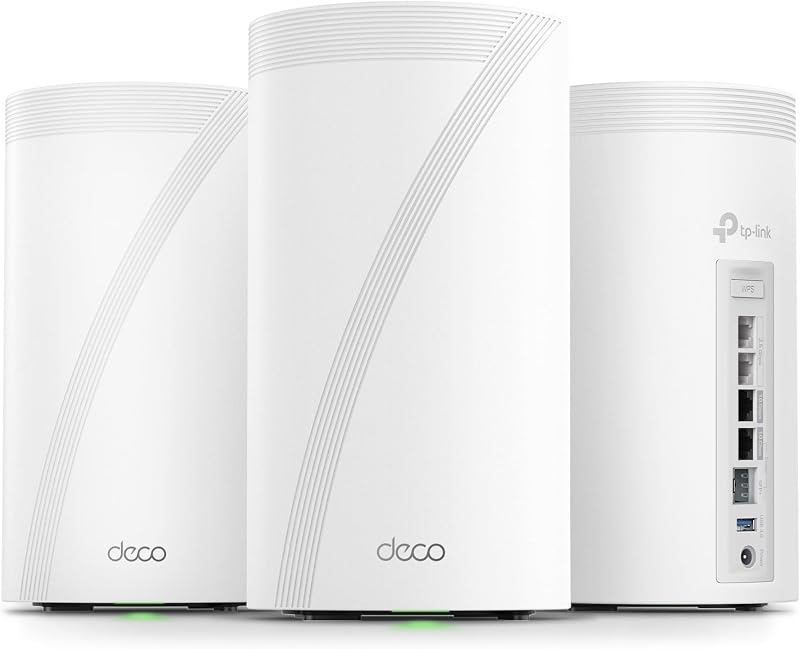
Pros
- Blazing BE22000 Wi-Fi 7 wireless speeds
- Dual 10G WAN and LAN ports
- SFP+ fiber and RJ45 combo connectivity
- Simultaneous wired and wireless mesh backhaul
- Eight internal antennas with active cooling
Cons
- Advanced HomeShield security requires paid subscription
- Larger footprint requiring dual internal fans
View TP-Link Deco BE85 on Amazon
Asus ZenWiFi XT9

Pros
- Lifetime free AiProtection Pro security
- Dedicated 2.5 Gbps multi-gigabit WAN port
- ASUS RangeBoost Plus extended coverage
- Comprehensive app and web-based management
- Instant Guard secure mobile VPN access
Cons
- Limited to older Wi-Fi 6 technology
- Lacks 10 Gbps wired connectivity options
View Asus ZenWiFi XT9 on Amazon
Who Should Buy Each One
Choose the TP-Link Deco BE85 If
- You subscribe to a multi-gigabit fiber internet tier exceeding 2.5 Gbps and require dual 10 Gbps ports to distribute those speeds.
- You own or plan to purchase cutting-edge Wi-Fi 7 smartphones, laptops, and tablets equipped with 320 MHz channel support.
- You require an optical SFP+ combo port to connect direct fiber lines without installing additional media converter boxes.
- You want a mesh backbone capable of simultaneous wired and wireless backhaul aggregation for zero-packet-drop performance.
Choose the Asus ZenWiFi XT9 If
- You want comprehensive, commercial-grade security with lifetime free updates from Trend Micro without paying subscription fees.
- Your home broadband plan tops out at 1 Gbps or 2.5 Gbps, making higher multi-gigabit hardware unnecessary.
- You prefer deep browser-based administrative control over your local firewall, routing tables, and Wi-Fi transmission characteristics.
- You want to incorporate your mesh hardware into an existing ASUS AiMesh network to expand your current Wi-Fi 6 coverage.
Final Verdict
Evaluating an Asus ZenWiFi XT9 vs TP-Link Deco BE85 matchup requires looking at the horizon of your home network. Any rigorous TP-Link Deco BE85 review must highlight that this system stands at the absolute vanguard of consumer networking. By delivering BE22000 speeds across three frequency bands, dual 10 Gbps ports, an SFP+ fiber combo socket, and simultaneous multi-channel backhaul, it provides performance that will easily remain relevant for years to come. For early adopters building a high-capacity smart home on multi-gigabit fiber, the answer to is TP-Link Deco BE85 worth it is a decisive yes.
Conversely, an objective Asus ZenWiFi XT9 review demonstrates that the Wi-Fi 6 standard remains the sensible, mature choice for most households. The XT9 packs impressive AX7800 performance, a multi-gigabit 2.5 Gbps WAN interface, and Asus RangeBoost Plus technology to easily blanket sprawling homes. Most importantly, it eliminates the hidden cost of security software by providing Trend Micro AiProtection Pro and Instant Guard VPN completely free for life. If you do not require 10G wired routing or Wi-Fi 7 wireless speeds, the answer to is Asus ZenWiFi XT9 worth it is equally clear: it is a practical, powerful, and cost-effective whole-home solution.
FAQ
Does the Asus ZenWiFi XT9 support Wi-Fi 7 client devices?
The Asus ZenWiFi XT9 is built on the Wi-Fi 6 (802.11ax) wireless standard. While Wi-Fi 7 devices are backward compatible and can connect to the XT9 without issue, they will operate at Wi-Fi 6 speeds and cannot use Wi-Fi 7 features such as 320 MHz channel widths, 4K-QAM modulation, or Multi-Link Operation.
Can the TP-Link Deco BE85 connect directly to fiber internet without a modem?
The TP-Link Deco BE85 includes a dual-personality 10 Gbps SFP+ Fiber/RJ45 Ethernet combo port. If your internet service provider supplies an optical transceiver module that matches the SFP+ port specifications, you can connect your fiber line directly into the unit. However, the listing notes that a modem is still required for most internet service providers.
Is a paid subscription required to use network security on the Asus ZenWiFi XT9?
No paid subscription is required. The Asus ZenWiFi XT9 includes lifetime free AiProtection Pro powered by Trend Micro, which provides automatic security signature updates, parental filters, malicious website blocking, and infected device isolation out of the box.
How does simultaneous backhaul function on the TP-Link Deco BE85?
TP-Link’s proprietary architecture allows the Deco BE85 to transmit backhaul traffic across both wired Ethernet and wireless Wi-Fi 7 spectrum at the same time. By aggregating wired and wireless data paths, the system boosts backhaul bandwidth, reduces inter-node transmission latency, and ensures data keeps moving if one path faces momentary congestion.
Can the Asus ZenWiFi XT9 integrate with existing Asus routers?
Yes. The Asus ZenWiFi XT9 supports ASUS AiMesh technology. This feature enables you to link the XT9 with any compatible AiMesh-enabled Asus router to create an expanded, unified whole-home mesh network using a single network name.
Does the TP-Link Deco BE85 feature internal active cooling fans?
Yes, the Deco BE85 chassis integrates two internal cooling fans. These active fans help dissipate the thermal load generated by the high-power Wi-Fi 7 radios, eight high-performance antennas, and dual 10 Gbps networking chips during continuous heavy data operations.
What VPN options are supported on the TP-Link Deco BE85?
The Deco BE85 provides built-in support for both VPN clients and VPN servers. This functionality allows client devices on your home network to route through remote VPN servers without requiring individual software installations on every phone, tablet, or PC, while running regular internet traffic simultaneously.