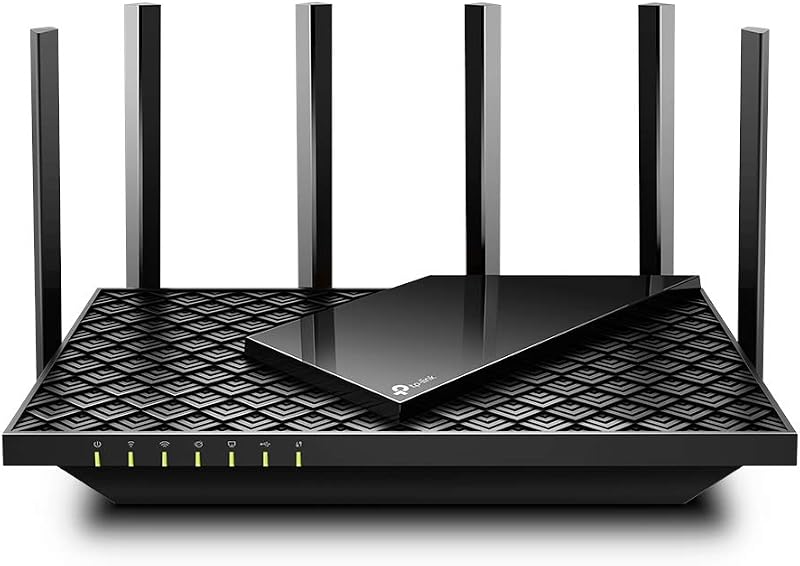
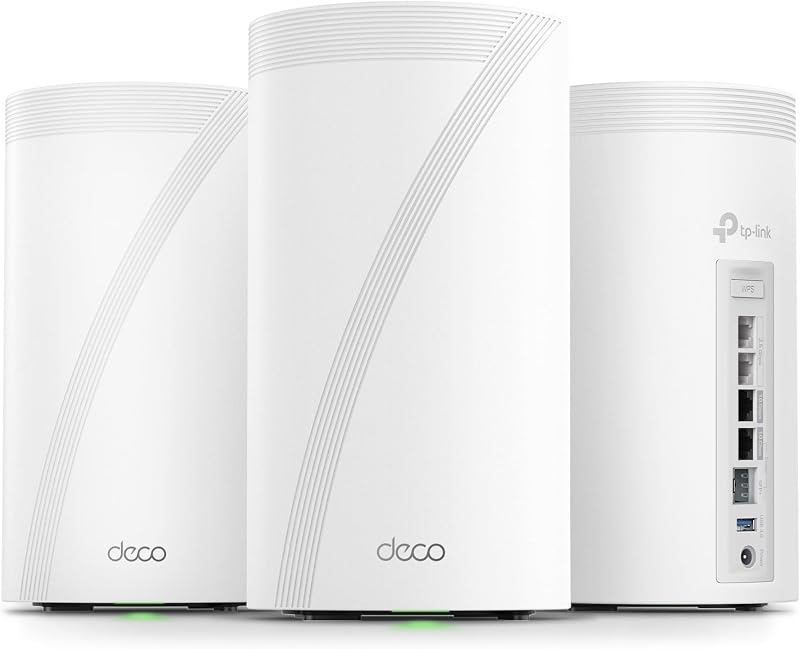
Choosing between the Netgear Orbi RBK752 and the TP-Link Deco BE85 comes down to whether your home network demands cutting-edge WiFi 7 speeds with dual 10 Gbps wired ports, or if a proven WiFi 6 tri-band setup with gigabit ports satisfies your everyday household bandwidth.
Homeowners seeking dependable whole-home coverage across standard gigabit internet connections should choose the Netgear Orbi RBK752, while power users running multi-gigabit fiber plans with bandwidth-heavy hardware should invest in the TP-Link Deco BE85.


Netgear Orbi RBK752 vs TP-Link Deco BE85 at a Glance
| Feature | Netgear Orbi RBK752 | TP-Link Deco BE85 |
|---|---|---|
| Wi-Fi Generation | WiFi 6 (802.11ax) | WiFi 7 (802.11be) |
| Maximum Data Transfer Rate | 4.2 Gbps (AX4200) | 22 Gbps (BE22000) |
| Frequency Band Architecture | Tri-Band | Tri-Band (with 6 GHz) |
| Wired LAN/WAN Ports | Gigabit Ethernet (3 on router, 2 on satellite) | Dual 10G (RJ45 + SFP+ combo) + Dual 2.5G |
| USB Connectivity | Not listed | 1 x USB 3.0 port |
| Internal Antennas | 6 internal antennas | 8 internal antennas |
| Security Protocol Support | WPA2-PSK | WPA, WPA2, WPA3 |
| Voice Control Support | Not listed | Amazon Alexa, Google Assistant |
| Best For | Reliable gigabit whole-home coverage | Multi-gigabit fiber and future-proof WiFi 7 setups |
Wireless Speed and Wi-Fi Generation Capabilities
Wireless throughput and generational architecture represent the sharpest divide between these two systems. The Orbi RBK752 is built on established WiFi 6 technology, providing an AX4200 aggregate rating that tops out at 4.2 Gbps across its tri-band channels. It handles concurrent 4K streaming, home office video conferencing, and general smart home traffic with reliable stability. However, it operates exclusively across standard 2.4 GHz and 5 GHz frequencies, lacking access to wider modern transmission bands.
In contrast, the TP-Link Deco BE85 represents the pinnacle of next-generation networking by implementing full WiFi 7 technology with an astronomical BE22000 speed rating. This allows the Deco BE85 to deliver up to 11,520 Mbps on the pristine 6 GHz band, 8,640 Mbps on the 5 GHz band, and 1,376 Mbps on the 2.4 GHz band. When comparing Deco BE85 vs Orbi RBK752 speed capabilities, the Deco introduces advanced WiFi 7 protocols including Multi-Link Operation (MLO), Multi-RUs, 4K-QAM, and massive 320 MHz channel widths. These features allow compatible devices to aggregate channels simultaneously, drastically cutting interference and data queues. Shoppers exploring other generational shifts often look at the netgear orbi rbk752 vs tp-link deco xe75 comparison to gauge older versus newer wireless standards.
For households operating typical connected gadgets, the AX4200 ceiling of the Netgear system delivers consistent bandwidth. But for environments with incoming multi-gigabit connections and newer client hardware, the massive throughput ceiling of the Deco BE85 provides unparalleled wireless headroom.
Edge: TP-Link Deco BE85 dominates with WiFi 7 standards, exclusive 6 GHz band access, and over five times the total aggregate wireless throughput.
Wired Connectivity and Multi-Gigabit Ethernet
A mesh router system must bridge the gap between incoming fiber lines and local wired hardware. The Orbi RBK752 approaches physical connectivity with traditional Gigabit Ethernet ports. The router unit features three Gigabit Ethernet LAN ports, while the satellite includes two Gigabit Ethernet ports. Across the two-pack hardware, you get dedicated physical connections suitable for desktop PCs, game consoles, and media streamers, with the system officially supporting ISP speeds up to 2 Gbps.
The Deco BE85 completely redefines home wired networking with pro-grade interfaces. Each node is equipped with dual 10 Gbps WAN/LAN ports-consisting of one standard RJ45 port and one versatile SFP+ Fiber/RJ45 combo port-alongside two 2.5 Gbps Ethernet ports and an integrated USB 3.0 port. Evaluating the Orbi RBK752 vs Deco BE85 multi gigabit capabilities reveals that the TP-Link system can handle symmetrical 5 Gbps or 10 Gbps residential fiber hookups directly without bottlenecking. Those weighing multi-gigabit hardware often weigh options like the eero max 7 vs netgear orbi rbk752 to see where wired thresholds differ.
Furthermore, the presence of an SFP+ cage on the Deco BE85 enables direct fiber transceiver modules, while the USB 3.0 port allows local network storage sharing. The Orbi RBK752 lacks both USB connectivity and ports exceeding 1 Gbps per individual socket, restricting local network transfer rates to standard gigabit ceilings.
Edge: TP-Link Deco BE85 wins decisively with dual 10G ports, dual 2.5G ports, SFP+ fiber flexibility, and USB 3.0 storage support.
Coverage Area and Mesh Backhaul Architecture
Coverage reach and the stability of the inter-node backhaul dictate whether a mesh system can eliminate dead zones. The Orbi RBK752 lists comprehensive coverage of up to 5,000 square feet for its router and single satellite bundle, with the ability to add 2,500 square feet per additional satellite. Using six high-gain internal antennas, it maintains connection capacity for up to 40 simultaneous devices, making it well-suited for sprawling two-story residential homes.
The Deco BE85 matches large-space demands by housing eight high-performance internal antennas, managed by internal cooling fans to sustain sustained multi-gigabit workloads. More importantly, TP-Link integrates simultaneous wireless and wired backhaul technology. Rather than choosing between an Ethernet cable or wireless airtime, the Deco BE85 combines wired and wireless backhaul concurrently, taking full advantage of WiFi 7 bands to maximize inter-unit throughput and reduce latency across nodes. Readers tracking top-tier mesh coverage often study the netgear orbi rbk752 vs 970 matchup to see how antenna counts scale.
While the Netgear RBK752 provides a clearly documented 5,000 square foot rating out of the box, the Deco BE85 delivers superior backhaul efficiency through its simultaneous hybrid transmission and AI-driven roaming algorithms, ensuring client devices switch nodes effortlessly.
Edge: TP-Link Deco BE85 takes the edge due to its simultaneous wireless plus wired backhaul technology and eight internal antenna arrays.
Gaming Performance and Latency Management
Online gaming places heavy demands on continuous packet delivery, jitter suppression, and localized latency. In competitive gaming scenarios, standard wireless congestion can cause sudden ping spikes. The Orbi RBK752 delivers solid gaming performance on WiFi 6, giving consoles and gaming PCs reliable tri-band separation to shield gaming streams from competing smart home appliances.
When assessing whether to choose the Orbi RBK752 or Deco BE85 for gaming, the Deco BE85 introduces architectural features tailored for ultra-low latency. WiFi 7 Multi-Link Operation enables devices to send and receive packets across different frequency bands at the same time, circumventing localized channel congestion. Furthermore, TP-Link integrates dedicated Quality of Service (QoS) controls to prioritize gaming packets over lower-priority household traffic. Gamers analyzing flagship mesh networks often inspect the netgear orbi 970 vs tp-link deco be85 breakdown to evaluate top-tier ping handling.
Wired gaming setups also benefit heavily from the Deco BE85, as competitive PC rigs can plug straight into 2.5G or 10G ports for instantaneous local responsiveness, whereas the Orbi RBK752 caps wired gaming connections at 1 Gbps.
Edge: TP-Link Deco BE85 leads with WiFi 7 Multi-Link Operation, QoS prioritization, and 10 Gbps wired gaming connectivity.
Software Features, Security, and Smart Home Integration
Network security and device management tools protect your connected ecosystem from external threats. The Orbi RBK752 operates on Netgear’s proprietary Linux-based OS and features NETGEAR Armor software. Powered by Bitdefender, NETGEAR Armor provides an automatic security shield, malware protection, and VPN privacy for connected devices, backed by an advanced router firewall. However, the system includes a 30-day trial, after which continued comprehensive protection requires an ongoing subscription. Additionally, its wireless security specification lists WPA2-PSK support.
The TP-Link Deco BE85 runs RouterOS and incorporates the TP-Link HomeShield suite. HomeShield delivers free basic features right out of the box, including basic network security scans, IoT device identification, basic parental controls, Quality of Service traffic scheduling, and monthly reports. The Deco BE85 also supports advanced WPA3 encryption, native VPN client and server functionality (allowing network-wide VPN tunneling without individual device software), and voice controls via Amazon Alexa and Google Assistant. Any detailed TP-Link Deco BE85 review confirms that these built-in utilities answer whether the TP-Link Deco BE85 is worth it for smart home administrators. Similar software considerations appear when exploring the netgear orbi 970 vs tp-link deco xe75.
For users who want out-of-the-box VPN client/server capabilities, modern WPA3 security, and native voice control without recurring subscriptions, the Deco BE85 provides a more comprehensive software environment.
Edge: TP-Link Deco BE85 wins with WPA3 encryption, free HomeShield network features, VPN client/server tools, and voice assistant support.
Pros and Cons
Netgear Orbi RBK752
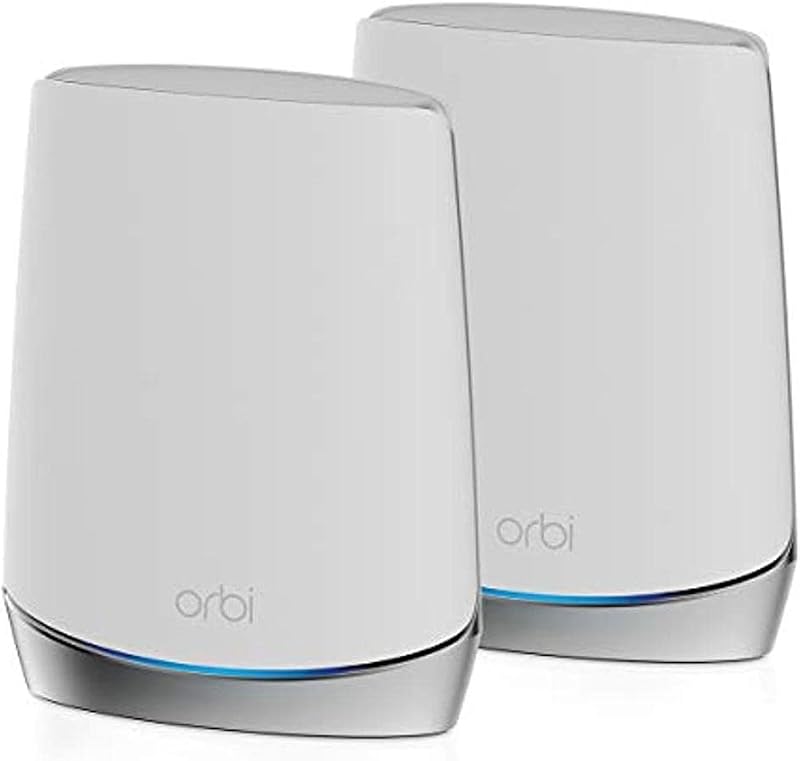
Pros
- Up to 5,000 sq ft coverage
- Tri-band WiFi 6 AX4200 speed
- Five Gigabit LAN ports total
- Supports internet plans up to 2Gbps
Cons
- Lacks 6GHz band support
- No multi-gigabit Ethernet ports
- WPA3 security not supported
View Netgear Orbi RBK752 on Amazon
TP-Link Deco BE85
Pros
- Massive BE22000 WiFi 7 throughput
- Dual 10G and dual 2.5G ports
- Simultaneous wired and wireless backhaul
- Built-in VPN client and server
- Integrated USB 3.0 port
Cons
- Only medium firewall rating listed
- Requires WiFi 7 clients for full speed
View TP-Link Deco BE85 on Amazon
Who Should Buy Each One
Choose the Netgear Orbi RBK752 If
- You subscribe to an internet service tier up to 1 Gbps or 2 Gbps and want reliable tri-band WiFi 6 performance.
- You need to blanket up to 5,000 square feet of living space across up to 40 smart home devices.
- You prefer an established mesh platform with five total Gigabit Ethernet LAN ports spread across the router and satellite.
- Your connected devices primarily use WiFi 5 and WiFi 6 standards and do not require 6 GHz bandwidth.
Choose the TP-Link Deco BE85 If
- You have multi-gigabit fiber internet requiring 2.5 Gbps or 10 Gbps Ethernet and SFP+ fiber WAN support.
- You own or plan to adopt WiFi 7 devices to take full advantage of 320 MHz channels, 4K-QAM, and Multi-Link Operation.
- You require simultaneous wired and wireless mesh backhaul to maintain top speeds between mesh nodes.
- You want advanced built-in router utilities like a VPN server/client, USB 3.0 network storage, and WPA3 security.
Final Verdict
The TP-Link Deco BE85 is the definitive winner when it comes to speed, advanced hardware interfaces, and future-ready wireless standards. By packing revolutionary WiFi 7 capabilities, a theoretical throughput ceiling of 22 Gbps, dual 10 Gbps ports, dual 2.5 Gbps ports, and simultaneous backhaul aggregation, it completely outclasses older hardware architectures. It serves as an uncompromising centerpiece for smart households running multi-gigabit fiber and high-demand local network transfers.
Nevertheless, a standard Netgear Orbi RBK752 review confirms that it remains a practical and dependable option for typical residential households. If your internet connection does not exceed 1 Gbps, your devices do not support WiFi 7, and you simply need rock-solid WiFi 6 coverage across 5,000 square feet, the Orbi RBK752 delivers proven tri-band reliability without requiring an investment in ultra-high-bandwidth multi-gigabit hardware.
FAQ
Does the Netgear Orbi RBK752 support the 6GHz wireless band?
No, the Netgear Orbi RBK752 is a WiFi 6 mesh system that operates across the 2.4 GHz band and two distinct 5 GHz bands. It does not support the 6 GHz frequency band, which is exclusive to WiFi 6E and WiFi 7 devices like the TP-Link Deco BE85.
Can the TP-Link Deco BE85 connect directly to fiber optic lines?
Yes, the TP-Link Deco BE85 includes a versatile 10G SFP+ Fiber and RJ45 Ethernet combo port. This design enables users to plug in supported fiber modules or standard copper Ethernet cables to achieve 10 Gbps WAN or LAN transfers.
How many wired ports are available on the Netgear Orbi RBK752 system?
The Netgear Orbi RBK752 two-pack includes six physical network ports in total: one Gigabit WAN port and three Gigabit LAN ports on the router unit, along with two Gigabit LAN ports on the satellite extender.
Does the TP-Link Deco BE85 require a subscription for basic parental controls and security?
No, the TP-Link Deco BE85 includes free basic TP-Link HomeShield features out of the box. These include basic network security scans, IoT device identification, basic parental controls, and Quality of Service prioritization without requiring a paid subscription.
What is simultaneous backhaul on the TP-Link Deco BE85?
Simultaneous wireless plus wired backhaul is a TP-Link technology that allows the Deco BE85 mesh nodes to link via wired Ethernet and wireless spectrum at the same time. This aggregation optimizes backhaul bandwidth and lowers latency between nodes throughout your home.
Is the Netgear Orbi RBK752 compatible with multi-gigabit internet service?
According to Netgear’s specifications, the Orbi RBK752 is compatible with internet service providers offering speeds up to 2 Gbps across cable, fiber, satellite, and DSL connections, though its individual physical Ethernet ports operate at 1 Gbps.