Choosing between the Netgear Orbi 970 and the TP-Link Deco XE75 comes down to whether your home network requires uncompromising multi-gigabit Wi-Fi 7 throughput or practical tri-band Wi-Fi 6E coverage. The Orbi 970 is engineered for extreme data demands with 10Gbps wired connectivity and massive quad-band capacity, whereas the Deco XE75 is built to eliminate everyday dead zones and legacy channel congestion using standard gigabit switching and tri-band routing.
Select the Netgear Orbi 970 if you operate multi-gigabit fiber internet, manage high-bandwidth local transfers, and need broad wireless coverage across estates up to 10,000 square feet. Opt for the TP-Link Deco XE75 if you have an internet service plan of 1 Gbps or lower and want clean 6 GHz channel performance for up to 7,200 square feet without paying for enterprise-grade hardware capabilities you will never utilize.


Netgear Orbi 970 vs TP-Link Deco XE75 at a Glance
| Feature | Netgear Orbi 970 | TP-Link Deco XE75 |
|---|---|---|
| Wi-Fi Generation | WiFi 7 (802.11be) | WiFi 6E (802.11ax) |
| Band Architecture | Quad-Band | Tri-Band |
| Maximum Total Speed | Up to 27Gbps | Up to 5,400 Mbps (AXE5400) |
| Ethernet Port Bandwidth | 10 Gbps LAN / 10 Gig Internet Port | 10/100/1000 Mbps Gigabit |
| Total Ethernet Ports | 6 ports across kit | 9 ports across 3-pack |
| Rated Coverage | Up to 10,000 sq. ft. | Up to 7,200 sq. ft. |
| Installed System RAM | 4 GB | 512 MB |
| Antenna Configuration | 3 Fixed Internal Antennas | Internal Antennas |
| Device Capacity | Up to 200 devices | Up to 200 devices |
| Security Platform | NETGEAR Armor (1-Year Included) | TP-Link HomeShield (Basic Included) |
| Best For | Multi-gigabit power users and ultra-large homes | Everyday gigabit connections and mainstream homes |
Wireless Throughput and Wi-Fi Standard Capabilities
The primary performance distinction in this mesh comparison involves the fundamental shift from Wi-Fi 6E to Wi-Fi 7. The TP-Link Deco XE75 operates on the 802.11ax protocol across three distinct bands, totaling up to 5,400 Mbps of aggregate bandwidth. This breaks down into 2402 Mbps on the 6 GHz band, 2402 Mbps on the 5 GHz band, and 574 Mbps on the 2.4 GHz band. The inclusion of the 6 GHz frequency eliminates interference from legacy wireless hardware, giving modern devices an uncluttered channel for clean data transmissions. However, each individual stream remains bounded by Wi-Fi 6 channel limits.
The Netgear Orbi 970 moves past these limitations by introducing the 802.11be Wi-Fi 7 wireless standard. Operating across a quad-band configuration, the Orbi 970 advertises aggregate speeds reaching up to 27Gbps, which the manufacturer notes is 2.4 times faster than previous Wi-Fi 6 implementations. This massive ceiling allows multiple client devices to engage in data-heavy tasks simultaneously, including 8K video streaming, high-throughput downloads, and intensive virtual reality workloads. The Orbi 970 is also fully backward compatible with legacy 802.11 standards, ensuring older connected hardware maintains functional connectivity without degrading the broader network.
When evaluating the eero max 7 vs netgear orbi 970 or comparing the Netgear Orbi 970 vs TP-Link Deco XE75 speed potential, the Orbi 970 delivers vastly higher throughput ceilings. The Deco XE75 easily manages everyday streaming and browsing, but it cannot match the peak file-transfer rates or expansive concurrency delivered by the 802.11be architecture on the Netgear hardware.
Edge: Netgear Orbi 970 provides drastically superior wireless capacity due to its 27Gbps Wi-Fi 7 quad-band architecture compared to the 5,400 Mbps Wi-Fi 6E rating on the TP-Link Deco XE75.
Wired Port Speeds and Local Network Bottlenecks
A mesh router’s physical Ethernet ports determine how effectively it can communicate with high-speed modems, network switches, and wired clients like desktop computers or network-attached storage units. The TP-Link Deco XE75 equips each unit in its 3-pack with three auto-sensing 10/100/1000 Mbps Ethernet ports, providing a total of nine physical wired connections across the entire home. These ports are versatile and automatically adapt to WAN or LAN assignments. However, because they are limited to 1 Gbps, any wired connection or wired backhaul between nodes cannot exceed standard gigabit speeds.
In contrast, the Netgear Orbi 970 incorporates true multi-gigabit hardware to match modern multi-gigabit internet subscriptions. The system features a 10 Gig internet WAN port alongside 10 Gbps LAN port bandwidth capabilities. In total, the 3-pack kit provides 6 Ethernet ports distributed across the router and two satellites. While this offers three fewer physical ports overall than the Deco XE75 3-pack, the bandwidth carrying capacity of each individual multi-gigabit port on the Orbi 970 is ten times greater than the standard gigabit jacks on the Deco units.
This difference has an immense practical impact on user infrastructure. If you pay for an internet plan faster than 1,000 Mbps, the Deco XE75 will bottleneck that incoming connection at the physical port level. The Orbi 970 can ingest a full 10Gbps ISP connection and redistribute it through high-speed wired switches or compatible client devices without hardware restriction.
Edge: Netgear Orbi 970 takes the victory here by providing 10 Gbps WAN and LAN ports that completely remove the standard 1 Gbps bottleneck found on the TP-Link Deco XE75.
Backhaul Architecture and Multi-Node Communication
Mesh stability relies almost entirely on how nodes communicate with one another behind the scenes. In any WiFi 7 vs WiFi 6E mesh deployment, the backhaul link dictates how much data client devices can push through satellite units before congestion takes hold. The TP-Link Deco XE75 uses a dynamic tri-band layout where the 6 GHz band functions as a dedicated wireless backhaul between nodes by default. Alternatively, users can configure the Deco app to switch the 6 GHz band into a client-facing network for Wi-Fi 6E devices. When configured as a client network, the backhaul must share wireless airtime with connected devices or fall back to standard 5 GHz communication.
The Netgear Orbi 970 approaches node communication differently by leveraging patented Quad-Band technology with an Enhanced Dedicated Backhaul. Because it contains four separate wireless bands rather than three, Netgear isolates satellite-to-router traffic onto a dedicated backhaul channel without stealing transmission slots from client devices. Whether you are running older 2.4 GHz hardware or the newest Wi-Fi 7 smartphones, the interconnecting traffic between the Orbi 970 satellites does not throttle your client-facing frequencies.
As explored in other platform breakdowns like the netgear orbi rbk752 vs tp-link deco xe75, dedicated backhaul engineering makes an observable difference in multi-satellite stability. Under heavy continuous transfer conditions, the Orbi 970 maintains consistent throughput at remote satellites, whereas the Deco XE75 must balance client traffic against backhaul coordination when the 6 GHz network is shared.
Edge: Netgear Orbi 970 wins this category with its patented quad-band configuration and Enhanced Dedicated Backhaul that isolates node-to-node communication from client traffic.
Whole-Home Coverage and Structural Penetration
Coverage area defines how well a mesh system envelops a residential property without creating dead zones. The TP-Link Deco XE75 3-pack is designed to cover up to 7,200 square feet, making it an excellent match for multi-story suburban homes. It uses an AI-Driven Mesh algorithm that continuously learns network conditions, client device health, and roaming patterns to hand off devices seamlessly as you walk from room to room. The internal antenna arrays maintain reliable line-of-sight coverage and manage structural interference typical of standard drywall and wood framing.
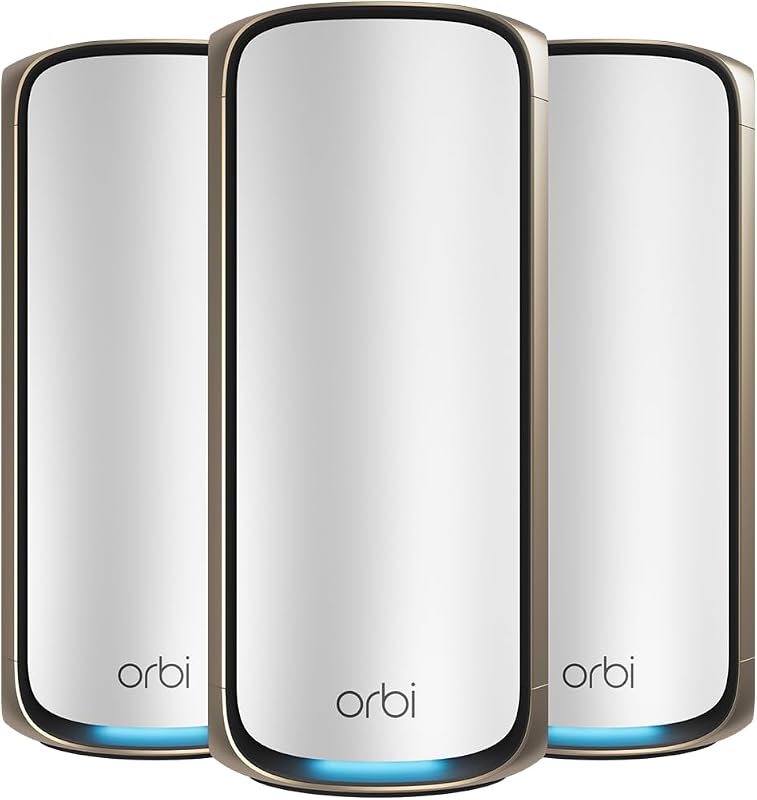
The Netgear Orbi 970 3-pack (comprising one router and two satellite extenders) steps up coverage specifications to an expansive 10,000 square feet. Netgear highlights that this system delivers comprehensive 360-degree wireless coverage from the basement to the rooftop and out into exterior yards. To achieve this, the Orbi 970 utilizes larger physical towers measuring 11.58 by 5.68 by 5.15 inches, housing three fixed high-performance internal antennas engineered specifically for extensive reach.
When choosing the netgear orbi 970 vs tp-link deco be85 or comparing the Netgear Orbi 970 or TP-Link Deco XE75 for large homes, square footage requirements play a primary role. If your property approaches the 8,000 to 10,000 square foot threshold, the physical amplification and broad antenna arrays inside the Orbi 970 offer a substantially stronger wireless footprint than the 7,200 square foot rating of the Deco XE75.
Edge: Netgear Orbi 970 wins due to its 10,000 square foot coverage rating, offering 2,800 square feet of additional reach over the TP-Link Deco XE75.
Hardware Processing, Memory, and System Management
Under-the-hood processing power dictates how stably a mesh router routes packets when hundreds of devices communicate simultaneously. The Netgear Orbi 970 is equipped with 4 GB of installed RAM and runs Netgear OS. This robust memory pool gives the Orbi system immense headroom to maintain low latency, track complex network tables, and execute high-speed QoS routines without software choking. Additionally, the Orbi 970 includes a 1-year subscription to NETGEAR Armor, providing network-wide threat defense, automatic firmware updates, and Advanced Router Protection against malicious traffic.
The TP-Link Deco XE75 operates on TP-Link Firmware with 512 MB of installed RAM. While 512 MB is sufficient for standard residential households handling everyday streaming and smart home gear up to its rated 200 devices, it offers significantly less buffer memory during intensive multi-client routing sessions. TP-Link counters with strong management utilities, including the Deco app, compatibility with Amazon Alexa voice commands for guest network toggling, and TP-Link HomeShield. HomeShield includes basic network security scans, IoT identification, and basic parental controls built into the platform without mandatory initial subscriptions. TP-Link is also a signatory of the CISA Secure-by-Design pledge, highlighting security-focused development.
When deciding whether the eero pro 6e vs netgear orbi 970 or the Deco XE75 makes sense for your technical requirements, processing memory matters. The Orbi 970 carries eight times the system RAM of the Deco XE75, providing an enterprise-grade hardware base that prevents memory exhaustion during continuous heavy utilization.
Edge: Netgear Orbi 970 takes the lead thanks to its massive 4 GB memory capacity, which vastly outpaces the 512 MB RAM found inside the Deco XE75.
Pros and Cons
Netgear Orbi 970
Pros
- Up to 27Gbps Wi-Fi 7 throughput
- 10Gbps WAN and LAN connectivity
- Quad-band with Enhanced Dedicated Backhaul
- Broad 10,000 sq ft coverage rating
- Large 4 GB installed system RAM
Cons
- Only six total ports across kit
- Substantial physical desktop footprint
- Listing specifies for U.S. use only
View Netgear Orbi 970 on Amazon
TP-Link Deco XE75

Pros
- Nine total gigabit Ethernet ports
- Clean 6 GHz frequency band access
- Up to 7,200 sq ft coverage
- Built-in TP-Link HomeShield basic tools
- Amazon Alexa voice management compatibility
Cons
- Ports capped at 1 Gbps speeds
- Modest 512 MB memory capacity
- Shares 6 GHz between backhaul and clients
View TP-Link Deco XE75 on Amazon
Who Should Buy Each One
Choose the Netgear Orbi 970 If
- You subscribe to a multi-gigabit ISP plan that requires a 10 Gig internet port and 10Gbps LAN connections to avoid physical bottlenecks.
- Your property encompasses up to 10,000 square feet and demands complete 360-degree coverage across multiple floors, basements, and exterior zones.
- You own or plan to purchase cutting-edge Wi-Fi 7 smartphones, laptops, and motherboards that can utilize 802.11be channels.
- You manage a heavy local network with frequent large file transfers that benefit from 4 GB of RAM and patented quad-band dedicated backhaul.
Choose the TP-Link Deco XE75 If
- Your home internet subscription is 1 Gbps or below, making standard 10/100/1000 Mbps gigabit ports the right practical match.
- You live in a home up to 7,200 square feet and want to bypass crowded 2.4 GHz and 5 GHz bands by tapping into the clean 6 GHz spectrum.
- You need multiple physical wired ports at every single satellite location, benefiting from nine total Ethernet jacks across the 3-pack.
- You prefer managing basic parental controls, network security scans, and Alexa voice commands through TP-Link HomeShield.
Final Verdict
A comprehensive Netgear Orbi 970 review demonstrates that this mesh flagship sits in a performance class of its own. By combining 802.11be Wi-Fi 7 support, total throughput ratings up to 27Gbps, 10Gbps physical interfaces, 4 GB of RAM, and patented quad-band architecture with dedicated backhaul, the Orbi 970 completely removes all hardware bottlenecks. When determining netgear orbi rbk752 vs tp-link deco be85 upgrades or asking is Netgear Orbi 970 worth it, the answer is an easy yes for multi-gigabit power users and massive properties requiring the ultimate in wireless infrastructure.
On the other hand, evaluating a TP-Link Deco XE75 review reveals a highly capable, practical networking solution for standard family environments. Asking is TP-Link Deco XE75 worth it leads to a resounding yes if your service provider delivers gigabit speeds or less. With up to 7,200 square feet of reliable tri-band coverage, nine total Ethernet ports, AI-driven roaming, and clean 6 GHz channel isolation, the Deco XE75 handles modern streaming, remote work, and smart home demands without unnecessary hardware overhead. For the vast majority of standard gigabit households, the Deco XE75 offers everything needed, while the Orbi 970 remains the undisputed champion for multi-gigabit performance.
FAQ
Can the TP-Link Deco XE75 handle multi-gigabit internet connections?
No, the TP-Link Deco XE75 is equipped with 10/100/1000 Mbps Ethernet ports. Because the physical Ethernet ports are limited to standard gigabit speeds, incoming internet connections from an ISP modem will max out around 1 Gbps, preventing multi-gigabit plan speeds from passing through the hardware.
Does the Netgear Orbi 970 support older WiFi devices?
Yes, the Netgear Orbi 970 is fully backward compatible with older 802.11 wireless protocols. Legacy equipment running on 2.4 GHz or 5 GHz bands can connect seamlessly to the Orbi 970 network alongside modern Wi-Fi 7 hardware.
What is the benefit of the quad-band system on the Netgear Orbi 970?
The Orbi 970 features exclusive patented quad-band technology with an Enhanced Dedicated Backhaul. This dedicated fourth band serves exclusively as an interconnect between the main router and satellite nodes, ensuring client devices do not have to share their wireless frequency airtime with node-to-node system communication.
Which mesh system is better for competitive gaming?
When selecting the Netgear Orbi 970 or TP-Link Deco XE75 for gaming, the Netgear Orbi 970 holds a clear technical advantage. Its 10 Gbps wired ports provide ultra-fast low-latency backbones for gaming rigs, while its 4 GB of RAM and Wi-Fi 7 channels minimize jitter and data queuing under heavy concurrent household traffic.
How do the Ethernet port configurations differ between these systems?
The TP-Link Deco XE75 provides nine total 1 Gbps ports across its 3-pack (three ports per node). The Netgear Orbi 970 provides six total ports across its 3-pack, but those ports include 10 Gig internet and 10 Gbps LAN bandwidth capabilities for significantly higher individual throughput.
Can the Netgear Orbi 970 be installed outside the United States?
According to the official product listing specifications, the Netgear Orbi 970 RBE973S model is made for use in the U.S. only, utilizing domestic frequency allocations and a 240-volt electrical specification.