The primary distinction between the Netgear Orbi 970 and the TP-Link Deco BE85 comes down to wireless architectural design versus wired interface flexibility: Netgear isolates inter-node communication across a patented quad-band structure with an Enhanced Dedicated Backhaul, while TP-Link prioritizes wired versatility with dual 10Gbps ports, an SFP+ fiber combination interface, and simultaneous hybrid backhaul modes.
Choose the Netgear Orbi 970 if you manage a sprawling residential property where running physical cables between nodes is impractical and you require completely uncompromised wireless airtime for dozens of high-demand client devices. Choose the TP-Link Deco BE85 if you want to integrate enterprise-grade optical fiber, attach network storage locally, or take advantage of concurrent wired and wireless backhaul paths across your property.


Netgear Orbi 970 vs TP-Link Deco BE85 at a Glance
| Feature | Netgear Orbi 970 | TP-Link Deco BE85 |
|---|---|---|
| Wi-Fi Generation and Class | Quad-Band WiFi 7 (802.11be) | Tri-Band WiFi 7 (802.11be) |
| Maximum Advertised Speed | Up to 27 Gbps | Up to 22 Gbps (BE22000) |
| Backhaul Method | Enhanced Dedicated Backhaul | Simultaneous Wireless + Wired Backhaul |
| Physical Port Selection | 6 ports with 10 Gbps LAN bandwidth | 4 ports (2x 10G RJ45/SFP+ combo, 2x 2.5G) |
| USB Connectivity | Not listed | 1x USB 3.0 Port |
| Internal Hardware | 4 GB RAM, 3 fixed antennas | 8 internal antennas, 2 cooling fans |
| VPN Client and Server | Not listed | Supported |
| Coverage and Capacity | Up to 10,000 sq. ft., 200 devices | Not listed |
| Bundled Security Software | NETGEAR Armor (1-year subscription) | TP-Link HomeShield (basic features included) |
| Best For | Expansive wireless-only estates needing raw multi-band isolation | Prosumers wanting 10G fiber inputs, local USB storage, and hybrid links |
Wireless Architecture and Band Allocation
Wireless spectrum distribution dictates how a mesh network handles congested family environments. When evaluating the Orbi 970 quad-band vs Deco BE85 tri-band layouts, the fundamental difference lies in how each system reserves frequency slices for device traffic versus inter-node coordination. The Netgear Orbi 970 utilizes a quad-band architecture, operating across distinct frequency bands to isolate its communication. By securing an exclusive transmission plane via its Enhanced Dedicated Backhaul, client communications on the remaining bands do not compete for airtime against data traveling between the main router and the remote satellites. For homeowners who have previously compared options like the netgear orbi 970 vs tp-link deco xe75, this fourth band represents a massive architectural leap in preventing throughput degradation across multi-node hops.
Conversely, the TP-Link Deco BE85 employs a tri-band framework comprising a 6GHz band delivering up to 11520 Mbps, a 5GHz band providing up to 8640 Mbps, and a 2.4GHz band reaching 1376 Mbps. Because it lacks a dedicated fourth band, the Deco BE85 distributes satellite-to-router traffic across the same operational bands that serve connected endpoints. TP-Link mitigates this through native WiFi 7 technologies, including 320 MHz channel widths, 4K-QAM modulation, and Multi-Link Operation (MLO). MLO allows devices to send and receive data across multiple frequency bands concurrently. However, when multiple heavy consumers stream 8K video or transfer bulky files, a tri-band mesh system must continually balance backhaul data alongside device traffic on shared channels.
The operational consequence is clear when placing nodes in rooms without Ethernet wiring. The Orbi 970 ensures that client traffic on standard channels never encroaches upon the primary backhaul pipeline. While TP-Link leverages high-end WiFi 7 features like Multi-RUs and wide channels to maximize efficiency across its three bands, Netgear provides a clean physical separation of traffic by dedicating physical radio spectrum exclusively to node coordination.
Edge: Netgear Orbi 970, because its quad-band architecture provides a dedicated wireless spectrum layer that completely isolates node-to-node traffic from client devices.
Wired Connectivity and Port Versatility
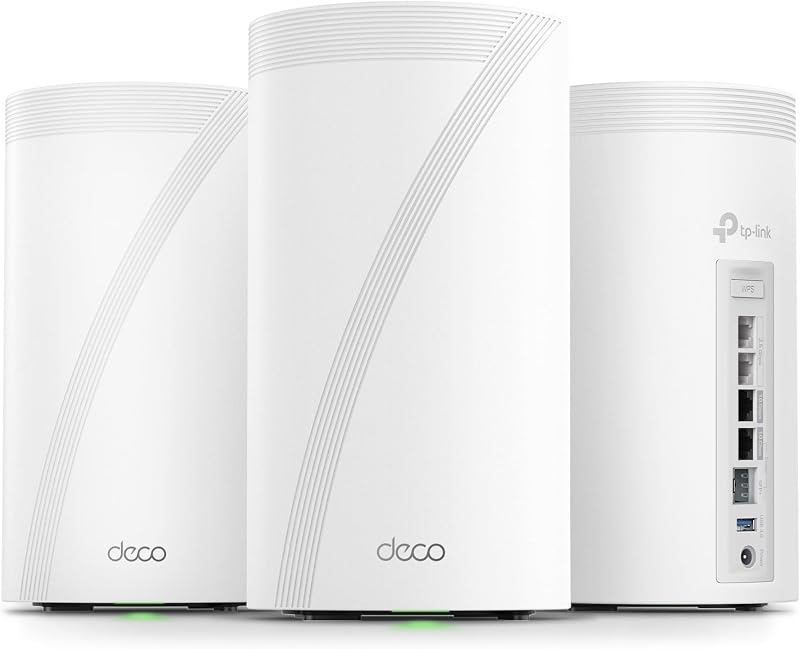
While wireless performance often commands the headlines, physical port configurations dictate whether a mesh system can act as a true enterprise-grade backbone for switches, network-attached storage, and fiber terminals. The TP-Link Deco BE85 offers pro-grade wired connectivity by providing dual 10Gbps WAN/LAN ports per unit. Crucially, one of these 10G ports is an SFP+ Fiber/RJ45 Ethernet combo socket. This allows users with direct optical fiber incoming lines to bypass copper transceivers entirely, plugging optical modules directly into the router. In addition to these dual 10G interfaces, each Deco BE85 unit integrates two 2.5Gbps ports and an onboard USB 3.0 port for network-attached hard drives, answering the question of whether netgear orbi rbk752 vs tp-link deco be85 upgraders get meaningful utility out of modern multi-gigabit hardware.
The Netgear Orbi 970 features 6 total physical ports across the hardware with a 10 Gig internet port and a LAN port bandwidth of 10 Gbps. This delivers exceptional raw bandwidth for high-speed internet service providers and downstream switches. However, all physical connections on the Orbi 970 rely solely on standard copper RJ45 interfaces. The listing does not specify any SFP+ optical fiber combo cages, nor does it provide USB ports for direct storage integration. While six total ports provide ample room for local devices, the lack of optical fiber input requires users with dedicated fiber drops to rely on external media converters or modem equipment.
For power users asking is TP-Link Deco BE85 worth it strictly from a wired networking perspective, the inclusion of the SFP+ port and USB 3.0 expansion makes TP-Link exceptionally adaptable. Users can connect an ultra-fast local backup drive right into the router while simultaneously routing high-speed 10G copper connections to a workstation and a switch. Netgear delivers high aggregate port bandwidth, but Deco BE85 provides superior interface diversity.
Edge: TP-Link Deco BE85, due to its versatile dual 10G setup featuring an SFP+ fiber combination socket, secondary 2.5G ports, and USB 3.0 capability.
Backhaul Dynamics and System Throughput
Throughput consistency over distance depends heavily on how nodes relay data back to the primary gateway. Looking closely at the Orbi 970 vs Deco BE85 backhaul mechanics reveals fundamentally opposing engineering philosophies. Netgear relies on its patented Enhanced Dedicated Backhaul, combined with WiFi 7 performance, to achieve an aggregate maximum upstream and downstream data rate of up to 27 Gbps. This 27Gbps total bandwidth allows the Orbi 970 to push data at rates 2.4 times faster than older WiFi 6 standards. Readers weighing the eero pro 6e vs netgear orbi 970 will note that the sheer volume of radio throughput on the Orbi 970 prevents the inter-node bottlenecking common to older mesh generations.
TP-Link counters this with a self-developed hybrid backhaul algorithm. The Deco BE85 is capable of connecting to wireless and wired backhaul simultaneously. Rather than forcing the owner to choose between an all-wireless mesh or an all-Ethernet backhaul, the Deco BE85 can aggregate data streams across an Ethernet connection and multiple wireless frequency bands at the same time. This capability takes full advantage of WiFi 7 Multi-Link Operation to increase stability and dynamic throughput. In terms of raw top speed, the Deco BE85 is rated as a BE22000 system, delivering cumulative theoretical speeds of up to 22,000 Mbps across its 6GHz, 5GHz, and 2.4GHz bands, with a maximum upstream data transfer rate of 10,000 Mbps.
When comparing Deco BE85 vs Orbi 970 WiFi 7 speed ratings, the Orbi 970 edges ahead in gross wireless transmission capability with its 27Gbps platform. If your home cannot support any data cabling, Netgear’s dedicated wireless channel maximizes wireless throughput. However, if your home features partial Ethernet or fiber wiring, TP-Link’s ability to fuse physical and over-the-air backhauls concurrently creates an exceptionally robust link that resists physical interference.
Edge: Netgear Orbi 970, as its 27Gbps aggregate rating and patented wireless dedicated backhaul provide superior headroom in environments reliant exclusively on wireless node links.
Software Capabilities, Security, and VPN Support
A router functions as both a radio broadcaster and the primary security gatekeeper for home automation and personal data. Any comprehensive Netgear Orbi 970 review must highlight its inclusion of a 1-year subscription to NETGEAR Armor. Armor provides all-in-one internet security protection designed to guard connected computers, mobile devices, and smart accessories against online intrusions. The system runs on Netgear OS, supports standard WPA2 and WPA3 protocols, includes WPS pairing, and operates with a medium router firewall security level. In past comparisons like the eero 6+ vs netgear orbi 970, Netgear’s focus has centered on robust consumer simplicity backed by commercial antivirus partnerships.
In contrast, a detailed TP-Link Deco BE85 review reveals a broader array of native network customization tools built into its RouterOS platform. TP-Link bundles its HomeShield security suite, which offers free built-in features including a network security scan, IoT device identification, Quality of Service (QoS) bandwidth management, basic parental controls, and weekly or monthly reporting. Crucially, the Deco BE85 natively integrates both VPN Client and VPN Server functionality. This allows connected devices throughout the entire house to tunnel through remote VPN servers without requiring individual software installations on every phone, tablet, and smart television.
Furthermore, the Deco BE85 can run ordinary internet traffic alongside a dedicated VPN connection simultaneously. It also includes voice control compatibility with Amazon Alexa and Google Assistant, as well as an alternate Access Point Mode for users integrating the mesh units behind an existing enterprise firewall. While Netgear Armor provides strong automated endpoint security, TP-Link provides greater administrative autonomy out of the box through built-in VPN tunneling, QoS controls, and flexible operation modes without relying on ongoing service renewals.
Edge: TP-Link Deco BE85, because of its integrated VPN client and server support, flexible QoS settings, and native voice assistant integration.
Antenna Configuration, Roaming, and Thermal Hardware
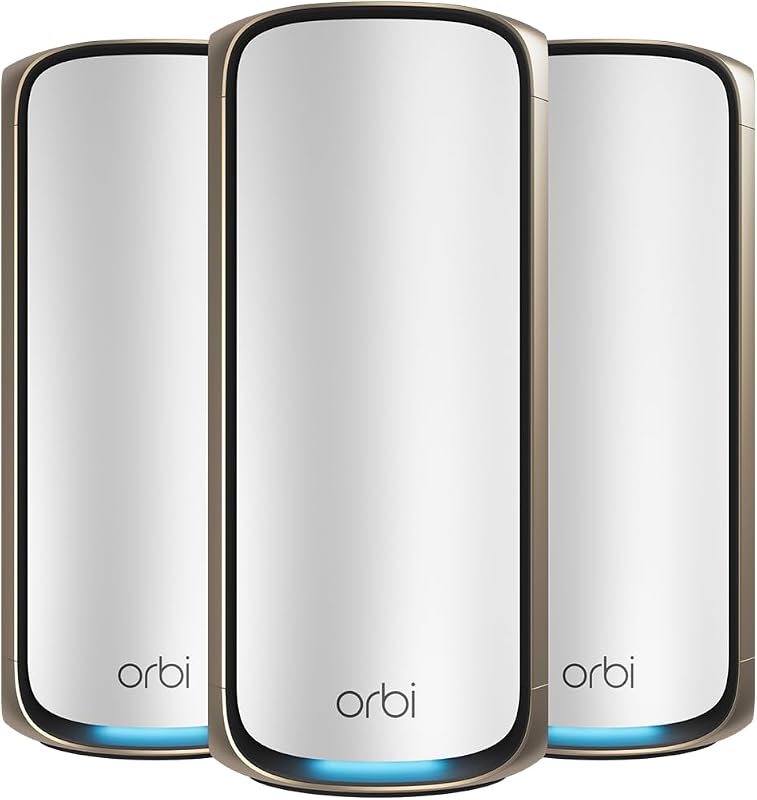
Sustaining peak WiFi 7 speeds requires sophisticated physical antenna arrays and diligent heat mitigation, especially during prolonged gaming and multi-user streaming sessions. The Netgear Orbi 970 is constructed as a substantial desktop pillar, measuring 11.58 by 5.68 by 5.15 inches, designed to deliver 360-degree coverage across sprawling footprints up to 10,000 square feet. The system supports up to 200 connected devices concurrently, utilizing 3 fixed antennas engineered for high-gain transmission across multi-story structures. To handle heavy data routing, Netgear equips the 970 series with 4 GB of installed RAM memory, ensuring the operating system has adequate memory buffers when managing large device pools.
The TP-Link Deco BE85 takes an internal engineering approach focused on dense signal distribution and active thermal regulation. It houses 8 internal high-performance antennas alongside 2 internal cooling fans. High-bandwidth WiFi 7 processing generates substantial thermal loads, particularly when driving 320 MHz wide channels and dual 10Gbps ports simultaneously. The dual internal cooling fans ensure that thermal throttling does not artificially depress packet transfer rates. For roaming, the Deco BE85 deploys self-learning AI-Roaming technology. This system uses advanced algorithms to track how client devices traverse the home, automatically switching endpoints to the optimal mesh node without connection drops.
When deciding between the Netgear Orbi 970 or TP-Link Deco BE85 for gaming, latency stability under heavy load is paramount. Netgear provides vast coverage metrics that can blanket massive properties up to 10,000 square feet. However, the Deco BE85’s active internal fans, eight internal antennas, and AI-driven roaming routines ensure that hardware temperatures remain low and client handoffs remain smooth during rigorous network sessions. Shoppers who study the netgear orbi 970 vs asus zenwifi xt9 know that proper cooling and antenna density directly impact long-term network reliability.
Edge: TP-Link Deco BE85, due to its internal 8-antenna array, active dual-fan cooling system, and AI-driven seamless roaming algorithms.
Pros and Cons
Netgear Orbi 970
Pros
- Patented quad-band dedicated backhaul
- Blistering 27Gbps total wireless speed
- Broad 10,000 square foot coverage
- Generous 4GB of installed RAM
- Supports up to 200 devices
Cons
- No SFP+ optical fiber combo port
- Lacks integrated USB storage port
- Restricted to United States use
View Netgear Orbi 970 on Amazon
TP-Link Deco BE85
Pros
- Dual 10G ports with SFP+ fiber support
- Simultaneous wired and wireless backhaul
- Built-in VPN client and server
- Integrated USB 3.0 sharing port
- Dual internal fans for cooling
Cons
- Tri-band lacks dedicated backhaul band
- Lower 22Gbps total maximum throughput
- Fewer total ports than Orbi
View TP-Link Deco BE85 on Amazon
Who Should Buy Each One
Choose the Netgear Orbi 970 If
- You live in a massive estate up to 10,000 square feet and cannot run physical Ethernet cables between satellite nodes.
- You demand a true quad-band network with a dedicated wireless backhaul band that never competes with client devices.
- You manage a smart home with up to 200 active devices that require high-capacity 4 GB RAM buffers to prevent memory congestion.
- You prefer a turnkey security suite with an included one-year subscription to NETGEAR Armor protecting all connected household clients.
Choose the TP-Link Deco BE85 If
- You have high-speed optical fiber internet and want to utilize an SFP+ fiber combo port directly on your primary mesh node.
- You want the performance advantage of running simultaneous wired and wireless backhauls across your living space.
- You run whole-home VPN client connections to protect sensitive network traffic without installing client software on every device.
- You require integrated USB 3.0 storage sharing and active dual-fan internal cooling to prevent thermal throttling during continuous transfers.
Final Verdict
In the direct matchup between TP-Link Deco BE85 vs Netgear Orbi 970, the superior selection hinges entirely on how your property handles backhaul communications. The Netgear Orbi 970 is the premier choice for large, cable-free residences where wireless performance cannot be compromised. Its quad-band radio design, backed by an Enhanced Dedicated Backhaul and an impressive 27Gbps cumulative bandwidth ceiling, isolates inter-node communication so that streaming, 8K media, and intense smart home traffic operate without signal degradation across properties up to 10,000 square feet.
On the other hand, the TP-Link Deco BE85 takes the victory for networking enthusiasts, hybrid-wired households, and prosumers requiring advanced routing versatility. With its dual 10Gbps interfaces, SFP+ optical fiber socket, USB 3.0 expansion, and concurrent wired-plus-wireless backhaul aggregation, the Deco BE85 offers unmatched flexibility. If you want deep administrative control featuring native VPN client/server capabilities and active cooling hardware, the Netgear Orbi 970 vs Deco BE85 comparison tilts decisively in favor of TP-Link for wired and hybrid deployments.
FAQ
Can the Netgear Orbi 970 operate outside the United States?
According to the product specifications, the Netgear Orbi 970 is explicitly made for use in the United States only, operating on a standard 240-volt electrical rating compatible with domestic power distribution.
Does the TP-Link Deco BE85 include USB ports for network storage?
Yes, the TP-Link Deco BE85 includes one USB 3.0 Type-A port on the unit, allowing users to connect external hard drives or flash memory directly to the mesh system for local storage and media sharing across the network.
How do the backhaul implementations differ between the Orbi 970 and Deco BE85?
The Netgear Orbi 970 uses a patented quad-band layout featuring an Enhanced Dedicated Backhaul, reserving a wireless frequency band solely for inter-node communication. The TP-Link Deco BE85 uses a tri-band framework that connects to wired and wireless backhaul paths simultaneously, fusing data paths for hybrid performance.
What security software comes included with each mesh system?
The Netgear Orbi 970 includes a 1-year subscription to NETGEAR Armor for network and endpoint protection. The TP-Link Deco BE85 includes TP-Link HomeShield, which provides baseline network security scans, IoT identification, QoS controls, and basic parental management without requiring an immediate paid subscription.
Does either mesh system offer optical fiber input?
The TP-Link Deco BE85 provides a 10G SFP+ Fiber/RJ45 Ethernet combo port that supports direct optical fiber module connections. The Netgear Orbi 970 features a 10 Gig internet port and a 10 Gbps LAN bandwidth profile, but relies on copper RJ45 connections rather than an SFP+ fiber cage.
Can I manage VPN traffic directly on these mesh routers?
The TP-Link Deco BE85 features native VPN Client and VPN Server capabilities directly within its operating software, allowing devices to route through secure VPN tunnels without third-party device apps. The Netgear Orbi 970 listing does not specify integrated VPN client or server support.