Deciding between top-tier Wi-Fi 7 mesh systems comes down to a fundamental architectural trade-off: whether you need an all-in-one smart home hub with multi-gigabit routing, or an ultra-wide quad-band mesh system with a dedicated wireless backhaul engineered to blanket sprawling estates. Both routers leverage cutting-edge 802.11be technology to reduce latency and accelerate wireless traffic, but their underlying channel management and internal hardware cater to entirely different home network setups in the Eero Max 7 vs Netgear Orbi 970 showdown.
Homeowners seeking unified smart home automation and compact multi-gigabit routing should choose the Eero Max 7. Property owners demanding comprehensive wireless coverage across expansive multi-story layouts should choose the Netgear Orbi 970.


Eero Max 7 vs Netgear Orbi 970 at a Glance
| Feature | Eero Max 7 | Netgear Orbi 970 |
|---|---|---|
| Wi-Fi Generation | Wi-Fi 7 (IEEE 802.11a/b/g/n/ac/ax/be) | Wi-Fi 7 (802.11be) |
| Wireless Band Class | Tri-Band (3 radios) | Quad-Band with Enhanced Dedicated Backhaul |
| Maximum Rated Throughput | BE20800 (up to 4.3 Gbps wireless, 9.4 Gbps wired) | Up to 27 Gbps total throughput |
| Advertised Coverage Area | Up to 2,500 sq. ft. per unit (28-foot radius) | Up to 10,000 sq. ft. (3-pack system) |
| Connected Device Capacity | 250+ devices | 200 devices |
| Multi-Gigabit Ethernet Ports | Two 10 GbE ports | 10 Gig Internet port and 10 Gbps LAN (6 ports total) |
| Integrated Smart Home Hub | Zigbee (controller), Thread, Matter, Bluetooth LE 5.0 | Not listed |
| Installed System Memory | Not listed | 4 GB RAM |
| Network Security Software | eero Plus (optional subscription) | 1-year NETGEAR Armor subscription included |
| Hardware Warranty | 3-year limited warranty | Not listed |
| Best For | Smart home automation and dense wired environments | Massive estates requiring dedicated wireless backhaul |
Wireless Architecture and Band Configuration
The primary technical divide between these two networking flagships is how they divide frequency spectrum between client devices and mesh satellite communication. The Wi-Fi 7 standard introduces 320 MHz wide channels across the 6 GHz band, enabling unprecedented throughput, yet how a mesh system manages those channels determines real-world stability under heavy concurrent usage.
When comparing eero max 7 tri-band vs orbi 970 quad-band hardware, the difference in radio architecture is striking. The Eero Max 7 features a tri-band configuration backed by 3 radios, carrying a BE20800 rating across 10 spatial streams with 2×2, 4×4, and 4×4 MU/SU-MIMO arrangements. Its channel widths span 20, 40, 80, 160, 240, and 320 MHz, operating across standard 2.4 GHz, 5 GHz, and 6 GHz spectrum blocks. Because it utilizes dynamic TrueMesh network intelligence, the Eero Max 7 actively negotiates backhaul traffic across the same shared tri-band frequencies used by connected phones, laptops, and tablets.
In contrast, the Netgear Orbi 970 implements a patented quad-band architecture designed to unleash total theoretical speeds up to 27 Gbps, which is 2.4 times faster than Wi-Fi 6 generations. By dedicating an entire fourth band specifically as an Enhanced Dedicated Backhaul, the Orbi 970 isolates node-to-node data routing from active client communication. In a head-to-head eero max 7 vs netgear orbi 970 wifi 7 evaluation, this dedicated highway ensures that transferring large files between nodes does not introduce congestion or halve client-facing bandwidth on satellite units.
Edge: Netgear Orbi 970 – The quad-band design with Enhanced Dedicated Backhaul keeps satellite communication separate from client traffic to preserve maximum wireless speeds.
Coverage Scale and Structural Reach
Physical coverage determines how many mesh hardware nodes you must place throughout your home to eliminate dead zones and bypass structural interference like concrete walls or subflooring. Understanding the square footage rating of each package helps prevent buying unnecessary satellite nodes or leaving distant rooms starved for wireless connectivity.
The baseline Eero Max 7 configuration is packaged as a single standalone router providing up to 2,500 square feet of coverage, which translates to an operational radius of roughly 28 feet from the node. For compact residences, single-floor flats, or homes already wired with structured cabling for multi-node TrueMesh extension, this focused footprint delivers multi-gigabit throughput efficiently without taking up substantial surface space on shelves or desks.
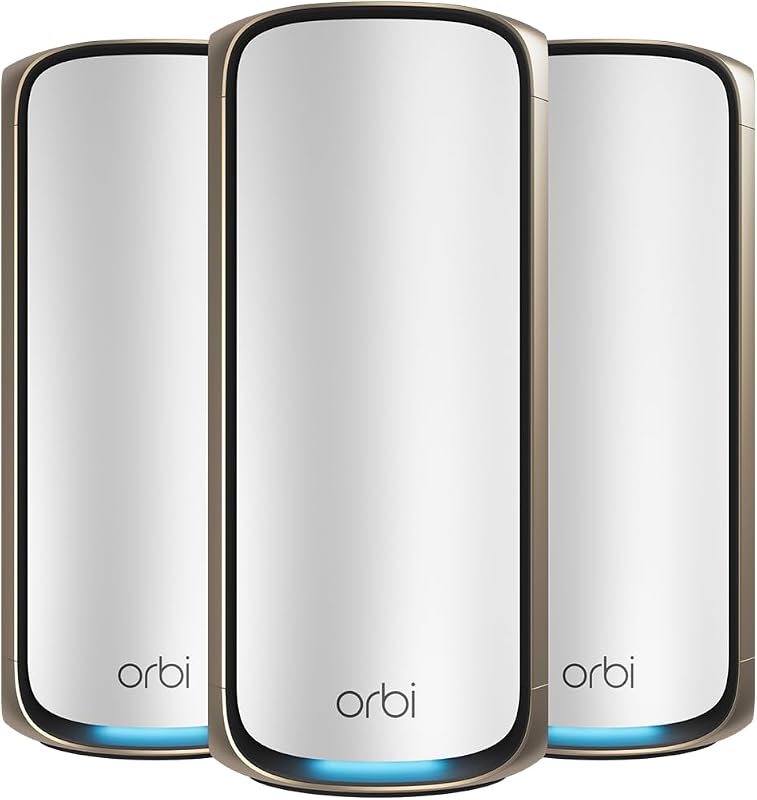
On the other hand, the Netgear Orbi 970 (RBE973S package) ships as a three-piece system containing a central router and two satellite extenders engineered to cover up to 10,000 square feet. NETGEAR advertises true 360-degree wireless coverage from the front door to the backyard and from the basement to the rooftop. Each substantial node measures 11.58 by 5.68 by 5.15 inches and houses 3 fixed antennas. Readers evaluating an upgrade path from older mesh equipment can examine the netgear orbi rbk752 vs 970 comparison to see how multi-node coverage scale has expanded over earlier generations.
Edge: Netgear Orbi 970 – The included three-pack setup covers up to 10,000 square feet across indoor and outdoor spaces straight out of the box.
Smart Home Automation and Protocol Support
A modern Wi-Fi system serves as the central nervous system for household gadgets, but some routers go beyond basic internet routing by integrating specialized home automation radios directly into the housing.
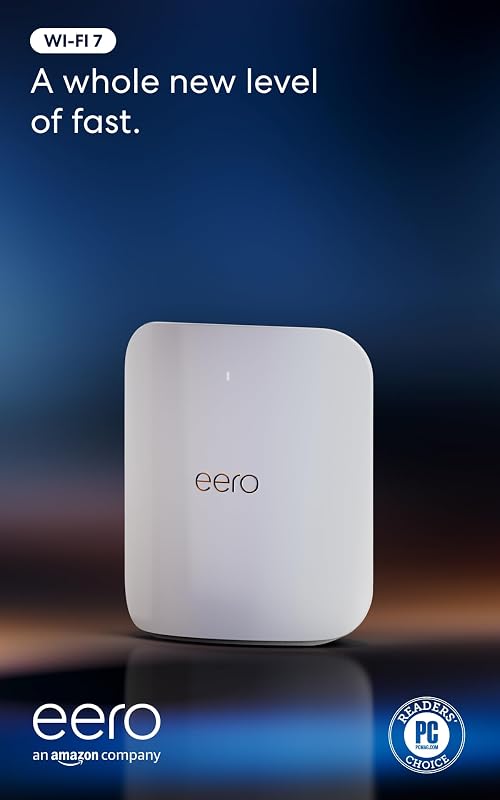
The Eero Max 7 operates as a fully functional smart home hub right out of the box. It incorporates physical radios for Thread and Bluetooth Low Energy 5.0, while also functioning as a Matter controller and a Zigbee controller. This native protocol integration enables smart locks, motion sensors, smart bulbs, and automated plugs to connect directly to the Eero mesh without relying on third-party bridge hardware plugged into wall outlets. With a stated capacity to support 250+ connected devices simultaneously, the Eero Max 7 effortlessly handles dense smart home setups alongside high-throughput personal computers.
The Netgear Orbi 970 listing focuses strictly on data routing performance, specifying standard Wi-Fi connectivity protocols without listing integrated Zigbee, Thread, or Matter controller hardware. While the Orbi 970 effortlessly manages up to 200 connected devices via standard 802.11be Wi-Fi, homeowners invested in Zigbee and Thread smart accessories will still need to maintain standalone hardware bridges connected to the network to bridge non-Wi-Fi smart devices.
Edge: Eero Max 7 – Built-in Thread, Zigbee controller, and Matter capabilities eliminate the need for standalone third-party smart home hubs.
Wired Ports and Multi-Gigabit Connectivity
True multi-gigabit performance depends heavily on physical Ethernet interfaces, both for handling incoming fiber internet service and for distributing high-bandwidth wired backhaul between access points. When inspecting the eero max 7 vs orbi 970 specs, wired connectivity presents impressive capabilities on both platforms.
The Eero Max 7 features two dedicated 10 Gigabit Ethernet ports on each unit. These interfaces support wired speeds up to 9.4 Gbps, perfectly aligning with symmetrical 10 Gbps fiber internet plans. Users can assign one 10 GbE port to an incoming multi-gigabit modem or ONT and utilize the second 10 GbE port to feed a high-speed unmanaged switch or establish a direct wired backhaul line to an additional Eero unit, avoiding wireless degradation completely.
The Netgear Orbi 970 system counters with an expansive array of 6 ports distributed across the system, headlined by a 10 Gig internet port and dedicated 10 Gbps LAN port bandwidth. This selection provides ample room to connect network-attached storage units, gaming PCs, and high-performance workstations directly to the back of the router without immediately consuming every available jack. Shoppers comparing high-end enterprise-grade alternatives can also review the netgear orbi 970 vs tp-link deco be85 to evaluate how multi-gigabit port versatility balances against other premium mesh options.
Edge: Tie – Both systems feature native 10 Gbps Ethernet throughput capable of supporting full multi-gigabit fiber connections and ultra-fast wired backhauls.
Gaming, Latency, and Peak Throughput Performance
Online multiplayer gaming, cloud streaming, and immersive virtual reality environments demand high burst throughput combined with low, jitter-free ping times. Choosing the eero max 7 or netgear orbi 970 for gaming depends primarily on how nodes communicate when client traffic spikes across multiple rooms.
The Eero Max 7 integrates specific Wi-Fi features engineered to trim latency, including OFDMA, WMM, and Transmit Beamforming (Tx Beamforming). When paired with Wi-Fi 7 client cards supporting 320 MHz channels, the Eero Max 7 delivers wireless speeds up to 4.3 Gbps. Eero positions the Max 7 directly for AR, VR, and cloud applications where immediate packet processing prevents rendering lag. When running a local orbi 970 vs eero max 7 speed test on a single node with direct line-of-sight, the Eero Max 7 delivers outstanding multi-gigabit data transfers.
However, once you introduce satellite nodes into the equation, the Netgear Orbi 970 demonstrates an architectural advantage for competitive gaming. Powered by 4 GB of installed RAM and its 27 Gbps total pipeline, the Orbi 970 keeps packet queues flowing even under massive household loads. Because the Enhanced Dedicated Backhaul handles communication between satellites, a game running in an upstairs bedroom does not suffer from ping spikes when another family member streams high-bitrate media on the ground floor. Players upgrading from older systems can review the eero pro 6e vs netgear orbi 970 matchup to see how dedicated backhaul architectures transform gameplay across multiple floors.
Edge: Netgear Orbi 970 – The dedicated wireless backhaul eliminates packet queueing and latency spikes across satellite nodes during intense multiplayer gaming.
Software Features, Security, and Long-Term Value
A router’s long-term utility relies on dependable firmware, straightforward mobile management, and active digital security to defend connected devices against online vulnerabilities. Examining software ecosystems reveals distinctly different ownership experiences between the two manufacturers.
Setting up the Eero Max 7 takes only minutes using the streamlined eero mobile application, which allows full network administration from anywhere. Software capabilities include automatic channel selection, band steering, device and profile pausing for parental controls, and easy password sharing for guest networks. For advanced protection, users can activate an optional subscription to eero Plus to safeguard personal data and connected hardware from threats. Furthermore, every eero Max 7 is backed by a 3-year limited warranty, with dedicated phone support at +1-877-659-2347 and email assistance at [email protected], giving buyers substantial peace of mind when asking is eero max 7 worth it.
The Netgear Orbi 970 operates on Netgear OS, managed through the Netgear application alongside hardware WPS support. It includes a medium router firewall security level, automatic firmware updates, and Advanced Router Protection to safeguard the home network. Notably, the Orbi 970 package includes a 1-year subscription of NETGEAR Armor, providing all-in-one internet security right out of the box. However, potential buyers should note that the Orbi 970 is explicitly designated for use in the United States only and operates on 240 volts. In any comprehensive netgear orbi 970 review, shoppers asking is netgear orbi 970 worth it must weigh the included security software against its regional hardware restrictions. For budget-conscious homeowners exploring alternatives, our guide on the eero 6+ vs netgear orbi 970 demonstrates how different tiers of software management balance out.
Edge: Eero Max 7 – An industry-leading three-year warranty, versatile international compatibility, and clean app controls deliver greater long-term ownership confidence.
Pros and Cons
Eero Max 7
Pros
- Integrated Zigbee, Thread, and Matter hub
- Two 10 Gigabit Ethernet ports
- Generous 3-year limited warranty
- Supports 250+ connected devices
Cons
- Lacks dedicated wireless backhaul band
- Smaller 2,500 sq ft base coverage
- Advanced security requires paid subscription
Netgear Orbi 970
Pros
- Quad-band with Enhanced Dedicated Backhaul
- Massive 10,000 sq ft 3-pack coverage
- Aggregated speed up to 27 Gbps
- Includes 1-year NETGEAR Armor subscription
Cons
- No integrated Zigbee or Thread hub
- Made for US use only
- Bulky physical node dimensions
View Netgear Orbi 970 on Amazon
Who Should Buy Each One
Choose the Eero Max 7 If
- You want a unified smart home hub with native controller support for Zigbee, Thread, and Matter accessories.
- Your home is already wired with 10 GbE Ethernet lines to leverage dual 10 Gigabit ports for multi-gigabit backhaul.
- You are outfitting a compact home, apartment, or modern space up to 2,500 square feet per node.
- You prioritize long-term manufacturer backing with an extensive three-year limited warranty and dedicated phone support.
Choose the Netgear Orbi 970 If
- You need to cover an expansive property, multi-level home, or estate up to 10,000 square feet without running Ethernet cables.
- Your household runs multiple high-bandwidth streams, VR experiences, and competitive gaming sessions simultaneously.
- You want the peace of mind of an included one-year NETGEAR Armor cybersecurity subscription upon installation.
- You reside in the United States and demand the highest possible aggregate wireless capacity up to 27 Gbps.
Final Verdict
The Netgear Orbi 970 emerges as the overall performance victor for large, demanding properties that rely on wireless mesh connectivity. Its quad-band architecture, fortified by an Enhanced Dedicated Backhaul and up to 27 Gbps of aggregate bandwidth, ensures that client speeds and latency remain rock-solid whether you are connected to the primary router or a distant satellite. Covering up to 10,000 square feet with a three-pack system, it effortlessly conquers architectural dead zones across multi-story layouts.
However, the Eero Max 7 remains the smarter, more versatile investment for automation-focused households and homes with structured Ethernet wiring. By packaging two 10 Gigabit Ethernet ports alongside integrated Zigbee, Thread, and Matter controllers, the Max 7 eliminates clutter by serving as both an ultra-fast Wi-Fi 7 gateway and a central smart home coordinator. Backed by a generous three-year warranty and a responsive mobile management app, the Eero Max 7 delivers unmatched integration for modern connected living.
FAQ
Can the Eero Max 7 connect directly to a 10 Gbps internet connection?
Yes. The Eero Max 7 features two 10 Gigabit Ethernet ports that support wired internet plans up to 10 Gbps, with actual wired throughput reaching up to 9.4 Gbps.
Does the Netgear Orbi 970 have an integrated smart home hub?
No. The Netgear Orbi 970 specifications do not list integrated smart home controller protocols such as Zigbee, Thread, or Matter. You will need separate bridges to control non-Wi-Fi smart devices.
What is the advantage of the quad-band design on the Netgear Orbi 970?
The quad-band configuration provides an Enhanced Dedicated Backhaul channel reserved exclusively for router-to-satellite communication. This prevents inter-node network synchronization from consuming the Wi-Fi bandwidth used by your client devices.
How many devices can connect to each system?
The Eero Max 7 supports 250+ connected devices simultaneously, while the Netgear Orbi 970 is rated to support up to 200 devices across its network.
Is the Netgear Orbi 970 compatible for use outside the United States?
The Netgear Orbi 970 listing explicitly states that the product is made for use in the United States only and operates on 240 volts.
Does the Eero Max 7 come with a hardware warranty?
Yes. The Eero Max 7 includes an industry-leading three-year limited warranty, supported by dedicated customer service via email and telephone.


