The core distinction separating these two whole-home mesh systems comes down to networking generations, raw throughput, and network scale: the Netgear Orbi RBK752 relies on WiFi 6 tri-band architecture designed for standard gigabit household connectivity, whereas the Netgear Orbi 970 deploys next-generation WiFi 7 quad-band technology engineered for multi-gigabit data demands across sprawling properties.
Choose the Netgear Orbi RBK752 if you live in an average-sized home with up to 40 connected devices and an internet plan up to 2Gbps. Choose the Netgear Orbi 970 if you manage a massive estate with up to 200 hardware clients and require a 10 Gbps wired infrastructure alongside 27Gbps total wireless capacity.


Netgear Orbi RBK752 vs Netgear Orbi 970 at a Glance
| Feature | Netgear Orbi RBK752 | Netgear Orbi 970 |
|---|---|---|
| Wi-Fi Generation | WiFi 6 (802.11ax, 802.11ac) | WiFi 7 (802.11be) |
| Frequency Band Class | Tri-Band | Quad-Band with Enhanced Dedicated Backhaul |
| Maximum Stated Speed | Up to 4.2Gbps (AX4200) | Up to 27Gbps |
| Maximum Coverage | Up to 5,000 sq. ft. | Up to 10,000 sq. ft. |
| Device Capacity | Up to 40 devices | Up to 200 devices |
| Package Configuration | Router + 1 Satellite Extender | Router + 2 Satellite Extenders |
| Wired LAN / WAN Bandwidth | Gigabit Ethernet | 10 Gbps / 10 Gig Internet Port |
| Antenna Count and Type | 6 Internal Antennas | 3 Fixed Antennas |
| Security Protocol | WPA2-PSK | WPA2 or WPA3 |
| Bundled NETGEAR Armor | 30-day trial | 1-year subscription |
| Best For | Standard households on gigabit internet | Massive estates with multi-gigabit connections |
Wireless Generation and Speed Capabilities
The Orbi RBK752 vs 970 speed difference represents a monumental generational leap in wireless networking. The RBK752 is built on WiFi 6 (802.11ax) standards, delivering aggregate bandwidth up to 4.2Gbps under the AX4200 rating. This capability comfortably accommodates standard high-bandwidth activities, such as streaming multiple 4K or 8K video feeds, remote office video calls, and responsive online play. For households with standard internet subscriptions, the RBK752 maintains plenty of wireless overhead to saturate standard connection tiers without introducing bottlenecks.
By contrast, the Orbi 970 unleashes WiFi 7 (802.11be) technology, pushing total theoretical speeds up to an astonishing 27Gbps. The manufacturer specifications state that this WiFi 7 platform operates 2.4 times faster than previous WiFi 6 hardware. This immense throughput head-room ensures that dense networks handling simultaneous VR streams, high-framerate cloud gaming, local network media servers, and continuous data transfers never experience airtime starvation. If you are comparing modern high-end platforms like the netgear orbi rbk752 vs tp-link deco be85, the shift toward multi-gigabit wireless performance becomes a major deciding factor.
While the Orbi 970 breaks speed barriers, fully capitalizing on its theoretical 27Gbps capability requires client devices equipped with WiFi 7 network cards. The unit remains completely backward compatible with legacy WiFi standards, ensuring older smartphones, tablets, and media streamers connect without incident, but the maximum data rates will only materialize on modern client hardware. The RBK752 offers maximum upstream transfer rates of 2100 Mbps, which matches up smoothly with domestic fiber plans up to 2Gbps.
Edge: Netgear Orbi 970 provides vastly superior maximum throughput with 27Gbps WiFi 7 technology compared to the 4.2Gbps WiFi 6 ceiling of the RBK752.
Coverage Area and Device Capacity
Coverage distribution determines whether a mesh system can eliminate dead zones in complex architectural layouts. The Netgear Orbi RBK752 package includes a router and one satellite extender, creating an operating footprint rated for up to 5,000 square feet. This two-piece system satisfies the layout requirements of typical single-family homes, and Netgear specifies that users can expand coverage by 2,500 square feet for each additional satellite purchased separately. The system is designed to support up to 40 connected devices simultaneously.
In contrast, the Netgear Orbi 970 system arrives as a three-piece configuration (RBE973S) containing a main router and two satellite extenders. This combination provides 360-degree wireless coverage across up to 10,000 square feet, penetrating from basements to attics and extending to outdoor spaces like front yards and patios. Furthermore, the Orbi 970 expands device concurrency dramatically, supporting up to 200 connected clients without performance degradation. Homeowners evaluating expansive property solutions alongside options like the netgear orbi rbk752 vs tp-link deco xe75 will find the Orbi 970 coverage boundary twice as broad out of the box.
For an automated smart home filled with connected light switches, security cameras, smart appliances, tablets, and streaming sticks, the 40-device ceiling on the RBK752 can be reached rapidly. The Orbi 970 removes device congestion concerns entirely, allowing smart automation networks to scale across hundreds of endpoints without choking router resources.
Edge: Netgear Orbi 970 wins decisively with double the included range at 10,000 square feet and support for up to 200 connected devices.
Band Architecture and Backhaul Management
Mesh networking stability relies heavily on how the system manages communication between the router and its remote satellites. The Netgear Orbi RBK752 utilizes a tri-band frequency class. In a tri-band mesh, one wireless band is typically dedicated to maintaining the communication link between the nodes, preventing client activity from halving the throughput between rooms. This architecture allows the RBK752 to maintain strong signal integrity for connected clients across its operating range.
The Netgear Orbi 970 steps up to a patented quad-band wireless architecture featuring an Enhanced Dedicated Backhaul. With four distinct wireless bands, the system establishes a separate, protected backhaul link while freeing up additional high-frequency bands exclusively for client communication. This dedicated channel architecture prevents data congestion during peak usage hours, ensuring that heavy local traffic between a laptop and a satellite does not interfere with another family member streaming media on the main router. Similar backhaul considerations emerge when comparing the eero pro 6e vs netgear orbi rbk752.
The tangible result in real-world environments is lower latency stability across multi-node hops. While the RBK752 handles standard household routing without issues, the quad-band architecture of the Orbi 970 ensures that packet delivery remains consistent even when multiple nodes are transferring gigabytes of data concurrently.
Edge: Netgear Orbi 970 delivers superior backhaul efficiency through its patented quad-band configuration and Enhanced Dedicated Backhaul.
Wired Connectivity and Port Speeds
Wired connectivity remains critical for stationary hardware that requires zero-latency networking, such as desktop workstations, network-attached storage, and gaming consoles. The Orbi RBK752 provides three Gigabit Ethernet ports on the router unit and two Gigabit Ethernet ports on the satellite extender, contributing to a total of six ports across the hardware profile. This setup works seamlessly for standard gigabit home networks, but the 1 Gbps physical ports create a ceiling for users with ISP internet plans exceeding 1 Gbps.
The Orbi 970 completely redefines physical networking limits with a 10 Gig internet WAN port and 10 Gbps LAN port bandwidth. This multi-gigabit physical pipeline allows users with multi-gigabit fiber connections to ingest the full bandwidth from their provider modem and redistribute it across high-speed switches or multi-gigabit client devices. When examining modern multi-gigabit routers like the eero max 7 vs netgear orbi rbk752, port bandwidth becomes a defining performance boundary.
Plugging gaming rigs or workstation hubs into a 10 Gbps Ethernet pipeline completely eliminates physical bottlenecks. While the RBK752 is compatible with internet providers up to 2Gbps, its physical LAN ports are restricted to standard Gigabit Ethernet, meaning no individual wired client can exceed 1 Gbps over a single wire.
Edge: Netgear Orbi 970 wins by delivering high-tier 10 Gbps LAN and WAN connectivity versus the 1 Gbps ports on the RBK752.
Security Protocols, Hardware, and Power Requirements
Under the hood, these two mesh systems incorporate distinct hardware platforms, operating systems, and power requirements. The RBK752 operates on Netgear Proprietary Linux-Based OS, drawing power from a standard 5-volt connection. It features an advanced router firewall security level and supports the WPA2-PSK wireless security standard. For device protection, it includes a 30-day trial of NETGEAR Armor software, which provides real-time security against online threats and privacy protection via VPN.
The Orbi 970 runs on Netgear OS, supported by 4 GB of installed RAM memory to process massive data queues across dozens of devices simultaneously. It features fixed external antenna housings containing 3 internal antennas, whereas the RBK752 utilizes 6 internal antennas within its chassis. For security, the 970 system upgrades encryption support to include WPA2 or WPA3, incorporates WPS connectivity, medium firewall settings, and automatic firmware protection. Netgear also bundles a full 1-year subscription to NETGEAR Armor with the Orbi 970, offering an extended period of comprehensive digital security compared to the RBK752 trial. Buyers looking at smart ecosystems alongside systems like the netgear orbi rbk752 vs google nest wifi pro should note these software inclusions.
A critical specification point for the Orbi 970 is its physical operational requirement: the listing notes a 240-volt power specification and explicitly states that the device is made for use in the U.S. only. Measuring 11.58 x 5.68 x 5.15 inches, the 970 nodes are substantial units compared to standard consumer mesh hardware.
Edge: Netgear Orbi 970 offers superior encryption with WPA3, a full 1-year NETGEAR Armor subscription, and 4 GB of internal RAM, though buyers must verify their electrical configuration.
Pros and Cons
Netgear Orbi RBK752
Pros
- Reliable tri-band WiFi 6 connectivity up to 4.2Gbps
- Covers homes up to 5,000 square feet
- Five total Gigabit Ethernet LAN ports across units
- Advanced built-in router firewall security
Cons
- Caps device capacity at 40 devices
- Lacks 10 Gigabit LAN connectivity
- Short 30-day security software trial
View Netgear Orbi RBK752 on Amazon
Netgear Orbi 970
Pros
- Ultra-fast WiFi 7 speeds up to 27Gbps
- Broad coverage up to 10,000 square feet
- Handles up to 200 connected devices
- High-speed 10 Gigabit Ethernet port
- Includes 1-year security software subscription
Cons
- Restricted for use in the United States only
- Requires higher 240-volt power input
View Netgear Orbi 970 on Amazon
Who Should Buy Each One
Choose the Netgear Orbi RBK752 If
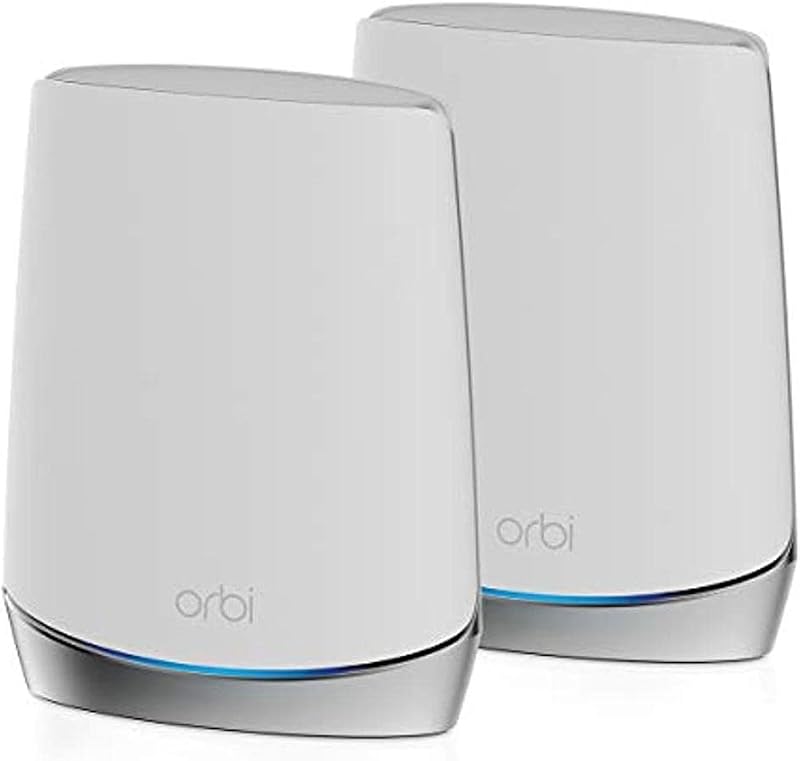
- Your property measures 5,000 square feet or less and requires two total mesh nodes for complete coverage.
- Your home network contains 40 or fewer connected devices running typical streaming and smart home tasks.
- Your current and near-future broadband package is capped at standard gigabit or 2Gbps speeds.
- You prefer standard low-voltage 5V hardware with proven WPA2-PSK security and an advanced internal firewall.
Choose the Netgear Orbi 970 If
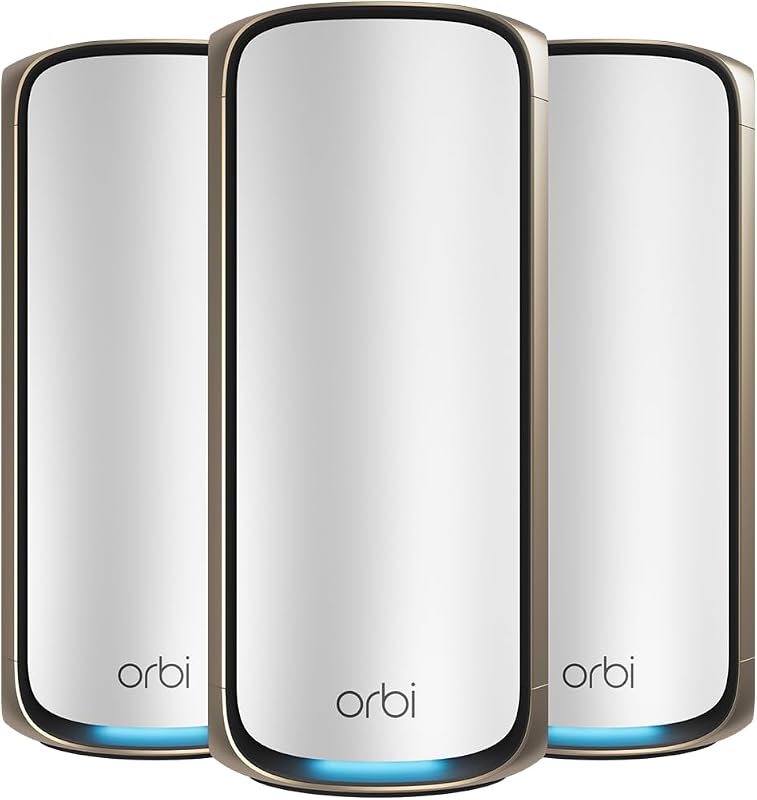
- You need to blank-out dead zones across a massive property up to 10,000 square feet from basement to backyard.
- You manage an enterprise-grade smart home ecosystem with up to 200 active wired and wireless clients.
- You have a multi-gigabit fiber connection and require a 10 Gig internet port alongside 10 Gbps wired LAN drops.
- You want cutting-edge WiFi 7 performance up to 27Gbps, quad-band backhaul routing, and modern WPA3 encryption.
Final Verdict
Evaluating the Netgear Orbi RBK752 vs 970 demonstrates how whole-home mesh technology has evolved across two distinct networking generations. The Orbi 970 is undeniably the high-performance powerhouse in this comparison, capturing clean victories in maximum throughput, physical port speed, total coverage, and device concurrency. With speeds reaching 27Gbps, a dedicated 10 Gbps WAN/LAN physical structure, and patented quad-band technology covering up to 10,000 square feet, the 970 is purpose-built for high-demand, device-heavy estates running multi-gigabit fiber internet.
However, the Netgear Orbi RBK752 remains the practical and sensible selection for standard single-family homes that do not require multi-gigabit infrastructure. If your network footprint fits within 5,000 square feet, your connected hardware sits well below 40 devices, and your ISP speeds hover around standard gigabit rates, the RBK752 delivers rock-solid WiFi 6 tri-band performance without overwhelming your infrastructure. Step up to the Orbi 970 when extreme bandwidth, multi-gigabit port routing, and sprawling estate coverage are genuine requirements.
FAQ
Does the Netgear Orbi 970 work with older WiFi devices?
Yes, the Netgear Orbi 970 uses WiFi 7 (802.11be) technology, which the manufacturer states is fully backward compatible with legacy WiFi standards, including WiFi 6, WiFi 5, and older hardware.
What is the difference between tri-band and quad-band on these Orbi systems?
The Orbi RBK752 features a tri-band design with three frequency bands, allocating one band primarily for communication between nodes. The Orbi 970 utilizes a quad-band architecture with an Enhanced Dedicated Backhaul, adding a fourth band to keep node-to-node communication isolated from heavy client device traffic.
Which system is better for competitive online gaming?
The Orbi 970 provides an edge for competitive gaming due to its 10 Gbps wired Ethernet connectivity, lower latency profile from WiFi 7 protocols, and quad-band architecture that prevents other household streaming from congesting the gaming connection.
How many devices can connect to each system simultaneously?
The Netgear Orbi RBK752 supports up to 40 connected devices across its router and single satellite, whereas the Netgear Orbi 970 supports up to 200 connected devices across its three-piece configuration.
How do the included NETGEAR Armor subscriptions differ?
The Netgear Orbi RBK752 comes with a 30-day trial of NETGEAR Armor internet security, while the Netgear Orbi 970 includes an extended 1-year subscription to the security and VPN protection service.
Can the Netgear Orbi RBK752 handle internet plans over 1Gbps?
The Netgear Orbi RBK752 listing states compatibility with internet service providers up to 2Gbps. However, because its physical LAN ports are rated for Gigabit Ethernet, no single wired connection from the router will exceed 1 Gbps.