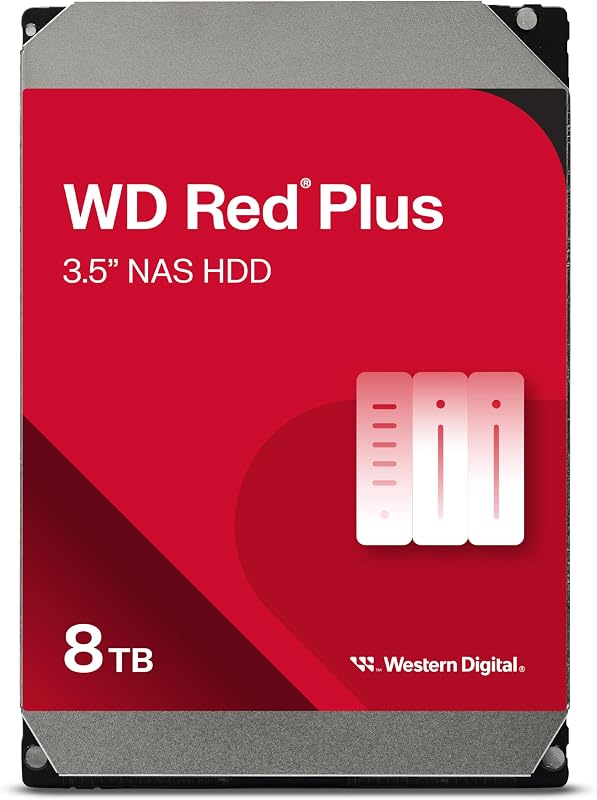
The choice between the Synology DS923+ and the UGREEN DXP2800 GT comes down to a fundamental architectural trade-off: four-bay multi-drive redundancy supported by an industry-standard software ecosystem versus two-bay high-throughput computing driven by native 10GbE networking and a four-core processor. While both devices serve as centralized storage hubs for intensive digital workflows, their physical configurations and component selections prioritize completely different operational demands.
Choose the Synology DS923+ if your priority is multi-drive parity protection across four bays, integrated business backup utilities, and a bundled storage setup featuring ECC memory out of the box. Choose the UGREEN DXP2800 GT if you need high-bandwidth local transfers for media editing, quad-core virtualization performance, and direct support for fast U.2 solid-state media.


Synology DS923+ vs UGREEN DXP2800 GT at a Glance
| Attribute | Synology DS923+ | UGREEN DXP2800 GT |
|---|---|---|
| Processor | AMD Ryzen R1600 (2-Core, 2.6GHz, up to 3.1GHz Turbo) | AMD Ryzen Embedded R2514 (4 Cores, 8 Threads, up to 3.70GHz) |
| System Memory | 32GB DDR4 ECC Memory | 8GB DDR4 (Expandable to 64GB; ECC upgrade supported) |
| Primary Drive Bays | 4 x 3.5-inch / 2.5-inch SATA Bays | 2 x SATA Bays (U.2 NVMe SSD compatible, up to 32TB each) |
| M.2 Solid-State Slots | 2 x M.2 2280 NVMe (1TB SSD included) | 2 x M.2 SSD Slots (up to 16TB supported) |
| Networking Ports | 2 x RJ-45 1GbE LAN (Link Aggregation / Failover) | 1 x 10GbE LAN Port |
| Auxiliary Ports | 1 x USB 3.2, 1 x eSATA | Not listed |
| File System & Security | Btrfs, EXT4, Advanced LUN iSCSI | TLS/SSL, RSA, AES, SHA-512 Encryption |
| Storage Included | 16TB (4 x 4TB HDDs) + 1TB NVMe SSD | Diskless (drives sold separately) |
| Operating System | Synology DSM Software | UGOS Pro |
| Best For | Multi-drive RAID redundancy and enterprise data management | High-speed media creation and direct-from-NAS network editing |
Network Speed and Data Transfer Bandwidth
Local network throughput establishes how effectively a network storage server functions when handling enormous datasets, direct media production, and high-concurrency client environments. In real-world network operations, standard gigabit connections transfer data at a theoretical ceiling of roughly 125 megabytes per second. While dual-port link aggregation can balance multi-client traffic, it cannot combine two individual gigabit links into a single accelerated pipe for a solitary client workstation without managed network configuration. Direct single-workstation transfers therefore remain bottlenecked at conventional gigabit speeds when connected to standard baseline interfaces.
Comparing the networking configurations in this head-to-head match shows a major divergence. The Synology unit is configured with two RJ-45 1GbE network ports supporting failover and link aggregation. In contrast, the DXP2800 GT includes native 10GbE networking directly on the backplate. For users evaluating a potential synology ds1522+ vs ugreen dxp2800 gt path, the UGREEN hardware eliminates the need for modular network expansion cards by delivering multi-gigabit throughput right out of the box. The UGREEN DXP2800 GT 10GbE speed can saturate network pipelines up to ten times faster than standard gigabit, making large file ingests and instant directory scrubbing remarkably fluid.
The DS923+ listing provides only dual 1GbE ports, which means users seeking faster transfers must navigate an optional Synology DS923+ 10GbE upgrade module to achieve comparable wired bandwidth. UGREEN provides 10GbE connectivity as a core factory feature. If your workflow involves transferring 4K or 8K raw video footage, moving uncompressed database archives, or streaming heavy files between workstations, the UGREEN model provides the necessary bandwidth without supplemental hardware installation.
Edge: UGREEN DXP2800 GT gives you native 10GbE network connectivity out of the box, whereas the DS923+ listing relies on standard dual 1GbE ports.
Processing Architecture, Multitasking, and Virtualization
Central processor capabilities govern how well an appliance executes concurrent Docker containers, background data compression, virtual machines, and computational storage workloads. A server operating with two processing cores can handle traditional file serving, basic backup automation, and media streaming. However, when multiple background services-such as cryptographic verification, index scanning, surveillance recording, and virtualized operating systems-run simultaneously, thread capacity and core count become critical factors in maintaining responsive system behavior.
The hardware specifications reveal distinct processor tiers across these two machines. The DS923+ runs on an AMD Ryzen R1600 dual-core processor operating at a 2.6GHz base clock with turbo boosts up to 3.1GHz. Meanwhile, the DXP2800 GT features an AMD Ryzen Embedded R2514 processor equipped with four physical cores, eight processing threads, and a clock speed capable of reaching 3.70GHz. When reading a thorough Synology DS923+ review alongside a modern UGREEN DXP2800 GT review, this processor differential shows up noticeably in container orchestration, virtual machine execution, and heavy concurrent multi-user transactions.
System memory configurations also present distinct trade-offs. The DS923+ listing includes 32GB of DDR4 ECC memory, delivering enterprise-level error-checking integrity right away, which protects against silent data corruption during long-term continuous operation. The DXP2800 GT includes 8GB of DDR4 non-ECC memory pre-installed, but it supports expansion up to 64GB and provides architectural compatibility for ECC memory upgrades if users swap in ECC modules later. While the DS923+ offers a generous pre-installed memory pool, the four-core, eight-thread processing architecture of the R2514 gives the DXP2800 GT significantly more computing headroom for virtual machines and intensive microservices.
Edge: UGREEN DXP2800 GT wins with its 4-core, 8-thread Ryzen Embedded R2514 processor and higher clock speeds compared to the 2-core processor on the DS923+.
Operating System Maturity, Ecosystem, and Data Integrity
The operating system defines how easily users can configure shared folders, automate data replication, defend against unauthorized access, and deploy home server applications. Synology DiskStation Manager (DSM) has built an exceptional reputation over decades of continuous enterprise and consumer development. DSM integrates robust storage management, flexible file synchronization, advanced LUN iSCSI services, and deep snapshot functionality powered by native EXT4 and Btrfs file system formats. The Btrfs file system on the DS923+ ensures self-healing metadata, point-in-time snapshots, and resilient protection against bit rot.
UGREEN powers its hardware with UGOS Pro, an operating system engineered to merge modern ease of use with professional system capabilities. In evaluating UGOS Pro vs Synology DSM, UGREEN equips its platform with multi-layer encryption-incorporating TLS/SSL, RSA, AES, and SHA-512 cryptographic technologies-alongside a centralized Security Manager to defend sensitive files against remote threats. UGOS Pro supports SAN Manager, virtual machines, and container deployment through Docker. For additional perspective on how these software ecosystems stack up in larger configurations, our analysis of the synology ds1522+ vs ugreen dxp4800 plus highlights similar architectural differences.
Despite UGREEN’s rapid software evolution, Synology DSM remains the gold standard for long-term operational stability and business-grade utility integration. Synology’s mature backup suites, comprehensive user privilege controls, and deeply integrated package center offer a level of reliability that third-party platforms take years to match. For administrators seeking an appliance that functions seamlessly in diverse network environments, DSM delivers proven software dependability.
Edge: Synology DS923+ dominates on operating system maturity, backed by the proven reliability and advanced data integrity of Synology DSM with Btrfs.
Storage Capacity, Drive Bay Flexibility, and Expansion
Physical drive bay capacity determines the RAID configurations you can implement and shapes the long-term scalability of your storage pool. A two-bay chassis fundamentally restricts users to either RAID 0 for raw performance with no redundancy, or RAID 1 for simple disk mirroring. Conversely, a four-bay chassis opens up RAID 5 and RAID 6 configurations, allowing storage pools to withstand single-disk or dual-disk hardware failures while maximizing usable storage capacity across multiple physical spindles.
The DS923+ is a four-bay tower server that arrives fully equipped in this listing package, featuring 16TB of total mechanical capacity across four 4TB SATA hard drives, alongside a 1TB solid-state cache setup comprised of two 500GB M.2 2280 NVMe SSDs. This four-bay layout allows immediate deployment of balanced multi-drive redundancy. It also features a dedicated eSATA expansion port, enabling physical chassis expansion when baseline capacity is exhausted. Similar scalability questions often arise when comparing the synology ds923+ vs ds1522+ for multi-bay storage arrays.
The DXP2800 GT approaches storage expansion differently. As a two-bay tabletop unit shipped diskless, it supports high-density SATA drives up to 32TB per bay. Remarkably, its two primary drive bays are also engineered to be compatible with ultra-fast enterprise U.2 NVMe solid-state drives. In addition to its two primary bays, the DXP2800 GT incorporates two M.2 solid-state slots supporting up to 16TB of dedicated solid-state capacity, pushing total system capability to 80TB. While the DXP2800 GT supports blazing-fast U.2 solid-state drives, the DS923+ provides true four-bay mechanical redundancy and eSATA scalability for safer data pooling.
Edge: Synology DS923+ takes the advantage here thanks to four drive bays that enable resilient RAID 5/6 configurations and an external eSATA expansion port.
Media Streaming, Docker Containers, and Application Hosting
Running network servers as personal media platforms and application hosts requires balanced synergy between hardware compute power, container support, and storage retrieval speeds. Home lab enthusiasts frequently look for reliable platforms capable of organizing media libraries, managing download clients, hosting private communication channels, and running centralized smart home nodes without lagging under continuous client requests.
When assessing the DS923+ vs DXP2800 GT for Plex, Jellyfin, and Emby, the hardware attributes lead to distinct experiences. The DXP2800 GT provides native application support for Plex, Emby, and Jellyfin within UGOS Pro, alongside full Docker support. The AMD Ryzen Embedded R2514 quad-core processor provides eight threads of computational power, making it capable of handling concurrent containerized background services without choking system responsiveness. The listing highlights its role as a smart home data hub, handling home automation services alongside media distribution.
The DS923+ also handles containerized applications and media serving through DSM’s integrated container tools and third-party packages, as explored in comparisons like the synology ds923+ vs qnap ts-464. However, its dual-core Ryzen R1600 processor has half the processing threads of the R2514, which limits CPU headroom when multiple microservices demand processing power simultaneously. For heavy container stacks, concurrent smart home tasks, and demanding media management, the quad-core architecture of the UGREEN model provides superior processing capacity.
Edge: UGREEN DXP2800 GT wins due to its 4-core, 8-thread processor that provides superior headroom for Docker containers, microservices, and media server apps.
Video Editing and Direct-from-NAS Workflows
Direct-from-NAS editing represents one of the most demanding network workloads. Video editors, colorists, and motion designers require immediate file access, smooth timeline playback, and zero frame-dropping when scrubbing through uncompressed or multi-stream video formats. Achieving this requires both high sustained storage throughput and a network interface wide enough to carry hundreds of megabytes per second without latency spikes.
When asking whether to choose the Synology DS923+ or UGREEN DXP2800 GT for video editing, the hardware data provides a clear distinction. The DXP2800 GT highlights direct-from-NAS editing as a marquee feature, made possible by its built-in 10GbE networking and support for U.2 NVMe SSDs alongside dual M.2 solid-state expansion slots. Because 10GbE delivers real-world sustained throughput exceeding 1,000 megabytes per second when paired with fast solid-state storage, content creators can work directly from the NAS timeline without copying project assets to local scratch disks.
The DS923+ listing comes equipped with two 1GbE network ports. Even with dual 500GB NVMe SSDs included, data leaving the device over a single client network link is restricted to standard gigabit rates of roughly 112 to 115 megabytes per second. This speed is adequate for archiving finished projects or editing basic compressed video streams, but it quickly bottlenecks high-bitrate multi-cam editing setups. Readers exploring modern options like the synology ds423+ vs ds923+ will recognize that without installing a separate 10GbE expansion card, the DS923+ cannot match the native editing pipeline throughput of the DXP2800 GT.
Edge: UGREEN DXP2800 GT delivers a decisive win with factory 10GbE networking and U.2 NVMe SSD drive support designed specifically for direct-from-storage video editing.
Pros and Cons
Synology DS923+
Pros
- Mature Synology DSM operating system
- Four drive bays for higher capacity
- Includes 32GB DDR4 ECC memory
- Bundled with 16TB storage and NVMe SSD
Cons
- Limited to 1GbE network speeds
- Slower dual-core Ryzen R1600 processor
- Drives and memory require manual installation
View Synology DS923+ on Amazon
UGREEN DXP2800 GT
Pros
- Built-in 10GbE network connectivity
- Faster quad-core AMD Ryzen R2514 processor
- Dual bays support U.2 NVMe SSDs
- Memory expandable up to 64GB
Cons
- Only two main drive bays
- No storage drives included
- Pre-installed 8GB RAM lacks ECC
View UGREEN DXP2800 GT on Amazon
Who Should Buy Each One
Choose the Synology DS923+ If

- You require four mechanical drive bays to configure resilient RAID 5 or RAID 6 storage pools with multi-drive redundancy.
- You want a complete out-of-the-box storage deployment that includes 16TB of hard drives, 1TB of NVMe caching, and 32GB of pre-installed ECC memory.
- Your storage environment demands the proven reliability, deep business backup software, and enterprise Btrfs integrity of Synology DSM.
- You plan to expand your physical array over time using external expansion enclosures through a dedicated eSATA port.
Choose the UGREEN DXP2800 GT If
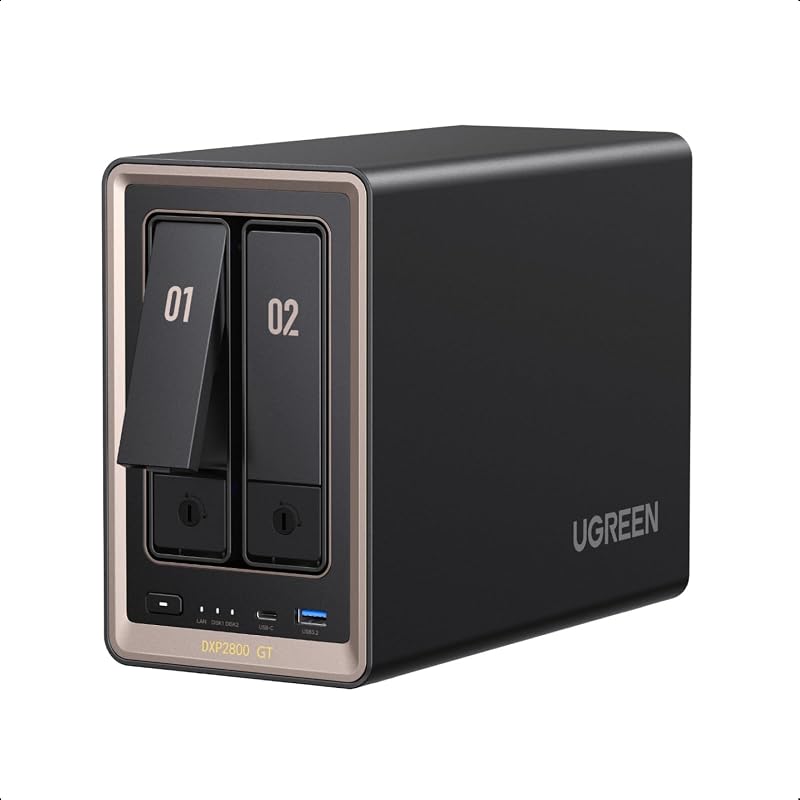
- You need native 10GbE network speeds out of the box to edit video projects directly from the NAS without network latency.
- You run multiple Docker containers, virtual machines, and background services that benefit from a 4-core, 8-thread Ryzen Embedded processor.
- You plan to use modern high-speed storage technologies such as U.2 NVMe solid-state drives in standard drive bays.
- You want a compact, two-bay tabletop appliance with up to 80TB total storage capacity across SATA, U.2, and M.2 storage options.
Final Verdict
For users who value data protection, storage longevity, and an established software foundation, the Synology DS923+ remains the superior choice. Its four-bay architecture enables balanced RAID 5 storage configurations that protect your data against unexpected drive loss, which a two-bay enclosure cannot deliver without sacrificing half its raw capacity to mirroring. Backed by Synology DSM, native Btrfs self-healing file systems, and a bundled configuration featuring 32GB of ECC memory alongside 16TB of storage, the DS923+ provides unmatched peace of mind for business data, surveillance deployments, and multi-user backup networks.
However, when raw processing throughput, direct media production, and high-speed network transfers take center stage, the UGREEN DXP2800 GT is the definitive winner. By combining native 10GbE connectivity with an AMD Ryzen Embedded R2514 quad-core processor and support for high-performance U.2 NVMe SSDs, UGREEN has delivered a machine tailor-made for freelancers, video editors, and power users. If your digital pipeline centers on high-speed creative workflows and direct network timeline scrubbing, the DXP2800 GT provides hardware capabilities that the standard DS923+ cannot match without additional hardware upgrades.
FAQ
Which NAS is better: Synology DS923+ or UGREEN DXP2800 GT for video editing?
The UGREEN DXP2800 GT is better suited for video editing workflows due to its native 10GbE network port and support for U.2 NVMe and M.2 SSD storage. This allows direct-from-NAS editing with throughput exceeding 1,000 MB/s. The Synology DS923+ listing features standard 1GbE ports, which creates a significant network bottleneck during live video timeline playback unless you purchase a separate 10GbE network upgrade card.
Can the Synology DS923+ match the UGREEN DXP2800 GT 10GbE speed?
Out of the box, the Synology DS923+ cannot match the UGREEN DXP2800 GT 10GbE speed because the Synology unit comes equipped with two standard 1GbE network ports. While the DS923+ supports link aggregation across its dual gigabit ports, a single client transfer will remain limited to gigabit speeds unless a proprietary 10GbE upgrade module is purchased and installed into the chassis expansion slot.
How do UGOS Pro and Synology DSM compare for home server apps?
Synology DSM is an established operating system known for its reliable enterprise backup packages, advanced Btrfs file system integrity, and extensive application ecosystem. UGOS Pro is a newer operating system that offers an intuitive interface, Docker container management, virtual machines, SAN Manager, and local encryption tools like TLS/SSL and AES. While DSM provides greater overall maturity and software depth, UGOS Pro delivers a modern, capable interface with native support for services like Plex, Emby, and Jellyfin.
Does the UGREEN DXP2800 GT include storage drives and memory?
The UGREEN DXP2800 GT is sold as a diskless system, meaning hard drives and SSDs are not included and must be purchased separately. It comes with 8GB of non-ECC DDR4 memory pre-installed, with expansion supported up to 64GB as well as support for ECC RAM upgrades. In contrast, the Synology DS923+ configuration analyzed here includes 16TB of HDD storage (4 x 4TB), a 1TB NVMe SSD cache, and 32GB of DDR4 ECC memory included separately in the box for user installation.
Which NAS is better for running Docker and Plex?
The UGREEN DXP2800 GT holds a distinct hardware advantage for Docker and Plex hosting because it features an AMD Ryzen Embedded R2514 processor with 4 cores and 8 threads reaching up to 3.70GHz. The Synology DS923+ uses an AMD Ryzen R1600 processor with 2 cores and 4 threads. The additional cores and threads on the UGREEN model provide superior multitasking performance when running concurrent containerized applications and streaming media libraries.
Is UGREEN DXP2800 GT worth it for buyers seeking data redundancy?
The UGREEN DXP2800 GT offers substantial processing power and speed, but its two-bay enclosure limits physical drive redundancy to RAID 1 mirroring or RAID 0 striping. If your primary goal is maximizing storage capacity while maintaining parity protection against single or multiple drive failures, a four-bay NAS like the Synology DS923+ is generally worth it over a two-bay model because four bays support resilient RAID 5 and RAID 6 configurations.