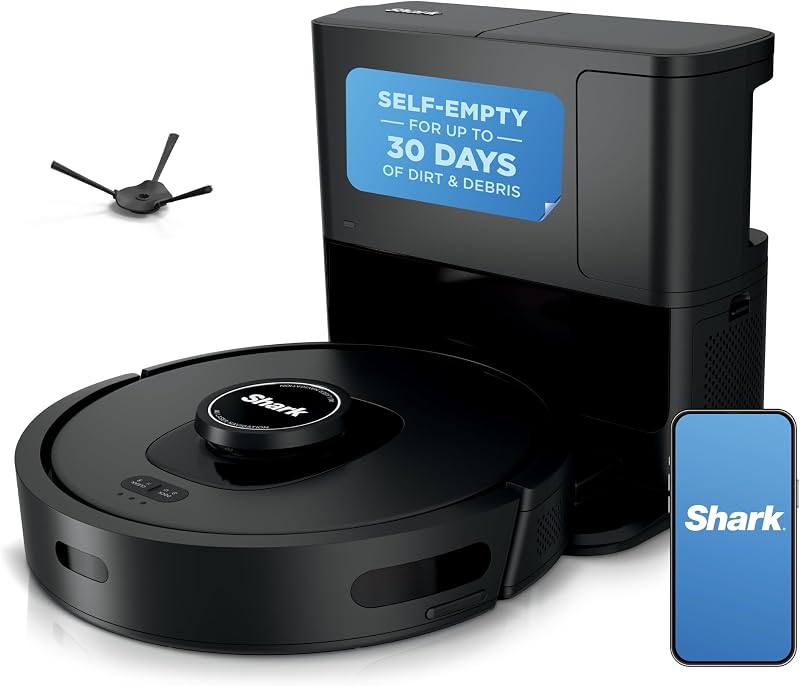
Deciding between these two automated cleaning systems comes down almost entirely to the debris holding volume of their self-emptying docks. The Shark AI Ultra utilizes a streamlined, bagless docking station built to store 30 days of collected dust and hair, while the Shark AI Robot XL incorporates an enlarged base engineered to store up to 60 days of dirt before requiring manual evacuation.
Homeowners seeking a space-saving footprint in average-sized spaces with light to moderate shedding should choose the Shark AI Ultra. Buyers dealing with multi-pet shedding across high-square-footage layouts should choose the Shark AI Robot XL for maximum hands-off autonomy.


Shark AI Ultra vs Shark AI Robot XL at a Glance
| Feature | Shark AI Ultra | Shark AI Robot XL |
|---|---|---|
| Model Number | AV2501S | AV2501AE |
| Self-Empty Base Capacity | Up to 30 Days | Up to 60 Days (2 Months) |
| Robot Dust Cup Capacity | 0.09 Liters | Not listed |
| Navigation Technology | 360° LiDAR Vision with Matrix Clean | 360° LiDAR Vision with Matrix Clean |
| Dock Filtration | True HEPA (Traps 99.97% down to .3 microns) | True HEPA (Traps 99.97% down to .3 microns) |
| Robot Filter Type | Foam | HEPA |
| Battery Runtime | Up to 120 Minutes | Up to 120 Minutes |
| Brushroll System | Self-Cleaning with Anti-Hair Wrap | Self-Cleaning with Anti-Hair Wrap |
| Cleaning Path Width | Not listed | 5.67 Inches |
| Exterior Color Finish | Dark Grey | Black with Bronze Finish |
| Best For | Standard Homes and Moderate Shedding | Multi-Pet Homes and High-Debris Spaces |
Base Capacity and Emptying Frequency
The primary mechanical division in this Shark AV2501S vs AV2501AE comparison centers on how frequently you must interact with the bagless docking station. In any automated vacuum system, self-empty functionality transfers debris from the small onboard canister into an external reservoir after every run. A larger reservoir prolongs the hands-off maintenance window, meaning the machine can clean on a rigid automated schedule for weeks without intervention. When comparing the Shark AI Ultra base capacity against the Shark AI Robot XL self empty base, this difference dictates how many weeks of autonomy you experience during peak shedding cycles.
The Shark AI Ultra features a base rated for up to 30 days of standard household dirt and hair. Inside the unit, an internal robot dust cup of 0.09 liters deposits its payload into the vertical dock cylinder after returning from a run. In contrast, the Shark AI Robot XL self-emptying base is physically expanded to hold a full 60 days, or two months, of compressed household debris. Both docking stations operate completely bagless, relying on a transparent canister with an easy-release bottom latch that dumps straight into your trash bin without ongoing recurring costs for disposable paper inserts.
For high-shedding environments or larger floor plans, the double-sized reservoir on the XL model provides crucial headroom. Smaller bases can pack tightly and lose suction if pet hair accumulates too quickly, demanding manual clearance ahead of schedule. While the 30-day base on the Ultra remains easy to manage for typical dust and light debris, the 60-day reservoir on the XL provides the necessary buffer for busy owners who want true monthly detachment. When evaluating older generations in guides like our Shark AI Ultra vs Shark IQ Robot breakdown, having this upgraded self-emptying design is a major leap forward.
Edge: Shark AI Robot XL because its dock holds twice as much debris, cutting base emptying chores down to once every two months.
Filtration and Allergen Containment
Vacuum exhaust cleanliness matters just as much as floor agitation, especially for households managing asthma, seasonal allergies, or pet dander. When a robot deposits dirt into an external base, forceful suction pulls fine particulate through internal chambers, risking dust leakage back into the living area if the seal is inadequate. Both of these automated vacuums feature True HEPA filtration in their self-empty stations, engineered to capture and trap 99.97 percent of dust and airborne allergens down to 0.3 microns.
Looking at the internal robot hardware, specifications reveal a subtle distinction in the onboard airflow design. The listing for the Shark AI Ultra specifies a washable foam filter inside the mobile robotic chassis to protect the motor assembly from loose dirt. Meanwhile, the Shark AI Robot XL listing documents a HEPA filter directly inside the robot itself alongside the True HEPA dock filtration. Both configurations prevent fine dander, pollen, and microscopic particles from escaping back into the room during both floor cleaning and base evacuation cycles.
In actual operation, having a sealed True HEPA system inside the bagless base eliminates the classic cloud of dust that often escapes when emptying bagless uprights. Because the dock holds debris for weeks behind sealed gaskets, trapped allergens remain safely locked away until you release the bin directly over a trash can. For pet owners concerned about airborne irritants, both units deliver dependable air purification, though the XL listing offers the added reassurance of integrated HEPA filtering across the robot hardware.
Edge: Tie. Both cleaning bases utilize sealed True HEPA filtration capturing 99.97 percent of microscopic debris down to 0.3 microns.
Pet Hair Cleanup and Brushroll Performance
Managing shedding pets requires powerful suction paired with an agitator that resists long strands binding around the bearings. In a dedicated Shark AI Ultra review or Shark AI Robot XL review, the mechanical brushroll determines how much time owners spend cutting hair off the roller. Both platforms use Shark’s specialized self-cleaning brushroll engineered with anti-hair wrap technology. As the vacuum sweeps over carpets and hard floors, integrated combs clear pet hair and human hair directly into the suction intake, keeping the roller clean and free-spinning.
When asking whether to pick the Shark AI Ultra or AI Robot XL for pets, their floor-level pickup performance is essentially identical. Both models combine powerful suction across all floor types with Matrix Clean Navigation. Instead of rolling over an area once in straight lines, Matrix Clean commands the robot to traverse dirty zones in a tight cross-hatch grid pattern. This ensures that stubborn fur embedded within carpet fibers receives multiple directional passes, dislodging deep dander that standard single-pass cleaning robots miss.
The distinction for pet parents lies entirely in what happens after the hair is lifted. Heavy shedding can quickly overwhelm a 0.09-liter onboard dust bin and fill a standard base reservoir long before a month passes. As examined in our comparison of the Shark Navigator RV2110 vs Shark AI Robot XL, large-capacity self-emptying docks prevent hair clogs from stalling automated cleaning routines. While both machines tackle pet hair off floors with equal force, the XL base absorbs heavy seasonal shedding without demanding constant bin maintenance.
Edge: Tie. Both vacuum models share identical powerful suction, Matrix Clean grid coverage, and self-cleaning anti-hair wrap brushrolls.
Navigation, Mapping, and Obstacle Avoidance
Systematic floor coverage separates modern robotic vacuums from primitive bump-and-turn units. Both the Shark AI Ultra and Shark AI Robot XL rely on a top-mounted 360-degree LiDAR vision turret. This laser sensor spins continuously to measure walls, doorways, and furniture legs in real time. Because LiDAR generates its own light beams rather than depending on ambient room lighting or optical cameras, both robots map and navigate accurately in broad daylight or pitch-black rooms.
The 360-degree LiDAR system feeds directly into Shark’s precision home mapping software. During initial setup, each robot quickly generates an interactive map of your living space within the smartphone app. From there, users can assign room names, establish targeted high-traffic zones, and identify no-go boundaries. When navigating everyday clutter, the LiDAR sensor detects obstacles in the robot’s forward path, allowing it to steer methodically around table legs, dropped clothing, and unexpected household items without aggressive collisions.
Both devices run the same proprietary Matrix Clean navigation logic. When deployed to a specific messy zone or scheduled for whole-home duty, the robot sweeps back and forth before shifting 90 degrees to repeat the pattern in a perpendicular grid. This dual-pass approach provides deeper carpet agitation than ordinary linear paths. When considering alternatives like the Shark AI Ultra vs Matrix Plus, the core LiDAR mapping engine on these two models represents Shark’s most capable navigation standard.
Edge: Tie. Both units utilize identical 360-degree LiDAR laser guidance, dark-room navigation, and Matrix Clean grid algorithms.
Battery Runtime and Dock Space Requirements
Automated vacuuming efficiency depends heavily on the relationship between battery life and floor plan scale. Both the Ultra and the XL carry a lithium-ion battery pack capable of delivering up to 120 minutes of continuous runtime on a single charge. Furthermore, both machines include a Recharge and Resume feature. If a robot depletes its battery halfway through a spacious layout, it automatically navigates back to the dock, recharges, and returns to the exact coordinates where cleaning stopped to finish the job.
While their runtime performance matches, their physical dock footprint introduces a practical living trade-off. The Shark AI Ultra uses a narrower base designed to sit neatly against baseboards in tight hallways, bedrooms, or compact apartments. Its 30-day capacity requires less vertical and horizontal volume, making it easy to tuck under side tables or between furniture without drawing visual attention in modest floor plans.
Conversely, the 60-day dock on the Shark AI Robot XL requires greater clearance due to its enlarged holding canister. For homeowners asking is Shark AI Robot XL worth it, the answer depends on whether your living area comfortably accommodates the larger station. The XL unit comes with an attractive black shell and bronze finish, while the Ultra features a clean dark grey appearance. If square footage is at an absolute premium, the Ultra gives you the full 120-minute battery capability without claiming valuable floor space, a trade-off explored across other models like the Shark Matrix Plus vs IQ Robot.
Edge: Shark AI Ultra because its more compact dock achieves the same 120-minute runtime and Recharge and Resume function while taking up less floor space.
Smart Connectivity and Controls
Operating either vacuum requires minimal effort thanks to flexible smart home integration. Both machines feature onboard Wi-Fi hardware that pairs with the SharkClean smartphone app. Through the mobile interface, you can set daily or weekly cleaning schedules, monitor cleaning history, initiate spot cleans, or select specific rooms for immediate vacuuming. The app also lets you toggle Matrix Clean mode when you want thorough grid cleaning rather than a single rapid pass.
Hands-free voice operation is fully supported across both systems. The Shark AI Ultra connects with Amazon Alexa and Google Assistant devices, letting you start, pause, or send the robot back to its base with voice prompts. The Shark AI Robot XL provides the exact same smart home capabilities, listing compatibility with Amazon Echo and Google Home setups. Whether giving voice commands in the kitchen or triggering a cleaning cycle while away at work, the software capabilities are identical across both models.
Physical controls on the robot bodies also match. Single-speed operation keeps things simple: press the clean button on top of the robot to launch a run, or command dock return directly from the chassis. For readers comparing different model families like the Shark Navigator RV2110 vs Shark AI Ultra, this modern app and voice framework represents the current standard for intuitive robotic vacuum operation.
Edge: Tie. Both vacuums provide the same companion smartphone app, scheduling options, and hands-free voice control via Amazon Alexa and Google Assistant.
Pros and Cons
Shark AI Ultra
Pros
- Up to 30 days of hands-off debris storage
- True HEPA sealed base filtration
- 360-degree LiDAR precision navigation
- Matrix Clean dual-pass grid coverage
- Compact dock footprint
Cons
- Smaller holding capacity than XL dock
- Requires more frequent dock emptying
Shark AI Robot XL

Pros
- Up to 60 days of debris storage
- Bagless True HEPA self-empty base
- Self-cleaning anti-hair wrap brushroll
- 120-minute battery with Recharge and Resume
- Ideal for heavy-shedding pet homes
Cons
- Larger base footprint requires more floor space
- Canister takes longer to visually inspect
View Shark AI Robot XL on Amazon
Who Should Buy Each One
Choose the Shark AI Ultra If
- You live in an apartment, condo, or single-story home where floor space for a large docking station is limited.
- Your household has standard cleaning demands with one pet or light shedding that will not overwhelm a 30-day base.
- You prefer a discreet dark grey finish that blends into modern home decor without drawing focus.
- You want 360-degree LiDAR navigation and Matrix Clean performance without housing an oversized 60-day cylinder.
Choose the Shark AI Robot XL If
- You have multiple shedding dogs or cats that generate high volumes of pet hair daily.
- You want extended hands-off autonomy and only want to empty the self-empty base once every two months.
- You manage a large, multi-room home where high debris volume would fill a 30-day base too quickly.
- You prefer a black chassis accented with a bronze finish to complement your interior styling.
Final Verdict
When looking at the Shark AI Ultra vs XL lineup, both robotic vacuums deliver high-end cleaning performance. Each robot utilizes 360-degree LiDAR navigation to build precise maps, cleans day or night, and maneuvers methodically around household furniture. Both feature Shark’s Matrix Clean technology for dual-pass grid cleaning, anti-hair wrap brushrolls for tangle-free hair pickup, 120 minutes of battery life, and True HEPA bagless docks that seal in 99.97 percent of dust down to 0.3 microns. Because the cleaning head, suction motor, and app features match, floor pickup results are virtually indistinguishable.
The deciding factor comes down strictly to dock capacity and lifestyle convenience. The Shark AI Robot XL earns the overall nod for high-traffic environments and multi-pet households because its 60-day base holds twice the debris, cutting dock maintenance down to six times a year. However, if your home has average cleaning requirements, modest shedding, or compact floor space where a bulky dock would get in the way, the Shark AI Ultra provides the identical cleaning power in a smaller, space-efficient package.
FAQ
What is the main difference between the Shark AV2501S and AV2501AE?
The primary difference is the debris holding capacity of the bagless self-emptying base. The AV2501S (Shark AI Ultra) holds up to 30 days of dust and dirt, while the AV2501AE (Shark AI Robot XL) features an expanded dock that stores up to 60 days of debris. The AV2501S features a dark grey finish, while the AV2501AE comes in black with bronze accents.
Do either of these Shark robots require buying replacement bags?
No, neither robot requires disposable dust bags. Both the 30-day base on the AI Ultra and the 60-day base on the AI Robot XL use bagless storage bins. When the bin is full, you simply hold the canister over a trash can and press the quick-release latch to dump the collected debris.
Can the Shark AI Ultra and AI Robot XL clean in the dark?
Yes, both models can clean in complete darkness. Because they use 360-degree LiDAR laser technology rather than optical cameras, they do not require room lighting to map boundaries, locate obstacles, or navigate between rooms.
How does Matrix Clean Navigation work on these vacuums?
Matrix Clean Navigation commands the robot to vacuum in a multi-directional grid pattern instead of a single straight pass. The vacuum cleans over dirt and debris in one direction, then shifts 90 degrees to clean across the same area perpendicularly, providing deeper agitation on carpets and hard floors.
What happens if the robot runs out of battery before finishing my home?
Both the Shark AI Ultra and Shark AI Robot XL support Recharge and Resume. If the battery runs low during a cleaning run, the robot automatically returns to its self-empty base, recharges its lithium-ion battery, and resumes cleaning at the exact spot where it left off.
Are the brushrolls on these models resistant to hair wrap?
Yes, both models are equipped with Shark’s self-cleaning brushroll. The roller features an anti-hair wrap design with integrated combs that actively clear long human hair and pet fur from the bristles during operation, preventing tight wraps around the core.