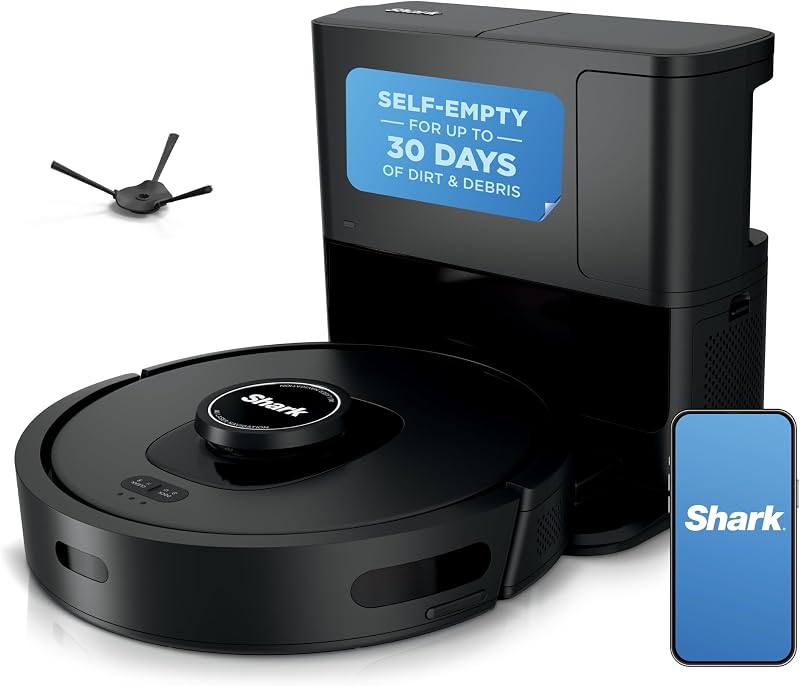
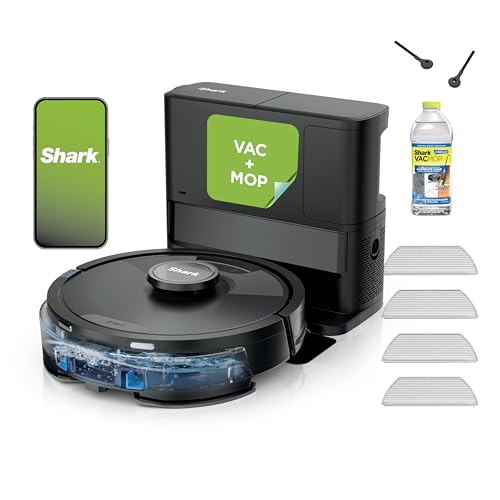
The single deciding factor when choosing between the Shark AI Robot XL and the Shark Matrix Plus is whether you want an automated wet sonic mop alongside your vacuum or a high-capacity self-empty dock that lets you ignore dry debris for twice as long. While both robotic platforms rely on Shark’s precision 360-degree LiDAR navigation and grid-based Matrix Clean passes, the Matrix Plus serves as a hybrid floor scrubber with edge-clearing air blasts, whereas the AI Robot XL focuses entirely on high-capacity dry extraction with minimal human intervention.
Choose the Shark AI Robot XL if you live in a mostly carpeted house or have heavy-shedding pets and prefer leaving dust containment untouched for up to two months. Choose the Shark Matrix Plus if you have hard flooring, high-traffic kitchens, or sealed surfaces that require automated mopping alongside daily vacuuming.

Shark AI Robot XL vs Shark Matrix Plus at a Glance
| Feature | Shark AI Robot XL | Shark Matrix Plus |
|---|---|---|
| Cleaning Type | Dry vacuuming only | 2-in-1 Vacuum and Sonic Mopping |
| Self-Empty Dock Capacity | Up to 60 days (2 months) | Up to 30 days |
| Dock Design | Bagless with true HEPA filtration | Bagless with true HEPA filtration |
| Navigation & Mapping | 360° LiDAR vision, Matrix Clean | 360° LiDAR vision, Matrix Clean |
| Mopping Technology | None | Sonic Mopping (100 scrubs/min), Matrix Mop |
| Edge Technology | 2 side brushes | CleanEdge Detect (air blasts + corner recognition) |
| Battery Runtime | Up to 120 minutes | Up to 110 minutes |
| Control Methods | SharkClean App, Amazon Alexa, Google Assistant | SharkClean App control |
| Included Accessories | XL HEPA base, 2 side brushes | HEPA base, 2 side brushes, 4 washable pads, solution |
| Best For | Carpeted homes and low-maintenance dry debris pickup | Mixed hard floors requiring vacuuming and wet scrubbing |
Mopping Performance and Multi-Surface Versatility
The operational gap between these two models appears most sharply on bare floors. The Shark Matrix Plus is engineered specifically as a wet-and-dry hybrid unit. During operation, its sonic mopping module oscillates at 100 scrubs per minute to agitate and break down stubborn, dried spills rather than merely dragging a damp pad across tile or sealed hardwood. Through the SharkClean mobile application, you can activate the dedicated Matrix Mop routine, which directs the machine to scrub over targeted floor zones in a multi-pass grid to deliver 50 percent better stain cleaning compared to single-pass mopping. To support continuous maintenance, Shark bundles four reusable, washable antimicrobial pads and a bottle of specialized cleaning solution directly in the box.
By contrast, the Shark AI Robot XL features no onboard water tank, no fluid pump, and no mopping bracket. It functions exclusively as a dry floor vacuum. If your home has extensive sealed tile, luxury vinyl plank, or hardwood, relying on this model means you will still need a manual mop or a separate hard floor cleaning appliance to address sticky messes, dried spills, and muddy paw prints. When evaluating the shark ai ultra vs matrix plus product family, the presence of sonic scrubbing changes the daily utility on hard surfaces completely.
For homes composed almost entirely of wall-to-wall carpets or large area rugs, the Matrix Plus mopping module offers no tangible benefit during carpet runs. The AI Robot XL directs all of its hardware toward dry extraction, avoiding the extra task of refilling liquid tanks, laundering cleaning pads, and segregating wet and dry cleaning cycles. However, for active households with kids, pets, and broad expanses of hard surfaces, having wet agitation integrated directly into the vacuum cycle saves significant manual labor.
Edge: Shark Matrix Plus, as its sonic mopping system scrubs hard floors 100 times per minute and provides targeted multi-directional stain removal.
Self-Empty Dock Capacity and Maintenance Frequency
Both robots include bagless, self-emptying charging stations that use cyclonic evacuation to pull accumulated dirt out of the robot’s dustbin when it docks. The pivotal distinction lies in holding capacity. Comparing the Shark robot vacuum 60 day vs 30 day capacity reveals a fundamental difference in how often you must physically interact with the base. The Shark AI Robot XL features an extra-large dock designed to store up to 60 days-roughly two full months-of typical dry household dust, dander, and hair before requiring you to carry the canister to the trash.
The Shark Matrix Plus features a more compact self-empty base rated to hold up to 30 days of dry sweepings. While cutting manual bin-emptying down to once a month is a massive improvement over traditional non-emptying robots, it still requires double the attention of the 60-day XL canister. If your home produces significant volumes of pet fur or you leave your property for extended vacations, the 30-day reservoir on the Matrix Plus fills far more rapidly. Homeowners exploring options like the shark matrix plus vs iq robot often note that compact dock sizes demand more frequent monitoring to prevent overfilling.
Importantly, both docks maintain Shark’s bagless philosophy. You never have to purchase or replace disposable paper dust bags, which keeps ownership overhead low across both units. Both docks also incorporate true HEPA filtration that traps 99.97 percent of microscopic particles down to 0.3 microns, preventing evacuated debris from escaping into the surrounding room air during the transfer cycle. Still, for purely hands-off dry debris management, the larger canister on the AI Robot XL is noticeably less demanding.
Edge: Shark AI Robot XL, because its 60-day base capacity provides double the dry debris containment volume of the Matrix Plus.
Edge Cleaning and Debris Pickup Dynamics
Debris along baseboards, cabinetry, and room corners often escapes robot vacuums that depend entirely on spinning perimeter brushes. The Shark Matrix Plus addresses this limitation by incorporating CleanEdge Detect technology. This system uses optical corner recognition paired with integrated blasts of air to physically force dirt, dust bunnies, and pet hair out of corners and away from wall margins, channeling the material directly into the robot’s primary cleaning path. Shark’s listing specifications confirm that CleanEdge delivers 50 percent better edge cleaning performance compared to the RV2610WD platform with the feature disabled.
The Shark AI Robot XL takes a more conventional mechanical approach to perimeter cleanup. It relies on dual spinning side brushes to sweep edge debris inward toward its 5.67-inch primary cleaning path. While these dual brushes rotate steadily to pull dust away from straight walls, they lack the active air jets found on the Matrix Plus. Over deep crevices along baseboards or inside sharp 90-degree room corners, mechanical sweepers can occasionally flick heavier particles away or miss light pet dander nestled tight against trim.
On open flooring, both machines use Shark’s Matrix Clean Navigation to sweep over floor surfaces in a dense, intersecting matrix pattern rather than a single back-and-forth pass. On the Matrix Plus, this grid pass delivers 30 percent better carpet cleaning performance against single-pass architectures when tested on level loop sand. The AI Robot XL also executes precise matrix grid passes, but without the supplemental CleanEdge air blast, edge pickup remains standard rather than boosted. Buyers researching the shark navigator rv2110 vs shark matrix plus will find that CleanEdge remains one of the most functional hardware evolutions in Shark’s lineup.
Edge: Shark Matrix Plus, thanks to its specialized CleanEdge Detect air blasts and corner-recognition hardware.
Navigation, Mapping, and Grid Cleaning Coverage
Accurate home navigation prevents a robot from becoming stranded on furniture legs or skipping entire sections of a floor plan. Both the Shark AI Robot XL and the Shark Matrix Plus utilize top-mounted 360-degree LiDAR vision domes. Unlike camera-based optical mapping systems that struggle or fail in dim lighting, LiDAR actively scans room boundaries with eye-safe light beams. This allows both units to construct detailed, proportional floor plans rapidly and navigate reliably in daylight or complete darkness.
Both vacuums also employ Shark’s Matrix Clean technology. Rather than making a single pass over high-traffic rugs or dining areas, the robots clean in a precise cross-hatch matrix grid. By traveling over the same area from perpendicular angles, the vacuums pull out stubborn debris trapped within carpet fibers that single-pass passes frequently leave behind. The LiDAR sensor array continuously detects unexpected household obstacles, allowing both machines to adapt to displaced chairs, dropped shoes, and changing room layouts without colliding aggressively into delicate baseboards or furniture.
Because their core navigation hardware, mapping speeds, and path-planning algorithms are virtually identical, there is no discernible difference in how accurately these two models map your home or avoid everyday obstacles. In any head-to-head Shark Matrix Plus vs Shark AI Robot XL mapping assessment, their shared 360-degree LiDAR arrays ensure equally reliable whole-home coverage and methodical room-to-room transit.
Edge: Tie, as both models use identical 360-degree LiDAR mapping arrays and Matrix Clean grid-coverage algorithms.
Battery Runtime and Recharge Management
Operating longevity determines how much square footage a robot can process before needing to dock. According to official manufacturer specifications, the Shark AI Robot XL features a lithium-ion battery delivering up to 120 minutes of continuous cleaning per charge. The Shark Matrix Plus provides up to 110 minutes of runtime on a full charge. That 10-minute margin gives the AI Robot XL a slight advantage when vacuuming larger, sprawling single-level floor plans in a single operational session.
To prevent incomplete cleaning jobs in expansive spaces, both robots feature Shark’s Recharge and Resume capability. When battery power drops below the threshold needed to complete an active floor map, the robot automatically navigates back to the self-empty base, docks, and recharges its battery. Once sufficient power is restored, the robot leaves the dock, returns to the exact coordinate where cleaning ceased, and resumes the cleaning cycle until the full map is executed.
While the AI Robot XL provides a modest runtime edge for pure vacuuming runs, the real-world battery drain on the Matrix Plus changes depending on whether sonic mopping is active. Running both the suction motor and the oscillating sonic scrub mechanism at the same time requires continuous energy distribution. Those comparing the shark navigator rv2110 vs shark ai ultra will observe that dedicated dry vacuum models generally achieve slightly longer continuous cleaning runs by avoiding auxiliary scrubbing motors.
Edge: Shark AI Robot XL, offering 120 minutes of runtime compared to the 110-minute battery specification of the Matrix Plus.
Pet Mess Handling and Allergy Management
Homes with pets generate a relentless mixture of shed hair, dander, and tracked-in grit. The Shark AI Robot XL is configured specifically around pet ownership demands. Its cleaning head integrates a self-cleaning brushroll engineered to clear pet hair continuously as it rotates, preventing long fur and fibers from tightly wrapping around the brush core. This dramatically reduces the tedious chore of cutting tangled hair off the roller. Paired with its massive 60-day base capacity, the AI Robot XL manages continuous shed cycles from multiple pets without demanding weekly maintenance.
The Shark Matrix Plus tackles pet ownership from an alternative angle: surface hygiene. While it pulls hair, dust, and dander into its internal dustbin, its true advantage in pet homes lies in its sonic mopping module. When pets track muddy paw prints across tile or leave dried slobber around water bowls, the Matrix Plus scrubs these wet residues away automatically. Its dock holds up to 30 days of dry pet hair, and the robot’s HEPA system keeps fine particles contained.
From an allergy perspective, both docks provide identical protection. Both the AI Robot XL and the Matrix Plus feature true HEPA filtration that seals inside the dock, capturing and locking away 99.97 percent of dust, pollen, and pet dander down to 0.3 microns. You will not experience allergen leakage during base evacuation cycles with either unit. Deciding between the Shark AI Robot XL vs Matrix Plus for pets ultimately hinges on whether your home struggles more with heavy fur accumulation on carpets or muddy paw prints and residue across hard surfaces.
Edge: Tie. The AI Robot XL provides a self-cleaning brushroll and a larger 60-day base for heavy shedders, while the Matrix Plus actively removes wet paw prints and floor stains.
Pros and Cons
Shark AI Robot XL
Pros
- Larger 60-day capacity self-empty base
- Longer 120-minute maximum battery runtime
- Hands-free Alexa and Google Assistant voice control
- Self-cleaning brushroll prevents hair tangles
Cons
- Lacks hard floor mopping capability
- No dedicated edge-cleaning air blast system
View Shark AI Robot XL on Amazon
Shark Matrix Plus
Pros
- Dual vacuuming and sonic hard-floor mopping
- CleanEdge Detect clears debris from corners
- Includes reusable antimicrobial mopping pads and solution
Cons
- Smaller 30-day base capacity
- Slightly shorter 110-minute runtime
View Shark Matrix Plus on Amazon
Who Should Buy Each One
Choose the Shark AI Robot XL If

- Your home consists primarily of wall-to-wall carpeting, dense rugs, and minimal hard flooring.
- You want maximum intervals between maintenance and prefer a 60-day bagless self-empty dock.
- You own multiple heavy-shedding pets and require a self-cleaning brushroll to prevent hair wraps.
- You frequently use Amazon Alexa or Google Assistant smart home devices for voice-activated cleaning commands.
Choose the Shark Matrix Plus If

- Your living space features extensive hardwood, tile, laminate, or vinyl flooring that demands wet scrubbing.
- You want an all-in-one appliance that sweeps debris and scrubs away stuck-on floor stains simultaneously.
- You need optimized perimeter cleaning powered by CleanEdge Detect air blasts along baseboards.
- You do not mind emptying the self-empty dock every 30 days in exchange for wet-mopping functionality.
Final Verdict
For most multi-surface households, the Shark Matrix Plus is the more capable machine. Modern homes rarely feature unbroken carpet from wall to wall, and the ability to vacuum dry grit while simultaneously scrubbing sticky spots at 100 oscillations per minute provides far superior everyday cleanliness. When you factor in CleanEdge Detect, which uses active air blasts to push dust out of tricky corners, the Matrix Plus solves the two biggest historical weaknesses of robotic floor care: wet grime and edge buildup. While you give up 30 days of dock storage capacity, the 30-day base still provides automated hands-free emptying for a full month.
On the other hand, the Shark AI Robot XL remains the better choice for carpet-dominant floor plans and buyers seeking true hands-off automation. If you have no need for wet mopping, paying for oscillating pads and fluid tanks is unnecessary. The AI Robot XL delivers a self-cleaning brushroll, full voice compatibility with Alexa and Google Assistant, an extra 10 minutes of battery life, and a 60-day self-empty dock that cuts your base maintenance in half. If your primary goal is managing heavy pet hair and carpet dust with as little human intervention as possible, the AI Robot XL is built for that exact mission.
FAQ
Can the Shark Matrix Plus vacuum carpets while the mopping pad is attached?
When the mopping reservoir and pad are installed on the Shark Matrix Plus, the robot is configured for hard surface cleaning to ensure wet pads do not drag across your carpets. You can use the SharkClean app to configure no-mop zones and carpet boundaries so the machine avoids rugs while the wet module is engaged.
How does the 60-day capacity on the Shark AI Robot XL work without bags?
The Shark AI Robot XL features a clear, bagless cyclonic dock canister. When the robot docks, a motor inside the base evacuates the debris directly into this holding chamber. Once the chamber fills near the two-month mark, you hold the canister over a trash bin, press the release latch, and empty it out without needing to buy replacement bags.
Does the Shark AI Robot XL support voice controls?
Yes. The Shark AI Robot XL listing specifies compatibility with both Amazon Alexa and Google Assistant. You can link your Shark account to your smart home ecosystem to initiate whole-home cleans, target specific rooms, or send the robot back to its dock using voice commands.
What cleaning solution does the Shark Matrix Plus use?
The Shark Matrix Plus includes a starter bottle of Shark’s specialized hard floor cleaning solution. The manufacturer recommends using only Shark-formulated cleaning solutions or clean water inside the onboard fluid reservoir to prevent internal nozzle clogs or deterioration of the fluid pump.
How do the side brushes differ between these two robot vacuums?
Both models include two rotating side brushes designed to pull debris inward toward the suction mouth. However, the Matrix Plus supplements its side sweeping with CleanEdge Detect technology, which uses corner recognition and sudden blasts of air to dislodge debris from baseboards where standard nylon side bristles cannot reach.
Can both robots clean in total darkness?
Yes. Both the Shark AI Robot XL and the Shark Matrix Plus use 360-degree LiDAR navigation sensors. Because LiDAR uses infrared light reflections rather than optical camera images to map and navigate rooms, both machines navigate, detect obstacles, and clean just as effectively in pitch-black rooms as they do in daylight.