The single operational factor that decides the choice between the DeWalt DCD794 and the DeWalt DCD801 is physical clearance versus active rotational control and top-end speed. If your daily work takes place between narrow wall studs, under sinks, or inside electrical cabinets, the ultra-short tool head of the Atomic series dictates your productivity. Conversely, if you routinely bore larger holes where unexpected bit snagging threatens your wrists, the integrated anti-rotation safety system and 2,000 RPM transmission of the XR model become critical safeguards.
Choose the DCD794 if you prioritize a compact 6.61-inch head length and agile handling for tight-space assembly and overhead maintenance. Choose the DCD801 if you need faster drilling speeds, heavy-duty bit retention, and electronic kickback prevention for demanding commercial jobsite tasks.

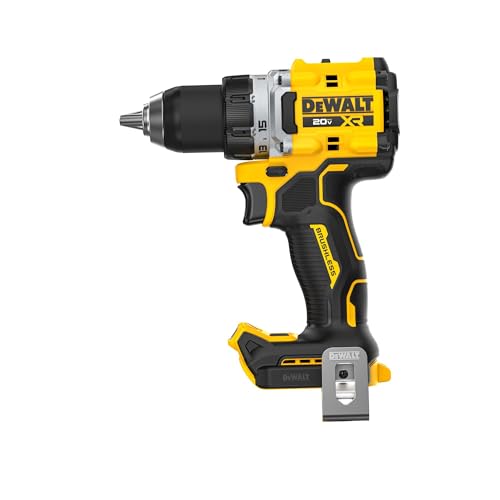
DeWalt DCD794 vs DCD801 at a Glance
| Feature | DeWalt DCD794 | DeWalt DCD801 |
|---|---|---|
| Product Line | Atomic Compact Series | XR Professional Series |
| Maximum Rotational Speed | 1,650 RPM | 2,000 RPM (2 Speeds: 0-650 / 0-2,000 RPM) |
| Motor Power Output | 300 Watts | Not listed (Up to 109% more powerful) |
| Stated Torque Output | 160 in-lb | Not listed |
| Chuck Size and Type | 1/2 in. chuck | 1/2 in. metal ratcheting chuck |
| Anti-Rotation Protection | Not listed | Integrated ANTI-ROTATION System with red LED indicator |
| Work Light Illumination | Integrated LED work light | 3-position adjustable LED (70 lumens with auto-shutoff) |
| Asset Tracking Readiness | Not listed | TOOL CONNECT CHIP READY functionality |
| Chassis Dimensions (L x W x H) | 6.61 x 3.32 x 8.39 inches | 9.0 x 3.5 x 7.1 inches |
| Bare Tool Weight | 2.51 pounds | 13.76 ounces |
| Best For | Tight-space drilling and overhead installation | High-speed production drilling and heavy contractor demands |
Rotational Speed and Drilling Productivity
Rotational velocity directly determines how fast cutting edges slice through wood fibers, clear metal shavings, and complete repetitive holes. In production environments like residential framing, electrical rough-ins, and mechanical installations, a drill driver with higher top-end rotations per minute finishes tasks with significantly less trigger time. When evaluating the DCD801 vs DCD794 rpm speed capabilities, the mechanical differences between their gearboxes become immediately apparent. The DCD801 incorporates a heavy-duty two-speed transmission paired with a variable-speed trigger. In low gear, it operates from 0 to 650 RPM for deliberate, high-torque driving, while high gear accelerates from 0 up to 2,000 RPM for rapid boring through lumber and metal up to its 0.5-inch capacity.
In contrast, the DCD794 listing specifies a maximum rotational ceiling of 1,650 RPM without detailing a multi-gear mechanical switch. While 1,650 RPM delivers more than enough velocity for driving standard drywall screws, cabinet hardware, and medium pilot bits, it lags behind when spinning spade bits or twist drills through dense stock. Over the course of boring dozens of holes for wiring or plumbing runs, a 350 RPM deficit creates cumulative lag that slows down a job. Contractors who examine earlier platform upgrades, such as the dewalt dcd771 vs dcd801 matchup, recognize that breaking past the 1,750 RPM barrier changes how aggressively high-speed bits cut without bogging.
Furthermore, the manufacturer notes that the DCD801 can make up to 175 holes per charge, emphasizing efficiency across prolonged drilling runs. Having access to distinct gear settings also prevents operators from stripping delicate fasteners when shifting from high-speed hole cutting to precision screw driving. Because the DCD794 focuses primarily on an ultra-compact Atomic chassis, its single listed 1,650 RPM threshold is tuned as a middle-ground compromise between physical motor size and general utility.
Edge: DeWalt DCD801 because its two-speed transmission reaches 2,000 RPM to deliver noticeably faster drilling and chip clearance.
Bind-Up Prevention and Operator Safety
Rotational bind-up is an inherent hazard when running drill drivers on construction sites. When a bit binds suddenly inside a structural knot, catches on a hidden nail, or seizes in thick sheet metal, the motor’s rotational energy transfers into the tool body. This reactionary force violently twists the drill in the user’s grip, risking severe wrist sprains, broken fingers, or throwing workers off balance on ladders. The most significant safety advancement on either tool is the DeWalt DCD801 anti rotation feature. The DCD801 contains an integrated electronic sensor that monitors rotational movement in real time. If the system detects sudden, uncontrolled tool rotation, it instantly cuts power to the motor and illuminates an onboard red LED indicator to signal that protective shutdown has occurred.
The DCD794 listing does not feature an electronic bind-up sensor or gyroscopic clutch cut-off mechanism. When using the DCD794, managing reactionary torque relies entirely on your physical grip, stance, and quick trigger release. While experienced tradespeople cultivate good trigger discipline, unexpected snags happen in split seconds, especially in awkward body positions where maintaining mechanical leverage against the tool grip is nearly impossible. In any serious DeWalt DCD801 review, trade professionals highlight how the active bind-up sensor transforms high-torque operation from a physical hazard into a controlled process.
For commercial employers and safety-conscious tradespeople, active tool management provides peace of mind. As seen when analyzing broader professional tool lines like the dewalt dcd801 vs dcd996 safety options, electronic safety shutoffs are becoming standard requirements on high-output drills. The presence of this active intervention system gives the DCD801 a decisive advantage on demanding commercial jobsites where sudden bind-ups are frequent.
Edge: DeWalt DCD801 because its active anti-rotation system senses violent tool twist and instantly shuts down the motor to protect user wrists.
Chassis Dimensions and Tight-Space Maneuverability
Physical clearance determines whether a tool can drive a fastener directly or whether you are forced to spend time disassembling obstructions, using right-angle attachments, or driving screws by hand. Evaluating the DeWalt DCD794 or DCD801 for tight spaces reveals the core engineering focus of the Atomic series. The DCD794 is built specifically as DeWalt’s shortest 20-Volt MAX drill driver head length. With an overall length of 6.61 inches, a width of 3.32 inches, and a height of 8.39 inches, the DCD794 fits into confined spaces where standard cordless tools physically cannot sit flat against the workpiece.
The DCD801, representing the heavy-duty XR series, measures 9.0 inches long, 3.5 inches wide, and 7.1 inches high. That 2.39-inch difference in length is substantial inside crowded mechanical bays. When attempting to drill between standard 16-inch-on-center framing studs, inside kitchen sink vanities, or within electrical utility troughs, a 9-inch chassis leaves very little room for the bit shank, forcing fasteners in at crooked angles. Any comprehensive DeWalt DCD794 review will emphasize that tool head length is its greatest operational asset, granting access to spots where bulky drill drivers are completely unusable.
Weight specifications present an intriguing contrast in the manufacturer data. The DCD794 lists an item weight of 2.51 pounds, whereas the DCD801 bare-tool listing specifies an exceptionally light 13.76 ounces. However, when working in cramped locations, front-to-back chassis clearance is almost always the deciding physical constraint rather than a matter of ounces. For electricians running wiring inside finished drywall, trim carpenters mounting cabinet hardware, and plumbers working behind copper lines, the compact head of the DCD794 eliminates constant clearance frustrations.
Edge: DeWalt DCD794 because its ultra-compact 6.61-inch head length fits into narrow framing cavities and tight enclosures where longer drills cannot fit.
Power Delivery and Motor Performance
Motor power defines whether a drill driver maintains its operating cadence under heavy resistance or bogs down, overheats, and stalls. The DeWalt Atomic vs XR drill driver classification represents two different motor configurations. The DCD794 utilizes a brushless motor rated at 300 watts of maximum power output and 160 in-lb of torque. For routine tradeswork-such as running self-tapping screws, drilling pilot holes into softwood, and assembling flat-pack materials-300 watts delivers dependable, smooth output without draining batteries prematurely.
The DCD801 sits at a much higher tier of power delivery. The listing identifies it as DeWalt’s most powerful 20V MAX 2-speed drill driver, engineered to be up to 109% more powerful than previous platforms, while also offering up to 25% more power when compared against competing Milwaukee drill drivers. Although the manufacturer listing does not state an exact torque number in inch-pounds for the DCD801, that massive percentage boost in available motor wattage provides substantial resistance against stalling when cutting dense structural materials. When choosing between the DeWalt DCD794 or DCD801 for contractors, sustained power throughput under load is the defining factor.
In high-load scenarios-such as driving large-diameter fasteners or forcing hole saws through laminated timber-the DCD794 will reach its thermal and torque limits much earlier than the XR model. Evaluating contractor-grade tools, such as the design trade-offs seen in the dewalt dcd801 vs dcd800 comparison, shows that heavy-duty motors are engineered to maintain high rotational speed under heavy drag. For continuous rough-in duties and tough commercial materials, the DCD801 provides higher power reserves.
Edge: DeWalt DCD801 because its XR brushless motor delivers up to 109% more power to prevent stalling under demanding construction loads.
Chuck Construction and Bit Retention
The chuck mechanism is the mechanical bridge that transfers motor torque directly to your accessories. In heavy construction, poor chuck quality leads to slipping drill shanks, damaged bits, and dropped hardware inside deep wall voids. The DCD801 is outfitted with a heavy-duty 1/2-inch metal ratcheting chuck. Metal ratcheting chucks feature hardened internal jaws that bite deeply into round and hex shanks as manual tightening engages the ratcheting teeth. This mechanism keeps the bit centered and securely locked even under intense vibration, high-speed reverse drilling, and sudden rotational shocks.
The DCD794 listing specifies a 1/2-inch chuck on a body constructed of plastic and blend materials, but does not state that it features an all-metal ratcheting sleeve. While a 1/2-inch capacity allows the DCD794 to accept full-size drill bits, composite or plastic chuck sleeves wear faster over time when bumped against rough masonry, dropped on concrete, or exposed to abrasive jobsite grit. They also lack the tactile, high-pressure locking feedback provided by metal ratcheting designs.
Additionally, the DCD801 listing notes an included metal belt hook in the package, enabling users to clip the drill safely to their tool bags while climbing ladders or positioning materials. The DCD794 listing does not confirm an included belt hook. For heavy commercial abuse, investigating tool builds like those in the dewalt dcd801 vs dcd805 guides demonstrates why metal chucks remain the gold standard for durability. The robust chuck construction on the DCD801 ensures superior bit retention under demanding conditions.
Edge: DeWalt DCD801 because its 1/2-inch metal ratcheting chuck provides superior bit clamping force and long-term durability under heavy vibration.
Work Area Illumination and Jobsite Connectivity
Poor lighting in unfinished basements, crawlspaces, and interior cabinet boxes creates accuracy errors and slows down work. The DCD801 provides an advanced lighting solution compared to standard tool LEDs. It features an integrated 3-position adjustable LED work light capable of producing up to 70 lumens. Because the light head pivots into three distinct angles and includes an auto-shutoff timer, users can direct the illumination beam precisely onto the fastener location or use the drill as a stationary task light when working inside unlit utility closets.
The DCD794 includes a basic integrated LED work light located at the tool base to illuminate small spaces. While this light helps reduce shadows right at the drill point, the listing does not specify multiple angle adjustments, auto-shutoff programming, or a high-lumen output rating. It operates as a standard fixed-position drill light, which is functional for basic tasks but lacks the versatility of a pivoting multi-position lamp.
Beyond lighting, the DCD801 includes TOOL CONNECT CHIP READY functionality. By adding an optional DeWalt Tool Connect chip into the integrated slot, tradespeople can pair the drill with the DEWALT Site Manager mobile application to track tool location and log asset inventory across commercial sites. The DCD794 provides no chip slot or digital tracking support. When deciding whether is DeWalt DCD801 worth it for commercial fleet managers and busy tradespeople who also research options like the dewalt dcd777 vs dcd801, the pairing of 70-lumen task lighting and digital tracking readiness adds substantial jobsite utility.
Edge: DeWalt DCD801 because it features a 70-lumen 3-position pivoting LED work light and Tool Connect asset tracking readiness.
Pros and Cons
DeWalt DCD794

Pros
- Short 6.61-inch head length
- Compact Atomic series frame
- 300 watts maximum power output
- Integrated base LED work light
Cons
- Lower maximum speed of 1650 RPM
- No electronic anti-rotation safety system
- Belt hook not included in listing
DeWalt DCD801

Pros
- High-speed 2-speed transmission up to 2000 RPM
- Active ANTI-ROTATION System with red LED
- Durable 1/2-inch metal ratcheting chuck
- Adjustable 70-lumen 3-position work light
- TOOL CONNECT CHIP READY tracking
Cons
- Longer 9-inch chassis restricts tight spaces
- Tool Connect chip sold separately
- Exact torque rating not listed
Who Should Buy Each One
Choose the DeWalt DCD794 If
- You regularly work inside tight cabinet interiors, narrow stud bays, and crawlspaces where tool head length is your main constraint.
- You perform overhead drilling, drywall fastening, and maintenance tasks where a compact 6.61-inch chassis minimizes arm fatigue.
- Your typical workload consists of light to medium fastener driving and pilot hole drilling requiring up to 300 watts of power and 160 in-lb of torque.
- You want an Atomic series drill driver that delivers full compatibility with 20V MAX batteries in the shortest possible frame.
Choose the DeWalt DCD801 If
- You need rapid drilling speeds up to 2,000 RPM across a two-speed transmission to bore holes through dimensional lumber and metal quickly.
- You want an active electronic anti-rotation safety system that shuts the motor down to protect your wrists during sudden bit bind-ups.
- You require a heavy-duty 1/2-inch metal ratcheting chuck that locks bits securely under high vibration and high torque loads.
- You manage tools across commercial jobsites and value Tool Connect asset tracking capability alongside an adjustable 70-lumen work light.
Final Verdict
For most commercial tradespeople, general contractors, and demanding DIY builders, the DeWalt DCD801 is the superior drill driver. Its high-speed two-speed transmission reaching 2,000 RPM, paired with a brushless motor engineered up to 109% more powerful, handles intensive hole-drilling and large fasteners far more effectively than compact alternatives. More importantly, its integrated anti-rotation system provides active bind-up protection that prevents severe wrist injuries when cutting tough lumber or metal. Combined with an all-metal ratcheting chuck, an adjustable 70-lumen work light, and Tool Connect asset tracking, the DCD801 is fully equipped for rigorous jobsite demands.
However, the DeWalt DCD794 is the smarter purchase when working in cramped, low-clearance environments where full-size drills simply cannot fit. Measuring just 6.61 inches from front to back, it easily slips between narrow framing members, under countertops, and inside electrical boxes where the 9-inch DCD801 jams against adjoining surfaces. If your daily tasks focus on finish carpentry, cabinet installation, or light maintenance where 300 watts of power and 160 in-lb of torque are plenty, the Atomic DCD794 delivers unmatched maneuverability in tight quarters.
FAQ
Does the DeWalt DCD794 have the anti-rotation safety feature found on the DCD801?
No. The DeWalt DCD794 listing does not feature an active anti-rotation sensor or electronic bind-up shutoff. The anti-rotation system is exclusive to the DCD801 in this comparison, which uses internal sensors to monitor rotational movement and instantly cut motor power while lighting a red LED indicator if the drill suddenly binds.
What is the difference in rotational speed between the DCD794 and DCD801?
The DeWalt DCD801 provides higher rotational speed through a two-speed transmission that reaches up to 2,000 RPM in high gear and 650 RPM in low gear. The DeWalt DCD794 listing specifies a single maximum operating speed of 1,650 RPM.
Which drill driver is better for working in tight spaces?
The DeWalt DCD794 is noticeably better for tight spaces. Engineered as DeWalt’s shortest 20-Volt MAX drill driver head length, its chassis measures 6.61 inches long compared to the 9.0-inch length of the DCD801, allowing it to fit into narrow wall cavities, crawlspaces, and compact cabinets where the DCD801 cannot fit.
Does the DeWalt DCD801 come with the Tool Connect chip included?
No. While the DeWalt DCD801 features TOOL CONNECT CHIP READY functionality, the chip itself is sold separately. Once the chip is installed into the tool, it pairs with the DEWALT Site Manager app for digital inventory management and tool tracking.
How do the chuck designs compare between the DCD794 and DCD801?
The DCD801 comes equipped with a 1/2-inch heavy-duty metal ratcheting chuck that provides secure bit retention and high wear resistance under heavy vibration. The DCD794 features a standard 1/2-inch chuck on a plastic and composite blend body.
Are batteries and chargers included with either tool?
No. Both the DeWalt DCD794 (model DCD794B) and the DeWalt DCD801 (model DCD801B) are sold as bare tools only. Batteries and chargers must be purchased separately or used from your existing DeWalt 20V MAX battery inventory.
What are the stated torque ratings for the DCD794 and DCD801?
The DeWalt DCD794 listing specifies a torque output of 160 in-lb alongside 300 watts of maximum power. The DCD801 listing does not state an exact torque rating in inch-pounds, but notes that the tool is engineered to be up to 109% more powerful than predecessor models.