The single difference that decides the choice between these two machines comes down to airflow power management versus active odor breakdown: the Coway Airmega 200M uses an automated Eco Mode that completely stops the fan when indoor air stays clean for 30 minutes, whereas the Winix 5500-2 relies on PlasmaWave technology to actively neutralize stubborn airborne impurities alongside light-sensing auto sleep.
Choose the Airmega 200M if you want a compact, energy-saving appliance designed for bedrooms and medium living spaces. Choose the 5500-2 if you manage pet smells in larger rooms and prefer automated nighttime dimming with app support.


Coway Airmega 200M vs Winix 5500-2 at a Glance
| Attribute | Coway Airmega 200M | Winix 5500-2 |
|---|---|---|
| Hourly Room Coverage | 1,748 sq. ft. (60 min) / 874 sq. ft. (30 min) | 1,881 sq. ft. (60 min) |
| Filtration Stages | 3-stage HyperCaptive (Pre-filter, Carbon, HEPA) | 4-stage (Pre-filter, Carbon, True HEPA, PlasmaWave) |
| Particle Retention Size | 0.3 micron (tested to 0.01 micron ultra-fine) | 0.01 micron |
| Dimensions (D x W x H) | 10 x 17 x 18 inches | 11 x 15.9 x 25.2 inches |
| Weight | 12.3 pounds | 13.3 pounds |
| Operating Sound Level | 24.4 dB minimum | Not listed |
| Power Consumption | 82 watts | Not listed |
| Air Quality Monitoring | Built-in real-time particle monitor | Built-in Smart Sensors with visual indicator |
| Night / Energy Settings | Eco Mode (auto fan shutoff) | Light-sensing Sleep Mode |
| Best For | Compact spaces and low energy consumption | Large living areas and active pet odor treatment |
Filtration Stages and Air Purification Technology
The core purpose of any home air purifier is the removal of airborne particulate matter, allergens, and volatile chemical compounds. When examining the Coway Airmega 200M review specifications, the unit relies on Coway’s proprietary HyperCaptive Filtration System. This mechanical stack combines a washable pre-filter for coarse hair and lint, an activated carbon deodorization filter designed to reduce harmful volatile organic compounds by 99%, and a HEPA filter rated to capture 99.97% of microscopic particulates down to 0.3 microns. Testing documentation from Korea Conformity Laboratories confirms the design captures ultra-fine particulates down to 0.01 microns under specific chamber conditions. If you are comparing mid-sized floor units, readers often cross-reference the levoit vital 200s vs coway airmega 200m to evaluate standard mechanical configurations against competing multi-stage boxes.
In contrast, the Winix 5500-2 review specifications describe an upgraded four-stage system built around a True HEPA layer, a high-deodorization carbon filter, and proprietary PlasmaWave technology. Winix claims the internal layout targets 99.99% of airborne particles down to 0.01 microns in size. PlasmaWave operates by releasing an electrical discharge that creates dual-polarity ions, breaking molecular bonds of airborne pollutants, viruses, and odors directly in the airstream before discharging pure air back into the room. This gives the Winix model an active treatment stage beyond standard mechanical media, making it especially effective when processing complex volatile smells. Shoppers evaluating whether the Winix 5500-2 filter replacement setup fits their home routine must remember that the physical carbon screen handles bulk fumes before PlasmaWave treats remaining trace molecules.
The Coway Eco Mode vs Winix PlasmaWave comparison highlights fundamentally different filtration philosophies. Coway focuses entirely on passive mechanical containment: pollutants land on physical filter fibers and stay there, avoiding any secondary ionization. Winix combines physical interception with an active electronic stage to neutralize stubborn gaseous threats. If you need clean, uncharged passive filtration for sensitive airways, Coway provides a proven three-barrier assembly. If you are dealing with lingering cooking smells and pet dander, Winix adds extra treatment power.
Edge: Winix 5500-2, because its four-stage system integrates an active PlasmaWave stage to treat microscopic odors beyond conventional mechanical entrapment.
Coverage Area and Air Circulation Speed
Airflow volume dictates how rapidly an air purifier cycles the entire volume of a room, preventing stagnant pockets where dust and pollen accumulate. In this Coway 200M vs Winix 5500-2 coverage analysis, both manufacturers state specifications based on hourly room volume turns. The Coway Airmega 200M explicitly rates its performance for spaces up to 874 square feet in 30 minutes, or up to 1,748 square feet in 60 minutes. This two-speed time benchmark gives owners a clear understanding of exchange rates: in a master bedroom or standard living room, the 200M can refresh the air two complete times every hour without running at maximum overload.
The Winix 5500-2 listing specifies coverage of up to 1,881 square feet in one hour. This gives the 5500-2 a modest edge of 133 square feet in total hourly volume compared to Coway. For open-concept floor plans where living rooms blend directly into dining spaces and kitchens, that extra displacement helps pull air across wider corners. Those looking at whole-house purification often explore the larger coway airmega 400 vs winix 5500-2 to gauge whether a single high-output chassis is preferable to standard mid-size towers.
While the numerical difference between 1,748 and 1,881 square feet seems minor on paper, the physical airflow geometry influences how quickly each machine gathers pollutants. The Airmega pulls air through its broad front grille and pushes clean air straight upward, whereas the taller chassis of the 5500-2 positions the intake across a longer vertical surface. In real-world operation, both handle large family rooms with ease, but the Winix moves slightly more cubic volume across a 60-minute window.
Edge: Winix 5500-2, due to its slightly higher maximum coverage capacity of 1,881 square feet per hour.
Smart Monitoring, Eco Mode, and Night Automation
Operating an air purifier around the clock requires smart automation that balances indoor air purity against unnecessary motor wear and noise. The Airmega 200M features an onboard air quality monitor that continuously samples particulate density and displays live status through an illuminated ring. When set to Auto Mode, the internal sensor speeds up or slows down the fan automatically across three manual stages. Its standout feature, however, is Eco Mode. If the room remains clean for 30 consecutive minutes, the 200M shuts its fan motor off completely. The onboard sensor remains active, and the moment particulate pollution rises, the fan wakes up and resumes circulation.
The Winix 5500-2 addresses room automation with built-in Smart Sensors that read air quality and present visual feedback via a color-coded front light. In Auto Mode, the machine ramps fan speeds up or down to match real-time contamination levels. Rather than an auto-shutoff Eco Mode, the 5500-2 includes a specialized light sensor that manages Sleep Mode. When the lights in the room are turned off, the unit detects the dark environment and automatically dims its display indicators while dropping the fan to its quietest, low-energy sleep setting. Additionally, this generation of the machine incorporates mobile app support, allowing owners to monitor operations from their smartphones.
Deciding between these platforms depends on where the machine sits. In a bedroom, the Winix light sensor prevents bright dashboard lights from disturbing sleep without requiring manual button presses. For buyers focused purely on power conservation in rooms that remain empty during the day, Coway’s complete motor shutdown during clean spells delivers distinct power efficiency. Readers comparing versatile automation frequently review the levoit core 400s vs coway airmega 200m to weigh manual control simplicity against automated digital schedules.
Edge: Tie. The Coway Airmega 200M saves power by stopping the motor entirely when clean, while the Winix 5500-2 automates nighttime dimming and includes mobile app connectivity.
Chassis Dimensions, Form Factor, and Placement Flexibility
Floor space and physical aesthetics determine where an air purifier can realistically live in your home. The Coway Airmega 200M features a squarer, more compact cabinet measuring 10 inches deep, 17 inches wide, and 18 inches tall, with an overall weight of 12.3 pounds. Its relatively low profile allows it to sit beneath low windowsills, against sideboards, or beside nightstands without dominating the visual line of the room. The integrated top touch controls and included remote control provide flexible operation whether you place the machine across the room or directly beside your desk.
The Winix 5500-2 takes the shape of a traditional floor tower, measuring 11 inches deep, 15.9 inches wide, and 25.2 inches high, weighing 13.3 pounds. Standing more than seven inches taller than the Coway, the Winix commands greater vertical presence. That extra height allows for a taller internal filter array, but it also means the unit cannot tuck easily under low furniture or discreet side tables. Moving the Winix between rooms requires managing slightly more bulk, though its 13.3-pound weight remains manageable for most adults.
If you have tight square footage or want an appliance that blends into small home offices, the Airmega 200M is far easier to position unobtrusively. If you are debating cabinet bulk across the wider product family, looking at the coway airmega 200m vs 400 shows how compact the 200M remains relative to high-capacity dual-suction consoles. The Winix 5500-2 requires a dedicated floor footprint away from low-hanging obstacles.
Edge: Coway Airmega 200M, because its compact 18-inch height and lighter 12.3-pound chassis make room placement much easier.
Sound Output and Bedroom Usability
A loud purifier quickly becomes an annoyance, especially when running on bedside tables overnight. When reviewing the Coway Airmega 200M noise level specifications, the manufacturer rates the unit at a whisper-quiet 24.4 dB on its lowest setting. At 24.4 dB, the sound profile resembles rustling leaves or a very soft hum, making it practically undetectable in standard suburban homes. Even as the three-stage fan ramps into medium speeds, the aerodynamic acoustic design avoids high-pitched motor whine. For more perspective on compact acoustics, shoppers frequently compare the coway airmega 200m vs dyson tp07 to see how standard fan impellers stack up against bladeless air multipliers.
On the other side, the listing for the Winix 5500-2 does not specify exact decibel metrics for its sound output stages. The product data explicitly highlights that its dedicated Sleep Mode provides quiet, energy-efficient operation triggered by ambient light reduction. However, without published decibel ratings in the manufacturer specifications, buyers cannot verify precise acoustic floor levels prior to purchase. In practical use, Sleep Mode keeps fan motor revolutions low to prevent waking light sleepers, but the lack of official laboratory decibel numbers leaves an information gap.
Because the Coway provides a verified 24.4 dB baseline alongside an Eco Mode that ceases mechanical motion when the air is already filtered, it provides superior predictability for noise-sensitive individuals. You know exactly how quiet it will run on low speed, and it will shut off entirely when air quality allows.
Edge: Coway Airmega 200M, thanks to its documented 24.4 dB low-noise floor and motor-pausing Eco Mode.
Pros and Cons
Coway Airmega 200M
Pros
- Energy-saving Eco Mode auto-shuts fan when clean
- Compact 18-inch height and lighter 12.3-pound frame
- Includes remote control unit
- Ultra-quiet 24.4 dB minimum noise operation
Cons
- Lower hourly coverage at 1,748 square feet
- Lacks darkness-activated sleep mode
- No mobile app connectivity
View Coway Airmega 200M on Amazon
Winix 5500-2
Pros
- Larger hourly coverage up to 1,881 square feet
- Four-stage filtration system with PlasmaWave technology
- Automatic light-sensing sleep mode
- Companion mobile app support
Cons
- Taller 25.2-inch body takes more vertical space
- Heavier 13.3-pound build
- Lacks physical remote control
Who Should Buy Each One
Choose the Coway Airmega 200M If

- You need an air purifier for a bedroom, office, or small apartment where a compact 18-inch height fits under furniture.
- You want to conserve electricity using an Eco Mode that shuts the fan motor off once air stays purified for 30 minutes.
- You are sensitive to nighttime sounds and demand a verified, whisper-quiet low-speed noise level of 24.4 dB.
- You prefer a dedicated remote control alongside responsive touch controls on the chassis.
Choose the Winix 5500-2 If
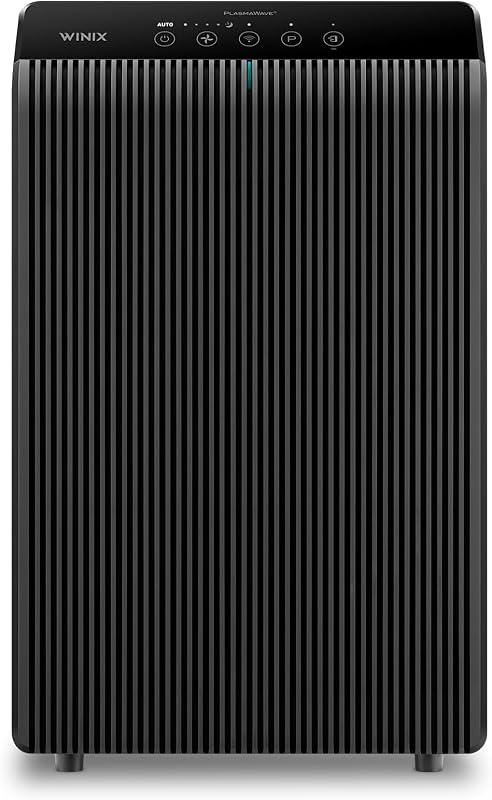
- You have an open-concept living space requiring up to 1,881 square feet of single-hour air cleaning capacity.
- You live with pets or cook frequently and want active PlasmaWave ionization to break down lingering volatile odors.
- You prefer set-and-forget bedroom convenience where an optical sensor automatically activates Sleep Mode when room lights turn off.
- You want smart connectivity features via dedicated mobile app support for remote system adjustments.
Final Verdict
For most homeowners seeking a reliable, low-maintenance air purifier, the Coway Airmega 200M is the overall superior choice. Its compact dimensions make it easy to position anywhere in your home, and its certified 24.4 dB operating level ensures quiet running through the night. More importantly, its intelligent Eco Mode saves wear on the mechanical components and keeps electrical draw minimal by pausing the fan motor whenever your living space remains clean. Combined with an included remote control, three-year warranty protection, and comprehensive HyperCaptive particle retention, it covers the essentials with exceptional precision.
However, the Winix 5500-2 remains the better option for households tackling aggressive organic odors, heavy pet dander, or wider open floor plans. Its 1,881 square foot hourly rating provides slightly higher total circulation, while its PlasmaWave technology actively neutralizes molecular odor compounds that standard carbon layers can miss. Furthermore, if you value smartphone controls and an automatic light-sensing sleep cycle that dims the control panel as soon as you switch off the bedroom lights, the 5500-2 delivers outstanding practical value.
FAQ
Coway Airmega 200M or Winix 5500-2 for allergies?
Both purifiers excel at allergen removal, but they suit different allergy triggers. The Coway Airmega 200M captures 99.97% of 0.3-micron particles and is tested down to 0.01-micron ultra-fine allergens using purely mechanical HyperCaptive filtration, making it great for individuals who prefer uncharged filtration. The Winix 5500-2 captures 99.99% of 0.01-micron particles and adds PlasmaWave technology, which actively breaks down airborne organic contaminants.
Coway Airmega 200M or Winix 5500-2 for pets?
The Winix 5500-2 holds an advantage for homes with multiple pets. Its four-stage layout features PlasmaWave technology and a high-deodorization carbon filter designed specifically to neutralize stubborn pet odors and airborne impurities, whereas the Coway uses a standard mechanical activated carbon layer to trap dander and pet scents.
Is Winix 5500-2 worth it compared to the Coway 200M?
The Winix 5500-2 is worth choosing if you want modern app support, light-sensing automatic sleep functions, and slightly larger room coverage reaching up to 1,881 square feet per hour. If you do not need mobile app management or ionization, the Coway 200M offers a more compact chassis with lower energy consumption via Eco Mode.
How does Coway Eco Mode differ from Winix Sleep Mode?
Coway Eco Mode monitors air quality and turns the fan motor completely off if the air remains clean for 30 minutes, turning back on only when pollution is detected. Winix Sleep Mode does not stop the fan; instead, an optical light sensor detects when the room goes dark, automatically dimming panel lights and setting the fan to its quietest operational speed.
Can I turn off the air quality indicator lights on these purifiers?
The Winix 5500-2 automatically dims its indicator lights when its light sensor registers darkness in the room. The Coway Airmega 200M includes touch controls and a remote control that allow you to adjust settings, though it lacks an optical light sensor to dim indicators automatically based on ambient room light.
What are the power requirements of the Coway Airmega 200M?
The Coway Airmega 200M operates on standard corded electric power with a rated power consumption of 82 watts at peak operation. When running in Eco Mode, power consumption drops significantly because the fan motor shuts off during periods of sustained air purity. The Winix product listing does not specify its maximum wattage rating.


