Room cleaning capacity and volumetric airflow represent the single deciding difference between the Coway Airmega 200M and the Coway Airmega 400. While both devices utilize multistage particulate and gas filtration to scrub indoor environments, their operational scale targets fundamentally different architectural demands.
Choose the Coway Airmega 200M if you need a lightweight, slender air cleaner tailored for enclosed bedrooms, home workspaces, or standard flats. Choose the Coway Airmega 400 if you need to circulate air across large open-concept living spaces, sweeping rooms, or expansive multi-room floors.

Coway Airmega 200M vs Coway Airmega 400 at a Glance
| Feature | Coway Airmega 200M | Coway Airmega 400 |
|---|---|---|
| Maximum Floor Area (60 Mins) | 1,748 sq. ft. | 3,120 sq. ft. |
| Rated Floor Area (30 Mins) | 874 sq. ft. | Not listed |
| Power Consumption | 82 watts | 66 watts |
| Minimum Noise Output | 24.4 dB | 22 dB |
| Cabinet Dimensions (D x W x H) | 10″D x 17″W x 18″H | 14.8″D x 14.8″W x 22.8″H |
| Unit Weight | 12.3 lbs | 24.7 lbs |
| Filtration Stages | Pre-Filter, Carbon Filter, HEPA Filter | Pre-Filter, Active Carbon Filter, HEPA Filter |
| Energy Certifications | CARB Certified | CARB, ETL, Energy Star Certified |
| Warranty Coverage | 3 Years | 5 Years |
| Best For | Bedrooms, home offices, and individual rooms | Open-concept living rooms and expansive home layouts |
Coverage Area and Air Processing Speed
The core distinction in this Coway Airmega 200M vs 400 comparison centers on total room cleaning capacity. The Airmega 200M is rated to purify 874 square feet in 30 minutes, or up to 1,748 square feet in 60 minutes. This makes it an effective choice for sealed single rooms, studio spaces, and master suites where air can be circulated through its internal filtration pack multiple times each hour. When evaluating a levoit core 400s vs coway airmega 200m matchup, the 200M shows consistent handling within medium footprints, but its single intake path sets a strict boundary on the total volume of air it can pull through the housing.
By comparison, the Airmega 400 steps up air circulation significantly, rated to manage up to 3,120 square feet in 60 minutes. When analyzing Coway Airmega 200M vs 400 square footage metrics, the 400 processes nearly 78 percent more square footage every hour. This vast difference is supported by its dual-sided intake architecture, which draws contaminated air through dual filter sets simultaneously. In high-traffic zones, shared living areas, and open floor plans, the higher volumetric exchange rate of the Airmega 400 ensures that particles do not linger suspended in stagnant pockets across distant corners.
If you are deciding between the Coway 200M or 400 for large rooms, deploying the smaller unit into a sprawling living area forces it to operate continuously on its highest manual fan setting. Running at maximum speed increases acoustic presence and wear. The Airmega 400 processes expansive square footage on intermediate fan speeds, keeping airflow continuous without straining the motor assembly. For spaces exceeding 1,000 square feet with open passages, the air volume processing of the 400 remains virtually mandatory.
Edge: Coway Airmega 400 delivers substantially higher volumetric air turnover, processing up to 3,120 square feet per hour to easily outperform the 200M in shared living zones.
Power Consumption and Energy Efficiency
Air cleaners operate continuously in most homes, making operational electrical demand an essential consideration. The motor specifications on these two units reveal a counterintuitive engineering contrast. Despite its smaller frame and lower total air output, the Airmega 200M listing specifies a maximum power consumption rating of 82 watts. Its fan motor requires higher wattage to drive air through its single rear filter channel at maximum speed, reflecting older motor design architecture.
In contrast, the Airmega 400 pulls a maximum of 66 watts according to its technical listing, despite circulating nearly double the volume of air. This efficiency is evidenced by its official Energy Star certification, alongside ETL and CARB compliances. The Airmega 200M listing notes CARB certification, but it lacks the Energy Star designation found on the larger model. When examining a levoit vital 200s vs coway airmega 400 comparison, the energy-saving design of the 400 highlights how modern multi-filter airflow channels minimize static resistance against the blower wheel.
Both models feature Coway’s automated Eco Mode, designed to mitigate unnecessary power draw. When Eco Mode is active, each machine continually samples the room air quality. If the internal sensor detects clean air for 30 consecutive minutes, the fan automatically turns completely off to conserve electricity, powering back on only when ambient pollution spikes. While both conserve energy in clean rooms, the Airmega 400 draws 16 fewer watts under full load, making it technically the more efficient machine when clearing heavy contamination.
Edge: Coway Airmega 400 is Energy Star certified and draws only 66 watts at peak output compared to the 82-watt rating of the smaller 200M.
Physical Footprint and Placement Requirements
The physical footprint of an air purifier dictates where it can realistically live inside your home. The Airmega 200M is built with a slim cabinet measuring 10 inches deep, 17 inches wide, and 18 inches high, weighing an agile 12.3 pounds. This rectangular, flatter profile allows it to slide cleanly against an interior wall, rest unobtrusively under a side table, or tuck into a bedroom walkway without creating a physical obstacle. For shoppers exploring a coway airmega 200m vs winix 5500-2 decision, the 200M stands out as one of the easiest rectangular units to relocate between living areas.
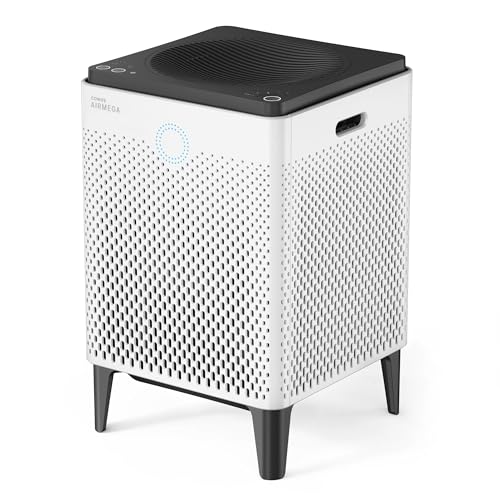
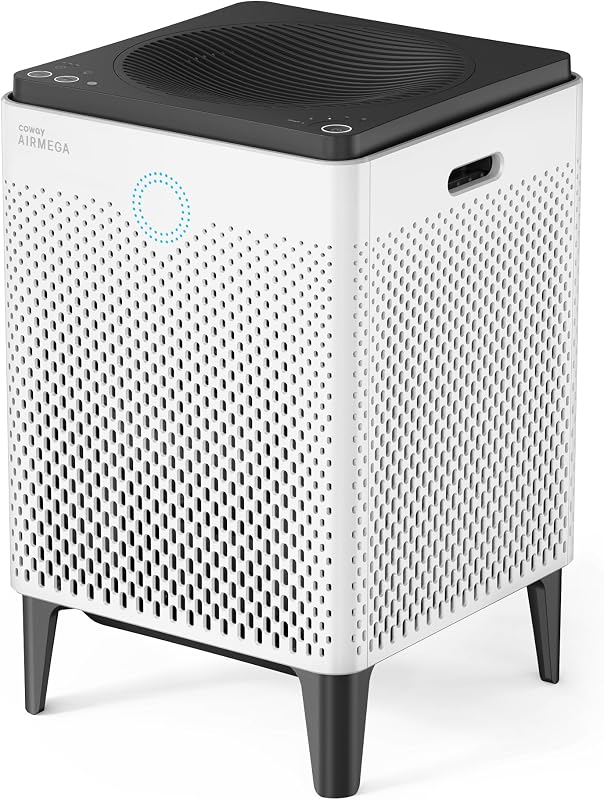
The Airmega 400 adopts a cube-like tower structure measuring 14.8 inches deep, 14.8 inches wide, and 22.8 inches high, weighing 24.7 pounds. At double the weight of the smaller machine, moving the 400 up and down stairs or from room to room demands intentional physical effort. Furthermore, because the 400 pulls air from both the left and right sides of its chassis, it cannot be pushed flat against a corner or flush against a bookshelf. It requires clearance on both intake flanks to maintain proper volumetric flow.
When selecting the Coway 200M or 400 for living room setups, spatial aesthetics and walking clearance dictate the winner. The 200M disappears into standard interior layouts and can be shifted between a home office and a bedroom in seconds. The 400 acts as a permanent piece of utility furniture that claims dedicated floor space. If square footage inside the room itself is scarce, the bulky profile of the 400 can feel intrusive.
Edge: Coway Airmega 200M is less than half the weight and features a slim 10-inch depth that fits seamlessly into compact rooms.
Acoustics and Sleep Functionality
Because purifiers often operate overnight in sleeping quarters, acoustic performance on low settings directly impacts day-to-day usability. The Airmega 200M operates down to a quiet 24.4 decibels on its lowest manual fan stage. At this level, the unit emits a soft white noise that blends into standard background room acoustics. Readers of a coway airmega 200m vs dyson tp07 assessment will appreciate that the 200M avoids high-pitched mechanical motor whine, maintaining a stable tone through its 3-stage manual fan settings.
The Airmega 400 drops even lower, achieving an ultra-quiet minimum noise rating of 22 decibels. Even more significant for bedroom duty is the dedicated Sleep Mode integrated into the 400. The Airmega 400 includes built-in ambient light sensors alongside its particle detectors. When the unit senses that the room has remained dark and the air clean for 3 consecutive minutes, Sleep Mode automatically engages, reducing fan speed and dimming onboard illumination to prevent sleep disturbances.
The 200M lacks an automated optical light sensor. While you can manually select low fan speed and operate the machine comfortably overnight, it does not adapt automatically to the lighting environment of the room. The combination of a 22-decibel baseline and automated light-sensing controls gives the Airmega 400 a tangible operational refinement for bedrooms, provided you have the physical space to accommodate its cabinet.
Edge: Coway Airmega 400 registers a quieter 22 dB floor and includes an automated light-sensing Sleep Mode that darkens controls in nighttime environments.
Filtration Capabilities and Monitoring Technology
Both purifiers employ Coway’s HyperCaptive filtration architecture, which combines three mechanical defense layers: a washable pre-filter, an active carbon deodorization filter, and an efficiency-rated HEPA filter. Specifications for both systems confirm capture of 99.97% of 0.3-micron airborne particles, including dust, pollen, and common allergens, alongside the reduction of volatile organic compounds and nuisance household odors. Laboratory testing by KCL confirms capture of ultra-fine particles down to 0.01 microns under standard test methodologies across both model lines.
The key functional difference lies in maintenance architecture and capacity. The Airmega 200M uses a single filter stack loaded through the front panel. It features an onboard air quality monitor with color-coded feedback and a filter life indicator light to signal replacement cycles. The technical listing also references remote control operation alongside its top touch controls. The Airmega 400 uses Coway’s MultiFilterManager system, housing two identical filter sets on opposing sides of the cabinet. This dual-sided design distributes particulate loading across two distinct HEPA-carbon pairs, increasing filter media surface area. Reviewing a levoit core 400s vs coway airmega 400 comparison highlights how dual-intake architecture helps large-format purifiers maintain throughput over long filter lifespans.
Warranty provisions also differentiate the hardware packages. The Airmega 200M includes a 3-year manufacturer warranty, whereas the Airmega 400 provides extended 5-year warranty protection. For buyers wondering is Coway Airmega 400 worth it, the extra two years of factory coverage combined with dual-sided filtration components and touch-activated timer controls provide substantial long-term mechanical assurance.
Edge: Coway Airmega 400 provides dual-sided filter sets for balanced particulate capture and carries a longer 5-year warranty.
Pros and Cons
Coway Airmega 200M
Pros
- Compact footprint
- Lightweight 12.3-pound frame
- Remote control operation
- Washable pre-filter
Cons
- Lower 1,748-square-foot coverage area
- Higher 82-watt power draw
- Shorter three-year warranty
View Coway Airmega 200M on Amazon
Coway Airmega 400
Pros
- Extensive 3,120-square-foot room coverage
- Lower 66-watt power consumption
- Light-sensing automatic sleep mode
- Quiet 22-decibel minimum operation
- Five-year manufacturer warranty
Cons
- Heavy 24.7-pound chassis
- Bulky floor footprint
View Coway Airmega 400 on Amazon
Who Should Buy Each One
Choose the Coway Airmega 200M If

- You need to clean dedicated single spaces such as bedrooms, nurseries, or private offices up to 874 square feet.
- You live in an apartment where floor space is limited and require a slender 10-inch cabinet depth.
- You want a lightweight 12.3-pound machine that can easily be picked up and transferred between rooms.
- You prefer a unit that provides remote control capability alongside touch controls.
Choose the Coway Airmega 400 If
- You have an open-concept home, sweeping living room, or finished basement spanning up to 3,120 square feet.
- You prioritize energy efficiency and want an Energy Star certified unit that caps power draw at 66 watts.
- You want automated Sleep Mode that uses light sensors to darken indicators when the room goes black.
- You want the peace of mind that comes with a longer 5-year manufacturer warranty.
Final Verdict
For most readers outfitting large spaces, connected living areas, or sprawling family rooms, the Coway Airmega 400 is the superior air cleaning investment. Its ability to process 3,120 square feet of air per hour through dual intake channels makes quick work of airborne allergens and smoke that overwhelm smaller units.
The Coway Airmega 200M remains the smarter choice for targeted single-room purification. If your primary goal is scrubbing a master bedroom, nursery, or apartment living room under 874 square feet, the 200M delivers the identical 99.97% filtration efficiency in a chassis that weighs half as much and occupies far less floor depth. Unless you need to sweep open-plan architectural layouts, the compact 200M provides all the air cleaning performance necessary without overcrowding your living space.
FAQ
Can the Coway Airmega 200M clean open living rooms as effectively as the Airmega 400?
No. The Airmega 200M is rated to clean up to 1,748 square feet in 60 minutes or 874 square feet in 30 minutes, whereas the Airmega 400 cleans 3,120 square feet in an hour. In expansive, open-concept living rooms, the 200M lacks the air processing volume required to cycle air rapidly across connected spaces.
Why does the larger Coway Airmega 400 consume less power than the smaller 200M?
The Airmega 400 utilizes an Energy Star certified motor and dual-sided intake architecture that draws 66 watts at peak speed. The Airmega 200M uses a single-sided intake design with an 82-watt motor rating, requiring more electrical draw to force air through its single filter stack on high settings.
Do both the Coway 200M and 400 feature washable pre-filters?
Yes. Both purifiers include washable pre-filters designed to capture large debris, hair, and dust before incoming air reaches the internal active carbon and HEPA stages. Rinsing these pre-filters regularly extends the functional life of the interior filters.
What is the difference between Auto Mode and Eco Mode on these purifiers?
Auto Mode continuously runs the fan, automatically stepping the speed up or down according to real-time air quality sensor readings. Eco Mode adds an energy-saving layer: if the air quality remains clean for 30 consecutive minutes, the fan shuts completely off until the sensor detects pollution again.
How does the Sleep Mode operate on the Coway Airmega 400?
The Airmega 400 features built-in light and air quality sensors. When the sensors detect that the room has remained dark and the air clean for 3 minutes, the purifier enters Sleep Mode, dimming control lights and reducing the fan to an ultra-quiet speed to minimize noise and energy use.
How do the factory warranty terms compare between these two models?
The Coway Airmega 200M listing specifies a 3-year manufacturer warranty, while the Coway Airmega 400 includes a 5-year warranty, offering two additional years of factory protection.