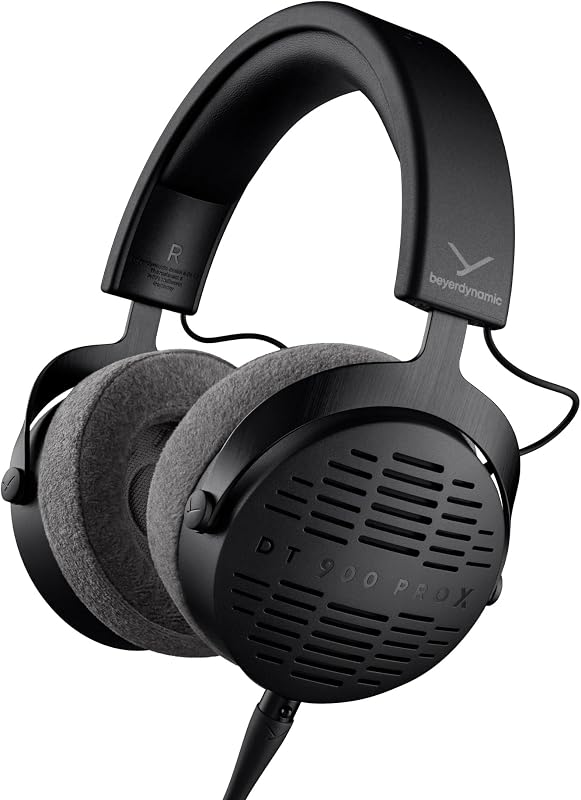
The decisive difference between the Beyerdynamic DT 900 Pro X and the Hifiman Sundara lies in their acoustic driver architecture and amplification requirements: Beyerdynamic utilizes an efficient 48-ohm STELLAR.45 dynamic driver engineered to deliver full volume and dynamic range directly from consumer headphone jacks and audio interfaces without an amplifier, whereas Hifiman implements an ultra-thin planar magnetic diaphragm with a 92 dB sensitivity rating that demands dedicated power to reveal its full acoustic speed and micro-detail.
Audio producers, mixing engineers, and creators who need a rugged studio headphone that plugs directly into any standard output should select the DT 900 Pro X. Home audiophiles and critical listeners seeking fast transient resolution, ultra-wide frequency extension, and dedicated desktop listening should opt for the Sundara.


Beyerdynamic DT 900 Pro X vs Hifiman Sundara at a Glance
| Attribute | Beyerdynamic DT 900 Pro X | Hifiman Sundara |
|---|---|---|
| Transducer Type | STELLAR.45 Dynamic | Planar Magnetic (80% thinner diaphragm) |
| Acoustic Design | Open-Back | Open-Back |
| Nominal Impedance | 48 ohm | 32 ohm |
| Sensitivity | Not listed | 92 dB |
| Frequency Response | Not listed | 6 Hz – 75 kHz |
| Cable Connection | Detachable mini-XLR (single-sided) | Detachable 3.5 mm dual connectors |
| Weight | 12.2 ounces (approx. 345 g) | 342 grams |
| Country of Origin | Made in Germany | Not listed |
| Manufacturer Warranty | 2 year manufacturer | Not listed |
| Included Accessories | Detachable mini-XLR cable, 1/4-inch adapter, protective case | Cable, 3.5mm-to-6.35mm adapter |
| Best For | Studio mixing, production, and high-versatility monitoring | Hi-Fi music listening and high-resolution desktop audio |
Driver Architecture and Acoustic Performance
The operational core of any high-end open-back headphone is its transducer design, and this comparison pits a modern dynamic driver against an advanced planar magnetic system. The DT 900 Pro X features the proprietary Beyerdynamic STELLAR.45 driver, a flagship dynamic transducer engineered to achieve ultra-low distortion and high acoustic resolution across varying playback levels. Dynamic drivers utilize a moving coil affixed to a specialized diaphragm, moving pistonically to generate acoustic wave fronts. Beyerdynamic designs this system specifically to offer an open-back reference sound suited for mixing, mastering, and critical listening, producing a balanced, natural presentation that faithfully reflects mix flaws.
In contrast, the Hifiman Sundara planar magnetic architecture operates on an entirely different acoustic principle. It features an ultra-thin membrane suspended between a symmetric array of magnets, with electrical traces etched directly onto the film. Hifiman highlights that this newly developed diaphragm is 80 percent thinner than those used on the previous HE400 series. This dramatic reduction in moving mass translates into exceptionally rapid transient response, pristine treble air, and a massive listed frequency response spanning 6 Hz up to 75 kHz. Listeners exploring critical acoustic recordings or comparing modern planar resolution against models like in the sennheiser hd 660s2 vs beyerdynamic dt 900 pro x matchup will note that the Sundara focuses heavily on speed and micro-detail.
Choosing between these two designs involves a trade-off between punchy dynamic impact and planar transient agility. The DT 900 Pro X presents acoustic energy with the physical excursion and cohesive mid-bass body that dynamic drivers naturally provide, ensuring percussion and bass lines carry realistic weight. The Sundara delivers lightning-fast recovery and effortless separation across complex orchestral or electronic arrangements, though its lower planar excursion lacks the punchy tactile snap of the STELLAR.45 driver.
Edge: Hifiman Sundara provides faster transient recovery and a wider published frequency bandwidth thanks to its ultra-thin planar magnetic membrane.
Amplification Demands and Source Versatility
Headphone efficiency and drive requirements define where and how an audio transducer can be used. The Beyerdynamic DT 900 Pro X impedance sits at a convenient 48 ohms. Beyerdynamic specifically optimized the STELLAR.45 driver so users can obtain full volume and clean headroom from virtually any source. Whether connected directly into an everyday laptop, an audio interface, or a mobile phone, this headphone delivers complete dynamic slam and volume without an external headphone amplifier. This makes testing the Beyerdynamic DT 900 Pro X without amp a seamless, plug-and-play experience for mobile creators.
The Sundara listing states a nominal impedance of 32 ohms, which might superficially suggest it is easy to drive. However, nominal impedance tells only half the story; sensitivity dictates true acoustic output per milliwatt. Hifiman lists the Sundara with an acoustic sensitivity of 92 dB. This relatively low sensitivity means that planar magnetic headphones demand significant clean current to reach proper listening levels and achieve intended dynamic range. Running the Sundara straight from a generic smartphone or weak laptop headphone jack typically results in quiet volume, compressed dynamics, and a lifeless low-end response.
This operational difference profoundly impacts user workflow. Those studying a beyerdynamic dt 770 pro vs dt 900 pro x comparison will recognize that the Pro X line was engineered specifically to liberate professionals from high-impedance studio gear limitations. With the DT 900 Pro X, you can track on location with a laptop or edit on a tablet with zero volume penalties. The Sundara, on the other hand, strictly expects a dedicated desktop amplifier or a powerful high-output interface to sound its best, confining it primarily to stationary listening spaces.
Edge: Beyerdynamic DT 900 Pro X reaches full volume and dynamic punch from any output jack without demanding an external amplifier.
Studio Mixing and Critical Production Workflow
When selecting the Beyerdynamic DT 900 Pro X or Hifiman Sundara for mixing, studio practicality and acoustic honesty outweigh casual listening enjoyment. Beyerdynamic deliberately created the DT 900 Pro X as a reference tool for the final mix. Its open-back soundstage delivers wide, natural imaging that shows exactly where every instrument, vocal layer, and panning artifact sits across the stereo field. The STELLAR.45 transducer preserves low distortion at high SPL levels, which ensures monitoring accuracy during demanding equalization sweeps and compression adjustments.
The Sundara brings formidable analytical characteristics to studio environments, particularly for audio restoration and inspecting high-frequency air. Because its diaphragm is 80 percent thinner than previous generations, it exposes subtle reverbs, vocal sibilance, and delicate micro-textures with surgical clarity. However, planar magnetic drivers behave differently than standard studio reference monitors. The lean, ultra-fast bass decay of the Sundara can tempt mixing engineers to overcompensate by boosting low frequencies, which often results in boomy, muddy mixes when played back on standard dynamic speaker systems or consumer earbuds.
Studio workflow also depends heavily on physical convenience. The DT 900 Pro X uses a single-sided detachable cable with a locking mini-XLR termination that drops neatly down one shoulder, preventing desk clutter around keyboards, audio faders, and mixing consoles. The Sundara uses a dual-entry Y-split cable that connects to both earcups simultaneously. For dedicated desktop listening this is standard, but in active audio engineering environments, dual cables frequently catch on gear or restrict movement. Evaluating a Beyerdynamic DT 900 Pro X review from a production standpoint reveals that its utilitarian design, reliable translation, and clutter-free cabling make it superior for music creation, as highlighted in comparisons like the beyerdynamic dt 900 pro x vs akg k371.
Edge: Beyerdynamic DT 900 Pro X offers more reliable mix translation, convenient single-sided routing, and consistent dynamic behavior for audio production.
Gaming and Spatial Soundstage Imaging
Competitive and immersive gamers seek open-back headphones for acoustic separation, natural soundstages, and directional accuracy. In evaluating the Beyerdynamic DT 900 Pro X or Hifiman Sundara for gaming, soundstage geometry and pin-point localization play crucial roles. The DT 900 Pro X relies on an open-back soundstage calibrated for natural imaging. In fast-paced competitive shooters, it renders distinct spatial cues, allowing players to track footsteps, reload animations, and directional gunfire with pinpoint placement across both near and distant boundaries.
The Sundara offers a remarkably vast, airy presentation that many gamers appreciate in wide-open atmospheric titles. Its planar driver speed allows complex audio cues-such as overlapping explosions, dialogue, and atmospheric wind-to remain distinctly separated without smearing. In any thorough Hifiman Sundara review, audiophiles celebrate this spatial separation. However, the planar imaging on the Sundara can sometimes feel diffused or wider than realistic boundaries, which makes precise lateral distance estimation slightly more ambiguous than the pinpoint localization found on studio-tuned dynamic drivers.
Practical gaming setups also dictate headphone viability. Gamers plugging their headset directly into a console controller, a portable gaming device, or a standard motherboard port will quickly realize that the 92 dB sensitivity of the Sundara produces underwhelming volume and thin bass. The DT 900 Pro X thrives across console controllers, capture cards, and basic PC jacks alike, offering rich spatial immersion and authoritative tactical cues without supplemental hardware. For gamers who have explored budget open-back alternatives in guides like the beyerdynamic dt 900 pro x vs philips shp9500, stepping up to the DT 900 Pro X offers effortless compatibility alongside premium acoustic precision.
Edge: Beyerdynamic DT 900 Pro X combines precise tactical imaging with effortless driveability directly from gaming controllers and PC motherboards.
Build Quality, Headband Ergonomics, and Portability
Long monitoring and listening sessions demand exceptional ergonomic design and durable structural materials. The Beyerdynamic DT 900 Pro X is officially made in Germany, upholding the brand’s storied reputation for rugged studio hardware. It features a space grey chassis, robust metallic frame, and a total weight of 12.2 ounces (approximately 345 grams). The headband utilizes a well-padded, replaceable cushion structure engineered for secure clamping pressure that keeps the earcups firmly seated when leaning over mixing consoles or studio desks. Beyerdynamic also backs the DT 900 Pro X with a 2-year manufacturer warranty and bundles a dedicated black protective case inside the box.
The Hifiman Sundara takes an entirely different approach to frame construction. It incorporates an all-metal headband structure intended to handle the wear and tear of everyday life with a sleek, sumptuous matte black finish. To manage its 342-gram weight, Hifiman designed an updated headband featuring a separate weight-spreading head strap. This suspension strap rests directly against the wearer’s scalp, distributing physical downward pressure evenly across the head to prevent localized pressure hotspots during extended sessions. The Sundara also features updated earpads tailored for a more comfortable fit.
While the suspension strap of the Sundara distributes weight exceptionally well for stationary listening, the frame lacks horizontal swivel and offers fewer modular replacement options. Furthermore, the Sundara packaging does not include a protective travel case, providing only the bare cable and adapter. Beyerdynamic designs the DT 900 Pro X as a field-ready studio tool that withstands rigorous daily transit inside its included protective case. Readers comparing the beyerdynamic dt 770 pro vs hifiman sundara will find that Beyerdynamic consistently builds with long-term industrial utility and transport in mind.
Edge: Beyerdynamic DT 900 Pro X features rugged German manufacturing, an included protective case, and a 2-year manufacturer warranty.
Cable Connectivity and Practical Durability
Cable design influences both daily longevity and gear integration. The DT 900 Pro X utilizes a robust, detachable mini-XLR connector that locks firmly into the left earcup. Mini-XLR connections are industry-standard in professional broadcast and studio environments because the physical latch prevents accidental disconnects during movement. The cable terminates in a standard 3.5 mm jack, and Beyerdynamic includes a screw-on 1/4-inch (6.35 mm) adapter to ensure immediate compatibility with professional mixing boards, audio interfaces, and studio monitor controllers.
The Hifiman Sundara utilizes standard 3.5 mm sockets located on the base of each earcup. Hifiman notes that these updated 3.5 mm sockets deliver improved connectivity and provide a physically robust connection compared to older connection types. The included cable breaks out into dual 3.5 mm plugs at the headphone end and terminates in a 3.5 mm source plug, bundled with an included 3.5mm-to-6.35mm adapter. Dual 3.5 mm sockets make aftermarket cable upgrades very straightforward, allowing audiophiles to easily swap in balanced cables if their desktop amplifiers support balanced outputs.
Nevertheless, for day-to-day durability and operational ease, a single-sided locking mini-XLR cable proves superior in active environments. The locking mechanism absorbs accidental cable tugs without putting stress on internal pins, whereas dual 3.5 mm earcup jacks expose two entry points to potential lateral leverage damage if the cable is abruptly yanked or stepped on while in use.
Edge: Beyerdynamic DT 900 Pro X provides a more secure locking mini-XLR connection and practical single-sided cable routing.
Pros and Cons
Beyerdynamic DT 900 Pro X
Pros
- Efficient 48-ohm STELLAR.45 driver runs without amp
- Detachable mini-XLR locking cable
- Includes protective case and 2-year warranty
- Engineered for open-back reference mix translation
- Durable Made in Germany build quality
Cons
- Listing does not publish frequency response range
- Traditional headband clamps firmer than suspension strap designs
View Beyerdynamic DT 900 Pro X on Amazon
Hifiman Sundara

Pros
- Planar magnetic diaphragm 80% thinner than previous series
- Massive 6 Hz to 75 kHz frequency response
- All-metal headband with weight-spreading suspension strap
- Standard dual 3.5 mm earcup connectors
Cons
- Low 92 dB sensitivity requires dedicated amplification
- Dual-sided cable can snag across studio workstations
- Does not include protective carrying case
View Hifiman Sundara on Amazon
Who Should Buy Each One
Choose the Beyerdynamic DT 900 Pro X If
- You produce, mix, or master audio and need an open-back reference sound that exposes technical flaws accurately.
- You work directly from laptops, audio interfaces, or mobile devices and require full volume without an external headphone amplifier.
- You need a single-sided, locking mini-XLR cable that keeps your workstation uncluttered while avoiding accidental disconnection.
- You value rugged German construction backed by an included protective carrying case and a 2-year manufacturer warranty.
Choose the Hifiman Sundara If
- You prioritize planar magnetic speed, fast transients, and micro-detail across an ultra-wide 6 Hz to 75 kHz frequency response.
- You own or plan to purchase a dedicated headphone amplifier capable of driving its 92 dB sensitivity.
- You prefer a suspension-style headband with a separate weight-spreading strap that distributes its 342-gram weight evenly.
- You intend to do most of your critical listening at a dedicated home Hi-Fi desktop station.
Final Verdict
For the vast majority of creators, audio professionals, and versatile listeners, the Beyerdynamic DT 900 Pro X is the overall winner. Its low 48-ohm impedance and highly efficient STELLAR.45 driver eliminate the requirement for expensive, bulky external amplification, allowing you to achieve reference-level volume and punch from any playback source. Combined with exceptional German studio build quality, a locking mini-XLR cable, an included protective case, and an honest acoustic presentation that translates reliably to consumer speakers, it stands out as an indispensable studio workhorse.
The Hifiman Sundara wins when the objective shifts purely to dedicated, high-resolution desktop audiophile listening. If you already possess a dedicated headphone amplifier capable of feeding its 92 dB sensitivity, the Sundara rewards you with planar speed, ultra-fast transients, and microscopic acoustic separation that dynamic drivers simply cannot reproduce. For deep home listening sessions focused on unpacking layered acoustic arrangements, the planar magnetic architecture of the Sundara delivers specialized fidelity that makes it well worth the amplification investment.
FAQ
Can the Beyerdynamic DT 900 Pro X be driven without an amp?
Yes. The Beyerdynamic DT 900 Pro X features a 48-ohm STELLAR.45 driver specifically designed to deliver full volume and dynamic range directly from laptops, smartphones, and basic audio interfaces without requiring a dedicated headphone amplifier.
Is the Hifiman Sundara worth it for portable listening with a phone?
No. While the Sundara has a low impedance of 32 ohms, its sensitivity is rated at 92 dB. Standard smartphone outputs lack the current required to drive this planar magnetic diaphragm properly, resulting in quiet volume and weak bass response.
Which headphone is better for mixing and music production?
The Beyerdynamic DT 900 Pro X is better suited for mixing and music production. It is engineered with an open-back reference profile designed for mix translation, features low distortion at all volume levels, and uses a single-sided locking mini-XLR cable that stays out of the way on a busy studio desk.
How does the weight and comfort compare between the DT 900 Pro X and Sundara?
The DT 900 Pro X weighs 12.2 ounces (around 345 grams) with a traditional padded headband, providing a secure, snug clamp ideal for active studio use. The Hifiman Sundara weighs 342 grams and uses an all-metal headband with a separate weight-spreading strap that distributes downward pressure broadly across the crown for stationary listening.
What cable connections do the DT 900 Pro X and Hifiman Sundara use?
The DT 900 Pro X utilizes a single-sided detachable mini-XLR connection on the left earcup terminating in a 3.5 mm jack with an included 1/4-inch adapter. The Hifiman Sundara utilizes dual 3.5 mm connections (one on each earcup) with an included cable and a 3.5mm-to-6.35mm adapter.
Are both headphones open-back designs?
Yes. Both the Beyerdynamic DT 900 Pro X and the Hifiman Sundara feature open-back earcups. This acoustic design allows sound to breathe naturally for a wide soundstage, meaning neither model provides passive noise isolation, and both will leak audio into quiet surroundings.