The primary decision point between the Beyerdynamic DT 900 Pro X and the AKG K371 comes down to acoustic enclosure architecture: open-back spatial transparency versus closed-back passive noise isolation. Studio engineers who prioritize wide, three-dimensional acoustic imaging for mixing in quiet control rooms need an open system, whereas creators needing acoustic isolation to prevent microphone bleed during recording sessions require a sealed earcup design.
Choose the Beyerdynamic DT 900 Pro X if you produce, mix, or master audio at a dedicated desk and demand an expansive soundstage with natural spatial separation. Choose the AKG K371 if you record vocals, track live instruments, or produce on the move and require sound isolation combined with a collapsible frame.


Beyerdynamic DT 900 Pro X vs AKG K371 at a Glance
| Attribute | Beyerdynamic DT 900 Pro X | AKG K371 |
|---|---|---|
| Acoustic Principle | Open-Back | Closed-Back |
| Transducer Type | STELLAR.45 Driver | 50mm Titanium-Coated Transducer |
| Frequency Response | Not listed | 5 Hz to 40 kHz |
| Impedance | 48 ohm | 32 ohm |
| Sensitivity | Not listed | 114 dB |
| Noise Control | None | Sound Isolation |
| Headband Structure | Fixed frame | Foldable notched headband |
| Weight | 12.2 ounces | Not listed |
| Country of Origin | Made in Germany | Not listed |
| Included Cables | Detachable mini-XLR cable | 3m coiled, 3m straight, 1.2m straight cables |
| Best For | Stationary Mixing and Mastering | Tracking, Podcasting, and Field Recording |
Acoustic Design and Spatial Imaging
The acoustic enclosure shapes how audio frequencies disperse around your ears and dictates the width of the stereo field. In an open-back system, sound waves emanate inward toward the ear canal and outward into the surrounding room through perforated grilles. This venting completely prevents internal air pressure buildup and eliminates resonance reflections inside the earcup chamber. Conversely, closed-back headphones trap energy within an acoustic chamber, relying on physical boundary seals to direct low-end pressure toward the ear while sealing out external noise.
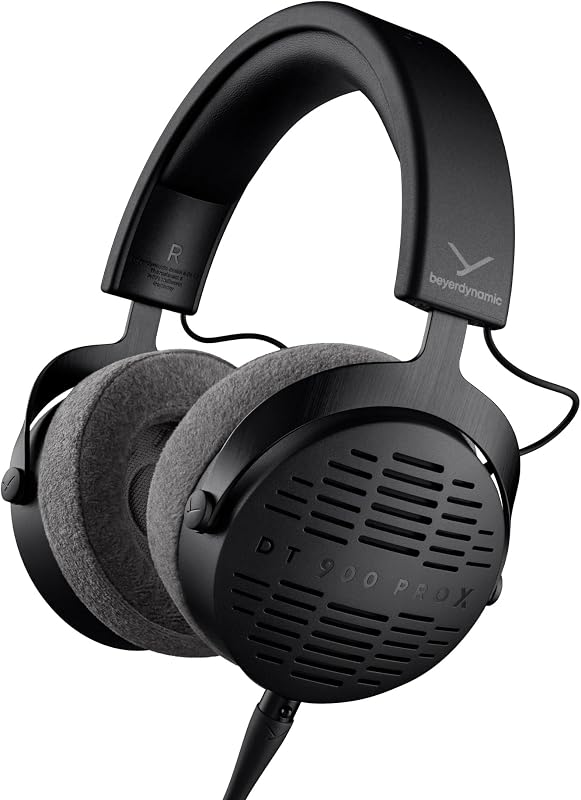
Comparing DT 900 Pro X open back vs K371 closed back highlights the functional divergence between these two philosophies. The DT 900 Pro X provides an open-back soundstage with wide, natural imaging that shows you exactly where every instrument sits within a complex arrangement. Because its specification lists noise control as none, it vents audio freely into the room and allows ambient room sound in. The K371 utilizes a closed-back, oval, over-ear design engineered for sound isolation. While its acoustic boundary reduces the perceived width of the stereo image, it stops audio leakage from bleeding into open condenser microphones. Mix engineers seeking a broader reference field often evaluate open platforms like those discussed in our sennheiser hd 560s vs beyerdynamic dt 900 pro x comparison.
The practical result is a distinct operational divide. The open grilles of the DT 900 Pro X reproduce three-dimensional panning, reverb tails, and depth cues with lifelike transparency, but they are unusable near sensitive vocal microphones. The K371 confines the stereo space to a tighter listening field, but its passive isolation allows for monitoring next to a hot mic or editing dialogue in noisy environments without disturbance.
Edge: Beyerdynamic DT 900 Pro X provides superior spatial separation and an open soundstage that closed acoustic chambers cannot replicate.
Driver Architecture and Frequency Performance
Transducer engineering determines dynamic transient speed, frequency response linearity, and total harmonic distortion under high output levels. Diaphragm size, voice coil material, and magnetic flux density all define how accurately a headphone translates sub-bass rumbles, midrange fundamentals, and upper-register air. Evaluating these driver specifications clarifies why each manufacturer targets a specific professional workflow.
The DT 900 Pro X incorporates Beyerdynamic’s proprietary STELLAR.45 driver, a flagship transducer specifically developed to achieve high resolution and low distortion at any operating level. While the official listing does not specify exact frequency range figures for the DT 900 Pro X, the driver assembly is tuned for reference-grade mixing and mastering accuracy, delivering clean transient response without harsh breakup. In an in-depth Beyerdynamic DT 900 Pro X review perspective, this transducer handles dense transient spikes with exceptional control across demanding mastering passes.
The AKG K371 features largest-in-class, titanium-coated 50mm transducers paired with pure oxygen-free copper voice coils. AKG precision-engineers these drivers to match the AKG reference response curve acoustic target, yielding an extensive AKG K371 frequency response ranging from 5 Hz to 40 kHz. This broad specification delivers deep low-frequency extension and extended high-frequency reach, presenting sub-bass frequencies below human hearing limits and ultrasonic harmonics. Producers looking for closed-back studio monitors often cross-shop this model, as detailed in our beyerdynamic dt 770 pro vs akg k371 head-to-head analysis.
Edge: AKG K371 delivers documented ultra-wide 5 Hz to 40 kHz frequency coverage with exceptional sub-bass extension from its 50mm titanium-coated drivers.
Studio Mixing vs Field Recording Workflows
Selecting DT 900 Pro X or AKG K371 for mixing depends entirely on your working environment and project demands. Studio mixing engineers operating in acoustically treated rooms need flat spatial representation to balance panning positions, EQ notches, and dynamic automation across dozens of tracks. A mixing headphone must expose masking issues rather than flatter the mix with artificial bass pressure.
The DT 900 Pro X is explicitly built for the final mix, providing a clinical reference sound for critical listening, EQ balancing, and mastering decisions. Its open design allows long listening sessions without ear fatigue or pressure accumulation. When comparing the beyerdynamic dt 770 pro vs 900 pro x, the open architecture of the 900 Pro X proves far more revealing for stationary desk mixing. However, when deciding between the Beyerdynamic DT 900 Pro X or AKG K371 for recording, the open design becomes a major liability because click tracks and monitor feeds leak directly through the grilles into live microphones.
This is where the K371 proves its worth for tracking, voiceover work, and field production. Engineered to match the AKG reference response curve target, it maintains a neutral, balanced tonal response while delivering sound isolation that locks audio inside the earcups. Podcasters, vocalists, and location recordists can monitor at elevated levels without bleed entering their recordings. For creators balancing mobile recording against stationary editing, the AKG K371 review profile reveals a versatile production tool capable of dual-purpose utility.
Edge: Beyerdynamic DT 900 Pro X wins for stationary mixing accuracy, while the AKG K371 wins for live recording and vocal tracking versatility.
Impedance, Sensitivity, and Source Driveability
Impedance and sensitivity dictate how easily an audio transducer converts electrical energy into acoustic output. High-impedance studio cans traditionally require dedicated, high-voltage outboard headphone amplifiers to achieve adequate volume and dynamic headroom. Modern studio gear, USB-powered audio interfaces, and mobile devices output lower voltages, requiring efficient driver impedance.
The Beyerdynamic DT 900 Pro X impedance sits at an efficient 48 ohms. Beyerdynamic explicitly engineered this 48-ohm drive system to deliver full volume and dynamic range from any playback source without needing an outboard headphone amplifier. Whether you connect directly to a laptop headphone jack, a compact USB audio interface, or a mobile phone, the STELLAR.45 driver maintains high output and low distortion without demanding external power stages. This efficiency makes it far simpler to integrate than high-impedance studio flagships, an advantage explored in our sennheiser hd 660s2 vs beyerdynamic dt 900 pro x evaluation.
The AKG K371 operates on an even lower 32-ohm impedance and pairs it with an exceptional 114 dB sensitivity rating. This optimal 32-ohm load ensures that low-powered mobile phones, field recorders, and portable media players can drive the 50mm titanium-coated transducers to high listening volumes with substantial headroom. The listing also notes media control and touch control features, reinforcing its integration with everyday digital devices. Both models eliminate the requirement for expensive desktop amplification hardware, but the K371 draws maximum SPL from minimal input power.
Edge: AKG K371 offers slightly higher power efficiency with its 32-ohm impedance and 114 dB sensitivity rating.
Portability, Build Quality, and Physical Ergonomics
A headphone’s mechanical structure dictates its working lifespan and suitability for life on the road. Studio headphones must endure routine abuse, headband adjustments, and repeated cable strain while remaining comfortable during marathon editing sessions.
The DT 900 Pro X weighs 12.2 ounces and features a robust, non-folding frame constructed in Germany. Finished in space grey with plush earpads, it includes a black carrying case for storage. The German-engineered chassis emphasizes mechanical rigidity and longevity over collapsible convenience. Its non-folding yoke structure takes up considerable space in a gear bag, making it best suited for a permanent mounting hook in a home or commercial studio desk setup. Audiophiles comparing premium reference chassis often weigh this against planar designs in guides like our beyerdynamic dt 900 pro x vs hifiman sundara breakdown.
In contrast, the AKG K371 prioritizes on-the-go utility. It features a robust design with a foldable, notched headband that collapses into a compact form factor for easy storage and portability inside its included protective carrying pouch. The closed-back, oval, over-ear earcups cradle the ears with plush, ergonomic isolating ear pads designed for long sessions. AKG also highlights replaceable ear pads, extending the operational life of the unit as materials wear down over time. For travel bags, location recording kits, and mobile laptop sleeves, the K371 provides superior spatial economy.
Edge: AKG K371 offers superior portability with its foldable notched headband, whereas the DT 900 Pro X provides rugged German-made stationary build quality.
Cable Accessories and Connector Versatility
Detachable cable systems protect studio headphones from accidental tugs and provide modular replacement options when cables inevitably degrade. The connection standard and included accessories determine whether a set of headphones can immediately connect to studio consoles, desktop interfaces, and mobile gear without buying aftermarket parts.
The Beyerdynamic DT 900 Pro X comes packaged with a detachable mini-XLR cable, a 3.5mm headphone jack termination, and a screw-on 1/4-inch adapter. The 3-pin mini-XLR interface locks securely into the base of the left earcup, preventing accidental disconnection during active mixing moves. The single included cable connects straight into any source, while the 2-year manufacturer warranty covers long-term structural reliability. While functional, the packaging supplies only one standard cord.
The AKG K371 surpasses standard package offerings by providing three distinct detachable cables in the box: a 3-meter coiled cable, a 3-meter straight cable, and a short 1.2-meter straight cable. All three connect to the K371 via a secure mini-XLR connector and terminate in a 3.5mm plug, supported by an included 3.5mm to 6.5mm (1/4-inch) adapter. The 1.2-meter straight cable provides tangle-free mobility for laptop desks and field recorders, while the 3-meter coiled cable prevents snagging around studio consoles. This broad accessory bundle ensures immediate adaptability across diverse recording scenarios.
Edge: AKG K371 provides significantly better accessory value with three distinct cables included in the box.
Pros and Cons
Beyerdynamic DT 900 Pro X
Pros
- STELLAR.45 driver with low distortion
- Wide open-back soundstage for mixing
- Efficient 48-ohm drive for any source
- Durable Made in Germany build quality
- Detachable mini-XLR cable design
Cons
- No passive noise isolation
- Non-folding frame limits portability
- Heavier weight at 12.2 ounces
View Beyerdynamic DT 900 Pro X on Amazon
AKG K371

Pros
- Wide 5 Hz to 40 kHz frequency response
- Sound-isolating closed-back earcups
- Foldable notched headband for travel
- Three detachable cables included in box
- High 114 dB sensitivity at 32 ohms
Cons
- Narrower soundstage than open-back headphones
- Acoustic chamber traps heat over time
Who Should Buy Each One
Choose the Beyerdynamic DT 900 Pro X If
- You mix, master, and edit audio primarily at a dedicated desk in a quiet room.
- You want a wide, natural open-back soundstage that reveals precise instrument separation.
- You prefer heavy-duty, Made in Germany build quality with a 2-year warranty.
- You work in environments where headphone sound leakage will not enter open microphones.
Choose the AKG K371 If
- You record vocals, track live instruments, or produce podcasts requiring sound isolation.
- You produce music on the go and need a foldable notched headband that packs flat.
- You demand deep sub-bass reproduction backed by an ultra-wide 5 Hz to 40 kHz frequency response.
- You want multiple cable options right out of the box, including coiled and short straight options.
Final Verdict
For audio professionals working in dedicated mixing suites or quiet home studios, the Beyerdynamic DT 900 Pro X represents the superior choice for critical listening. Its open-back architecture eliminates internal acoustic resonances, providing an accurate, wide stereo soundstage with pinpoint spatial imaging. Powered by the proprietary STELLAR.45 driver at an accessible 48-ohm impedance, it translates dynamic shifts and transient details with master-level clarity straight from any audio interface or laptop output.
However, when your workflow demands isolation, portability, and versatile recording capabilities, the AKG K371 takes the win. Its closed-back earcups prevent click bleed from leaking into live vocal microphones, while its 50mm titanium-coated drivers deliver deep low-end response reaching down to 5 Hz. Packed with three modular cables and a folding headband that slips effortlessly into a travel pouch, the K371 is the ultimate tool for mobile content creators, field recordists, and tracking engineers.
FAQ
Is the DT 900 Pro X worth it for home studio mixing?
Yes, is DT 900 Pro X worth it for mixing because its open-back design prevents acoustic resonance buildup inside the earcups and presents a wide, natural stereo image. Its STELLAR.45 driver offers low distortion and balanced reference imaging, allowing mixing engineers to accurately judge panning, EQ, and reverb balance.
Is the AKG K371 worth it for podcasting and vocal tracking?
Yes, is AKG K371 worth it for content creators because its closed-back oval earcups provide sound isolation that keeps monitor audio from leaking into sensitive microphones. The 50mm titanium-coated transducers and neutral acoustic target ensure transparent speech monitoring and pristine vocal tracking.
Do you need a dedicated headphone amplifier for the Beyerdynamic DT 900 Pro X?
No, you do not need an external headphone amplifier. The Beyerdynamic DT 900 Pro X impedance is rated at 48 ohms, which is engineered specifically to achieve full volume and low distortion directly from laptops, audio interfaces, and mobile devices.
What is the main acoustic difference between the DT 900 Pro X and the AKG K371?
The primary acoustic difference is enclosure design: the DT 900 Pro X uses an open-back acoustic structure that vents sound freely for a wider stereo soundstage, whereas the AKG K371 uses a closed-back design that seals sound inside for passive noise isolation and enhanced sub-bass retention.
Which model includes more cable options in the box?
The AKG K371 includes three cables in the box: a 3-meter coiled cable, a 3-meter straight cable, and a 1.2-meter straight cable, alongside a 1/4-inch adapter. The DT 900 Pro X includes a single detachable mini-XLR cable and a 1/4-inch adapter.
Can the Beyerdynamic DT 900 Pro X fold down for travel?
No, the DT 900 Pro X features a fixed-frame design that does not fold. If you need collapsible headphones for mobile production or field recording, the AKG K371 features a notched folding headband that packs down into a travel pouch.
How do the frequency ranges compare between these two headphones?
The AKG K371 listing specifies a wide frequency response of 5 Hz to 40 kHz powered by its 50mm titanium-coated drivers. In contrast, the product data for the Beyerdynamic DT 900 Pro X listing does not specify exact frequency range figures, focusing instead on the low distortion and reference clarity of its STELLAR.45 driver.


