The core difference that determines whether you should buy the Corsair Dominator Titanium DDR5 or the G.Skill Flare X5 DDR5 6000 comes down to high-capacity workstation throughput versus low-latency gaming bandwidth. Corsair supplies a dense 64GB dual-channel configuration with dedicated cooling architecture and customizable profile software, while G.Skill prioritizes a rapid 6000 MT/s data rate with aggressive CL30 response times tailored specifically for modern AMD desktop architectures.
Choose the Corsair Dominator Titanium DDR5 if your primary workload involves heavy video rendering, virtual machines, or intensive creative suites that readily consume more than 32GB of system memory. Choose the G.Skill Flare X5 DDR5 6000 if your goal is achieving peak gaming frame rates and seamless AMD EXPO configuration without paying for unneeded memory capacity or tall aesthetic lighting.


Corsair Dominator Titanium DDR5 vs G.Skill Flare X5 DDR5 6000 at a Glance
| Feature | Corsair Dominator Titanium DDR5 | G.Skill Flare X5 DDR5 6000 |
|---|---|---|
| Total Capacity | 64GB (2x32GB) | 32GB (2x16GB) |
| Memory Speed | 5200 MHz | 6000 MT/s |
| CAS Latency | CL40 | CL30 (30-38-38-96) |
| Operating Voltage | 1.25V | 1.35V |
| Overclocking Profile | Intel XMP 3.0 | AMD EXPO |
| Thermal Dissipation | Patented DHX cooling | Matte black heatspreader |
| RGB Lighting | 12 Capellix RGB LEDs | None |
| Form Factor | DIMM (Bumper) | 288-pin UDIMM |
| Platform Support | Desktop (Intel optimized) | AMD X870, X670, B850, B840, B650, A620 |
| Best For | Intel content creation and heavy multitasking | AMD Ryzen competitive gaming rigs |
Memory Frequency and Data Transfer Rates
Memory frequency dictates how much raw data passes between your processor and memory modules per second. In the transition between architectural standards discussed in guides like our ddr4 vs ddr5 breakdown, raw bandwidth plays an essential role in keeping high-core-count processors fed. The G.Skill Flare X5 runs at an aggressive 6000 MT/s rating, while this specific Corsair Dominator kit operates at a conservative 5200 MHz baseline. This difference creates a notable gap in maximum theoretical throughput across memory-bound scenarios.
The 6000 MT/s transfer rate on the G.Skill kit aligns perfectly with the performance targets of modern processors, where high memory bus speeds translate directly into reduced CPU queue stalls and smoother frame pacing in titles sensitive to memory communication. Conversely, the 5200 MHz speed on the Corsair memory focuses on delivering reliable data handling for large rendering tasks and compute pipelines where raw capacity matters more than absolute peak transfer frequency. When analyzing G.Skill Flare X5 DDR5 6000 vs Corsair Dominator Titanium DDR5 transfer capabilities, the extra 800 MT/s provides a clear boost for data-intensive gaming loops.
Edge: G.Skill Flare X5 DDR5 6000 because its 6000 MT/s transfer rate provides significantly higher raw data bandwidth than the 5200 MHz frequency of the Corsair kit.
CAS Latency and Timing Performance
CAS latency indicates the delay in clock cycles before the memory can return requested data to the processor. Evaluating a comparison such as DDR5 5200 CL40 vs 6000 CL30 requires looking at the timing structure as well as frequency. Lower numbers indicate faster response times. The G.Skill Flare X5 operates with ultra-tight timings of CL30-38-38-96, whereas the Corsair Dominator Titanium configuration carries a CL40 latency rating. This mechanical gap establishes the G.Skill kit as a considerably faster responder when retrieving scattered data instructions.
When selecting Corsair Dominator Titanium DDR5 or G.Skill Flare X5 DDR5 6000 for gaming, this difference becomes immediately noticeable. Game engines constantly query random data points, textures, and asset tables from system memory, making low access latency essential for minimizing 1% low frame dips. In analyses like our cl30 vs cl36 ddr5 examination, tighter primary timings consistently showcase their value in micro-stutter reduction. Corsair Dominator Titanium DDR5 latency remains tuned for steady, fault-tolerant execution at 1.25V, but G.Skill achieves rapid cycle turnaround times that give competitive gamers a true performance advantage.
Edge: G.Skill Flare X5 DDR5 6000 because its tight CL30 rating ensures drastically lower memory access latency than Corsair’s CL40 configuration.
Memory Capacity and Multitasking Overhead
Memory capacity sets the limit for how many concurrent programs, background assets, and heavy datasets your PC can manage simultaneously before relying on slower system drive paging. In this matchup, the Corsair Dominator kit delivers 64GB through two 32GB dual-rank modules, whereas the G.Skill Flare X5 delivers 32GB across two 16GB modules. For creative applications such as 4K video rendering, 3D asset generation, visual effects timeline caching, and virtual machine management, having 64GB of addressable memory completely eliminates workflow bottlenecks.
Modern gaming titles generally remain comfortably within 32GB limits, making G.Skill’s capacity well-suited for everyday performance builds. However, enthusiasts running complex multitasking workloads, large data simulations, or extensive browser tabs alongside professional production applications will exhaust 32GB quickly. Comparing these Corsair Dominator Titanium DDR5 specs against alternatives like in our corsair vengeance ddr5 6000 cl30 vs dominator titanium ddr5 review illustrates how Corsair prioritizes massive memory overhead, giving users complete freedom from memory allocation warnings during intensive rendering jobs.
Edge: Corsair Dominator Titanium DDR5 because its 64GB capacity is double what the G.Skill kit provides, giving power users ample headroom for heavy multi-threaded productivity.
Platform Optimization and Overclocking Profiles
Modern DDR5 relies heavily on pre-configured overclocking profiles embedded directly on the module firmware to achieve rated speeds with a single BIOS toggle. The G.Skill Flare X5 includes dedicated AMD EXPO profile support alongside standard JEDEC defaults. G.Skill specifically validates this memory on AMD platforms including X870, X670, B850, B840, B650, and A620 motherboards. If you are debating Corsair Dominator Titanium DDR5 or G.Skill Flare X5 DDR5 6000 for Ryzen, G.Skill Flare X5 DDR5 6000 AMD EXPO performance guarantees simple setup and direct alignment with AMD memory controllers.
On the other side, Corsair Dominator Platinum DDR5 features native Intel XMP 3.0 support and integrates onboard voltage regulation. This architecture pairs directly with Corsair iCUE software, enabling builders to monitor operational parameters and build custom XMP profiles saved directly to the hardware. As highlighted when comparing options like the corsair vengeance ddr5 6000 cl30 vs g.skill flare x5 ddr5 6000, platform-level integration dictates usability. G.Skill provides turn-key ease for AMD users, while Corsair brings modular software profile tuning designed around Intel workstations.
Edge: Tie because G.Skill provides flawless automated integration for AMD EXPO motherboards, while Corsair offers advanced XMP 3.0 profile saving and iCUE software tuning for Intel systems.
Thermal Dissipation, Aesthetics, and Physical Clearance
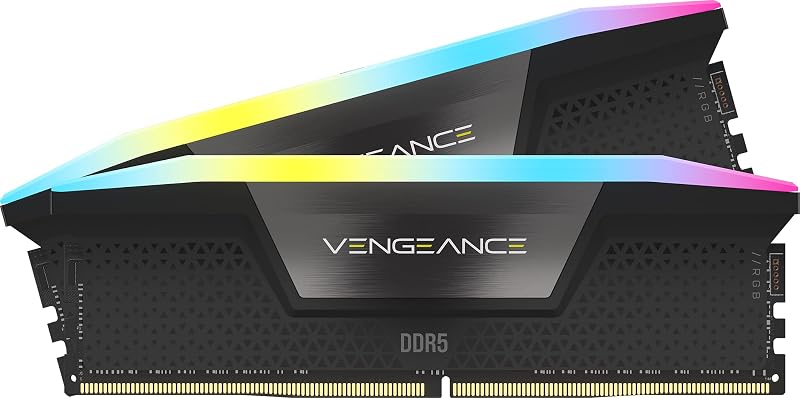
High-performance DDR5 generates heat across its integrated circuits and internal power management ICs, requiring proper cooling to sustain stability. Corsair equips its Dominator series with patented DHX cooling technology, an advanced engineering approach that cools both the integrated circuits and the ground plane of the physical PCB using a dedicated heatspreader. Alongside this thermal design, Corsair includes 12 ultra-bright, individually addressable Capellix RGB LEDs that interface with iCUE for complete system illumination synchronization.
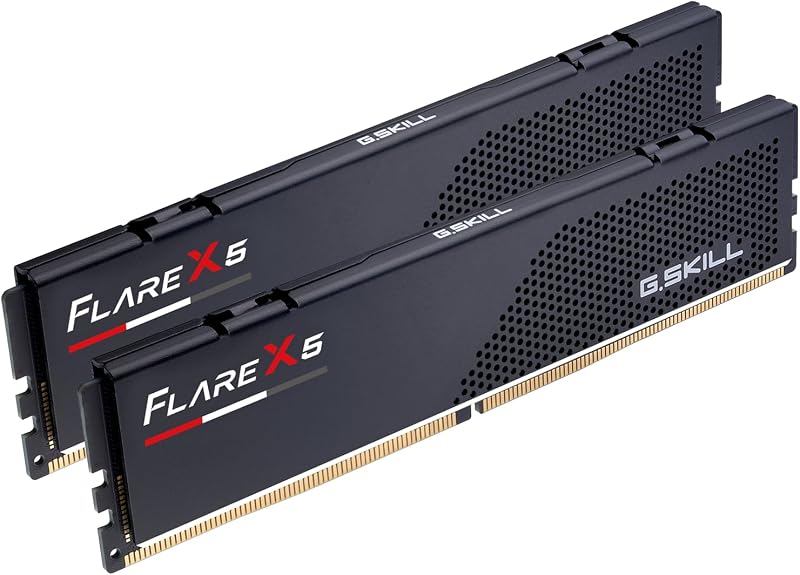
By contrast, any detailed G.Skill Flare X5 DDR5 6000 review reveals a minimalist philosophy: it uses a compact, low-profile matte black aluminum heatspreader without any lighting components. While Corsair’s imposing design creates an eye-catching centerpiece inside a showcase chassis, its taller height can complicate clearance under oversized dual-tower air coolers. Similar to contrasts observed in our corsair dominator titanium ddr5 vs g.skill ripjaws s5 ddr5 matchup, G.Skill eliminates physical interference issues entirely, while Corsair delivers an elite showpiece with dedicated PCB thermal dissipation.
Edge: Corsair Dominator Titanium DDR5 because its patented DHX cooling design provides superior multi-layer thermal management and premium addressable Capellix RGB aesthetics.
Pros and Cons
Corsair Dominator Titanium DDR5

Pros
- 64GB high-capacity dual-channel kit
- Patented DHX cooling technology
- Customizable Intel XMP 3.0 profiles
- 12 ultra-bright Capellix RGB LEDs
Cons
- Slower 5200 MHz transfer rate
- Higher CL40 CAS latency
View Corsair Dominator Titanium DDR5 on Amazon
G.Skill Flare X5 DDR5 6000
Pros
- Rapid 6000 MT/s data rate
- Tight CL30-38-38-96 latency timings
- Native AMD EXPO platform support
- Compact low-profile matte black heatspreader
Cons
- Lower 32GB total capacity
- No integrated RGB lighting
View G.Skill Flare X5 DDR5 6000 on Amazon
Who Should Buy Each One
Choose the Corsair Dominator Titanium DDR5 If
- You manage heavy 64GB creative pipelines such as 4K video rendering, CAD modeling, or multiple virtual machines.
- You run an Intel-based system and want onboard voltage regulation paired with custom XMP 3.0 profile management via iCUE.
- You are designing an aesthetic PC build that benefits from patented DHX cooling and 12 Capellix RGB lighting zones.
- You prefer a 1.25V operating profile that prioritizes low voltage and memory density over aggressive clock speeds.
Choose the G.Skill Flare X5 DDR5 6000 If
- You run an AMD Ryzen build built on X870, X670, B850, B840, B650, or A620 series motherboards.
- You want maximum gaming responsiveness provided by a 6000 MT/s data rate and low CL30-38-38-96 latency.
- You use a large air cooler that requires a low-profile, non-RGB heatspreader for unobstructed clearance.
- You need plug-and-play AMD EXPO compatibility without the hassle of custom software suites.
Final Verdict
For most competitive desktop gamers, the G.Skill Flare X5 DDR5 6000 stands out as the definitive selection. The pairing of 6000 MT/s throughput with a tight CL30 CAS latency operates at the ideal performance tier for modern computing, particularly for AMD Ryzen systems relying on AMD EXPO profiles. The compact matte black profile fits neatly beneath virtually every aftermarket CPU cooler on the market, avoiding clearance headaches while supplying clean, stable 1.35V performance.
However, the Corsair Dominator Titanium DDR5 claims victory for creators, production professionals, and Intel platform enthusiasts. Its 64GB capacity delivers the immense overhead required to prevent workstation bottlenecks during complex rendering and data-crunching tasks. Backed by patented DHX cooling that extracts heat from the PCB itself, integrated Capellix RGB lighting, and custom XMP 3.0 control through iCUE, Corsair delivers an exceptionally refined high-capacity solution for serious power users.
FAQ
Is G.Skill Flare X5 DDR5 6000 worth it for gaming?
Yes, the G.Skill Flare X5 DDR5 6000 provides high 6000 MT/s speed matched with tight CL30 timings, which together reduce memory latency and smooth out minimum frame rates in modern titles.
Can I run the Corsair Dominator kit on an AMD system?
While the Corsair Dominator memory module listing highlights Intel XMP 3.0 optimization, it operates as standard DDR5 memory and can run on compatible platforms, though motherboards must support manual timing or XMP interpretation rather than native AMD EXPO.
What does DDR5 5200 CL40 vs 6000 CL30 mean for everyday performance?
The 6000 CL30 rating on the G.Skill kit completes data cycles faster and moves more bandwidth than the 5200 CL40 Corsair kit, making system responsiveness and game asset streaming faster on the G.Skill memory.
Does the G.Skill Flare X5 include any RGB illumination?
No, the G.Skill Flare X5 features a stealthy, low-profile matte black aluminum heatspreader without LEDs, designed primarily for functionality and tight mechanical clearance under large CPU heatsinks.
What makes Corsair DHX cooling different from standard heatspreaders?
Corsair DHX cooling cools both the memory integrated circuits and the ground plane of the custom PCB itself using a dedicated heatspreader structure, keeping operating temperatures controlled under prolonged loads.
Can I combine two separate G.Skill Flare X5 kits to reach 64GB?
G.Skill explicitly warns against mixing separate memory kits, even if they share the same model number. Memory kits are sold as matched pairs designed to work together; mixing them can cause system instability or boot failure.
What operating voltage do these memory kits require?
The Corsair Dominator Titanium DDR5 kit operates at a tested voltage of 1.25V, whereas the higher-frequency G.Skill Flare X5 DDR5 6000 kit operates at 1.35V to maintain its aggressive CL30 timings.