The single difference that decides the choice between these two desktop memory kits comes down to physical clearance versus operating frequency and total capacity. The Corsair kit emphasizes guaranteed low-profile fitment inside compact computer cases alongside tighter base timings, whereas the G.Skill kit prioritizes higher transfer speeds and double the memory density for data-intensive computing.
Choose the Corsair Vengeance LPX DDR4 3200 if you run a small-form-factor enclosure or a bulky air cooler that demands guaranteed vertical space. Choose the G.Skill Ripjaws V DDR4 3600 if you need maximum memory bandwidth and heavy multitasking headroom for workstation tasks or high-refresh gaming on modern architectures.


Corsair Vengeance LPX DDR4 3200 vs G.Skill Ripjaws V DDR4 3600 at a Glance
| Attribute | Corsair Vengeance LPX DDR4 3200 | G.Skill Ripjaws V DDR4 3600 |
|---|---|---|
| Memory Generation | DDR4 DRAM | DDR4 SDRAM |
| Data Transfer Rate | 3200 MHz | 3600 MHz |
| CAS Latency | 16 | 18 (18-22-22-42) |
| Total Capacity | 32 GB | 64 GB (2 x 32GB) |
| Operating Voltage | 1.35V | 1.35V |
| Module Height | 34mm | Not listed |
| PCB Layers | 8-Layer PCB | Not listed |
| Overclocking Profile | Intel XMP 2.0 | Intel XMP Supported |
| Target Platform Compatibility | Intel 300, 400, X299 & AMD DDR4 | AMD X570, B550 & Intel Z390, Z490+ |
| Best For | Compact cases and tight cooler clearance | Bandwidth-intensive multitasking and large projects |
Memory Frequency and Real-World Bandwidth
Clock frequency defines how many cycles per second a memory module can execute, which translates directly into raw throughput for memory-intensive applications. The G.Skill Ripjaws V kit operates at a rated speed of 3600 MHz, delivering a noticeable jump in peak data transfer rates over the 3200 MHz frequency provided by the Corsair Vengeance LPX. In everyday tasks, higher memory clock speeds reduce rendering bottlenecks, improve asset streaming in open-world game engines, and speed up large-file extraction. Understanding these frequency differences is essential when deciding how system memory behaves across modern generations, much like evaluating transitions in our ddr4 vs ddr5 architecture overview.
While 3200 MHz has long served as the baseline standard for responsive DDR4 performance, the 3600 MHz rate of the Ripjaws V allows modern desktop processors to pull data continuously without stalling execution threads. G.Skill Ripjaws V 3600 MHz performance benefits systems that feed large assets into the CPU cache simultaneously, giving complex workstation software and compute jobs extra breathing room. The Corsair kit, running at 3200 MHz, still provides smooth execution across general desktop workflows, but its peak throughput ceiling remains lower than that of the faster G.Skill module.
For builders wondering is G.Skill Ripjaws V DDR4 3600 worth it on bandwidth alone, the answer hinges on how heavily your daily applications saturate the memory bus. If your workflow involves live simulation, multi-track audio processing, or running virtual machines, the increased frequency of the Ripjaws V provides an undeniable operational advantage over a standard 3200 MHz configuration.
Edge: G.Skill Ripjaws V DDR4 3600 because its 3600 MHz rating provides significantly higher peak data transfer bandwidth than the 3200 MHz Corsair module.
CAS Latency and Memory Timings
Memory responsiveness depends not only on megahertz, but also on the delay cycles required to access stored information. The Corsair Vengeance LPX features a CAS latency rating of CL16, whereas the G.Skill Ripjaws V operates at CL18 with rated timings of 18-22-22-42. When evaluating DDR4 3200 CL16 vs DDR4 3600 CL18, calculated first-word latency comes out nearly identical at roughly 10 nanoseconds. This means that despite having a lower clock speed, the Corsair memory initiates data retrieval just as quickly as the higher-clocked alternative.
Because the Corsair Vengeance LPX operates with tighter cycle delays, instructions that require frequent, random data access execute with zero hesitation. Corsair utilizes hand-sorted memory chips and individually screened integrated circuits to ensure these tighter timings maintain solid stability under sustained desktop loads. When conducting a Corsair Vengeance LPX DDR4 3200 review based on technical timing specifications, its tighter latency provides an exceptionally balanced baseline for standard productivity applications without requiring manual timing adjustments.
The G.Skill Ripjaws V offsets its looser CL18 timings through raw speed. Because its clock cycles tick faster at 3600 MHz, the physical time elapsed between read requests remains minimal, allowing sequential reads to pull ahead. However, for builders who value snappy random access and proven stability out of the box without pushing higher memory controller voltages, the tighter factory latency on the Corsair kit delivers consistent, predictable cycle management.
Edge: Corsair Vengeance LPX DDR4 3200 due to its tighter CL16 baseline latency that delivers immediate responsiveness on standard memory controllers.
Physical Height and Cooler Clearance
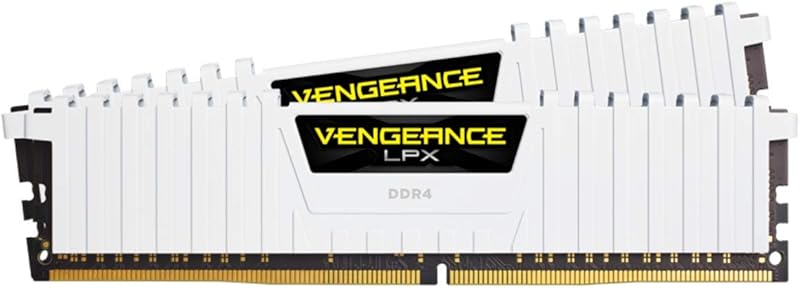
Chassis integration and physical compatibility often dictate whether a memory upgrade can even be installed. The Corsair Vengeance LPX is purpose-built for space-constrained environments, featuring a compact heatspreader with a low-profile height of just 34mm. This ultra-slim profile makes it effortless to seat beneath oversized dual-tower CPU air coolers or inside compact Mini-ITX cases where motherboard real estate is at an absolute premium. If space constraints are your primary concern, comparing slim options in our corsair vengeance lpx ddr4 3200 vs kingston fury beast ddr4 breakdown reveals just how critical millimetre-level clearance can be.
In contrast, the listing for the G.Skill Ripjaws V does not specify its exact module height. The aggressive, peaked styling of the Ripjaws series heatspreader traditionally extends further upward from the motherboard slot than low-profile kits, which can introduce physical interference when paired with low-hanging horizontal heatsinks or front intake fan assemblies. If your desktop build leaves minimal clearance around the DIMM slots, installing memory modules with unlisted or taller dimensions introduces the risk of having to offset cooling fans or alter component arrangements.
Having exact dimensions takes the guesswork out of system planning. The defined Corsair Vengeance LPX 3200 MHz RAM height allows PC builders to confirm clearance against CPU cooler specification sheets before purchasing, preventing frustrating build-day clearance surprises.
Edge: Corsair Vengeance LPX DDR4 3200 thanks to its clearly specified 34mm low-profile build that eliminates cooler overhang interference.
Kit Capacity and Multitasking Headroom
Memory capacity determines the volume of data your system can actively hold before relying on slower page files on your storage drive. The G.Skill Ripjaws V package provides a massive 64GB total capacity split across two 32GB dual-channel modules. A 64GB footprint is specifically configured to manage demanding modern multitasking, such as 4K video editing, heavy CAD rendering, large software compilation jobs, and running multiple background containers simultaneously without approaching capacity thresholds.
The Corsair Vengeance LPX configuration featured here delivers 32GB of system memory. For mainstream desktop computing, general content creation, and standard gaming environments, 32GB remains plenty of space. However, heavy professional applications that cache massive databases or high-resolution textures will eventually encounter memory pressure on a 32GB allocation. Those deciding between differing memory configurations across capacity tiers can review our corsair vengeance lpx ddr4 3200 vs vengeance rgb pro ddr4 analysis to see how Corsair sizes its performance lines.
With double the addressable space straight out of the box, the G.Skill kit offers extended functional longevity for users planning intensive workloads. Having 64GB installed across just two DIMM slots also leaves secondary slots open on four-slot motherboards, offering a clear upgrade trajectory that a smaller initial capacity configuration cannot match.
Edge: G.Skill Ripjaws V DDR4 3600 because its 64GB dual-channel capacity doubles the available working space for memory-intensive applications.
Thermal Dissipation and Structural Engineering
Stable memory operation under continuous electrical load requires efficient heat dissipation and sturdy structural construction. The Corsair Vengeance LPX features a heatspreader manufactured from pure aluminum, engineered to rapidly draw heat away from the individual integrated circuits. Furthermore, Corsair equips this module with an eight-layer printed circuit board (PCB). This multi-layered PCB design actively separates electrical traces to suppress signal interference and manage heat generation, creating clean electrical pathways that enhance overclocking stability.
The G.Skill Ripjaws V utilizes an engineered desktop heatspreader as well, packaged into a dual-module kit with an overall item weight of 120 grams. The listing confirms solid construction aimed at high-performance and gaming reliability, running safely at a standard 1.35V profile. However, the listing does not specify the exact PCB layer count or specific heatspreader alloy used in this particular Ripjaws SKU, leaving Corsair with the more transparent hardware specification sheet.
Both kits operate at identical 1.35V operational voltages, ensuring thermal output remains manageable under proper chassis airflow. Nevertheless, Corsair’s explicit focus on an eight-layer PCB structure combined with pure aluminum heat dissipation provides measurable structural reassurance for demanding builders who monitor internal module thermals closely.
Edge: Corsair Vengeance LPX DDR4 3200 due to its specified eight-layer PCB architecture and pure aluminum heat dissipation material.
Motherboard Optimization and Platform Synergy
Ensuring memory stability requires matching kit profiles with motherboard memory controllers. The G.Skill Ripjaws V listing highlights specific validation for mainstream platforms, noting it is designed specifically for AMD Ryzen X570 and B550 series chipsets, as well as Intel Z390, Z490 and newer motherboards. For PC enthusiasts debating Corsair Vengeance LPX or G.Skill Ripjaws V for Ryzen, the Ripjaws V holds an architectural advantage: 3600 MHz matches the preferred 1:1 Infinity Fabric clock ratio on third-generation and 5000-series AMD processors, delivering optimal interconnect efficiency.
The Corsair Vengeance LPX listing lists verified compatibility across Intel 300 Series, 400 Series, and X299 platforms, alongside broad optimization for both Intel and AMD DDR4 motherboards. It includes integrated support for Intel XMP 2.0, which allows users to engage rated 3200 MHz speeds and CL16 timings with a single BIOS setting. You can see how this kit lines up against other enthusiast modules in our corsair vengeance lpx ddr4 3200 vs g.skill trident z neo ddr4 match-up.
While both modules provide seamless one-step XMP setup on modern motherboards, G.Skill’s clear alignment with high-performance AMD 500-series chipsets and Intel Z-series boards makes it slightly more attractive for modern desktop gaming and overclocking builds.
Edge: G.Skill Ripjaws V DDR4 3600 thanks to targeted validation for AMD X570/B550 and Intel Z-series platforms running at optimal interconnect ratios.
Gaming Viability and System Responsiveness
When selecting Corsair Vengeance LPX DDR4 3200 or G.Skill Ripjaws V DDR4 3600 for gaming, frame pacing and minimum framerates take center stage. High-refresh-rate titles rely heavily on the memory subsystem to feed draw calls to the graphics card. The G.Skill Ripjaws V, pushing data at 3600 MHz, provides the sustained throughput necessary to reduce frame drops in asset-heavy, CPU-bound games. This gives competitive players consistent rendering performance across complex gaming scenes.
At the same time, the Corsair Vengeance LPX delivers reliable gaming execution thanks to its CL16 rating. Games that do not heavily saturate total memory bandwidth still benefit from tight cycle response times. If you are comparing stylish aesthetics and gaming performance among similar memory lines, check out our comparison between the corsair vengeance rgb pro ddr4 vs g.skill ripjaws v ddr4 3600 for further design context.
Although the Corsair kit handles modern gaming libraries comfortably, the combination of 3600 MHz data rates and double the total memory capacity gives the G.Skill kit the upper hand for contemporary gaming rigs running secondary utilities, streaming software, and communication clients in the background.
Edge: G.Skill Ripjaws V DDR4 3600 because its combination of 3600 MHz bandwidth and 64GB capacity offers superior headroom for modern high-refresh titles and multitasking.
Pros and Cons
Corsair Vengeance LPX DDR4 3200
Pros
- Low 34mm module clearance
- Tighter CL16 CAS latency
- Pure aluminum heatspreader
- Eight-layer PCB construction
- Hand-sorted memory chips
Cons
- Lower 3200 MHz transfer speed
- Smaller 32GB total capacity
View Corsair Vengeance LPX DDR4 3200 on Amazon
G.Skill Ripjaws V DDR4 3600

Pros
- Higher 3600 MHz frequency
- Massive 64GB dual-channel capacity
- Optimized for AMD X570 and B550
- Generous bandwidth for heavy workloads
Cons
- Looser CL18 CAS timings
- Listing does not specify height
View G.Skill Ripjaws V DDR4 3600 on Amazon
Who Should Buy Each One
Choose the Corsair Vengeance LPX DDR4 3200 If
- You are building in a compact Mini-ITX chassis where every millimeter of component height counts.
- You use a massive dual-tower CPU air cooler that hangs over the motherboard DIMM slots and requires low 34mm clearance.
- You prefer tighter CL16 memory timings to maintain low cycle latency at standard 1.35V profiles.
- Your system runs on Intel 300, 400, or X299 series motherboards with standard 3200 MHz sweet-spot limits.
Choose the G.Skill Ripjaws V DDR4 3600 If
- You run memory-heavy productivity tools, virtualization software, or video editing suites that demand a massive 64GB capacity.
- You utilize an AMD Ryzen system on an X570 or B550 motherboard that benefits directly from a 3600 MHz memory clock.
- Your desktop chassis provides open vertical clearance with an all-in-one liquid cooler or slim air heatsink.
- You want high-speed DDR4 performance to eliminate memory bandwidth bottlenecks in modern gaming and content creation.
Final Verdict
For users running modern desktop processors on AMD 500-series or Intel Z-series motherboards, the G.Skill Ripjaws V DDR4 3600 stands out as the stronger overall performer. By delivering a higher 3600 MHz data rate alongside a cavernous 64GB dual-channel configuration, this kit provides both the bandwidth and the storage density required for seamless high-load computing. Whether processing expansive creative timelines or driving competitive frame rates in demanding titles, the Ripjaws V kit ensures your system memory never serves as the primary system bottleneck.
On the other hand, the Corsair Vengeance LPX DDR4 3200 remains the definitive pick for compact builds and setups utilizing large air-cooling towers. Its guaranteed 34mm low-profile stature eliminates fitment headaches entirely, while its tighter CL16 latency and eight-layer PCB design provide rock-solid electrical stability. If chassis clearance, guaranteed cooler compatibility, and reliable 32GB baseline performance take precedence over peak clock frequency, the Corsair Vengeance LPX is the exact memory kit your build requires.
FAQ
What is the physical height of the Corsair Vengeance LPX DDR4 3200 modules?
The Corsair Vengeance LPX modules measure exactly 34mm in vertical height. This low-profile form factor is specifically engineered to fit inside small-form-factor PC enclosures and clear large CPU air-cooling heatsinks without physical interference.
Does the G.Skill Ripjaws V DDR4 3600 kit support dual-channel operation?
Yes, the listing confirms that this G.Skill Ripjaws V package is a dual-channel desktop memory kit containing two 32GB modules to provide a combined 64GB capacity operating over 288-pin UDIMM slots.
What are the exact latency timings on the G.Skill Ripjaws V DDR4 3600?
The G.Skill Ripjaws V DDR4 3600 is rated with a CAS latency of CL18, running with specific timing parameters of 18-22-22-42 at its standard 1.35V operating voltage.
Is Corsair Vengeance LPX DDR4 3200 worth it for small-form-factor builds?
Yes, the Corsair Vengeance LPX is exceptionally well suited for small-form-factor builds because its low 34mm height fits where taller heatspreaders collide with power supplies, case panels, or cooling radiators.
Can I run the G.Skill Ripjaws V DDR4 3600 kit on an AMD Ryzen system?
Yes, the G.Skill Ripjaws V memory listing explicitly notes that it is designed specifically for AMD Ryzen X570 and B550 series motherboards, alongside compatibility with modern Intel Z-series chipsets.
Do both memory kits require manual voltage adjustments to reach advertised speeds?
Both kits are engineered to run at their advertised clock speeds using standard 1.35V profiles. The Corsair Vengeance LPX supports Intel XMP 2.0 for one-setting configuration in your motherboard BIOS, and the G.Skill kit likewise supports standard XMP profile activation.