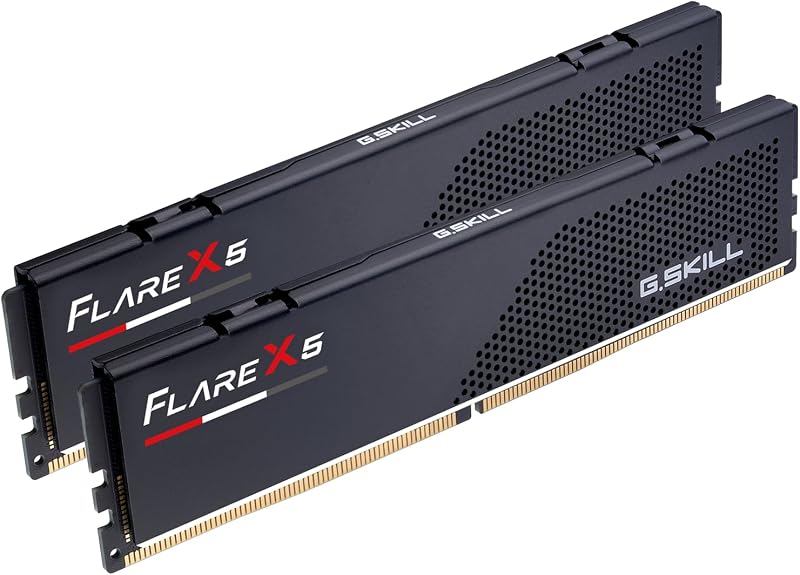
The decisive difference between the Corsair Vengeance RGB Pro DDR4 and the G.Skill Ripjaws V DDR4 3600 comes down to a clear division between visual customization and raw processing capacity. Corsair focuses heavily on dynamic multi-zone illumination managed by a proprietary software ecosystem, while G.Skill prioritizes operating frequency and double the total storage density in a discreet form factor.
Choose the Corsair Vengeance RGB Pro DDR4 if you prioritize customized internal illumination and balanced 32GB system memory for a showpiece desktop tower. Choose the G.Skill Ripjaws V DDR4 3600 if your workload demands 64GB of high-density memory running at 3600 MHz for demanding creative production and maximum memory bandwidth.
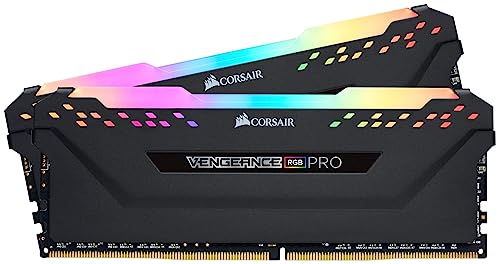

Corsair Vengeance RGB Pro DDR4 vs G.Skill Ripjaws V DDR4 3600 at a Glance
| Attribute | Corsair Vengeance RGB Pro DDR4 | G.Skill Ripjaws V DDR4 3600 |
|---|---|---|
| Total Capacity | 32 GB (2 x 16GB) | 64 GB (2 x 32GB) |
| Memory Speed | 3200 MHz | 3600 MHz |
| CAS Latency and Timings | CL16 (16-20-20-38) / Column Address Strobe Latency 15 listed | CL18 (18-22-22-42) |
| Operating Voltage | 1.2 volts / 1.35V listed | 1.35 volts |
| Lighting System | Dynamic multi-zone RGB (10 LEDs per module) | Not listed |
| Software Integration | Corsair iCUE with Light LINK | Not listed |
| Form Factor | 288-pin DIMM | 288-pin UDIMM |
| Platform Compatibility | Intel Z390, AMD 400 Series, 500 or X570 chipsets | AMD Ryzen X570, B550; Intel Z390, Z490 and newer |
| Module Weight | Lightweight (exact grams not listed) | 120 g |
| Best For | Showcase gaming rigs and synchronized RGB setups | High-density workstations and high-clock memory pipelines |
Memory Speed and Bandwidth Throughput
Operating frequency defines the operational tempo of system memory, dictating how many millions of transfer cycles occur every second. The DDR4 3200 vs 3600 comparison highlights a measurable split in throughput potential. G.Skill provides an out-of-the-box transfer rate of 3600 MHz (PC4-28800), offering substantially higher theoretical data bandwidth than Corsair’s rated 3200 MHz speed. For memory-bound processes such as large database lookups, multi-track audio processing, and texture streaming in open-world game engines, greater raw clock speed shortens processing queues between the system processor and physical memory banks. Corsair registers a transfer rate specification of 12 gigabits per second, which maintains steady standard throughput but yields to G.Skill’s faster factory clock.
Architecture matching is particularly relevant when deciding between Corsair Vengeance RGB Pro or G.Skill Ripjaws V for Ryzen desktop processors. Modern AMD processors tie their internal Infinity Fabric interconnect clock to the memory controller in a 1:1 ratio up to 1800 MHz. By utilizing memory running at 3600 MHz, G.Skill synchronizes natively with an 1800 MHz fabric clock without requiring memory divider adjustments. As noted in our analysis of corsair vengeance lpx ddr4 3200 vs g.skill ripjaws v ddr4 3600, reaching this speed milestone directly out of the box delivers noticeable memory latency benefits on AMD platforms.
Overclocking potential depends on the physical construction of the memory module. Corsair designs its memory with a custom performance PCB and carefully screened ICs intended to preserve signal integrity when pushing memory clocks beyond stock baselines. Enthusiasts can manually tune the Corsair modules to seek higher frequencies, but achieving stable operation at 3600 MHz depends on silicon quality. G.Skill supplies a factory-validated 3600 MHz rating, eliminating guesswork for users who want certified high-frequency operation without manual adjustments.
Edge: G.Skill Ripjaws V DDR4 3600 delivers higher factory-certified clock speeds that maximize system memory bandwidth without manual tuning.
Total Memory Capacity and Multitasking
Memory capacity sets the limit for how many concurrent applications, browser tabs, and background utilities a desktop can hold in high-speed storage before swapping data to slower system storage drives. G.Skill ships this Ripjaws V configuration as an expansive 64GB dual-channel kit comprised of two 32GB modules. Corsair supplies this Vengeance RGB Pro kit as a 32GB package split across two 16GB modules. While 32GB comfortably satisfies current gaming demands and standard office productivity, a 64GB configuration accommodates heavy production workflows without memory limitations.
Demanding tasks like 4K and 8K video timelines, complex CAD assemblies, software compilation, and running multiple virtual machines consume memory rapidly. A 64GB memory footprint allows professional creators to execute render queues in applications like Adobe Premiere Pro or DaVinci Resolve while keeping asset libraries open in the background. Builders examining our corsair vengeance rgb pro ddr4 vs g.skill trident z neo ddr4 guide frequently discover that memory density remains essential for productivity workstations. Additionally, deploying two 32GB sticks leaves two open slots on four-slot motherboards, preserving a path to 128GB.
High-density 32GB modules generally utilize dual-rank memory configurations, which take advantage of rank interleaving to execute memory requests in parallel. While Corsair’s 32GB setup provides adequate capacity for modern gaming, streaming setups, and typical daily multitasking, creative workstations can encounter bottlenecks during heavy data caching. G.Skill provides immediate capacity security for workloads that depend on sustained memory depth.
Edge: G.Skill Ripjaws V DDR4 3600 doubles the total memory pool to 64GB, delivering immense capacity for professional content creation and future expansion.
Lighting, Aesthetics, and Software Control
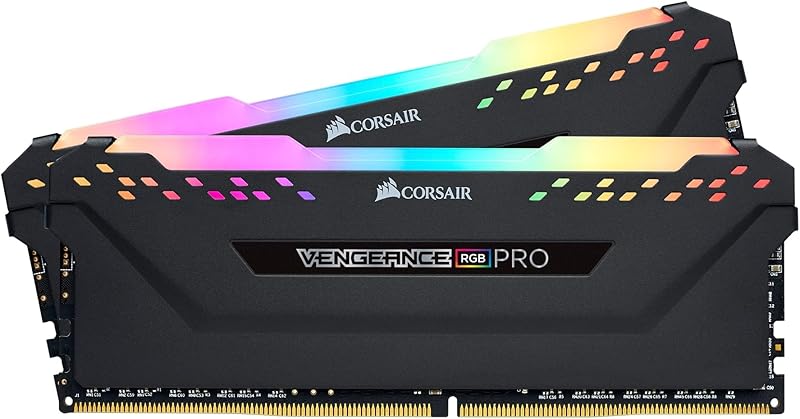
For custom desktop builders focused on internal visuals, the visual execution of memory modules is an important buying factor. Corsair outfits each Vengeance RGB Pro module with dynamic multi-zone illumination powered by ten ultra-bright, individually controllable RGB LEDs. An integrated light diffuser spans the entire upper edge of the module, blending illumination smoothly across distinct color zones. Corsair utilizes a wire-free installation layout that routes all necessary lighting power directly through the 288-pin motherboard socket, eliminating supplemental cables inside the case.
Software capability is where Corsair establishes an advantage in any Corsair Vengeance RGB Pro vs Ripjaws V comparison. Through Corsair iCUE software, users can customize individual LED zones, apply complex movement patterns, and link color states to system temperature readouts. The Light LINK feature enables unified color coordination across Corsair CPU coolers, case fans, and peripherals. As detailed in our comparison of corsair vengeance lpx ddr4 3200 vs vengeance rgb pro ddr4, selecting the RGB Pro series is primarily driven by this extensive visual software integration.
The G.Skill Ripjaws V DDR4 3600 listing does not specify any onboard illumination features. G.Skill equips the module with an angular black aluminum heat spreader designed for classic non-illuminated builds. This understated finish suits blackout builds, enterprise workstations, and setups where builders prefer to avoid background lighting utilities. However, for builders aiming to showcase illuminated components through a tempered glass side panel, G.Skill does not include RGB hardware on this model.
Edge: Corsair Vengeance RGB Pro DDR4 dominates on aesthetic appeal with ten individually addressable LEDs per stick and deep iCUE software integration.
Latency and Timing Performance
Memory latency measures the time delay between a command issued by the processor memory controller and the actual availability of the requested data. Corsair notes a rated CAS latency of CL16 with primary timings of CL16-20-20-38 (with listing attributes also referencing Column Address Strobe Latency 15) at a baseline voltage rating of 1.2V to 1.35V. G.Skill configures the Ripjaws V kit with a CAS latency of CL18 and factory timings of 18-22-22-42 operating at 1.35 volts. In any practical G.Skill Ripjaws V DDR4 3600 review, these primary timings represent standard timing parameters for high-density 3600 MHz memory.
Evaluating absolute latency requires analyzing both clock cycle speed and CAS latency together. Calculating true first-word response time reveals that 3200 MHz memory running at CL16 and 3600 MHz memory operating at CL18 both compute to approximately 10.0 nanoseconds. Corsair’s lower CAS number appears faster in isolation, but G.Skill’s faster 3600 MHz clock rate offsets its higher timing values. As noted in our evaluation of corsair vengeance rgb pro ddr4 vs kingston fury beast ddr4, identical absolute response times mean that real-world performance differences stem primarily from raw frequency rather than latency delays.
Corsair builds its kit with a custom performance PCB and screened ICs to maintain signal clarity, which is useful when fine-tuning memory configurations. G.Skill provides balanced CL18 stability under high-density 32GB module configurations at 1.35 volts. Because both models achieve an equivalent first-word latency of roughly 10 nanoseconds, neither product holds a tangible latency advantage during everyday desktop usage.
Edge: Tie. Both modules deliver an identical true first-word latency of approximately 10 nanoseconds once clock speed and CAS timing are factored together.
Platform Compatibility and Physical Clearance
Motherboard compatibility and physical clearance ensure smooth installation inside various chassis layouts. Corsair lists official support for desktop platforms built on Intel Z390 as well as AMD 400 Series, 500 Series, and X570 chipsets. G.Skill specifies readiness for AMD Ryzen X570 and B550 Series motherboards alongside Intel Z390, Z490, and newer DDR4 motherboards. Both memory kits employ the industry-standard 288-pin interface, providing straightforward physical socket compatibility with standard desktop motherboards.
Physical height becomes an important consideration when installing memory beneath large CPU air coolers. Corsair Vengeance RGB Pro features a taller heat spreader design to incorporate its multi-zone light bar. While the listing notes the modules as lightweight, their increased vertical profile can create physical interference with dual-tower air coolers that extend over the memory slots. In our guide on corsair vengeance rgb pro ddr4 vs crucial ballistix ddr4, cooler overhang often determines whether low-profile memory modules are required.
G.Skill lists the Ripjaws V kit with an item weight of 120 grams and a moderately profiled aluminum heat spreader. Without the extra height required for an LED diffuser bar, it fits more comfortably underneath oversized CPU heatsinks and ceiling-mounted liquid cooling radiators. For builders weighing Corsair Vengeance RGB Pro or G.Skill Ripjaws V for gaming chassis with limited internal clearance, G.Skill provides simpler mechanical compatibility across dense motherboard layouts.
Edge: G.Skill Ripjaws V DDR4 3600 edges ahead on physical cooler clearance and broad modern motherboard platform support.
Pros and Cons
Corsair Vengeance RGB Pro DDR4
Pros
- Ten individually addressable RGB LEDs per module
- Corsair iCUE software synchronization with Light LINK
- Custom performance PCB for enhanced signal quality
- Carefully screened ICs for extended stability
Cons
- Lower 3200 MHz speed than Ripjaws V
- Half the total memory capacity at 32GB
- Taller module profile can interfere with air coolers
View Corsair Vengeance RGB Pro DDR4 on Amazon
G.Skill Ripjaws V DDR4 3600

Pros
- Faster 3600 MHz operational clock speed
- Massive 64GB capacity across two modules
- Ideal 1800 MHz Infinity Fabric sync for Ryzen
- Compact profile with broad CPU cooler clearance
Cons
- No RGB lighting or visual customization
- Listing specifies no dedicated control software
View G.Skill Ripjaws V DDR4 3600 on Amazon
Who Should Buy Each One
Choose the Corsair Vengeance RGB Pro DDR4 If
- You want vibrant multi-zone RGB lighting with ten individually addressable LEDs per module visible through a case window.
- Your desktop ecosystem relies on Corsair iCUE software to coordinate lighting effects across liquid coolers, fans, and peripherals.
- A 32GB memory footprint fully satisfies your gaming and multitasking requirements without requiring extra capacity.
- You prefer clean cable-free memory installation that draws all illumination control directly through the motherboard DIMM socket.
Choose the G.Skill Ripjaws V DDR4 3600 If
- You run demanding workstation applications such as video editing, CAD modeling, or virtualization that benefit from 64GB of memory.
- You are configuring an AMD Ryzen build that benefits from 3600 MHz speeds matching the 1800 MHz Infinity Fabric clock.
- You use a large dual-tower air cooler that requires standard module heights without tall lighting diffusers.
- You prefer an understated blackout aesthetic that functions without background lighting control software.
Final Verdict
For builders focused on operational capability and platform throughput, the G.Skill Ripjaws V DDR4 3600 is the stronger choice. With an operating frequency of 3600 MHz and a total capacity of 64GB across two 32GB sticks, it provides extensive memory bandwidth and lasting headroom for complex workloads, content production, and modern gaming. In any G.Skill Ripjaws V DDR4 3600 vs Corsair Vengeance RGB Pro DDR4 comparison focused on raw capacity and clock frequency, G.Skill delivers superior hardware utility.
The Corsair Vengeance RGB Pro DDR4 remains the leading choice for custom builds where visual presentation is a core requirement. With ten addressable RGB LEDs per module and complete integration into the Corsair iCUE software ecosystem, it functions as an eye-catching visual element inside a transparent chassis. If 32GB meets your computing requirements and synchronized RGB lighting matches your build priorities, Corsair provides a reliable and stylish memory solution.
FAQ
Which memory kit performs better for gaming?
G.Skill Ripjaws V DDR4 3600 provides a performance edge in CPU-bound gaming scenarios due to its 3600 MHz clock frequency. Faster clock cycles increase overall bandwidth and enable 1:1 synchronization with the memory controller on modern AMD processors. However, for visual-focused gaming builds where 32GB is plenty of capacity, Corsair Vengeance RGB Pro DDR4 delivers dependable gaming performance alongside customizable RGB lighting.
Can I run the Corsair Vengeance RGB Pro DDR4 and G.Skill Ripjaws V DDR4 3600 together?
Combining these two memory kits is not recommended. They feature different clock speeds (3200 MHz vs 3600 MHz), different primary timings (CL16 vs CL18), different stick capacities (16GB vs 32GB), and different voltage baselines. Mixing modules with dissimilar specifications can cause system instability, memory training errors, or force the motherboard to downclock all sticks to the slowest common denominator.
Does the Corsair Vengeance RGB Pro DDR4 require separate cables for lighting?
No, the Corsair Vengeance RGB Pro DDR4 utilizes a wire-free design. All multi-zone RGB lighting power and data communication are handled directly through the standard 288-pin motherboard DIMM socket. Lighting adjustments, custom effects, and hardware synchronization are managed directly via Corsair iCUE software without auxiliary cables.
Is G.Skill Ripjaws V DDR4 3600 worth it for AMD Ryzen systems?
Evaluating whether is G.Skill Ripjaws V DDR4 3600 worth it for AMD platforms comes down to system architecture. Running memory at 3600 MHz allows third- and fifth-generation Ryzen processors to maintain an optimal 1:1 ratio with their 1800 MHz Infinity Fabric clock. This reduces latency across internal processor cores compared to running memory at slower 3200 MHz speeds.
What motherboards support these DDR4 memory kits?
Corsair lists compatibility with desktop motherboards featuring Intel Z390 as well as AMD 400 Series, 500 Series, and X570 chipsets. G.Skill specifies validation for AMD Ryzen X570 and B550 Series motherboards along with Intel Z390, Z490, and newer DDR4 platforms. Both kits require standard 288-pin DDR4 DIMM slots.
How do the timings and latency compare between these two kits?
Corsair features a primary CAS latency rating of CL16 with 16-20-20-38 timings (with CL15 also noted in listing attributes) at 3200 MHz, while G.Skill operates at CL18 with 18-22-22-42 timings at 3600 MHz. Although Corsair displays a lower CAS number, both kits calculate to an identical true first-word response time of approximately 10.0 nanoseconds because G.Skill’s faster clock cycles offset its higher timing values.