The primary distinction between the Corsair Vengeance RGB Pro DDR4 and the G.Skill Trident Z Neo DDR4 comes down to out-of-the-box operating frequency versus comprehensive software lighting control. Trident Z Neo targets maximum raw throughput with a factory XMP profile rated at 3600MHz, whereas Vengeance RGB Pro runs at 3200MHz while offering ten individually addressable LEDs per module configured natively through the Corsair iCUE ecosystem.
Choose the Corsair Vengeance RGB Pro DDR4 if you prioritize unified desktop aesthetic synchronization across existing Corsair components alongside dependable 3200MHz performance. Choose the G.Skill Trident Z Neo DDR4 if you want to push higher memory throughput for bandwidth-hungry workloads and AMD Ryzen gaming setups that thrive on 3600MHz speeds.
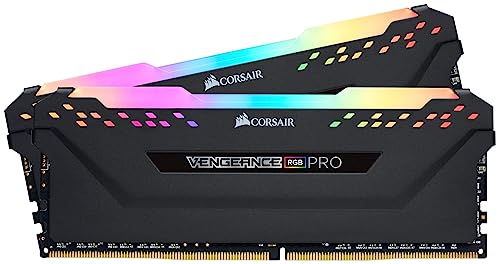
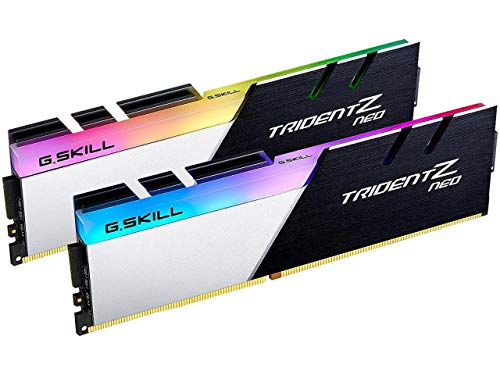
Corsair Vengeance RGB Pro DDR4 vs G.Skill Trident Z Neo DDR4 at a Glance
| Feature | Corsair Vengeance RGB Pro DDR4 | G.Skill Trident Z Neo DDR4 |
|---|---|---|
| Total Memory Capacity | 32 GB (2 x 16 GB) | 32 GB (2 x 16 GB) |
| Memory Generation & Form Factor | DDR4 DIMM (288-pin) | DDR4 U-DIMM (288-pin) |
| Advertised Memory Frequency | 3200 MHz | 3600 MHz (Up to 3600MT/s) |
| Primary Latency Timings | CL16-20-20-38 (CAS 15 listed in specs) | CL16-19-19-39 |
| Operating Voltage | 1.2V (1.35V listed in title) | 1.35V |
| RGB Lighting Control | 10 Ultra-bright LEDs via Corsair iCUE | Multicolor integrated light bar |
| Platform Validation | Intel Z390, AMD 400 Series, 500, X570 | Intel XMP profile and AMD platforms via QVL |
| Physical Dimensions | The listing does not specify | 5.2 x 0.67 x 1.7 inches |
| Item Weight | The listing does not specify (Lightweight) | 5.3 ounces |
| Best For | Corsair iCUE ecosystem builds | High-frequency AMD Ryzen systems |
Memory Speed and Throughput Performance
Memory frequency dictates how many data transfers a module completes each second, measured in megahertz or megatransfers. In high-refresh gaming and memory-intensive productivity, higher clock speeds allow the processor to access assets and compute threads with reduced waiting time. When analyzing Trident Z Neo vs Vengeance RGB Pro 3600MHz vs 3200MHz, this base clock variance serves as the defining operational difference between the two memory kits.
The G.Skill Trident Z Neo DDR4 operates at an advertised speed of 3600MHz (3600MT/s) when enabling its Intel XMP memory overclock profile in the motherboard BIOS. In contrast, the Corsair Vengeance RGB Pro DDR4 runs at an advertised frequency of 3200MHz, with a data transfer rate listed at 12 gigabits per second. That 400MHz frequency gap gives the G.Skill kit an immediate advantage in memory bandwidth, which directly benefits workloads that stream massive datasets through the system memory bus.
When weighing corsair vengeance rgb pro ddr4 vs g.skill ripjaws v ddr4 3600 or looking at Corsair Vengeance RGB Pro or G.Skill Trident Z Neo for gaming, the Trident Z Neo provides extra throughput overhead. That additional bandwidth yields higher minimum frame rates in modern titles that demand high data throughput, while the 3200MHz speed of the Corsair module remains a reliable baseline for general gaming tasks.
Edge: G.Skill Trident Z Neo DDR4 because its 3600MHz operating frequency delivers 400MHz more operational speed than the 3200MHz Corsair kit.
Primary Timings and Memory Latency
Clock speed represents only half of the performance equation; primary timings determine how many clock cycles pass before the memory executes read, write, or access commands. Lower timing numbers equate to faster internal responsiveness. When evaluating Corsair Vengeance RGB Pro DDR4 latency against G.Skill, the relationship between primary timings and clock cycles defines real-world memory responsiveness.
The G.Skill Trident Z Neo listing documents timings of CL16-19-19-39 at 1.35 volts. Corsair outlines timings of CL16-20-20-38 in its product title, while the technical specification section notes a Column Address Strobe latency of 15 alongside an operating voltage of 1.2 volts. While both kits feature a primary CAS latency of 16 at their rated profiles, Trident Z Neo maintains tighter secondary numbers (19-19 versus 20-20) despite running at a significantly higher clock rate.
In practice, running CL16 timings at 3600MHz results in a shorter absolute nanosecond delay than running CL16 timings at 3200MHz. Builders researching whether is G.Skill Trident Z Neo worth it will find that the combination of tighter internal delays and faster clock frequencies gives G.Skill a measurable responsiveness advantage during latency-sensitive operations such as competitive gaming.
Edge: G.Skill Trident Z Neo DDR4 because pairing CL16-19-19-39 timings with a 3600MHz frequency results in lower overall true latency than 3200MHz at CL16-20-20-38.
RGB Lighting and Ecosystem Integration
Visual customization has become a crucial criterion for modern desktop builds, requiring capable hardware and responsive software control. While both memory kits feature integrated lighting arrays embedded along the top of their heat spreaders, the implementation and control mechanisms differ drastically in day-to-day use.
The Corsair Vengeance RGB Pro DDR4 incorporates ten ultra-bright, individually addressable RGB LEDs inside each module. These lights interface directly with the Corsair iCUE software suite, which allows users to design multi-zone lighting patterns, monitor module temperatures, and link effects across cases, coolers, and peripherals using Light LINK. Anyone consulting a Corsair Vengeance RGB Pro DDR4 review will find that iCUE integration remains the primary selling point for this series, especially when comparing the kit in guides like corsair vengeance rgb pro ddr4 vs crucial ballistix ddr4.
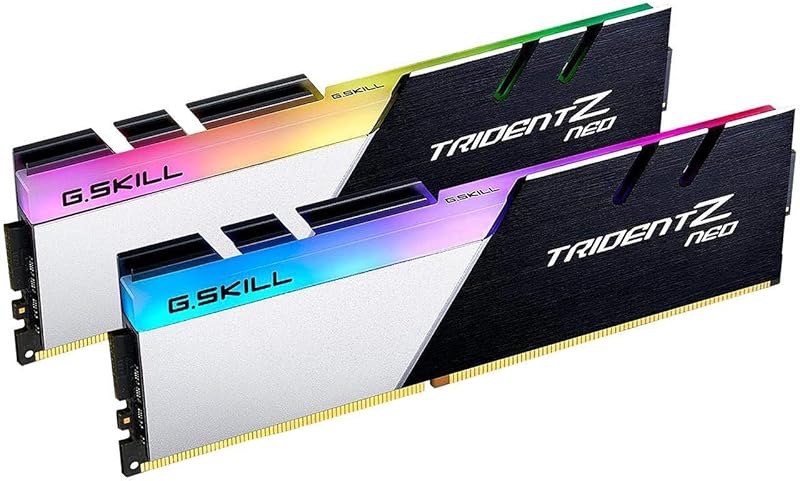
The G.Skill Trident Z Neo DDR4 features a multicolor light bar set inside a two-toned heat spreader. The product data notes that the modules boot using standard SPD settings and support multicolor illumination, but G.Skill does not provide a dedicated software ecosystem with peripheral synchronization on the scale of Corsair iCUE. PC builders asking is Corsair Vengeance RGB Pro worth it will discover that for comprehensive lighting customization, Corsair stands well ahead.
Edge: Corsair Vengeance RGB Pro DDR4 because its ten individually addressable LEDs per module and advanced iCUE software synchronization deliver far superior lighting control.
Platform Compatibility and System Optimization
Ensuring system stability requires selecting memory validated for your specific motherboard chipset and processor architecture. Different processor lines, particularly across Intel and AMD generations, handle memory frequency profiles and voltage regulation with varying degrees of sensitivity.
Corsair explicitly validates the Vengeance RGB Pro for Intel Z390 motherboards as well as AMD 400 Series, AMD 500, and AMD X570 chipsets. Corsair notes that its custom performance PCB and tightly screened ICs provide maximum bandwidth and tight response times optimized for the latest Intel and AMD DDR4 motherboards. Comparing options in our corsair vengeance lpx ddr4 3200 vs g.skill trident z neo ddr4 breakdown shows Corsair engineering geared toward broad, plug-and-play platform stability.
G.Skill specifically targets the Trident Z Neo series toward modern desktop platforms, highlighting validated compatibility through the G.Skill memory QVL (Qualified Vendor List) and RAM Configurator tool. The listing emphasizes that reaching its 3600MT/s speed requires overclocking and BIOS adjustments via Intel XMP profiles. When deciding between Corsair Vengeance RGB Pro or G.Skill Trident Z Neo for Ryzen, the 3600MHz frequency aligns directly with the optimal 1:1 Infinity Fabric clock on AMD platforms, offering superior system-level tuning harmony.
Edge: G.Skill Trident Z Neo DDR4 because its 3600MHz frequency is specifically tuned for optimal Infinity Fabric synchronization on AMD platforms, backed by G.Skill QVL testing.
Circuit Engineering and Memory Overclocking Profiles
System memory stability hinges on electrical trace routing, printed circuit board (PCB) quality, and the grading of the memory integrated circuits (ICs) soldered to the board. Memory kits operating at elevated frequencies require robust power delivery and stable signaling to prevent data corruption.
Corsair emphasizes hardware construction by utilizing a custom performance PCB engineered to deliver the highest signal quality for maximum stability. Corsair also specifies that it uses tightly screened memory with carefully tested ICs to enable extended overclocking potential. This makes the module an attractive option for builders cross-shopping alternatives like the corsair vengeance rgb pro ddr4 vs kingston fury beast ddr4.
G.Skill approaches hardware stability by supplying factory-matched kits designed to run together as a cohesive unit. The listing explicitly warns against mixing distinct memory kits, as combining sets can result in stability issues or boot failures. Regarding G.Skill Trident Z Neo DDR4 overclocking, the kit relies on pre-programmed Intel XMP profiles to run at 3600MHz at 1.35 volts, booting at safe JEDEC default SPD speeds until the profile is engaged. Both manufacturers apply rigorous screening, ensuring reliable high-speed operation within their rated parameters.
Edge: Tie because both kits incorporate custom performance circuit boards and tightly screened memory ICs designed for reliable profile loading.
Form Factor, Clearance, and Heat Spreader Construction
Physical dimensions dictate whether a memory module fits cleanly beneath large air coolers or inside compact mini-ITX cases. Tall heatsinks or bulky light diffusers can obstruct CPU cooler fans and complicate maintenance inside cramped chassis.
The G.Skill Trident Z Neo DDR4 listing provides exact physical dimensions of 5.2 x 0.67 x 1.7 inches and an overall weight of 5.3 ounces. The module features an aggressive, two-toned finned aluminum heat spreader designed to radiate heat away from the DDR4 SDRAM chips. At 1.7 inches tall, builders must account for cooler clearance before pairing it with dual-fan heatsinks.
For the Corsair Vengeance RGB Pro DDR4, the listing details do not specify exact length, width, or height measurements, though it classifies the unit as a standard 288-pin DIMM form factor and highlights its lightweight, wire-free design. As seen when comparing low-profile modules in corsair vengeance lpx ddr4 3200 vs vengeance rgb pro ddr4, full-sized RGB diffusers demand generous vertical headroom inside desktop enclosures.
Edge: Tie because both modules feature prominent top-mounted RGB light bars that require ample vertical clearance under large CPU tower coolers.
Pros and Cons
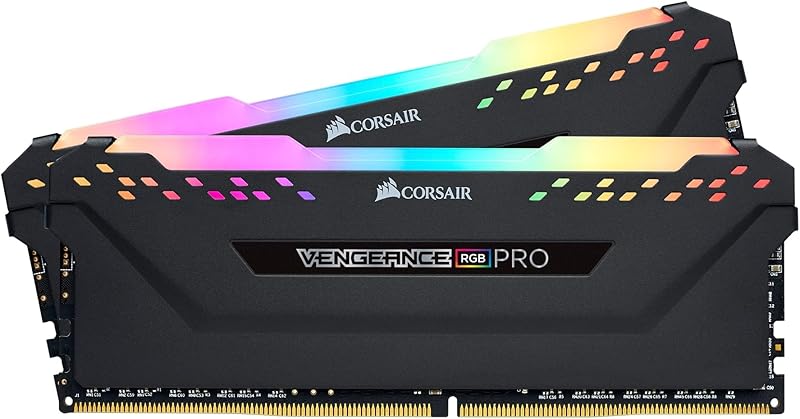
Corsair Vengeance RGB Pro DDR4
Pros
- 10 ultra-bright RGB LEDs per module
- Deep Corsair iCUE software integration
- Custom performance PCB for signal quality
- Screened ICs for extended overclocking
Cons
- Lower 3200MHz advertised frequency
- Looser CL16-20-20-38 secondary timings
View Corsair Vengeance RGB Pro DDR4 on Amazon
G.Skill Trident Z Neo DDR4
Pros
- Higher 3600MHz operating frequency
- Tighter CL16-19-19-39 latency timings
- Pre-programmed Intel XMP overclock profile
- Factory-matched kit ensures pair stability
- Validated across G.Skill motherboard QVL
Cons
- Requires BIOS adjustments to hit 3600MHz
- Less comprehensive RGB software ecosystem
View G.Skill Trident Z Neo DDR4 on Amazon
Who Should Buy Each One
Choose the Corsair Vengeance RGB Pro DDR4 If
- You already use Corsair hardware such as liquid coolers, cases, or fans and want synchronized lighting via iCUE.
- You want ten individually addressable RGB LEDs per module for intricate, multi-zone illumination effects.
- You prefer a plug-and-play 3200MHz memory profile that provides broad compatibility with Intel Z390 and AMD 400/500/X570 motherboards.
- You prioritize wire-free installation backed by a custom performance PCB built for steady signal stability.
Choose the G.Skill Trident Z Neo DDR4 If
- You run an AMD Ryzen system that benefits directly from a 3600MHz clock frequency to match processor fabric speeds.
- You want tighter primary timings of CL16-19-19-39 for reduced memory latency in competitive gaming.
- You want a pre-tested, factory-matched 32GB kit verified through the G.Skill QVL qualification database.
- You prefer an aggressive two-toned heat spreader aesthetic to complement your motherboard design.
Final Verdict
The G.Skill Trident Z Neo DDR4 earns our recommendation for the majority of PC builders and gamers looking to maximize system performance. By pairing an out-of-the-box 3600MHz clock speed with responsive CL16-19-19-39 timings, the Trident Z Neo delivers higher memory bandwidth and lower true latency. These attributes make it particularly effective for AMD Ryzen architectures, where memory clock speed ties directly to internal processing efficiency.
The Corsair Vengeance RGB Pro DDR4 remains the superior choice for users whose primary goal is aesthetic customization. Its ten individually addressable LEDs per stick and native integration with the Corsair iCUE software allow for lighting effects that standard RGB modules cannot match. If you prioritize visual coordination with an existing ecosystem of Corsair components, the Vengeance RGB Pro offers dependable 3200MHz stability with unmatched lighting flexibility.
FAQ
Can the G.Skill Trident Z Neo DDR4 run at 3600MHz without changing BIOS settings?
No, the listing specifies that the kit boots at JEDEC default SPD speeds under default BIOS settings. Achieving the advertised 3600MT/s speed requires enabling the Intel XMP memory overclock profile inside your motherboard BIOS.
How many RGB LEDs are included on each Corsair Vengeance RGB Pro DDR4 module?
Each Corsair Vengeance RGB Pro module features ten ultra-bright, individually controlled RGB LEDs embedded along the top diffuser bar.
Can I combine two separate 32GB kits of G.Skill Trident Z Neo DDR4 to get 64GB?
G.Skill advises against mixing memory kits, even if they share the same model number. Memory kits are sold in matched sets engineered to operate together, and combining multiple packages can lead to system instability or boot failure.
Which motherboards are compatible with the Corsair Vengeance RGB Pro DDR4 kit?
According to the product specifications, the Corsair kit is compatible with desktop computers featuring Intel Z390, AMD 400 Series, AMD 500 Series, and AMD X570 chipsets.
What are the physical dimensions of the G.Skill Trident Z Neo DDR4 modules?
The G.Skill Trident Z Neo DDR4 modules measure 5.2 inches in length, 0.67 inches in width, and 1.7 inches in height, weighing 5.3 ounces.
Does Corsair Vengeance RGB Pro DDR4 require external cables for lighting control?
No, the Corsair Vengeance RGB Pro utilizes a wire-free design that draws both power and control signals directly through the standard 288-pin DDR4 DIMM slot.