The single deciding factor between these two memory kits is physical clearance versus peak clock speed. Your decision rests almost entirely on whether your PC case and CPU cooling setup require a low-profile heatspreader that avoids physical interference, or if your chassis has ample room to support a taller, illuminated module that provides higher factory memory frequencies.
Choose the Corsair Vengeance LPX DDR4 3200 if you are assembling a compact desktop or running a large air cooler that demands guaranteed hardware clearance. Pick the G.Skill Trident Z Neo DDR4 if you want higher out-of-the-box data transfer rates, multi-zone RGB lighting, and an aggressive aesthetic for a standard windowed gaming rig.

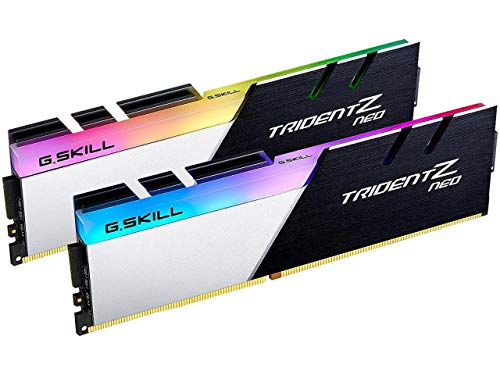
Corsair Vengeance LPX DDR4 3200 vs G.Skill Trident Z Neo DDR4 at a Glance
| Attribute | Corsair Vengeance LPX DDR4 3200 | G.Skill Trident Z Neo DDR4 |
|---|---|---|
| Memory Generation | DDR4 SDRAM | DDR4 SDRAM |
| Total Capacity | 32 GB | 32 GB (2×16 GB) |
| Rated Memory Speed | 3200 MHz | 3600 MHz (3600 MT/s) |
| Tested CAS Latency | CL16 | CL16 (16-19-19-39) |
| Tested Voltage | 1.35V | 1.35V |
| Module Height | 34 mm | 1.7 inches (approx. 43.2 mm) |
| Heatspreader Material | Pure aluminum | Aluminum with light diffuser |
| Lighting Type | Non-RGB | Multicolor (RGB) |
| Warranty Coverage | Limited lifetime warranty | Manufacturer warranty policy |
| Best For | Small-form-factor and tight cooler builds | High-bandwidth gaming and RGB aesthetics |
Memory Frequency and Real-World Speed
Rated memory frequency dictates the theoretical bandwidth available to your processor, measuring how many millions of data transfers occur every second. Operating at higher frequencies enables your system to shuttle data between the memory controller and active system processes with less delay. For users running high-refresh-rate monitors or memory-sensitive games, extra transfer speed can smooth out frame-time inconsistencies and raise minimum frame rates.
In this Corsair Vengeance LPX 3200 vs Trident Z Neo 3600 comparison, the specifications show an immediate divide. The Corsair Vengeance LPX operates at a base tested frequency of 3200 MHz, delivering a dependable baseline for DDR4 architectures. The Trident Z Neo pushes data rates higher to 3600 MHz (3600 MT/s). Both modules operate at a tested voltage of 1.35V, meaning G.Skill extracts that additional 400 MHz without requiring an increase in module operating voltage. When exploring platform transitions like ddr4 vs ddr5, users often find that a tuned 3600 MHz DDR4 kit represents the functional sweet spot for modern desktop architectures.
That extra 400 MHz bandwidth gives Trident Z Neo DDR4 Ryzen performance an operational advantage. AMD processors relying on an interconnected Infinity Fabric clock run at peak efficiency when the memory frequency operates in a 1:1 ratio with the fabric clock, which naturally peaks around 1800 MHz (equivalent to DDR4-3600). The Vengeance LPX provides perfectly adequate data throughput for everyday tasks and moderate gaming, but it cannot match the peak bandwidth delivered by the faster Trident Z Neo module right out of the box.
Edge: G.Skill Trident Z Neo DDR4 because its 3600 MHz frequency provides higher memory bandwidth and better alignment with high-performance desktop memory controllers at the same 1.35V rating.
Module Height and Physical Cooler Clearance
Module height is an unforgiving mechanical constraint when assembling desktop computers. Large twin-tower CPU air coolers frequently overhang the motherboard DIMM slots, leaving limited clearance for memory sticks. Similarly, compact mini-ITX enclosures route power cables, tubing, and low-profile cooling assemblies directly over the motherboard memory area, making tall heatspreaders impossible to install.
Physical dimensions highlight the most prominent engineering contrast in this Corsair Vengeance LPX vs Trident Z Neo height clearance matchup. The Corsair Vengeance LPX DDR4 3200 low profile design measures exactly 34mm in total height. This compact footprint lets it slide directly underneath nearly every oversized air cooler on the market without requiring you to offset intake fans or sacrifice cooling efficiency. When selecting hardware for a Corsair Vengeance LPX or Trident Z Neo for SFF build, the 34mm vertical measurement ensures compatibility with tight, small-form-factor internal layouts.
Conversely, the Trident Z Neo measures 1.7 inches tall (approximately 43.2mm) according to its listed dimensions. That extra 9.2mm of vertical height is occupied by its sculpted aluminum fins and top-mounted translucent light bar. In standard mid-tower chassis using all-in-one liquid cooling blocks, this height presents no obstruction. However, beneath bulky dual-fan air coolers, that extra height will force you to mount cooling fans higher on the heatsink fins or prevent installation entirely. If you have compared other illuminated kits in our corsair vengeance rgb pro ddr4 vs g.skill trident z neo ddr4 breakdown, you know that performance RGB modules almost universally require significant vertical space.
Edge: Corsair Vengeance LPX DDR4 3200 because its 34mm low-profile build guarantees effortless fitment under massive CPU air coolers and inside compact cases.
Timings, Latency, and Overclocking Architecture
Memory latency measures the delay between a command issued by the memory controller and the moment data becomes available. CAS latency (CL) counts this delay in clock cycles. When evaluating pure responsive speed, true latency is calculated by weighing clock cycle frequency against access cycle counts. A memory module with lower latency ratings executes read and write instructions faster, reducing micro-stutters during heavy computational loads.
Analyzing this Corsair Vengeance LPX DDR4 3200 review against the G.Skill Trident Z Neo DDR4 review reveals nuanced differences in timing structure. The Vengeance LPX features a rated CAS latency of 16 at 3200 MHz. Corsair equips this module with an eight-layer PCB and hand-sorted memory chips to ensure stable signal quality and thermal headroom for manual overclocking. Meanwhile, the G.Skill kit specifies full primary timings of CL16-19-19-39 at its higher 3600 MHz transfer rate. Because true latency is a function of both cycle time and CAS rating, 3600 MHz at CL16 delivers a lower absolute latency (roughly 8.89 nanoseconds) than 3200 MHz at CL16 (10.0 nanoseconds).
G.Skill also packages this Trident Z Neo offering as a verified factory-matched pair of two 16GB modules, designed specifically to operate in tandem without timing mismatches. G.Skill explicitly cautions users not to mix disparate memory kits to prevent system instability. While Corsair provides an eight-layer board with individually screened ICs for overclocking headroom, G.Skill delivers tighter absolute timings straight from its factory-tested profile.
Edge: G.Skill Trident Z Neo DDR4 because maintaining a CL16 rating at 3600 MHz delivers lower absolute memory latency than CL16 at 3200 MHz.
Aesthetics and Heatspreader Design
A memory module’s heatspreader manages thermal output while defining the visual character of your desktop interior. High-performance memory chips generate heat during continuous read and write operations, especially when operating at elevated voltages or under extended gaming sessions. Dissipating that thermal load prevents signal degradation and prolongs module lifespan.
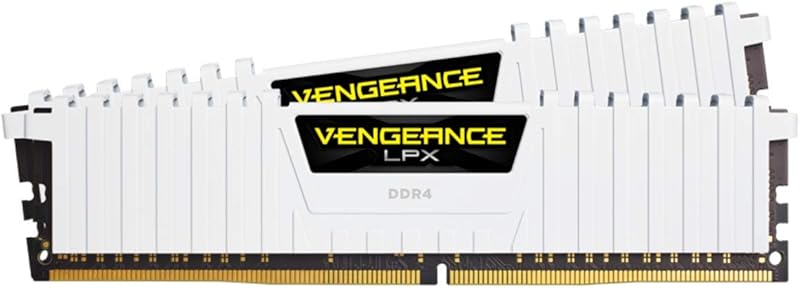
The Corsair Vengeance LPX uses a low-profile heatspreader crafted from pure aluminum. Corsair designs this component purely for functional efficiency, using horizontal ridges across the shell to maximize surface area for passive airflow dissipation. The listing notes that Vengeance LPX modules come in multiple color finishes-including the white model specified here-allowing clean color coordination without the complexity of power-drawing diodes. Builders seeking a stealthy, understated workstation aesthetic often prefer this design over flashier alternatives, as detailed in our corsair vengeance lpx ddr4 3200 vs kingston fury beast ddr4 guide.
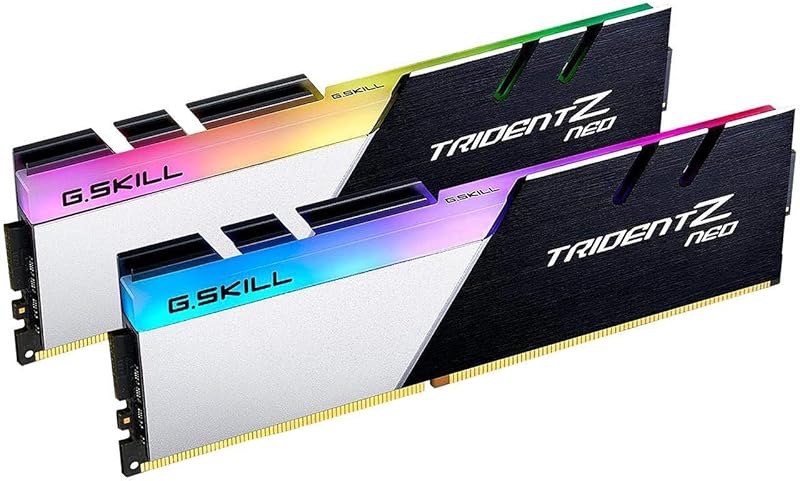
The G.Skill Trident Z Neo approaches heat dissipation with a blend of thermal metalwork and custom styling. It features a multicolor finish across a dual-toned brushed aluminum and silver heatspreader, topped with an integrated multi-zone RGB light diffuser. The module weighs 5.3 ounces, reflecting a dense, substantial heatsink assembly. For showcase gaming rigs with tempered glass side panels, the Trident Z Neo transforms functional memory into a central visual accent. However, users running closed-panel cases gain no functional benefit from the integrated lighting array.
Edge: Corsair Vengeance LPX DDR4 3200 because its pure aluminum heatspreader maximizes functional passive cooling without adding bulk, excess weight, or unnecessary lighting overhead.
Platform Compatibility and Setup Ease
Ensuring your memory kit boots cleanly at its rated performance profile requires proper motherboard and processor compatibility. While DDR4 is a universal standard, high-speed profiles rely on Intel Extreme Memory Profile (XMP) protocols to apply tuned frequencies, timings, and voltages without manual BIOS value entry.
Corsair engineered the Vengeance LPX for broad compatibility across multiple hardware generations. The listing confirms specific validation for Intel 300 Series, Intel 400 Series, and Intel X299 platforms, alongside general optimization for AMD DDR4 boards. It features full Intel XMP 2.0 support, allowing users to achieve the rated 3200 MHz speed with a single setting toggle in the motherboard firmware. The 3200 MHz frequency presents a modest workload for modern integrated memory controllers, making out-of-the-box stability virtually guaranteed across entry-level and older motherboards. Those comparing non-RGB options can see similar stability profiles in our corsair vengeance lpx ddr4 3200 vs g.skill ripjaws v ddr4 3600 analysis.
G.Skill also integrates an Intel XMP memory profile alongside standard JEDEC fallback profiles on the Trident Z Neo. The listing notes that the kit boots at default JEDEC speeds until the user enables the overclock profile in BIOS. G.Skill advises checking their Qualified Vendor List (QVL) or RAM Configurator tool before purchase, noting that reaching 3600 MT/s depends on motherboard and CPU capability. Pushing 3600 MHz requires a capable memory controller; older or budget motherboards may struggle to hold stability at this higher data rate. G.Skill does, however, provide a factory-tested matched kit of two 16GB DIMMs, eliminating pairing guesswork.
Edge: Tie because both kits offer reliable one-click Intel XMP 2.0 configuration, with Corsair providing broader tolerance on budget boards and G.Skill providing factory-matched dual-channel pairing.
Pros and Cons
Corsair Vengeance LPX DDR4 3200
Pros
- Low-profile 34mm height fits tight builds
- Pure aluminum heatspreader for heat dissipation
- Hand-sorted memory chips with eight-layer PCB
- Intel XMP 2.0 one-setting setup support
- Covered by a limited lifetime warranty
Cons
- Lacks integrated RGB visual lighting
- Lower 3200 MHz rated data speed
View Corsair Vengeance LPX DDR4 3200 on Amazon
G.Skill Trident Z Neo DDR4
Pros
- Higher 3600 MHz data transfer rate
- Tight CL16-19-19-39 latency timings
- Factory-matched 32GB dual-channel kit
- Multicolor RGB styling with light diffuser
Cons
- 7-inch height may block large coolers
- May require manual BIOS tuning to stabilize
- Heavier 5.3-ounce module construction
View G.Skill Trident Z Neo DDR4 on Amazon
Who Should Buy Each One
Choose the Corsair Vengeance LPX DDR4 3200 If
- You are building inside a small-form-factor or mini-ITX enclosure with limited interior clearance.
- You use a massive dual-tower air cooler that hangs low over your motherboard memory slots.
- You prefer a clean, understated workstation aesthetic without RGB lighting or excess software management.
- You want a dependable memory module backed by Corsair’s limited lifetime warranty coverage.
Choose the G.Skill Trident Z Neo DDR4 If
- You want 3600 MHz speeds to optimize memory bandwidth and Infinity Fabric ratios on AMD Ryzen platforms.
- You have a showcase desktop chassis with a transparent side panel and want vibrant multicolor lighting.
- You want a guaranteed factory-matched 32GB (2x16GB) dual-channel memory kit right out of the box.
- You possess a motherboard that fully supports higher-frequency DDR4 overclock profiles via XMP.
Final Verdict
When deciding between the Corsair Vengeance LPX DDR4 3200 and the G.Skill Trident Z Neo DDR4, your primary criteria are physical build boundaries and target performance metrics. The Corsair Vengeance LPX is the practical choice for space-restricted systems. At just 34mm tall, its pure aluminum heatspreader slides effortlessly beneath wide CPU air coolers and fits inside restrictive mini-ITX cases where taller modules simply cannot go. Its 3200 MHz CL16 specification delivers stable, reliable operation with virtually universal motherboard compatibility.
For standard ATX builds with unhindered clearances, the G.Skill Trident Z Neo DDR4 is the clear performance winner. Offering a 3600 MHz transfer rate while maintaining a low CL16 latency, it delivers superior theoretical bandwidth and responsive performance for high-end desktop computing. If your case accommodates its 1.7-inch height and your setup benefits from custom RGB illumination, the Trident Z Neo delivers the higher technical ceiling.
FAQ
Corsair Vengeance LPX or G.Skill Trident Z Neo for gaming?
For pure gaming performance, the G.Skill Trident Z Neo holds the advantage due to its higher 3600 MHz clock speed and CL16 latency, which supply greater memory bandwidth to reduce frame drops. However, if your gaming setup relies on a large air cooler that blocks the memory slots, the Corsair Vengeance LPX is the necessary option to guarantee physical fitment.
Is G.Skill Trident Z Neo DDR4 worth it over slower 3200MHz RAM?
The G.Skill Trident Z Neo is worth choosing if you run an AMD Ryzen system or high-refresh gaming setup where memory throughput directly impacts performance. The jump to 3600 MHz at CL16 provides measurable improvements in memory-intensive tasks without requiring higher operating voltages.
What is the exact height difference between these two modules?
The Corsair Vengeance LPX stands 34mm tall, making it a true low-profile module. The G.Skill Trident Z Neo measures 1.7 inches tall (approximately 43.2mm). This makes the Trident Z Neo roughly 9.2mm taller due to its integrated light diffuser and styled heatsink fins.
Do both memory kits support one-click setup using XMP?
Yes, both memory products feature Intel XMP support. The Corsair Vengeance LPX supports Intel XMP 2.0 for single-setting speed configuration, and the G.Skill Trident Z Neo includes an Intel XMP overclock profile to automatically apply its rated 3600 MT/s speed and timings in compatible BIOS environments.
Will the Corsair Vengeance LPX fit in small form factor PC cases?
Yes, the Corsair listing explicitly notes that its low-profile 34mm height ensures it fits inside most small-form-factor builds. Its compact dimensions make it an industry standard for tight chassis where space between the motherboard and power supply or cooling bracket is limited.
Does the Corsair Vengeance LPX DDR4 3200 feature RGB lighting?
No, the Corsair Vengeance LPX does not have RGB lighting. It is built strictly for compact thermal management using a solid aluminum heatspreader available in select solid colors, such as white. If you want Corsair memory with built-in illumination, examine our corsair vengeance lpx ddr4 3200 vs vengeance rgb pro ddr4 guide.
Can I mix different memory kits together in the same motherboard?
The G.Skill listing explicitly warns against mixing memory kits, noting that memory modules are sold in matched kits engineered to run together as a cohesive set. Combining modules from different packs or different manufacturers can result in timing mismatches, lower operational speeds, or total system failure.


