The fundamental difference that decides the choice between the DeWalt DCD771 and the DeWalt DCD998 is hammer drilling capability paired with heavy-duty motor output. The DCD771 is a compact drill driver built strictly for standard rotary drilling and screwdriving in wood, plastic, and light metal, whereas the DCD998 is an advanced brushless hammer drill engineered to power through tough masonry, concrete, and heavy structural timbers.
Homeowners, hobbyists, and light renovators looking for an easy-handling, complete starter kit should choose the DCD771 drill driver. Contractors, commercial tradespeople, and serious DIY builders who regularly encounter masonry work or require maximum torque under load should pick the DCD998 hammer drill.

DeWalt DCD771 vs DCD998 at a Glance
| Feature | DeWalt DCD771 | DeWalt DCD998 |
|---|---|---|
| Tool Classification | Compact Drill Driver | Heavy-Duty Hammer Drill |
| Motor Technology | High-Performance Motor (Brushed) | Brushless Motor with POWERDETECT |
| Power Output | 300 UWO (300 Watts) | 300 Watts (Up to 29% boost with 8Ah battery) |
| Torque Rating | 650 in-lb max (530 in-lb rated) | 80 N m (59.65 ft-lb) |
| Gearbox Speeds | 2-Speed (0-450 & 1,500 RPM) | 3-Speed All-Metal (Up to 2,800 RPM) |
| Hammer Action / Masonry | No (Not suitable for masonry) | Yes (Optimized for masonry materials) |
| Chuck Construction | 1/2-Inch Single Sleeve Ratcheting | 1/2-Inch Nitro-Carburized Metal with Carbide Inserts |
| Worklight Configuration | Standard Integrated Worklight | 3-Mode LED with 20-Minute Spotlight Mode |
| Item Dimensions | 13.88″L x 9.88″W x 4.25″H | 12.3″L x 8.7″W x 4.06″H |
| Bare Tool Weight | Not listed | 4.8 pounds |
| Included Equipment | 2x 1.3Ah Batteries, Charger, Contractor Bag | Tool Only |
| Best For | Light DIY, Drywall, and Cabinet Assembly | Masonry Drilling and Heavy Jobsite Framing |
Hammer Drilling and Masonry Capability
The presence of an internal hammer mechanism defines what a drill can physically accomplish when faced with concrete, brick, cinder block, or stone. Rotary drill drivers turn a bit purely through rotational torque, which works cleanly in wood and metal but creates friction, heat, and dull bits when pressed against dense masonry. A hammer drill introduces a high-frequency percussion action that pulverizes brittle masonry materials while the flutes evacuate dust from the hole.
When evaluating the dewalt dcd771 vs dcd998 hammer drill options, this mechanical divide is absolute. The product specifications for the DCD771 state clearly that it is a basic drill driver intended for wood, plastic, and light metal, and is explicitly not suitable for drilling into concrete or masonry. In contrast, the DCD998 is an authentic hammer drill built with a high-performance transmission optimized specifically for drilling in masonry materials. Choosing between the dewalt dcd771 or dcd998 for masonry is straightforward because only the DCD998 possesses the percussion mechanism required for tapcon anchors, brick anchors, and poured concrete work.
Attempting to force the DCD771 through foundation walls or mortar joints will quickly overheat its motor and damage standard bits. The DCD998 handles routine masonry boring without bogging down, giving remodelers and mechanical contractors the flexibility to work across both timber and stone on the same jobsite. If your upcoming projects include any anchoring into brick fireplaces, concrete slabs, or basement walls, the hammer mechanism on the DCD998 is an absolute necessity.
Edge: DeWalt DCD998 because it features a dedicated, heavy-duty hammer mechanism built to drill into masonry materials, while the DCD771 is strictly rated for non-masonry tasks.
Motor Performance and POWERDETECT Technology
Motor engineering dictates sustained power under load, heat management, and battery efficiency. Brushless motors eliminate physical carbon brushes, reducing mechanical friction, keeping operating temperatures cooler, and preserving electrical energy. In demanding applications such as boring large holes with spade bits or sinking structural timber screws, a superior motor design prevents thermal shutdowns and maintains constant rotational momentum.
A closer look at the dewalt dcd771 vs dcd998 specs reveals major differences in core powertrain design. The DCD771 uses a standard high-performance motor generating 300 unit watts out (UWO) with maximum torque ratings listed between 530 and 650 in-lb. While this dewalt dcd771 torque is more than sufficient for everyday drywall screws and furniture assembly, the DCD998 steps into commercial territory. It houses a high-efficiency brushless motor that delivers up to 57% more runtime compared to brushed equivalents. Readers exploring our dewalt dcd771 vs dcd777 comparison will note how brushless upgrades consistently transform real-world motor stamina.
Where the DCD998 truly distinguishes itself is through integrated dewalt dcd998 powerdetect tool technology. This internal circuitry actively communicates with high-capacity XR battery packs, recognizing when an 8Ah battery is installed. When equipped with that high-capacity pack, the drill outputs up to 29% more power and delivers 60% more runtime than standard XR drills. While the DCD771 works within a fixed electrical profile, the DCD998 scales its power delivery upward to meet extreme resistance.
Edge: DeWalt DCD998 because its brushless motor and POWERDETECT circuitry deliver substantial gains in efficiency, thermal management, and peak power under heavy resistance.
Speed Ranges and Transmission
Gear transmissions allow a drill to balance rotational speed against mechanical leverage. Low gear provides high turning force for large fasteners and wide boring bits, while high gear produces rapid spinning for clean, small-diameter holes in wood and metal. Having multiple mechanical gear selections allows an operator to match the drill’s rotational output to the specific hardness of the material and diameter of the bit.
The DCD771 relies on a dual-speed transmission offering a low setting from 0 to 450 RPM and a high setting up to 1,500 RPM. This two-range system works seamlessly for driving cabinet screws slowly without stripping threads, or switching into high gear to drill 1/4-inch holes in pine or drywall. Those looking at compact alternatives often examine our dewalt dcd771 vs dcd800 guide to see how gear configurations vary across basic and mid-range tiers.
The DCD998 incorporates a commercial-grade, 3-speed, all-metal transmission that reaches a maximum rotational speed of 2,800 RPM (and up to 78,000 revolutions per hour in specification listings). Having three distinct mechanical speeds gives operators an intermediate gear that standard two-speed drills lack, bridging the gap between delicate low-RPM driving and aggressive high-RPM boring. The rugged all-metal internal gearing on the DCD998 also withstands the violent internal stresses of hammer drilling and heavy structural drilling without stripping teeth.
Edge: DeWalt DCD998 because its 3-speed all-metal transmission provides a much higher 2,800 RPM top speed and an extra gear for precise application matching.
Chuck Construction and Bit Gripping
The chuck is the critical mechanical connection between the tool’s motor and the accessory bit. In demanding applications, high torsional stress can cause bits to slip inside the chuck jaws, scarring the bit shank and halting work. A quality chuck must resist rounding off under extreme torque while retaining smooth one-handed tightening operation for quick bit swaps on the job.
Any detailed dewalt dcd771 review must highlight its 1/2-inch single-sleeve ratcheting chuck. This chuck design provides solid grip for household shank diameters, accommodating drilling capacities up to 30 millimeters in wood and 13 millimeters in metal. For routine household repairs, shelf mounting, and light metal drilling, this single-sleeve mechanism is convenient and easy to lock down by hand. However, the external sleeve is largely polymer-based, which makes it lighter but more susceptible to scuffing against rough surfaces.
In contrast, any thorough dewalt dcd998 review will emphasize its heavy-duty 1/2-inch nitro-carburized metal chuck equipped with integrated carbide inserts. The nitro-carburized treatment hardens the steel shell against drop damage, abrasion, and harsh outdoor elements, while the carbide inserts bite directly into bit shanks to prevent slipping during intensive masonry percussion. For contractors using hole saws, large augers, or masonry bits, this chuck build provides far superior durability and bit retention.
Edge: DeWalt DCD998 because its heavy-duty nitro-carburized metal chuck features carbide inserts that eliminate bit slippage during high-torque and percussive tasks.
Worklight Modes and Visibility
Adequate illumination at the work point is essential for driving fasteners straight and landing drill bits precisely on center marks. When working inside dark lower kitchen cabinets, crawlspaces, attics, or unfinished basements, relying on a standalone flashlight is inconvenient. An integrated lighting system that stays illuminated can completely replace supplemental work lights in tight working quarters.
The DCD771 features an integrated worklight positioned to illuminate the immediate area around the chuck when the variable-speed trigger is engaged. This basic light functions well for general indoor tasks, providing adequate visibility for aligning screw tips with cabinet hinges or finding pre-drilled pilot holes. However, because it operates alongside the trigger cycle, it turns off shortly after the trigger is released, limiting its use as an ambient light source.
The DCD998 upgrades illumination significantly with an advanced 3-mode LED system rated up to 20 times brighter than previous generations. Alongside low and medium task lighting, it includes a dedicated LED spotlight mode equipped with a 20-minute shutoff timer. This extended lighting function allows the DCD998 to stand on its battery base and illuminate an entire electrical panel, plumbing bay, or dark mechanical closet hands-free without the operator needing to keep the motor running.
Edge: DeWalt DCD998 because its 3-mode LED is significantly brighter and includes an independent 20-minute spotlight shutoff mode.
Kit Contents and Battery Ecosystem
A cordless tool purchase must be weighed against what comes in the box versus what accessories you already own. A bare tool requires the separate acquisition of batteries and charging hardware, while an all-in-one kit allows immediate out-of-the-box operation. However, pairing a high-draw tool with an undersized battery pack can severely throttle its performance ceiling.
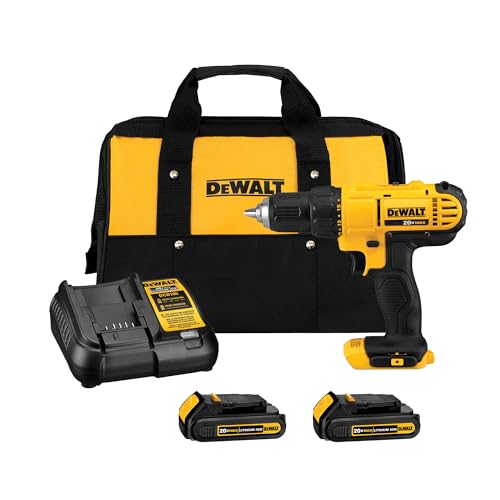
The DCD771 is sold as a full kit (model DCD771C2) containing the drill driver, two 20V MAX 1.3Ah lithium-ion compact batteries, a matching charger, and a rugged contractor bag. This complete package makes it exceptionally convenient for first-time cordless tool owners who do not possess existing DeWalt batteries. The lightweight 1.3Ah packs keep the total tool package compact and nimble, which reduces forearm fatigue when assembling modular furniture or working overhead. Those considering similar stepped-up options frequently study our dewalt dcd771 vs dcd996 breakdown for perspective on bundled accessories.
The DCD998 (model DCD998B) is sold as a bare tool without included batteries or a charger, weighing in at a substantial 4.8 pounds before a battery is even attached. Its 8A amperage rating and POWERDETECT technology require serious battery investment to realize its potential, specifically high-output packs like the 8Ah XR battery. For shoppers debating whether the dewalt dcd998 vs dcd771 fits their workflow, the DCD771 provides instant usability for beginners, while the DCD998 assumes you already operate within an established 20V XR battery collection. For further reading on bare-tool upgrades, check out our dewalt dcd777 vs dcd998 review or the dewalt dcd796 vs dcd998 guide.
Edge: DeWalt DCD771 because it includes two batteries, a charger, and a storage bag, offering immediate complete utility for buyers who do not already own 20V accessories.
Pros and Cons
DeWalt DCD771

Pros
- Complete kit with two batteries and charger
- Compact and lightweight for easy handling
- Two-speed transmission for common DIY fastening
- 300 UWO motor handles wood and light metal
Cons
- Not suitable for concrete or masonry drilling
- Lower 1500 RPM maximum rotational speed
- Plastic single-sleeve chuck without carbide inserts
DeWalt DCD998

Pros
- Hammer mechanism optimized for masonry materials
- Brushless motor with POWERDETECT technology
- Three-speed all-metal gearbox up to 2800 RPM
- Nitro-carburized metal chuck with carbide inserts
- Three-mode LED with 20-minute spotlight mode
Cons
- Sold as bare tool without battery or charger
- Heavier 4.8-pound bare tool weight
Who Should Buy Each One
Choose the DeWalt DCD771 If
- You need an all-in-one starter kit with two batteries, a charger, and a carry bag ready to use immediately.
- Your primary tasks involve routine home repairs, assembling furniture, hanging shelves, and installing cabinetry.
- You want a lightweight, compact tool body that reduces arm strain during overhead drilling and tight-quarter drywall work.
- You only drill into wood, plastic, drywall, and light metals, with no plans to drill concrete or brick.
Choose the DeWalt DCD998 If
- You require a high-performance hammer drill to bore holes into brick, poured concrete, and masonry materials.
- You already own or plan to purchase high-capacity DeWalt 20V MAX XR batteries to unlock POWERDETECT performance.
- You need the durability of a 3-speed all-metal transmission, top speeds of 2,800 RPM, and a nitro-carburized chuck with carbide inserts.
- You frequently work in unlit jobsite environments where a 3-mode LED with a 20-minute spotlight feature adds practical utility.
Final Verdict
Deciding between the dewalt dcd771 or dcd998 for diy comes down to matching the tool to the severity of your projects. The DCD771 remains an exceptional, practical pick for the vast majority of homeowners and casual hobbyists. It delivers ample power at 300 UWO, handles everyday wood and plastic boring effortlessly, and comes as a complete kit with two 1.3Ah batteries, a charger, and a contractor bag so you can start working immediately without buying separate accessories.
So, is dewalt dcd998 worth it? If your work involves masonry, foundation walls, heavy timber framing, or sustained commercial workloads, the DCD998 is unquestionably worth the investment. Its brushless motor, POWERDETECT technology, 3-speed all-metal gearbox, and heavy-duty hammer action give it an entirely different class of capability that the DCD771 cannot match. For pure DIY maintenance, buy the DCD771; for structural framing and masonry drilling, step up to the DCD998.
FAQ
Can the DeWalt DCD771 drill into concrete or brick?
No, the DCD771 is a basic rotary drill driver and does not feature a percussion hammer mechanism. The manufacturer explicitly states that it is not suitable for drilling into concrete or masonry, as forcing it into stone or brick will dull bits and potentially overheat the motor.
What does POWERDETECT mean on the DeWalt DCD998?
POWERDETECT is an advanced electronic tool technology built into select DeWalt cordless tools that actively identifies the battery pack attached. When paired with high-capacity XR batteries, such as an 8Ah pack, the DCD998 automatically increases its electrical throughput to deliver up to 29% more power and up to 60% more runtime compared to standard XR drills.
Do the DeWalt DCD771 and DCD998 share the same batteries?
Yes, both tools belong to the DeWalt 20V MAX cordless platform and can mechanically accept the same lithium-ion slide-style battery packs. However, while the DCD771 operates efficiently on small 1.3Ah compact packs, the high-draw brushless motor and POWERDETECT circuitry of the DCD998 require larger, high-capacity XR batteries to achieve their maximum power output.
Why does the DeWalt DCD998 have three speed settings instead of two?
The DCD998 features an all-metal 3-speed transmission to offer finer control across diverse applications. Speed 1 provides maximum torque at low RPM for driving wide structural fasteners, Speed 2 provides a balanced mid-range for general hole sawing and large wood boring, and Speed 3 reaches up to 2,800 RPM for rapid masonry hammer drilling and small-diameter metal boring.
Is the DeWalt DCD771 powerful enough for building a deck or framing?
The DCD771 can drive standard decking screws, bore pilot holes, and handle light-duty construction tasks using standard lumber. However, for continuous heavy-duty framing involving large structural timber screws, thick lag bolts, or dense wet framing lumber, its 300 UWO brushed motor will experience strain compared to heavy-duty brushless alternatives like the DCD998.
Does the DeWalt DCD998 come with a battery and charger?
The DCD998 listing is for the bare tool only (model DCD998B). It does not include a battery, charger, or storage bag, meaning you must already own compatible DeWalt 20V MAX batteries and a charger or purchase them separately to use the drill.