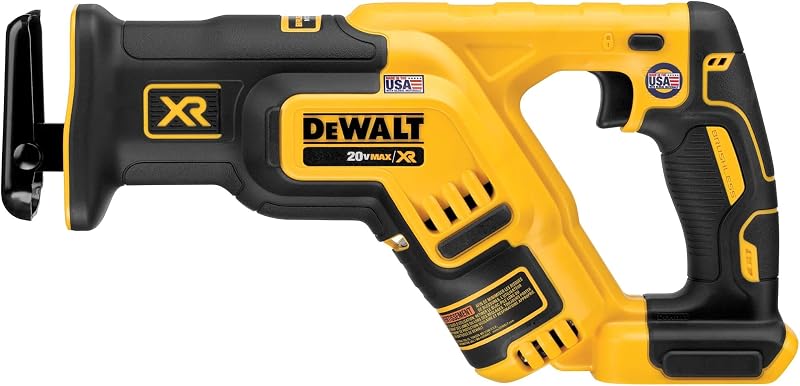
The fundamental dividing line in the DeWalt DCS367 vs DeWalt DCS380 matchup comes down to working clearance versus cutting leverage. While the compact DCS367 packages its power into a 14.5-inch overall footprint designed to slip between 16-inch framing studs, the traditional DCS380 utilizes a full-length layout fitted with an adjustable pivoting shoe that regulates blade engagement and maximizes leverage during heavy demolition cuts.
Plumbers, electricians, and remodelers navigating congested joists and stud cavities should choose the compact DCS367. Demolition specialists and rough carpenters who require an adjustable shoe to extend blade teeth life and control cutting depth will find the DCS380 better aligned with their workflow.


DeWalt DCS367 vs DCS380 at a Glance
| Feature | DeWalt DCS367 | DeWalt DCS380 |
|---|---|---|
| Motor Type | Brushless | Brushless |
| Stroke Length | 1-1/8 inches | 1-1/8 inches |
| Strokes Per Minute (SPM) | 0 – 2,900 SPM | 0 – 3,000 SPM |
| Overall Tool Length | 14.5 inches | Not listed |
| Tool Weight (Bare Tool) | 5.0 lbs (5.4 lbs item weight) | 2.41 kg (approx. 5.3 lbs) |
| Blade Clamp Mechanism | Keyless 4-position | Keyless lever-action 4-position |
| Shoe Design | Pivoting head | Pivoting adjustable shoe |
| Worklight | Built-in LED | Not listed |
| Shaft Protection | Not listed | Double oil sealed shaft |
| Best For | Stud bays, crawlspaces, and overhead cutting | General demolition and depth-controlled cuts |
Form Factor and Tight-Space Maneuverability
Reciprocating saws spend substantial time cutting inside wall cavities, crawlspaces, and crowded utility chases. In these environments, tool length determines whether you can make an orthogonal cut or must angle the blade obliquely, often damaging surrounding framing or mechanical runs. The primary advantage of a dewalt 20v compact vs full size reciprocating saw becomes apparent the moment you slide a tool into a standard 14.5-inch stud cavity.
According to the official specs, the Dewalt DCS367 brushless reciprocating saw measures exactly 14.5 inches in total length. This specific dimension allows trade professionals to place the rear handle and the front nose of the saw squarely between standard center-to-center wall framing studs without kinking the blade or contorting their wrists. Furthermore, with a bare weight of only 5.0 pounds (and an item shipping weight listed at 5.4 pounds), the DCS367 reduces operator strain when sawing overhead branches or cutting ceiling penetrations for hours at a time.
In contrast, the DCS380 adheres to a traditional elongated recip chassis. While the Amazon listing does not specify its exact operational body length beyond placeholder package figures, full-length tools in this class typically exceed 17 inches. When weighing dewalt dcs380 vs dcs367, that added length restricts the DCS380 from executing straight crosscuts inside closed framing bays. When evaluating cutting reach against alternatives like the dewalt dcs380 vs milwaukee 2720-20, users will find the DCS380 emphasizes forward reach rather than lateral clearance. At an item weight of 2.41 kg (roughly 5.31 pounds), it matches the compact model closely in overall mass, but the distribution of that mass sits farther forward from the main trigger grip.
Edge: DeWalt DCS367 due to its compact 14.5-inch length that fits cleanly between standard framing studs and lighter handling characteristics.
Shoe Mechanism and Blade Depth Control
The shoe of a reciprocating saw acts as a mechanical fulcrum against the material being cut. Firm shoe contact reduces tool chatter, prevents kickback, and transfers reciprocating motor power directly into chip removal. However, continuous cutting against a fixed point wears out blade teeth at the exact distance of the stroke, frequently leaving the rest of the blade sharp yet unusable.
The DeWalt DCS380 features a pivoting adjustable shoe. This mechanism allows the operator to extend or retract the shoe along the nose collar, altering where the 1-1/8-inch stroke cycle impacts the blade. By shifting the contact point, users can access unused blade teeth further along the shaft, significantly extending blade life across abrasive materials like nail-embedded wood and galvanized pipe. Additionally, the ability to lock shoe depth prevents the tip of the blade from striking hidden obstructions, such as electrical conduits or plumbing pipes seated just behind a substrate being opened.
On the other hand, the DCS367 incorporates a standard pivoting head rather than an adjustable shoe. The head pivots to follow uneven wall surfaces and maintain footing, but it does not telescope forward or backward to expose fresh teeth or set a specific cutting depth. While effective for flush stabilization, it lacks the modular depth regulation found on the full-length saw. Readers analyzing a dewalt dcs367 vs makita xrj05z comparison will note that shoe adjustability is often an intentional trade-off made to keep compact tools short.
Edge: DeWalt DCS380 because its adjustable shoe enables depth-of-cut regulation and significantly extends blade life.
Cutting Speed and Stroke Dynamics
Cutting cadence dictates how swiftly a reciprocating saw chews through dense structural lumber, cast iron, and heavy steel framing. Two primary specifications dictate this performance: stroke length (how far the clamp travels on each pass) and speed (strokes per minute, or SPM). A longer stroke length pulls more aggressive gullet teeth through the cut line with every cycle, preventing teeth clogging in wet or gummy woods.
When comparing the dcs367 vs dcs380 stroke length, both DeWalt tools share an identical 1-1/8-inch stroke cycle. This generous stroke length gives both units aggressive material removal rates compared to short-stroke mini-saws that typically register under one inch. However, there is a minor variance in maximum reciprocating velocity. The DCS380 features a variable speed trigger delivering up to 3,000 strokes per minute (SPM). This slight speed bump gives it the upper hand when cutting through soft materials or free-cutting lumber where rapid tooth movement clears sawdust immediately.
The DCS367 matches the 1-1/8-inch stroke length but tops out at 2,900 SPM (the spec sheet also notes 2800 rpm motor speed rating). In practical cutting applications, the 100 SPM variance between 2,900 and 3,000 SPM is virtually undetectable under load. Both saws use variable-speed triggers that let users crawl into delicate starts on pipe before running full-throttle. However, on pure manufacturer numbers, the DCS380 claims a marginally higher ceiling for raw cycling velocity.
Edge: Tie as both models feature identical 1-1/8-inch stroke lengths and a practically indistinguishable 100 SPM speed difference.
Motor Efficiency and Runtime Endurance
Cordless tools rely entirely on electrical efficiency to translate battery capacity into completed cuts per charge. Brushless motors eliminate physical carbon contact brushes, substantially mitigating internal friction, heat buildup, and energy waste. In contrast, standard motors generate heat through mechanical friction, drawing down battery reserves at a faster rate during sustained heavy loading.
The DCS367 is engineered as part of the 20V MAX XR line, highlighting a brushless motor design. DeWalt specifications state that this motor delivers up to 2.5 times more runtime on average when paired with a DCB205 5.0Ah battery compared to older legacy saws like the DC385 cutting 2×4 lumber. For tradesmen managing remote jobs without active charging stations, this brushless efficiency ensures more framing cuts, conduit slices, and rough-in notches per amp-hour. Those comparing the dewalt dcs367 vs milwaukee 2821-20 often look closely at brushless motor platforms to gauge battery longevity under full-day operations.
Turning to the DCS380, the product specifications list “Brushless” under its special features, yet the primary listing description focuses primarily on general 20V MAX battery platform integration rather than providing explicit runtime multipliers. It operates at 100 watts and requires 20V power packs. While it holds its own as a capable cordless workhorse, the listing data does not document the extended 2.5x runtime benchmark claimed by the XR-designated DCS367. The DCS367 remains the more clearly validated option for maximum cutting volume per battery charge.
Edge: DeWalt DCS367 thanks to its XR brushless motor architecture documented to deliver up to 2.5 times extended runtime.
Durability, Environmental Sealing, and Jobsite Illumination
Reciprocating saws routinely encounter abrasive debris, airborne gypsum dust, splattered water, and dimly lit workspaces. Tool durability and integrated sightline assistance directly dictate whether a saw survives repeated jobsite abuse and whether cuts land on mark.
The DeWalt DCS380 incorporates mechanical protections specifically targeted at high-abrasion environments. Its critical advantage is a double oil-sealed shaft. This redundant internal barrier actively resists contamination from entering the reciprocating drive gear assembly, preventing drywall grit and metal shavings from grinding down the internal drive mechanism. Furthermore, the DCS380 integrates a rubber overmolded comfort grip across its main handle to optimize hand control while dampening vibrations transmitted back from high-impact demolition cuts.
The DCS367 counters with superior visual utility. It features a built-in bright LED light positioned to illuminate the cutting path directly ahead of the blade clamp. In dark remodel situations, under sinks, or inside unlit crawlspaces, this integrated light eliminates the need to balance an auxiliary flashlight while operating a high-power saw. While the listing does not state whether the DCS367 features double oil sealing on its shaft, the LED inclusion addresses an everyday functional hurdle. However, regarding mechanical gear protection against contaminated air, the DCS380 carries explicit protective sealing.
Edge: Tie as the DCS380 provides superior mechanical protection via its double oil-sealed shaft, while the DCS367 provides built-in LED illumination for dark spaces.
Blade Versatility and Clamping Mechanisms
Changing blades quickly and orienting them to suit unusual angles is a staple requirement for professional reciprocating saws. Removing the need for hex keys or loose tooling speeds up workflow, while multi-directional clamping allows flush cutting against adjacent walls, subfloors, and headers.
Both models excel equally here by deploying a keyless 4-position blade clamp. The DeWalt system allows the operator to insert reciprocating blades facing upward, downward, leftward, or rightward. By turning the blade 90 degrees horizontally, users can execute true flush cuts against a stud, sill plate, or ceiling without bending the blade shaft or gouging surrounding lumber. The lever-action mechanism on both units enables fast, tool-free swaps even when wearing heavy leather work gloves.
Because both the DCS367 and DCS380 feature identical 4-position keyless clamping capabilities, neither model gains a mechanical edge in blade retention or directional flexibility. Whether making flush cuts across concrete slabs or trimming copper pipe flush with drywall, both tools provide the exact same clamp utility. Those exploring alternatives like the dewalt dcs380 vs makita xrj05z will appreciate that DeWalt’s 4-position clamp remains an industry standard for positional versatility.
Edge: Tie because both saws feature the exact same tool-free, 4-position keyless blade clamp system.
Pros and Cons
DeWalt DCS367
Pros
- Compact 14.5-inch length fits between studs
- Lightweight 5.0-pound bare tool chassis
- Integrated bright LED worklight
- Up to 2.5x more runtime efficiency
- Keyless 4-position blade clamp
Cons
- Shoe does not adjust for depth control
- Slightly lower maximum speed at 2,900 SPM
DeWalt DCS380

Pros
- Pivoting adjustable shoe extends blade life
- Higher maximum speed at 3,000 SPM
- Double oil-sealed shaft resists contamination
- Rubber overmolded comfort grip
- Keyless 4-position blade clamp
Cons
- Longer frame restricts tight-space access
- No integrated LED worklight listed
Who Should Buy Each One
Choose the DeWalt DCS367 If
- You regularly work inside standard 16-inch center stud bays or tightly packed joist layouts where tool length determines access.
- You require a lightweight bare tool (5.0 pounds) to minimize forearm fatigue during sustained overhead cutting.
- You work in unlit basements, crawlspaces, or utility chases that benefit from the built-in LED worklight.
- You want the high-efficiency XR brushless motor documented to deliver up to 2.5x more runtime per battery charge.
Choose the DeWalt DCS380 If
- You perform heavy demolition where an adjustable shoe is necessary to vary depth of cut and protect unseen utilities.
- You want to maximize blade lifespan by moving the contact shoe to expose unused blade teeth.
- You routinely cut in abrasive, dusty environments and need the protection of a double oil-sealed shaft.
- You prefer a slightly higher free-speed cutting rate of 3,000 SPM for aggressive demolition tasks.
Final Verdict
For the majority of modern tradespeople and general DIYers, the DeWalt DCS367 is the superior all-around selection. Its 14.5-inch compact chassis solves the most common limitation of standard reciprocating saws: cutting between studs and maneuvering in tight, congested locations. When combined with an integrated LED worklight, 1-1/8-inch stroke length, and an XR brushless motor platform engineered for up to 2.5 times extended runtime, the DCS367 delivers modern jobsite versatility that outmatches traditional full-length form factors.
Nevertheless, the DeWalt DCS380 remains an indispensable tool for dedicated rough demolition and heavy remodeling. Its pivoting adjustable shoe gives users precise control over depth of cut while dramatically extending blade usability across abrasive materials. Paired with a double oil-sealed shaft that repels grit and moisture, plus a slightly faster 3,000 SPM motor, the DCS380 stands as a durable, heavy-leverage solution for users who have ample working clearance and prioritize blade longevity.
FAQ
Can the DeWalt DCS367 fit between standard 16-inch framing studs?
Yes. The DeWalt DCS367 has an overall length of 14.5 inches, specifically designed to fit within the typical 14.5-inch clear space found between framing studs spaced 16 inches on center.
Does the DeWalt DCS380 have an integrated LED worklight?
The official listing data for the DeWalt DCS380 does not specify or include a built-in LED worklight, unlike the DCS367 which explicitly features an integrated bright LED to illuminate dark work areas.
What is the difference in stroke length between the DCS367 and DCS380?
There is no difference in stroke length. Both the DeWalt DCS367 and DeWalt DCS380 feature an identical 1-1/8-inch stroke length, delivering aggressive and fast cutting action across various materials.
How does the adjustable shoe on the DCS380 help extend blade life?
The pivoting adjustable shoe on the DCS380 moves forward and backward, allowing the user to change where the stroke engages the blade. This lets you utilize previously untouched teeth along the blade length rather than wearing down a single section.
Are both the DCS367 and DCS380 compatible with standard 20V MAX batteries?
Yes. Both tools operate on DeWalt’s 20-volt battery platform and are compatible with 20V MAX lithium-ion battery packs, which are sold separately from these bare tool offerings.
Can both saws make flush cuts against adjacent walls or floors?
Yes. Both models feature a keyless 4-position blade clamp that lets users insert blades sideways or upside down, allowing flush cutting against floors, walls, and studs without bending the blade.