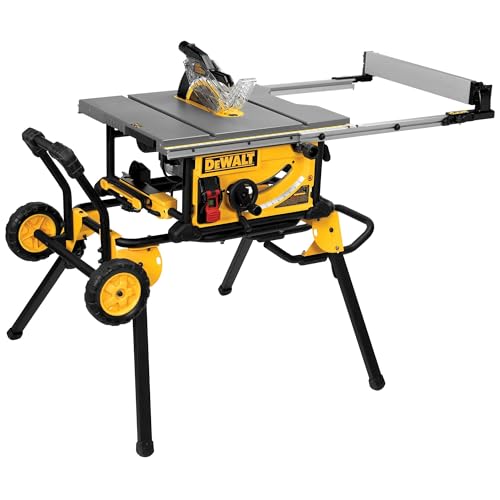
The single deciding factor between the DeWalt DWE7491RS and the DeWalt DWE7491X is the stand design: the DWE7491RS includes an integrated rolling stand with large wheels and folding legs, whereas the DWE7491X comes paired with a stationary folding scissor stand without wheels. Because both packages feature the exact same core 10-inch 15-amp table saw unit, choosing between them comes down entirely to whether your daily operations require rolling transit or a lighter total assembly to lift.
Solo contractors, remodelers, and tradespeople who regularly haul their gear across active jobsites should choose the DWE7491RS for its rolling mobility. Woodworkers with compact basement workshops or tradespeople who prefer a lighter package to hoist into a truck bed should select the DWE7491X.

DeWalt DWE7491RS vs DWE7491X at a Glance
| Attribute | DeWalt DWE7491RS | DeWalt DWE7491X |
|---|---|---|
| Stand Configuration | Foldable rolling stand with wheels | Folding scissor stand without wheels |
| Item Weight | 110 pounds | 87 pounds |
| Motor Rating | 15 Amp (4800 RPM) | 15 Amp (1800 Watts) |
| Rip Capacity | 32-1/2 inches | 32-1/2 inches |
| Depth of Cut at 90 Degrees | 3-1/8 inches | Not listed |
| Depth of Cut at 45 Degrees | 2-1/4 inches | Not listed |
| Dust Collection Port | 2-1/2 inches | 2-1/2 inches |
| Table Surface Dimensions | 21-7/8″ x 26-3/8″ | Not listed |
| Overall Dimensions | 31″L x 24″W x 28.52″H | 26.75″L x 26.75″W x 30.25″H |
| Best For | Solo jobsite mobility and frequent outdoor setup | Lighter lifting into vehicles and stationary shop setups |
Stand Mobility and Daily Transit
Mobility dictates how smoothly a commercial table saw fits into your day-to-day workflow. The DWE7491RS features a heavy-duty rolling stand engineered with integrated tubular steel legs, wide rubberized wheels, and a built-in pull handle. When folded, the stand remains attached to the saw base, forming an upright cart that functions much like a hand truck. You can tilt the entire assembly onto its wheels and roll it over extension cords, subfloors, and rough gravel without uncoupling the machine. When exploring a dewalt dwe7491rs vs bosch 4100xc-10 comparison, tradespeople often evaluate this exact style of integrated rolling base because it eliminates the strain of carrying heavy machinery across sprawling commercial properties.
In contrast, the DWE7491X ships with a traditional folding scissor stand. The scissor stand provides sturdy support when opened on level ground, but it features zero wheels. Moving the saw requires detaching it from the stand, moving the steel base separately, or picking up the combined unit with both arms. If you have to reposition your cut station multiple times a day on a large residential site, hauling a scissor-mounted saw by hand drains energy fast. However, if your cutting happens inside a single garage bay or a dedicated basement workshop where the machine remains parked in one corner, the rolling wheels on the DWE7491RS add unnecessary mechanical bulk.
This structural variance is central to any DeWalt DWE7491X stand comparison. The wheeled mechanism transforms the machine into an all-in-one transport cart, saving your back whenever distance is involved. The scissor stand is strictly a stationary platform that requires manual hauling whenever it needs to change zip codes or rooms. For workers tackling multi-room remodels or outdoor deck installations, the time and effort saved by wheeling the saw cannot be overstated.
Edge: DeWalt DWE7491RS provides vastly superior transit mobility across jobsite terrain thanks to its integrated rolling wheel system.
Weight and Lifting Dynamics
Weight is a double-edged sword when assessing jobsite machinery. The listed DeWalt DWE7491RS weight comes in at 110 pounds for the entire saw-and-stand package. That mass provides tremendous anchoring stability when running eight-foot framing lumber or full sheets of three-quarter-inch plywood through the blade. However, hoisting 110 pounds into a raised truck bed or navigating it up a narrow flight of porch stairs by yourself is a punishing endeavor. Solo operators must either lift the entire combined weight at once or spend extra time detaching the saw from the rolling frame.
The DWE7491X drops that total figure to 87 pounds, creating a significant 23-pound weight advantage. When conducting a DeWalt DWE7491X review, this lighter footprint emerges as a critical selling point for solo operators with smaller trucks or vans. The scissor stand separates rapidly from the saw chassis, allowing you to carry the saw body at a manageable weight and the scissor stand as a lightweight secondary piece. Lifting 87 pounds distributed across two quick trips is vastly easier on the shoulders and spine than wrestling a 110-pound rolling cart into a tailgate.
When weighing the DWE7491RS rolling stand vs scissor stand, consider your physical loading routine. If you own an enclosed trailer with a fold-down ramp, the 110-pound weight of the DWE7491RS is effortless because you simply wheel it up the incline. But if your daily routine involves deadlifting the unit over high truck bed sides, the 87-pound DWE7491X represents a much safer, back-friendly arrangement. Deciding whether the extra weight penalty is worth the rolling convenience depends entirely on how your equipment travels between locations.
Edge: DeWalt DWE7491X wins for physical lifting and vehicle loading due to its 23-pound lighter profile and easily separated scissor components.
Jobsite Setup and Working Stability
Deploying a table saw on an active jobsite requires rapid setup, easy leveling, and solid stance. The DWE7491RS rolling stand features spring-loaded release levers that let you kick out the legs, drop the saw into position, and secure the stance in seconds. The wide base footprint and low center of gravity prevent tipping, even when you push heavy framing timbers across the table surface. Installers ripping filler boards, decking planks, or exterior trim will appreciate how the rolling stand locks firmly into place without wobbling on uneven asphalt or compacted dirt.
The scissor stand bundled with the DWE7491X opens into an X-frame configuration. Setting it up requires manually spreading the steel legs until they lock, then aligning the saw’s rubber feet onto the mounting brackets. While the scissor base holds the saw firmly during standard crosscuts and narrow rip cuts, it features a slightly narrower stance than the wide-track rolling frame. Heavy material hung over the edge can cause minor flex if not properly supported, making external outfeed stands mandatory when feeding heavy dimensional lumber through the cut line.
When tradespeople ask whether the DWE7491RS or DWE7491X for jobsite duty is superior, setup repeatability plays a major role. The integrated stand of the DWE7491RS stays permanently squared to the machine, meaning you never lose mounting hardware or misalign the saw brackets during a frantic morning setup. The DWE7491X requires you to marry the saw and stand every morning and uncouple them at pack-out. While simple enough, managing two separate pieces adds minor friction to your daily jobsite routine.
Edge: DeWalt DWE7491RS delivers faster one-step deployment and greater operational stability on uneven outdoor ground.
Vehicle Storage and Footprint
Vehicle cargo space is prime real estate for any finish carpenter, framer, or flooring installer. The DWE7491RS measures 31 inches long by 24 inches wide by 28.52 inches high. Because the rolling stand wraps around the saw perimeter with rugged steel tubing and outboard wheels, it claims a noticeably wider, bulkier volume. To store it efficiently, many contractors stand the rolling frame vertically against a trailer wall. If you transport tools in a short-bed pickup with a tonneau cover or inside an SUV cargo hatch, the vertical height and axle width of the rolling stand can create real fitment headaches.
The DWE7491X listing specifies dimensions of 26.75 inches long by 26.75 inches wide by 30.25 inches high, reflecting the saw when mounted atop the open scissor stand. When broken down for transport, the scissor stand collapses completely flat, like a folding camp chair. You can slide the collapsed scissor stand behind a truck seat or tuck it beneath a job box, leaving only the bare square saw housing to sit flat in your trunk or truck bed. Comparing this configuration against other compact options like the dewalt dwe7485 vs dwe7491x highlights how valuable a detachable stand setup is for space-constrained tradespeople.
In a tight garage workshop, the DWE7491X also tucks onto a sturdy workbench or shelf whenever you need the floor space for assembly. The DWE7491RS, while capable of upright resting, remains locked into its tubular metal chassis. If your storage strategy relies on modular flexibility, storing the bare saw box separately from its support frame makes the DWE7491X the far more adaptable machine for tight quarters.
Edge: DeWalt DWE7491X provides a much more compact transport profile due to its flat-folding, separate scissor frame.
Cutting Performance and Fence Capacity
Underneath the different support stands, both the DWE7491RS and DWE7491X share the same mechanical cutting platform. Both units feature a powerful 15-amp corded electric motor capable of delivering 4800 RPM on the DWE7491RS (the DWE7491X listing notes 1800 watts, matching standard 15-amp 120V motor draws). Both saws provide an impressive 32-1/2-inch rip capacity to the right of the blade. This wide capacity enables users to slice full four-by-eight-foot plywood sheets down the center or rip wide shelving boards with ease, an ability explored extensively in any thorough DeWalt DWE7491RS review.
Both models utilize DeWalt’s signature rack-and-pinion telescoping fence system. This mechanism relies on gears driving tracks at the front and back of the table simultaneously, ensuring the fence remains parallel to the blade throughout travel without manual squaring. Both saws also incorporate a multi-position flip-over fence design that acts as a narrow rip support when working close to the blade. Whether you review a dewalt dwe7491rs vs skil ts6307-00 or evaluate a dewalt dwe7491x vs skil ts6307-00, this rack-and-pinion fence remains the benchmark standard for portable jobsite accuracy.
Blade depth specifications are also built for heavy stock. The DWE7491RS listing highlights a 3-1/8-inch maximum cutting depth at 90 degrees and a 2-1/4-inch cut depth at 45 degrees, allowing you to cut through two-by-four framing lumber in a single pass. Both models also feature a standard 2-1/2-inch dust collection port on the rear shroud to hook directly up to a jobsite vacuum. Because the saw core, arbor assembly, and fence rack are identical between the DWE7491X vs DWE7491RS, your cut precision and feed rate will be completely indistinguishable between the two machines.
Edge: Tie. Both saws utilize identical 15-amp motors, rack-and-pinion fence rails, and 32-1/2-inch ripping capacities.
Safety Systems and Onboard Storage
Jobsite safety and accessory organization keep production moving without dangerous delays. Both models feature the modular Site-Pro guarding system, which allows tool-free removal and adjustment of the blade guard assembly, anti-kickback pawls, and riving knife. Tool-free swapping makes it easy to switch from full through-cuts to non-through dado cuts without hunting for an Allen wrench. Both saws also feature an integrated blade brake listed in their core specifications to stop the blade promptly after releasing the power paddle.
Where these tools keep you organized on the jobsite is their integrated housing. The DWE7491RS features dedicated onboard storage clips for the push stick, blade guard assembly, riving knife, miter gauge, rip fence, cord wrap, and blade wrenches. Everything clips directly into the impact-resistant roll cage. The DWE7491X includes those same mounting points on the saw base itself, so you never have to toss sharp push sticks or guard parts into a loose tool bucket. When evaluating higher-end safety options like the dewalt dwe7491rs vs sawstop jss-120a60 or dewalt dwe7491x vs sawstop jss-120a60, users frequently note that DeWalt’s accessory retention and mechanical guarding remain exceptionally practical for rapid jobsite workflows.
The only slight variance in the Amazon product data relates to the packaged blade teeth. The DWE7491RS includes a 10-inch 24-tooth carbide blade optimized for aggressive construction rip cuts in hardwoods and framing lumber. The DWE7491X listing mentions both a 10-inch 24-tooth carbide blade in its components list and 50 teeth in its specification breakdown, which represents either a finer crosscut blade or a catalog spec discrepancy. Beyond that listing quirk, the onboard safety architecture and accessory containment systems on both saws function identically.
Edge: Tie. Both models share the tool-free Site-Pro guarding system, mechanical blade brake, and integrated accessory storage mounts.
Pros and Cons
DeWalt DWE7491RS

Pros
- Integrated heavy-duty rolling stand
- Large wheels navigate jobsite terrain
- 32-1/2-inch rip capacity
- Precise rack-and-pinion fence
- Complete onboard tool storage
Cons
- Heavy 110-pound total weight
- Larger vehicle cargo footprint
View DeWalt DWE7491RS on Amazon
DeWalt DWE7491X

Pros
- Lighter 87-pound total assembly
- Detachable flat-folding scissor stand
- Identical 32-1/2-inch rip capacity
- Powerful 15-amp 1800-watt motor
- Smaller vehicle storage footprint
Cons
- Stand lacks wheels for rolling
- Must be lifted and carried manually
View DeWalt DWE7491X on Amazon
Who Should Buy Each One
Choose the DeWalt DWE7491RS If
- You are a solo remodeler, framing contractor, or deck builder who moves cutting equipment across rough outdoor jobsites, gravel driveways, or unfinished subfloors.
- You transport tools in an enclosed trailer with a ramp or a full-sized truck where rolling a 110-pound integrated unit is practical.
- You want a one-step scissor-lever setup that snaps open and locks into an ultra-wide, wobble-free stance without detaching parts.
- You prefer an all-in-one cart design where the frame, wheels, and saw remain unified through transit and jobsite teardown.
Choose the DeWalt DWE7491X If
- You work out of a compact garage workshop, basement, or utility shed where you want the option to uncouple the saw and store it on a workbench.
- You lift your tools solo into a standard car trunk, SUV hatch, or elevated truck bed and need the 23-pound weight savings of the 87-pound setup.
- You prefer a detachable scissor stand that folds completely flat against a wall or slides behind vehicle seats.
- You do not need to wheel your machine across large construction sites and want the proven 32-1/2-inch rip performance in a more compact overall package.
Final Verdict
When asking is DWE7491RS worth it, the answer depends entirely on your transport logistics. For the vast majority of mobile contractors, commercial carpenters, and solo remodelers, the DeWalt DWE7491RS is the superior package. The rugged rolling stand completely solves the burden of relocating a 10-inch commercial saw across lawns, dirt, and rough framing sites. Being able to tilt the frame back and roll your entire cutting station with one hand saves time and physical stamina, easily justifying the heavier 110-pound total build.
On the flip side, is DWE7491X worth it for stationary shops and tight transport setups? Absolutely. If you do not have long distances to wheel your equipment, paying the weight penalty of a heavy rolling frame makes little sense. The DeWalt DWE7491X delivers the exact same 15-amp motor, rack-and-pinion telescoping fence, and wide 32-1/2-inch rip capacity while shedding 23 pounds of dead weight. For woodworkers who keep their saw on a stationary bench or operators who must hoist their equipment into a covered pickup bed daily, the DWE7491X remains an outstanding, space-conscious workhorse.
FAQ
Are the table saws on the DWE7491RS and DWE7491X identical?
Yes. Both models feature the exact same DeWalt 10-inch jobsite table saw base, utilizing a 15-amp motor, a 32-1/2-inch rip capacity, a rack-and-pinion telescoping fence, a 2-1/2-inch dust collection port, and the tool-free Site-Pro modular guarding system. The sole difference between the two packages is the included stand configuration.
Can I detach the DWE7491RS saw from the rolling stand?
Yes. The saw is bolted to the tubular steel rolling stand with standard mounting hardware. You can remove the saw body from the rolling chassis if you need to mount it permanently to a dedicated workshop bench, though it is designed to remain permanently attached for rolling transit.
Can you add wheels to the DWE7491X scissor stand?
The scissor stand included with the DWE7491X is engineered as a static X-frame support with rubberized feet. It does not feature mounting points or hardware for wheels. If rolling transport is a requirement for your workflow, purchasing the DWE7491RS with the factory rolling stand is the recommended route.
What is the weight difference between the DWE7491RS and DWE7491X?
According to the product specifications, the DWE7491RS weighs 110 pounds with its integrated wheeled rolling stand, while the DWE7491X weighs 87 pounds with its folding scissor stand. That creates a 23-pound difference, making the DWE7491X significantly lighter to deadlift into vehicles.
What is the maximum rip capacity on both saws?
Both models feature a 32-1/2-inch rip capacity to the right of the blade. The rack-and-pinion fence rails telescope outwards smoothly to accommodate wide sheet goods, cabinet filler panels, and large shelving boards.
Does either model support a vacuum for dust extraction?
Yes. Both the DWE7491RS and DWE7491X are equipped with a 2-1/2-inch dust collection port located on the rear of the blade shroud. This port connects directly to standard shop vacuums or dedicated dust extraction systems to keep your workspace clear of sawdust.
Do these saws come with an electric blade brake?
Both product listings specify a brake under their special product features, ensuring the 10-inch blade comes to a controlled stop after the power paddle is shut off to enhance operator safety.