The core difference that separates these two moisture extractors comes down to daily removal capacity and automated drainage: the Midea Cube 50 provides heavy moisture extraction with an integrated vertical pump and an oversized tank for large areas, whereas the Waykar 34 Pint delivers ultra-low power consumption and quiet performance tailored to standard living quarters.
Choose the Cube 50 if you need to dry a damp basement or large open layout without the burden of constant manual dumping. Choose the 34 Pint if you want an energy-conscious, whisper-quiet dehumidifier for a bedroom, home office, or apartment.
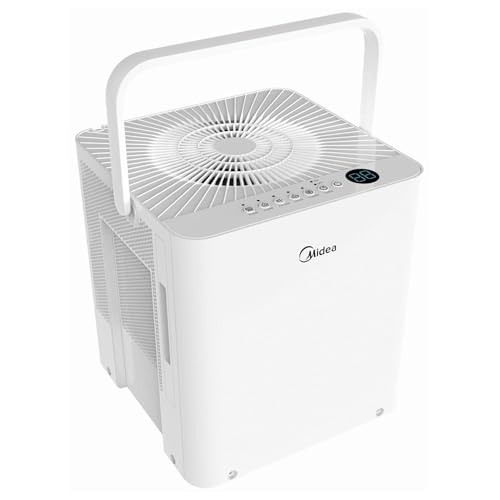

Midea Cube 50 vs Waykar 34 Pint at a Glance
| Feature | Midea Cube 50 | Waykar 34 Pint |
|---|---|---|
| Moisture Removal Rate | 50 pints per day | 34 pints per day |
| Rated Coverage Area | 4,500 sq. ft. | 2,000 sq. ft. |
| Water Tank Capacity | 4.2 gallons | 0.62 gallons |
| Drainage Mechanism | Built-in pump (16 ft hose) and continuous gravity | Continuous gravity drain (3.3 ft hose) and manual bucket |
| Power Consumption | 425 watts | 190 watts |
| Operating Modes | Continuous, target humidity (35% to 85%) | DEHU, DRY, CONT |
| Fan Speeds | 3 speeds | 2 speeds |
| Noise Level | Not listed | 38 dB (minimum) |
| Smart Connectivity | Wi-Fi, SmartHome app, Alexa, Google Assistant | Not listed |
| Dimensions and Weight | 14.45 x 14.76 x 14.57 inches, 43 lbs | 10.87 x 8.39 x 19.3 inches, 22.1 lbs |
| Best For | Large damp basements and hands-free pumping | Bedrooms, living rooms, and energy savings |
Moisture Removal Capacity and Room Coverage
Moisture removal capacity determines how rapidly an appliance can stabilize relative humidity in a saturated room. The Midea Cube 50 pulls up to 50 pints of moisture per day from ambient air, designed specifically for expansive areas up to 4,500 square feet. This volume allows it to tame deep structural moisture, crawlspaces, and humid open-plan levels where air volume overwhelms smaller hardware. When evaluating the frigidaire 50 pint dehumidifier vs midea cube 50, high-volume extraction remains the critical metric for preventing moisture buildup across broad floor plans.
By contrast, the Waykar 34 Pint is calibrated to collect 34 pints per day under standard testing conditions, designed for spaces up to 2,000 square feet. This output is suited for master suites, enclosed basements, kitchens, and individual apartments. While it can run continuously in severe dampness, pulling 34 pints per day means it will take substantially longer than a 50-pint compressor to pull humidity down to a target 45% or 50% threshold in an oversized room.
In a direct comparison of Midea Cube 50 vs Waykar 34 Pint capacity, the Midea extracts roughly 47% more water daily. If you are deciding between the Midea Cube 50 or Waykar 34 Pint for basement moisture issues, the higher throughput of the Cube prevents the compressor from running without stopping when damp weather strikes.
Edge: Midea Cube 50 provides significantly higher daily extraction and more than double the rated floor coverage.
Drainage Options and Built-In Pump Mechanics
Collecting water is only half the battle; disposing of it dictates your daily maintenance routine. The Cube 50 features an integrated vertical and horizontal water pump paired with a 16-foot drain hose. This pump physically lifts water against gravity, allowing you to route wastewater up into a laundry sink, out of a high basement hopper window, or directly into overhead plumbing pipes. It also provides a versatile no-bucket continuous drain setup where the main machine can sit directly over a floor drain without its bucket attached.
The Waykar 34 Pint relies solely on passive drainage. It includes a 3.3-foot gravity drain hose that connects to the rear condensation port. Because it lacks a motorized pump, water can only flow downward. If you intend to run continuous drainage without manual bucket maintenance, the Waykar must sit on a counter, shelf, or elevated platform higher than your drain opening. Shoppers reading a frigidaire 50 pint dehumidifier vs waykar 34 pint comparison often discover that the absence of a pump limits floor placement options in subterranean rooms.
When analyzing Waykar 34 Pint vs Midea Cube 50 drainage, the Cube eliminates the need to elevate the appliance. The Waykar gravity system is perfectly adequate if you have a sunken floor drain nearby, but the 16-foot powered hose on the Cube 50 offers complete freedom of placement anywhere in a room.
Edge: Midea Cube 50 wins easily due to its internal pump that overcomes gravity to discharge water through a 16-foot hose.
Bucket Size and Emptying Frequency
If you choose not to run a continuous hose, tank capacity dictates how often you must walk to the sink. The Midea Cube 50 incorporates an expansive 4.2-gallon water tank, engineered using a patented lift-and-twist structure. In extended mode, the main compressor unit nests on top of this large bucket, providing up to three times more volume than standard units. At maximum extraction, a homeowner might only need to empty the 4.2-gallon reservoir once every 16 to 24 hours.
The Waykar 34 Pint incorporates a much smaller 0.62-gallon water bucket. Under heavy humidity conditions where the unit approaches its 34-pint capacity, the reservoir can fill completely in less than five hours of continuous operation. Once full, the unit triggers its automated shutoff switch to prevent overflow, stopping dehumidification until you manually empty the bucket. Anyone weighing a midea cube 50 vs vremi midea 22 pint matchup knows that small tanks require rigorous personal attention throughout the day.
The tradeoff for the Cube 50’s autonomy is physical weight. When the Midea tank is filled to its 4.2-gallon limit, the water alone adds roughly 35 pounds to the machine’s 43-pound dry weight. The Waykar, with its 0.62-gallon tank, remains lightweight and easy to carry at 22.1 pounds, but requires routine vigilance if you rely on the internal tank.
Edge: Midea Cube 50 wins on tank autonomy, holding nearly seven times more water than the Waykar reservoir.
Energy Consumption and Operating Efficiency
Dehumidifiers often run for dozens of consecutive hours during humid summer months, making electrical draw a primary ownership factor. The Waykar 34 Pint operates at an ultra-low 190 watts. Certified as ENERGY STAR Most Efficient 2025, it uses an upgraded rotary compressor and 7mm high-tooth pure copper internal threading to maximize thermal conductivity while drawing minimal current. It also carries DOE and TUV energy certifications, making it one of the leanest compressor-driven units on the market.
The Midea Cube 50 requires 425 watts of electrical power. While it holds an ENERGY STAR certification, its larger compressor and internal water pump naturally pull more than double the wattage of the Waykar during active condensation cycles. In a household running a dehumidifier continuously through the season, the difference between 190 watts and 425 watts translates into distinct power consumption figures over several months of operation.
When asking homelabs 4,500 sq ft 32 pint vs waykar 34 pint questions or evaluating whether the Waykar 34 Pint is worth it for everyday living spaces, electrical efficiency stands out as its greatest strength. For moderate humidity issues where a 50-pint machine is excessive, the Waykar provides steady drying without placing unnecessary demand on your electric meter.
Edge: Waykar 34 Pint wins with an ultra-efficient 190-watt power draw and 2025 Energy Star Most Efficient rating.
Noise Output, Fan Control, and Smart Automation
Acoustic output and control mechanisms heavily influence where a dehumidifier can comfortably live inside a home. The Waykar 34 Pint specifies advanced noise reduction technology, delivering a minimum operating sound level of 38 dB on its low fan setting. It offers two fan speeds and three dedicated operation modes: Dehumidifying (DEHU), Drying (DRY), and Continuous (CONT). This hushed performance allows the Waykar to operate unobtrusively in a nursery, bedroom, or home office without disrupting sleep or telephone calls.
The Midea Cube 50 features three adjustable fan speeds and a multi-directional air intake system. While the listing does not specify exact decibel numbers, it integrates cloud-connected smart features that the Waykar lacks. Using the SmartHome app on iOS or Android, you can adjust target humidity between 35% and 85%, monitor water tank levels remotely, and automate schedules. It also responds to voice controls via Amazon Alexa and Google Assistant, giving it modern convenience for connected households. A glance at the midea cube 50 vs ge 50-pint wifi smart dehumidifier comparison highlights how valuable remote water-level alerts are when managing a basement unit.
Both units feature power-outage memory and auto-restart functions to resume settings after an electrical interruption, as well as automatic defrost sensors to protect internal coils in cooler temperatures. If raw acoustic quietness is your goal, the Waykar holds the advantage. If app tracking, voice activation, and smart scheduling take priority, the Cube 50 is the superior platform.
Edge: Tie. Waykar 34 Pint guarantees an ultra-quiet 38 dB sound floor, while Midea Cube 50 delivers full Wi-Fi and voice automation.
Pros and Cons
Midea Cube 50

Pros
- 50 pints per day heavy-duty extraction
- Built-in pump drains vertically up to 16 feet
- Massive 4.2-gallon water bucket
- Wi-Fi enabled with SmartHome app and voice control
- Covers large spaces up to 4,500 square feet
Cons
- Heavier 43-pound weight
- Higher power consumption at 425 watts
- Listing does not state decibel rating
Waykar 34 Pint

Pros
- Ultra-low 190-watt power consumption
- Whisper-quiet operation down to 38 dB
- ENERGY STAR Most Efficient 2025 certified
- Lightweight 22.1-pound frame for easy moving
Cons
- Small 0.62-gallon water tank fills quickly
- No internal pump for upward drainage
- Lacks Wi-Fi and smartphone app support
Who Should Buy Each One
Choose the Midea Cube 50 If
- You need to dry a large, persistently damp basement or crawlspace up to 4,500 square feet.
- You want continuous hands-off drainage routed upward into a sink or window using a built-in pump.
- You prefer emptying a water reservoir once a day rather than multiple times throughout the afternoon.
- You want Wi-Fi connectivity to check humidity levels and receive full-bucket alerts on your smartphone.
Choose the Waykar 34 Pint If
- You need quiet moisture control in a bedroom, nursery, or office where noise levels must stay near 38 dB.
- You prioritize energy conservation and want an ENERGY STAR Most Efficient model that runs on just 190 watts.
- You need a lightweight unit under 25 pounds that you can easily carry between floors and rooms.
- You have a floor drain nearby or intend to use the compact appliance in a space under 2,000 square feet.
Final Verdict
For demanding environments, subterranean spaces, and stubborn moisture problems, the Midea Cube 50 is the clear choice. Its 50-pint daily extraction rate, enormous 4,500-square-foot rating, and built-in vertical pump solve the two most frustrating aspects of dehumidifier ownership: inadequate drying speed and the chore of lifting full buckets of water. The unique lift-and-twist nested chassis allows you to store the unit compactly when seasonal dryness returns, while the 4.2-gallon reservoir ensures hours of unattended runtime when running without a hose.
The Waykar 34 Pint excels where the Cube 50 is overbuilt. If your moisture challenges are confined to a standard bedroom, apartment living room, or finished space under 2,000 square feet, the Waykar provides silent 38 dB operation and draws less than half the electrical wattage of its larger competitor. While its 0.62-gallon bucket requires frequent trips to the sink or an elevated continuous gravity setup, its low power consumption, light frame, and quiet operation make it the ideal companion for everyday living quarters.
FAQ
Does the Waykar 34 Pint have an internal pump like the Midea Cube 50?
No, the Waykar 34 Pint relies entirely on passive gravity drainage through its included 3.3-foot hose. It cannot pump water upward into an elevated sink or window. The Midea Cube 50 features an active built-in pump with a 16-foot hose that pushes water vertically or horizontally.
Can the Midea Cube 50 operate without its water tank?
Yes, the Midea Cube 50 features a versatile continuous drain configuration where the top unit can be removed from the tank entirely. You can position the operational head directly over a floor drain or near a sink with the included hose, eliminating the need to use the lower bucket.
Which dehumidifier is better for a bedroom?
The Waykar 34 Pint is significantly better suited for bedrooms due to its 38 dB minimum noise level and compact 22.1-pound footprint. The Midea Cube 50 is larger, heavier, and features a higher-capacity compressor that generates more air movement, making it better suited for basements and utility rooms.
How often will I need to empty the bucket on the Waykar 34 Pint?
Under very humid conditions where the Waykar extracts close to its 34-pint daily maximum, the 0.62-gallon bucket will fill in under five hours. This means you will need to empty it multiple times a day unless you connect the gravity hose and route it downward to an appropriate drain.
Can I monitor humidity levels from my phone on both units?
Only the Midea Cube 50 includes Wi-Fi connectivity and app support. You can monitor ambient humidity, change targets, adjust fan speeds, and verify bucket levels through the SmartHome app or voice assistants. The Waykar 34 Pint uses on-unit controls without wireless app integration.
What happens to these units after a power outage?
Both models feature auto-restart and power outage memory. When electrical power is restored, both the Midea Cube 50 and the Waykar 34 Pint automatically resume operation using the exact modes and humidity settings selected prior to the blackout.


