Choosing between desktop storage servers often hinges on whether your workflow demands long-term scalability or straightforward, low-maintenance file storage. The decisive difference between the QNAP TS-464 and the QNAP TS-233 comes down to architectural class: the TS-464 is an expandable, four-bay x86 powerhouse equipped with an Intel quad-core processor, dual 2.5GbE connections, and dedicated M.2 NVMe caching slots, whereas the TS-233 is a compact, two-bay personal cloud appliance centered on an energy-conscious ARM processor with a single gigabit network port.
Buyers needing multi-drive RAID redundancy, container virtualization, rapid local backup speeds, and room to grow over several years should invest in the TS-464. Users seeking a streamlined personal hub to back up family photos, manage light document collections, and run simple automated snapshots should pick the TS-233.
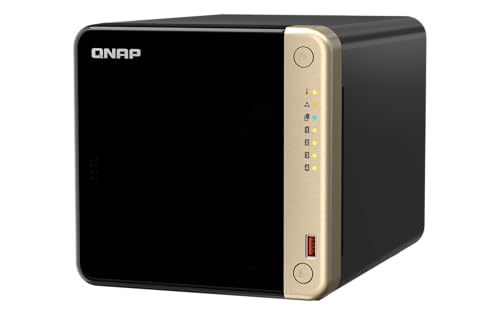

QNAP TS-464 vs TS-233 at a Glance
| Feature | QNAP TS-464 | QNAP TS-233 |
|---|---|---|
| Drive Bays | 4 x 3.5-inch SATA 6 Gb/s (Hot Swappable) | 2 x 2.5-inch / 3.5-inch SATA 6.0 Gb/s |
| Processor | Intel Celeron N5105 / N5095 4-core burst up to 2.9 GHz | ARM Cortex-A55 64-bit 4-core 2.0 GHz |
| System Memory | 8 GB DDR4 (supports up to 16 GB) | 2 GB system memory |
| Networking Ports | Dual 2.5GbE (2.5G/1G/100M) ports | 1 x Gigabit LAN port |
| M.2 NVMe Slots | 2 x M.2 PCIe Gen3 x2 slots | Not supported |
| USB Connectivity | USB 3.2 Gen 2 Type-A (up to 10 Gb/s) | USB connectivity (listing does not specify USB version) |
| Hardware Acceleration | Intel AES-NI hardware encryption engine | Neural Processing Unit (NPU) and ARM NEON |
| Stated Transfer Rate | 2.5 gigabits per second | 3 gigabits per second listed (125 MB/s media speed) |
| Target Deployment | Business, virtualization, advanced home labs | Personal cloud, home file sync, family media |
| Best For | Demanding multi-user networks and deep expansion | Entry-level personal backup and light photo indexing |
Drive Bays and Storage Expansion
Physical bay count determines how much usable capacity your array can deliver, which RAID types you can deploy, and how gracefully your system handles hard drive degradation over time. The TS-464 is constructed around four 3.5-inch internal drive trays with hot-swappable SATA 6 Gb/s functionality, giving you the ability to configure resilient arrays such as RAID 5, RAID 6, or RAID 10. This layout allows for single-drive or dual-drive parity protection, meaning one or two disks can fail completely without halting access or corrupting existing records. In enterprise or active home lab environments, being able to pull a bad drive and slide in a fresh 7200 rpm drive while the system is powered on prevents downtime entirely.
By contrast, the TS-233 features a two-bay layout that accommodates both 2.5-inch and 3.5-inch SATA hard disks. With only two drives available, your choices for data redundancy are restricted to RAID 1 mirroring or non-redundant configurations like RAID 0 and single disks. While a RAID 1 mirror mirrors your data across both drives safely, it sacrifices half of your total purchased disk capacity. If your storage needs double in two years, expanding a two-bay system requires swapping out both drives one by one and rebuilding the array sequentially, whereas a four-bay unit lets you add a third or fourth drive to an established pool seamlessly, as discussed in our synology ds923+ vs qnap ts-464 comparison.
Beyond traditional mechanical hard drive bays, the TS-464 integrates dual M.2 PCIe Gen3 x2 NVMe SSD slots directly into its mainboard. These slots can be configured for read/write SSD cache acceleration to speed up random input-output tasks, or set up as an independent, high-speed storage pool for responsive system files and operational data. The TS-233 provides no internal M.2 interfaces, locking its storage subsystem entirely to mechanical drives or standard SATA solid-state drives mounted in the primary two bays. For users mapping out significant capacity growth over the next five years, four drive bays combined with dedicated flash caching provide a level of durability and versatility that two bays cannot match.
Edge: QNAP TS-464 delivers twice the drive capacity, hot-swappable trays, flexible multi-disk RAID modes, and dual M.2 NVMe expansion slots.
Processing Power and Hardware Architecture
The processor inside a network enclosure governs far more than file read and write operations; it dictates how many concurrent users can access the system, how quickly background services process indexing queues, and what software ecosystems can be deployed. Powering the TS-464 is an Intel Celeron N5105 / N5095 quad-core, four-thread processor capable of bursting up to 2.9 GHz. Because this chip uses standard x86-64 microarchitecture, it enjoys universal compatibility with virtual machines, containerized utilities via Docker, complex database scripts, and advanced system packages. An integrated Intel AES-NI hardware encryption engine takes the mathematical burden of encrypting folders and volumes off the CPU cores, maintaining snappy transfer speeds even when securing sensitive client data.
On the other side of the QNAP TS-464 vs TS-233 specs matchup, the TS-233 is powered by a 64-bit ARM Cortex-A55 quad-core processor clocked at 2.0 GHz. ARM hardware is renowned for low power consumption, allowing the TS-233 to run quietly with minimal heat generation inside its compact chassis. However, the Cortex-A55 architecture is designed for sequential file serving and lightweight consumer utilities rather than heavy enterprise multi-tasking. While it handles basic QNAP QTS administrative tools and automated file synchronization easily, its processing ceiling is reached much sooner under intense concurrent access patterns, an architectural divide detailed in our synology ds423+ vs qnap ts-464 evaluation.
Where the TS-233 stands out within its tier is the inclusion of a dedicated NPU (Neural network Processing Unit). This hardware component accelerates AI-driven image processing, giving the TS-233 the ability to index family photo libraries, recognize faces, and categorize objects without grinding the primary CPU cores to a halt. It also integrates ARM NEON multimedia acceleration technology. Despite these specialized consumer components, the raw computing muscle, higher clock speeds, and broad software ecosystem of the Intel Celeron in the TS-464 provide far superior responsiveness under mixed business or developer workloads.
Edge: QNAP TS-464 wins with a significantly faster Intel x86 quad-core processor and dedicated AES-NI hardware encryption.
Networking Throughput and Transfer Speeds
A network-attached storage unit is only as capable as the pipe connecting it to your local switches and client computers. The TS-464 features dual 2.5GbE (2.5G/1G/100M) Ethernet ports, allowing data to flow over multi-gigabit connections without relying on specialized enterprise adapters. The QNAP TS-464 2.5GbE speed unlocks real-world performance well beyond the traditional 125 MB/s ceiling of standard gigabit connections, which is particularly beneficial when transferring large 4K video files, ISO images, or massive system backups across a home or office LAN. Furthermore, because there are two 2.5GbE ports, users can combine them via port trunking for failover reliability or higher combined throughput across multiple client workstations simultaneously.
In contrast, the TS-233 is fitted with a single gigabit Ethernet (1x Gb LAN) port. While its listing technical specifications record a bus transfer interface of 3 gigabits per second, its physical network jack limits continuous data output over the local area network to standard gigabit rates. The listing records a media speed rating of 125 MB/s, which reflects the theoretical peak of a 1GbE connection, and notes a baseline read speed metric of 445 bytes per second for specific access tests. In everyday home usage, the QNAP TS-233 transfer speed is perfectly adequate for single-user backups, streaming an HD video to a living room TV, and syncing smartphone camera rolls over Wi-Fi, which balances well for home setups like those in our synology ds224+ vs qnap ts-464 review.
The speed gap becomes glaring when you integrate external peripherals. The TS-464 provides multiple USB 3.2 Gen 2 Type-A ports capable of 10 Gb/s transfer speeds, allowing you to ingest massive camera media drives or attach fast multi-bay expansion enclosures without creating an input bottleneck. The TS-233 listing specifies USB connectivity for basic external drive connections, but lacks the high-speed 10 Gb/s pipeline of the larger unit. If you plan to move dozens of gigabytes on a regular basis, the combination of dual 2.5GbE network links and 10 Gb/s USB gives the TS-464 a massive performance advantage.
Edge: QNAP TS-464 offers vastly superior bandwidth via dual 2.5GbE ports and 10 Gb/s USB 3.2 Gen 2 connectivity.
Memory Capacity and Multitasking Performance
System memory dictates how smoothly a network storage device handles multiple background tasks, application suites, and disk cache maintenance. The TS-464 comes equipped with 8 GB of DDR4 RAM out of the box, with motherboard support allowing expansion up to 16 GB DDR4. Having an 8 GB baseline allows the operating system to allocate generous memory caches for incoming disk operations, keep background file scanners responsive, and run multiple lightweight services or virtualized operating systems concurrently. When multiple users access shared spreadsheets, write project archives, and pull historical records at the same time, this substantial RAM cushion prevents the system from bogging down.
The TS-233 arrives configured with 2 GB of memory. Because this compact ARM system is tailored for basic home appliances, the 2 GB capacity is soldered onto the board and cannot be expanded to a higher capacity later. While 2 GB is sufficient for running the core QTS operating system, managing basic network shares, and serving documents to a couple of family devices, it leaves very little overhead for advanced functionality. Opening multiple administrative browser tabs, running deep antivirus scans, or orchestrating continuous photo indexing can push the memory utilization near its maximum threshold.
Memory capacity also shapes how aggressively you can deploy snapshot protection. Both units feature snapshot capabilities to protect against accidental file deletions and ransomware attacks, but the TS-464 can maintain larger snapshot histories across multiple shared folders without consuming memory needed by active applications. The difference in operational flexibility is clear: the TS-464 acts as a robust multi-tasking workstation, while the TS-233 functions strictly as a focused, single-purpose storage hub, comparable to the architectural trade-offs explored in our synology ds1522+ vs qnap ts-464 analysis.
Edge: QNAP TS-464 wins with an 8 GB memory baseline that expands up to 16 GB, compared to the fixed 2 GB pool in the TS-233.
Multimedia Handling and Content Management
For many households, network storage acts as a central media library for streaming home video, cataloging personal photos, and managing music collections across mobile devices and televisions. When evaluating the QNAP TS-464 or TS-233 for home setups, both platforms provide dedicated multimedia management software to store, browse, organize, and share photos, music, and video files centrally. Remote management is made straightforward on both systems via myQNAPcloud, which allows family members to access their personal files, stream music, and back up mobile devices over encrypted internet connections without configuring complex router ports.
The differences surface when you evaluate the QNAP TS-464 or TS-233 for Plex and real-time video transcoding. The TS-464 features an Intel Celeron processor with an integrated graphics engine, making it well-suited for on-the-fly media transcoding when streaming movies to devices that lack native codec compatibility. Its substantial processing headroom and dual 2.5GbE pipeline allow it to stream multiple high-bitrate media files across the home simultaneously while maintaining active background backups. As noted in any comprehensive QNAP TS-464 review, this unit functions effectively as a complete, multi-user media server for enthusiasts who manage sprawling high-definition libraries.
The TS-233 approaches media management through an efficient, specialized lens. It features hardware-accelerated transcoding capabilities and supports ARM NEON technology to accelerate video processing for a smoother playback experience. Additionally, its dedicated NPU processor significantly speeds up face and object recognition in photo management suites, making it remarkably fast at sorting family portraits without heating up the living room entertainment console. While it lacks the raw muscle for heavy multi-stream transcoding, any balanced QNAP TS-233 review highlights that its photo categorization and low-power streaming meet the exact requirements of a single-family home, mirroring the balance seen in our synology ds423+ vs qnap ts-233 overview.
Edge: QNAP TS-464 takes the edge for heavy media streaming and flexible transcoding, though the TS-233 offers great efficiency for photo indexing via its onboard NPU.
Pros and Cons
QNAP TS-464

Pros
- Quad-core Intel Celeron processor
- Dual 2.5GbE network ports
- Dual M.2 PCIe NVMe slots
- Expandable to 16GB DDR4 memory
Cons
- Larger four-bay physical footprint
- Higher overall operational complexity
QNAP TS-233

Pros
- Minimalist space-saving desktop design
- Built-in NPU for photo sorting
- Integrated snapshot ransomware protection
- Energy-efficient ARM Cortex-A55 processor
Cons
- Fixed 2GB memory cannot expand
- Limited to single 1GbE LAN
Who Should Buy Each One
Choose the QNAP TS-464 If
- You manage a growing home lab, creative studio, or small business that requires four-bay RAID 5 or RAID 6 data protection.
- You have a multi-gigabit home network and want to take full advantage of dual 2.5GbE transfer speeds and 10 Gb/s USB ports.
- You intend to install high-speed M.2 NVMe SSDs for dedicated cache acceleration or fast application storage pools.
- You require an Intel x86 processor with expandable memory up to 16 GB for heavy multitasking, virtualization, and multi-user media streaming.
Choose the QNAP TS-233 If
- You need an unobtrusive, minimalist personal cloud to centrally store family photos, personal documents, and music collections.
- You want an energy-efficient desktop appliance that runs cool and quiet on a standard gigabit network router.
- You value hardware-assisted AI photo indexing powered by a dedicated NPU processor without managing complex hardware settings.
- Your primary disaster recovery requirement is simple snapshot protection against accidental file deletion and ransomware threats.
Final Verdict
When comparing the two systems, the choice hinges directly on your performance ceiling and long-term storage strategy. Is QNAP TS-464 worth it? For users who manage expanding media libraries, collaborate over multi-gigabit connections, or require four hot-swappable bays to run resilient multi-disk arrays, the answer is an unambiguous yes. Between its Intel Celeron quad-core chip, dual 2.5GbE interfaces, M.2 NVMe slots, and expandable 8 GB DDR4 memory, the TS-464 provides the structural resilience and computational headroom needed to serve demanding multi-user environments for years without showing its age.
Conversely, is QNAP TS-233 worth it for the entry-level user? Absolutely, provided your demands align with its design intentions. If your primary goal is to escape recurring commercial cloud storage subscription fees, create a private home repository for phone backups, and organize photos with an intelligent NPU, the TS-233 delivers all the fundamental strengths of the QTS platform in an elegant, energy-conscious enclosure. The TS-464 is the undisputed performance pick for power users, while the TS-233 remains an ideal first step into network storage for modest home setups.
FAQ
Can the RAM on the QNAP TS-233 be upgraded after purchase?
No, the QNAP TS-233 comes with 2 GB of memory installed, and the listing does not support user-accessible RAM expansion. The 2 GB memory pool is integrated directly onto the ARM system board. If you anticipate needing larger memory buffers for heavy multitasking or software development, the TS-464 is the better option because its 8 GB DDR4 configuration can be expanded up to 16 GB.
Which NAS is better suited as a Plex media server?
The TS-464 is vastly superior for Plex media streaming. Its quad-core Intel Celeron N5105 / N5095 processor features integrated graphics and dedicated processing capabilities that handle real-time file conversion and multi-stream delivery smoothly. The TS-233 includes ARM NEON technology and hardware-accelerated transcoding for basic playback, but its 2 GB memory and ARM processor cannot accommodate multiple concurrent high-bitrate Plex transcodes.
How do the network transfer speeds compare between the TS-464 and TS-233?
The TS-464 features dual 2.5GbE ports, allowing transfer speeds up to 2.5 gigabits per second per port, which can saturate modern high-speed switches and handle heavy file movement rapidly. The TS-233 features a single 1x Gb LAN port, which limits continuous network throughput across your local area network to standard gigabit rates, backed by a listed media transfer speed rating of 125 MB/s.
Does the QNAP TS-233 support SSD caching?
The TS-233 does not include dedicated M.2 slots for NVMe solid-state caching drives. While you could technically install standard 2.5-inch SATA solid-state drives into its primary drive bays, doing so reduces your mechanical capacity bays. The TS-464 includes two dedicated M.2 PCIe Gen3 x2 NVMe slots inside the unit, allowing you to deploy SSD caching without sacrificing any of its four primary 3.5-inch hard drive bays.
Can both models protect my data against ransomware using snapshots?
Yes, both units support QNAP snapshot technology. Snapshots record the block-level state of your storage pool at specific points in time, allowing you to roll back modified or encrypted files quickly if your network is compromised by ransomware or if files are accidentally deleted. The TS-464 simply has more RAM and processing headroom to retain deeper snapshot archives across heavier volume workloads.
What hard drives can be installed in the QNAP TS-464?
The TS-464 accommodates 3.5-inch SATA 6 Gb/s hard drives, including high-performance 7200 rpm models, across its four hot-swappable internal bays. It also supports internal M.2 PCIe Gen3 x2 NVMe drives in its dedicated motherboard slots for caching or secondary storage pools.


