Choosing between the Samsung 980 Pro and the Samsung 990 EVO comes down to a clear divide between peak sequential throughput and modern power efficiency. While the 980 Pro pushes the upper boundaries of PCIe 4.0 bandwidth with maximum read rates up to 7,000 MB/s, the 990 EVO takes advantage of a hybrid PCIe 4.0 x4 and PCIe 5.0 x2 interface that optimizes performance per watt for balanced everyday computing.
Demanding desktop power users and content creators who transfer large datasets should choose the Samsung 980 Pro for its higher sustained write thresholds and specialized controller cooling. Everyday PC builders, laptop upgraders, and general users seeking cooler running temperatures and lower energy draw will find the Samsung 990 EVO to be the more practical drive for their systems.
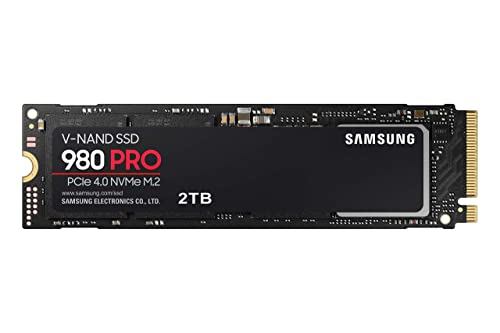

Samsung 980 Pro vs Samsung 990 EVO at a Glance
| Feature | Samsung 980 Pro | Samsung 990 EVO |
|---|---|---|
| Digital Storage Capacity | 2 TB | 2 TB |
| Interface Support | PCIe Gen 4×4 (PCIe 3.0 backward compatible) | PCIe Gen 4×4, PCIe Gen 5×2 |
| Sequential Read Speed | Up to 7,000 MB/s | Up to 5,000 MB/s |
| Sequential Write Speed | Up to 5,100 MB/s | Up to 4,200 MB/s |
| Internal Controller | Samsung Elpsis Controller | Fine-tuned Samsung Controller |
| Thermal Dissipation | Nickel-coated controller and heat spreader label | Smart thermal control and heat spreading label |
| Console Compatibility | Sony PlayStation 5 | Sony PlayStation 5, Xbox Series S, Xbox Series X |
| Hardware Encryption | AES 256-Bit Encryption | 256-Bit AES Hardware Encryption |
| Form Factor | M.2 2280 | M.2 2280 |
| Best For | Sustained high-bandwidth workloads and gaming rigs | Energy-conscious builds, laptops, and flexible upgrades |
Sequential Read and Write Performance
Sequential data transfer speed determines how quickly an internal solid-state drive can ingest massive files, compile complex gaming directories, or export high-resolution video timelines. In any thorough Samsung 980 Pro review, the standout metric remains its maximum sequential read velocity of up to 7,000 MB/s alongside sequential writes reaching up to 5,100 MB/s. Built upon Samsung V-NAND flash technology and driven by an Elpsis controller, the 980 Pro operates at twice the data transfer rate of preceding PCIe 3.0 designs, maximizing the full potential of four Gen 4 lanes.
By contrast, looking at the Samsung 990 EVO read write speed shows a different set of engineering priorities. The 990 EVO provides sequential read rates up to 5,000 MB/s and sequential write capabilities up to 4,200 MB/s utilizing Intelligent TurboWrite technology. When assessing Samsung 980 Pro vs 990 EVO speed metrics across large directory transfers, the 2,000 MB/s advantage in sequential reads and the 900 MB/s edge in the Samsung 980 Pro write speed allow the Pro model to move heavy single-file assets significantly faster. Readers weighing this against generational benchmarks can also explore our samsung 980 pro vs 990 pro analysis to see how flagships evolve over time.
While the 990 EVO delivers sufficient throughput for operating system booting, office productivity, and routine file copying, it cannot match the peak ceiling of the Pro drive. Heavy workstation tasks, uncompressed media production, and deep local data processing actively leverage the extra bandwidth offered by the 980 Pro. For sustained sequential tasks, having that additional head space ensures that data processing queues do not bottleneck system workflows.
Edge: Samsung 980 Pro, because it delivers substantially higher peak sequential read and write speeds of 7,000 MB/s and 5,100 MB/s.
PCIe Lane Flexibility and Interface Architecture
Storage architecture dictates not just current drive speed, but how efficiently a solid-state drive integrates with differing host motherboard lane allocations. The Samsung 980 Pro operates exclusively on a traditional PCIe Gen 4×4 physical link, maintaining full backward compatibility with PCIe 3.0 slots at reduced transfer rates. It requires all four lanes of a Gen 4 slot to reach its rated 7,000 MB/s read potential, making it standard equipment for modern desktop motherboards designed around dedicated full-width M.2 slots.
The Samsung 990 EVO introduces a versatile hybrid interface capable of functioning either as PCIe Gen 4×4 or PCIe Gen 5×2. By providing native compatibility with PCIe 5.0 across two lanes, the drive matches its full 5,000 MB/s throughput while consuming only half the lane count of a PCIe 4.0 x4 connection on supported platforms. Those evaluating the evolutionary line from earlier drives in our samsung 970 evo plus vs 980 pro comparison will notice how interface engineering has shifted from pure Gen 4 lane saturation toward flexible lane distribution.
This dual-mode operational capability allows builders on newer motherboards to conserve PCIe 5.0 lanes for graphics cards or expansion cards while maintaining full drive performance over two lanes. However, because the 990 EVO caps out at 5,000 MB/s regardless of whether it runs on Gen 4×4 or Gen 5×2, the PCIe 5.0 specification here provides lane economy rather than generational speed records. The 980 Pro remains committed to saturating PCIe 4.0 lanes for peak output.
Edge: Samsung 990 EVO, due to its unique dual-mode architecture that operates across both PCIe 4.0 x4 and PCIe 5.0 x2 configurations.
Power Efficiency and Thermal Regulation
Sustained performance in modern M.2 storage depends heavily on how the internal controller regulates thermal build-up and draws power under operational stress. High-end solid-state drives can generate significant heat during sustained writes, which can lead to thermal throttling if not dissipated effectively. The Samsung 980 Pro relies on an industrial-grade thermal solution featuring a specialized nickel coating directly on the Elpsis controller, paired with a heat spreader label over the NAND chip to transfer heat away during heavy input and output cycles.
In contrast, a critical focal point of any Samsung 990 EVO review is its aggressive pursuit of energy conservation. Samsung engineered the 990 EVO to deliver up to 70% improved performance per watt over previous models such as the 970 EVO Plus. This substantial gain in power efficiency directly translates to lower thermal output, supported by a fine-tuned controller and smart heat spreading label designed to avoid performance drops mid-project without demanding elaborate supplementary cooling hardware. Those comparing value propositions across generations can consult our samsung 980 vs 990 evo breakdown to examine this efficiency trajectory.
For compact laptop chassis or tightly packed small-form-factor builds with limited airflow, the power-sipping characteristics of the 990 EVO provide a distinct operational advantage. While the 980 Pro manages its higher thermal output well through its nickel-plated controller, its overall energy footprint is notably heavier during high-load computing. The 990 EVO maintains cooler operating behavior with less power draw overall.
Edge: Samsung 990 EVO, because of its 70% improved performance per watt and reduced thermal footprint during sustained operation.
Gaming Rigs and Console Storage Expansion
Selecting Samsung 980 Pro or 990 EVO for gaming requires evaluating both raw asset-streaming speeds and platform-specific compatibility. For PC gaming rigs, both drives leverage the compact M.2 2280 form factor to slot neatly beneath motherboard thermal armor. The 980 Pro excels at moving massive game installs and stream-loading dense textures quickly, using its 7,000 MB/s bandwidth to keep loading screens minimal in titles utilizing direct drive streaming architectures.
When looking at the Samsung 980 Pro vs 990 EVO PS5 compatibility, the manufacturer listings reveal clear operational boundaries. The 980 Pro lists direct support for the Sony PlayStation 5 console, where its 7,000 MB/s read speed comfortably exceeds Sony’s baseline performance recommendations for internal M.2 storage expansions. Interestingly, the Samsung 990 EVO listing also cites compatibility with the Sony PlayStation 5 alongside Microsoft Xbox Series S and Microsoft Xbox Series X hardware platforms, reflecting its versatile design. Those exploring broader lineup pairings may also reference our samsung 980 pro vs 990 evo plus overview for additional context.
Despite the broader platform compatibility listed for the 990 EVO, the 980 Pro remains the favored hardware choice for high-intensity gaming installations. The 980 Pro provides higher continuous write speeds when patching multi-gigabyte modern game updates, meaning less time waiting for game files to finalize. The 990 EVO handles standard loading sequences reliably, but the 980 Pro delivers the raw bandwidth headroom dedicated gamers seek.
Edge: Samsung 980 Pro, because its 7,000 MB/s read throughput and 5,100 MB/s write capability provide better bandwidth for demanding game installations.
Software Ecosystem and Data Security
Drive longevity and data protection depend on the background software infrastructure that maintains firmware health and secures stored information. Both storage units feature robust 256-bit AES hardware-based encryption, ensuring that corporate documents, creative projects, and personal data remain protected against unauthorized access without burdening system processing resources. This hardware encryption conforms to advanced modern security standards across enterprise and personal deployments.
On the maintenance side, both solid-state drives benefit from Samsung Magician Software integration. Magician provides real-time drive health monitoring, firmware update management, performance benchmarking, and system security configurations. In the case of the 990 EVO, the listing specifically emphasizes Magician Software integration to ensure the unit performs consistently with continual drive health tracking and regular updates. If you want to see how Samsung balances features across adjacent models, check out our guide on the samsung 980 vs 990 pro.
Additionally, the 990 EVO product data notes water and dust resistance, offering extra physical resilience for internal solid-state components. While both drives provide equivalent AES 256-bit data encryption standards and Magician firmware utility, the newer 990 EVO listing incorporates these extra environmental protections alongside its software management highlights. Nonetheless, at a core functional level, both drives provide enterprise-grade data protection.
Edge: Tie, as both drives offer robust AES 256-bit hardware encryption and full integration with Samsung Magician Software.
Pros and Cons
Samsung 980 Pro

Pros
- Sequential read speeds up to 7000 MB/s
- Sequential write speeds up to 5100 MB/s
- Nickel-coated Elpsis controller for heat dissipation
- Established PlayStation 5 console compatibility
- Hardware-based AES 256-bit encryption
Cons
- Higher power consumption than 990 EVO
- Lacks PCIe 5.0 x2 lane flexibility
View Samsung 980 Pro on Amazon
Samsung 990 EVO

Pros
- Up to 70% improved performance per watt
- Flexible PCIe 4.0 x4 and PCIe 5.0 x2 support
- Smart thermal control for cooler operation
- Integrated Samsung Magician Software management
- Water and dust resistance design
Cons
- Lower maximum read speed of 5000 MB/s
- Lower maximum write speed of 4200 MB/s
View Samsung 990 EVO on Amazon
Who Should Buy Each One
Choose the Samsung 980 Pro If
- You need maximum sustained read bandwidth up to 7,000 MB/s for high-intensity media editing, workstation tasks, and rapid transfers.
- You want a proven PlayStation 5 expansion drive that easily surpasses the platform’s recommended sequential read speeds.
- You manage large gaming libraries and require faster write speeds of up to 5,100 MB/s for rapid patch deployment and file installation.
- You run a dedicated desktop motherboard with full PCIe 4.0 x4 slot availability and integrated heat sinks to manage thermal loads.
Choose the Samsung 990 EVO If
- You want up to 70% improved performance per watt over older drives like the 970 EVO Plus for cooler laptop and small-PC operation.
- You are building on a modern motherboard and want the flexibility of running storage across either PCIe 4.0 x4 or PCIe 5.0 x2 lanes.
- You need a dependable internal drive for everyday multitasking, general productivity, and moderate gaming with 5,000 MB/s read speeds.
- You prioritize low energy consumption and smart thermal management without installing massive aftermarket thermal hardware.
Final Verdict
When weighing the Samsung 990 EVO vs 980 Pro, the Samsung 980 Pro is the superior drive for the majority of power users, dedicated gamers, and media editors. Its peak performance of 7,000 MB/s read and 5,100 MB/s write speeds firmly cements it as the performance leader between the two. The inclusion of an Elpsis controller with specialized nickel plating ensures that intense, high-bandwidth computing runs reliably without early thermal penalties.
However, the Samsung 990 EVO is the smarter pick for users constructing quiet, power-conscious PC builds or upgrading modern laptops. With its hybrid PCIe 4.0 x4 and PCIe 5.0 x2 compatibility, 5,000 MB/s read speeds, and a 70% leap in performance per watt compared to the 970 EVO Plus, it offers outstanding operational balance. If raw sequential transfer records are secondary to efficiency and cool running temperatures, the 990 EVO is an exceptionally capable storage choice.
FAQ
Is Samsung 990 EVO worth it compared to the 980 Pro?
Yes, the Samsung 990 EVO is worth it if your main priority is power efficiency, thermal control, and interface flexibility rather than absolute top-end read speeds. While the 980 Pro is faster in sequential transfers, the 990 EVO delivers up to 70% better performance per watt over previous models and supports PCIe 5.0 x2 lanes.
Samsung 980 Pro or 990 EVO for gaming: which should you pick?
The Samsung 980 Pro is generally the better option for high-end gaming rigs due to its higher sequential read speed of 7,000 MB/s and write speed of 5,100 MB/s. These metrics provide faster game loading and shorter wait times during massive patch installations compared to the 5,000 MB/s read ceiling of the 990 EVO.
How do Samsung 980 Pro vs 990 EVO PS5 installations compare?
Both models cite PlayStation 5 compatibility in their specifications, but the Samsung 980 Pro delivers 7,000 MB/s read speeds, which significantly exceeds the console manufacturer’s baseline recommendations. The 990 EVO operates at up to 5,000 MB/s, making the 980 Pro the preferred choice for maximizing storage throughput on the PS5.
Can the Samsung 990 EVO run on a standard PCIe 4.0 motherboard?
Yes, the Samsung 990 EVO is fully compatible with standard PCIe 4.0 x4 slots as well as PCIe 5.0 x2 configurations. It automatically adjusts to the available lane architecture, delivering read speeds up to 5,000 MB/s and write speeds up to 4,200 MB/s on Gen 4 platforms.
What thermal management does the Samsung 980 Pro use?
The Samsung 980 Pro uses a specialized nickel coating to regulate the thermal output of its Elpsis controller, alongside an integrated heat spreader label on the back of the drive to manage heat from the V-NAND flash chip.
Does the Samsung 990 EVO come with software management tools?
Yes, the Samsung 990 EVO is supported by Samsung Magician Software, which enables firmware updates, health monitoring, encryption management, and continuous performance tracking to ensure the drive operates reliably over time.


