The core distinction deciding the contest between the Sennheiser HD 650 and the Beyerdynamic DT 770 Pro comes down to acoustic architecture: the open-back ear cups of the HD 650 prioritize distortion-free spatial resolution for quiet environments, whereas the closed-back ear cups of the DT 770 Pro deliver total acoustic isolation and leakage prevention for tracking and recording.
Engineers and audiophiles focusing on mastering, critical listening, and transparent reference monitoring in a controlled room should choose the Sennheiser HD 650. Recording artists, vocalists, and creators working in noisy studio spaces or requiring a long workstation tether should select the Beyerdynamic DT 770 Pro.


Sennheiser HD 650 vs Beyerdynamic DT 770 Pro at a Glance
| Feature | Sennheiser HD 650 | Beyerdynamic DT 770 Pro |
|---|---|---|
| Acoustic Operating Principle | Open-back dynamic | Closed-back dynamic |
| Manufacturer Part Number | 508825 | 717770 |
| Rated Impedance | Not listed | 80 Ohm |
| Driver Matching | Hand-selected matched driver elements | Custom built diaphragms |
| Total Harmonic Distortion (THD) | 0.05 percent | Not listed |
| Frequency Response | 10 to 41,000 Hz (10 to 39,500 Hz at -10 dB) | Not listed |
| Magnet and Damping Technology | Neodymium magnets with acoustic silk damping | Not listed |
| Cable Style and Length | Wired with 3.5mm plug and 1/4″ connector | 3m (9.8 ft) straight single-sided cable |
| Included Accessories | 3.5mm jack plug and 1/4″ connector | Gold-plated 1/4″ screw-on adapter, drawstring bag |
| Manufacturing Origin | Not listed | Handcrafted in Germany |
| Best For | Critical reference listening and home mastering | Studio tracking, vocal monitoring, and noisy spaces |
Acoustic Enclosure and Environmental Isolation
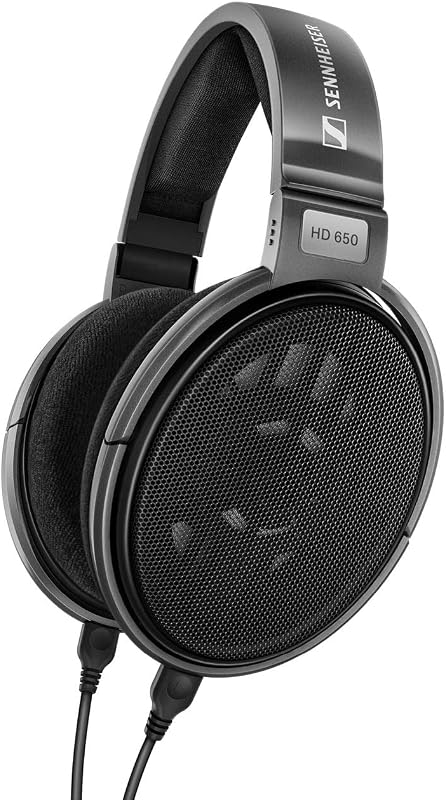
The operational philosophy of any reference headphone begins with its cup enclosure. The HD 650 uses an open-back dynamic system that leaves the reverse side of the transducer exposed to ambient air. Sennheiser incorporates specially designed acoustic silk across the driver baffle to achieve uniform damping across the entire frequency range. Because air flows freely through the rear grilles, sound waves disperse outward rather than reflecting against an inner wall. In a quiet, dedicated control room, this eliminates internal cavity resonance. However, the listing instructions explicitly emphasize that for optimum sound quality the ear cups must not be covered. This open pathway works both ways: ambient room sounds enter unfiltered, and audio from the headphones leaks directly into the immediate room.
The DT 770 Pro utilizes a closed-back chassis engineered directly for acoustic containment. Beyerdynamic highlights this closed-back construction specifically to ensure minimal sound leakage, positioning the model as a dedicated studio standard for vocal tracking and live instrument recording. In a tracking room with an active, high-gain condenser microphone, a singer or acoustic guitarist wearing open headphones risks bleed contaminating the take. The physical barrier of the closed ear cups attenuates background chatter, computer fan whine, and headphone bleed. For creators weighing the broader market options across acoustic formats, examining the sennheiser hd 650 vs beyerdynamic dt 900 pro x demonstrates how open and semi-open structures compare when room isolation is not mandatory.
In a direct Beyerdynamic DT 770 Pro vs Sennheiser HD 650 comparison, isolation represents a fundamental boundary line rather than a minor design preference. The HD 650 demands a quiet, private workspace where sound leakage cannot disturb others and ambient background noise will not interfere with low-level audio details. The DT 770 Pro operates anywhere from crowded project studios to bedroom tracking setups without allowing microphone bleed. If your daily production process involves a live microphone in the same room as your ears, the closed shell is essential.
Edge: Beyerdynamic DT 770 Pro because its closed-back architecture seals sound inside the ear cups to eliminate microphone bleed during tracking sessions.
Soundstage Presentation and Spatial Accuracy
A headphone’s acoustic enclosure directly dictates the width and depth of the sonic landscape. In evaluating the HD 650 vs DT 770 Pro soundstage, the HD 650 relies on its open-air architecture and hand-selected matched driver elements to simulate an out-of-head listening experience. Because sound waves travel unobstructed away from the back of the transducer, music presents with an organic, natural room-like dispersion. The listing notes that audiophiles will experience a truly unique natural sound, designed to recreate the sensation of long concerts in the comfort of home. Spatial transitions from center to hard left or right occur seamlessly without the boxed-in sensation common to sealed enclosures.
The DT 770 Pro counters with an internal acoustic chamber tuned to deliver a transparent, detailed soundstage despite its sealed rear shells. Beyerdynamic states that unique design, construction, and custom-built diaphragms yield superb sound reproduction across all frequencies for precise audio decisions. While closed-back headphones naturally feature a more intimate, immediate soundstage due to sound wave reflections inside the cup, the DT 770 Pro positions stereo instruments with distinct clarity. The placement of percussion, vocal pans, and synthesized cues remains tight and localized, giving editors precise diagnostic insight into individual track elements.
When listening critically to stereo imaging, open-back geometry holds a physical acoustic advantage. The open enclosure of the HD 650 allows sonic cues to expand beyond the perimeter of the ear cups, providing natural spatial decay without internal cabinet reflections. The DT 770 Pro produces an exceptionally detailed stereo image for a closed model, but the physical boundaries of its sealed cups restrict the perceived depth and dimensional breadth of the soundstage.
Edge: Sennheiser HD 650 because its open-back transducer deployment provides a more expansive, natural spatial presentation free from internal acoustic reflections.
Critical Audio Precision and Distortion Control
When deciding on the Sennheiser HD 650 or Beyerdynamic DT 770 Pro for mixing, raw precision and driver behavior determine whether equalization moves translate across different playback systems. The HD 650 listing specifies a total harmonic distortion (THD) rating reduced to an incredible 0.05 percent. Sennheiser achieves this through highly optimized magnet systems using high-power neodymium magnets designed to minimize harmonic and intermodulation distortion. Coupled with matched driver pairs and an extended frequency response reaching from 10 Hz up to 41,000 Hz (measured at 10 to 39,500 Hz at -10 dB), the HD 650 allows mixing engineers to identify unwanted artifacts, sibilance, and masking without driver-induced coloration.
The DT 770 Pro approaches audio production from a monitoring perspective, branded as a closed reference headphone for control and monitoring applications. Beyerdynamic notes that its 80 Ohm configuration represents the most versatile option for universal studio use, providing a balanced frequency response tailored for recording, mixing, mastering, and critical studio applications. The custom diaphragms manufactured in Germany produce reliable, consistent performance refined over 30 years of use in professional studios. While the listing omits numerical THD percentages and specific frequency cutoffs, it highlights the transducer’s balanced accuracy across all registers, allowing producers to spot sub-bass overages and mid-range balance issues reliably.
For audio engineers seeking an analytical tool to verify mastering balance, the documented 0.05 percent THD and hand-matched drivers of the HD 650 deliver rare acoustic transparency. The DT 770 Pro provides the punch and balance required for everyday studio monitoring, but the low-distortion engineering of the HD 650 gives mixing engineers higher resolution when evaluating delicate reverb tails and micro-dynamics. Readers comparing open alternatives in this tier can evaluate the sennheiser hd 560s vs beyerdynamic dt 770 pro to understand how different open driver tunings contrast with closed-back monitoring.
Edge: Sennheiser HD 650 because its documented 0.05 percent THD and hand-selected matched drivers ensure lower distortion across critical audio frequencies.
Build Quality and Serviceability
Studio equipment must endure repetitive daily handling, drop hazards, and constant repositioning. Beyerdynamic emphasizes long-term ownership on the DT 770 Pro, highlighting over 100 years of company manufacturing expertise and German handcrafting. Crucially, the DT 770 Pro is marketed as fully serviceable: users can replace pads, headbands, and drivers to maintain professional performance across decades of use. The unit features rugged metal yokes, durable plastic shells, and a heavily padded spring steel headband wrapped for demanding environments. For studios comparing other high-end options, assessing the beyerdynamic dt 770 pro vs dt 900 pro x reveals how Beyerdynamic has iterated on mechanical durability across generations.
The HD 650 is built around a lightweight structural frame with rounded ear cups and an over-ear profile. Sennheiser relies on precision-formed acoustic silk damping materials inside the acoustic chamber and robust high-efficiency neodymium magnet assemblies. The ear cups utilize designated “L” and “R” markings for proper orientation and allow the cups to slide smoothly along the headband to achieve a custom rest position over the ears. While the physical chassis remains reliable for home and control room work, the listing does not advertise the extensive component-level modularity or full-assembly driver servicing highlighted by its German counterpart.
Both manufacturers back their headphones with a 2-year warranty, demonstrating confidence in their manufacturing standards. However, Beyerdynamic explicitly establishes the DT 770 Pro as a serviceable workhorse with readily replaceable drivers, ear cushions, and headband parts. That repairable architecture ensures that inevitable physical wear in high-traffic recording environments does not require replacing the entire headphone.
Edge: Beyerdynamic DT 770 Pro because its fully serviceable construction allows owners to replace headbands, drivers, and pads to preserve functionality indefinitely.
Cable Engineering and Studio Mobility
Cable management significantly influences operational convenience around mixing desks, computer desks, and instrument racks. The DT 770 Pro comes factory-fitted with a professional 3-meter (9.8-foot) straight single-sided cable. Beyerdynamic emphasizes that this generous length offers maximum freedom of movement around a workstation or mixing desk. Running the wire exclusively to one ear cup makes handling the headphone easy, eliminating wire entanglement under the chin when moving between an audio interface, synthesizers, and outboard hardware processors.
The HD 650 employs a wired connection terminating in a 3.5mm jack plug alongside a 1/4″ connector to interface with standard consumer jacks and dedicated studio hardware. The listing indicates that the HD 650 uses a traditional headphone controller configuration with separate feed lines running to both left and right ear cups. While dual-entry cabling guarantees direct channel feeds to each matched transducer, it doubles the cable mass draping over the user’s chest and lacks the single-point cleanliness of single-sided designs. For those curious about how modern wired studio open-backs compare against closed monitors, the sennheiser hd 660s2 vs beyerdynamic dt 770 pro provides further insight into contemporary cabling arrangements.
When working actively across a broad studio desk, the DT 770 Pro offers superior physical mobility. Its 9.8-foot single-sided wire lets users roll across an editing suite without pulling equipment off the desk, and its included screw-on 1/4″ adapter ensures a secure, threaded fit that will not disconnect when tugged. The HD 650 provides necessary adapter options, but its dual-sided routing is more restrictive during physical studio tasks.
Edge: Beyerdynamic DT 770 Pro because its 9.8-foot single-sided cable provides expansive reach and reduces wire clutter around studio desks.
Comfort and Extended Session Wearability
Long mixing and listening sessions demand physical ergonomics that minimize head fatigue. The DT 770 Pro is equipped with Beyerdynamic’s iconic black velour ear pads. The listing stresses maximum comfort from these soft, breathable cushions, specifically designed to support fatigue-free editing during marathon days in home studios or professional vocal booths. The breathable nature of velour reduces heat accumulation around the ears, which is particularly beneficial since closed-back ear cups tend to trap warmth more than open designs.
The HD 650 focuses on comfort through balanced weight distribution and open airflow. The listing notes that with sound this good, long concerts in the comfort of home are a certainty, setting standards in comfort and convenience. The ear cups feature rounded earpieces designed to enclose the ears fully, adjusted by pulling the ear cups down until they rest naturally against the skull. Because the open grilles allow interior air to exchange constantly with the surrounding room, user ears stay cool over multi-hour listening stretches, eliminating the thermal buildup common in leatherette or sealed models.
Both models excel in long-term wearability through different mechanical means. The DT 770 Pro combats the heat retention inherent to closed headphones by utilizing plush, breathable velour padding. The HD 650 eliminates heat retention entirely through its open-air architecture and rounded ergonomic cups. Because both sets provide comfortable ear contact, this category represents a balance between open air circulation and soft velour cushion contact.
Edge: Tie because the HD 650 offers cool, ventilated open cups while the DT 770 Pro delivers plush, breathable velour ear cushions.
Pros and Cons
Sennheiser HD 650
Pros
- Acoustic silk dampens entire frequency range
- Total harmonic distortion rated at 0.05%
- Hand-selected matched driver elements
- Broad 10 to 41,000 Hz response
- Neodymium magnet system reduces intermodulation distortion
Cons
- Open-back ear cups leak audio externally
- Zero passive acoustic isolation from environment
- Impedance rating omitted from product listing
View Sennheiser HD 650 on Amazon
Beyerdynamic DT 770 Pro

Pros
- Closed-back acoustic seal prevents microphone leakage
- Breathable black velour ear pads
- Fully serviceable components handcrafted in Germany
- Generous 3-meter straight studio cable
- Screw-on quarter-inch adapter and drawstring bag included
Cons
- Fixed single-sided cable cannot detach
- Narrower soundstage than open acoustic models
- Frequency response range not specified in listing
View Beyerdynamic DT 770 Pro on Amazon
Who Should Buy Each One
Choose the Sennheiser HD 650 If
- You mix, master, or critically analyze audio in a quiet, acoustically controlled room where sound leakage does not matter.
- You demand ultra-low distortion, benefiting from the 0.05 percent THD and hand-selected matched drivers.
- You want a wide, natural, open soundstage that mimics the spatial presentation of live room acoustics.
- You listen to high-resolution recordings requiring extended frequency reproduction reaching up to 41,000 Hz.
Choose the Beyerdynamic DT 770 Pro If
- You record vocals or acoustic instruments and need a closed-back acoustic seal that prevents headphone bleed into live microphones.
- You work in dynamic home environments, offices, or shared studios requiring passive isolation from ambient background noise.
- You need the physical freedom of a long 3-meter (9.8 ft) single-sided cable to move around mixing consoles and rack gear.
- You value long-term investment protection through fully serviceable, handcrafted German components and replaceable parts.
Final Verdict
When assessing whether the sennheiser hd 560s vs beyerdynamic dt 900 pro x or our featured pairing is the right path, your decision between the HD 650 and the DT 770 Pro should align with your specific studio workflow. For mixing, mastering, and analytical listening, the HD 650 stands out as the acoustic benchmark. Its combination of acoustic silk precision damping, ultra-low 0.05 percent harmonic distortion, matched drivers, and open spatial presentation provides an uncolored acoustic window into your audio files. In any setting where room silence is assured, the HD 650 delivers reference transparency that closed designs cannot match.
Conversely, the DT 770 Pro is the clear winner when your work demands isolation, versatility, and heavy studio use. Its closed-back construction prevents audio leakage from reaching sensitive tracking microphones, while the 80 Ohm rating ensures universal compatibility across studio monitoring hardware. Backed by German craftsmanship, fully serviceable components, plush velour ear pads, and a 9.8-foot single-sided cable, the DT 770 Pro remains an indispensable monitoring tool for tracking booths, broadcast stations, and bustling editing workstations.
FAQ
Is Sennheiser HD 650 worth it for a home recording studio?
The HD 650 is worth it if your home studio includes a quiet space dedicated to mixing, audio editing, and mastering. Its 0.05 percent total harmonic distortion, hand-matched drivers, and wide frequency response ranging up to 41,000 Hz provide reference-grade accuracy. However, because its open-back cups leak audio outward, it cannot be used for tracking vocals or acoustic instruments near open microphones.
Is Beyerdynamic DT 770 Pro worth it for tracking vocals and instruments?
The DT 770 Pro is worth it for tracking because its closed-back ear cups create a physical acoustic barrier that prevents sound leakage. This isolation stops headphone monitor feeds from bleeding into sensitive vocal or instrument microphones, ensuring clean recordings while providing the performer with a balanced frequency response.
What are the key differences between the Beyerdynamic DT 770 Pro 80 Ohm vs Sennheiser HD 650?
The primary difference is acoustic design: the DT 770 Pro is a closed-back headphone with an 80 Ohm impedance, a 3-meter single-sided cable, and replaceable velour pads engineered for studio monitoring and tracking isolation. The HD 650 is an open-back headphone engineered for critical listening with acoustic silk damping, 0.05 percent THD, matched drivers, and an open design that does not isolate ambient sound.
Can I use the Sennheiser HD 650 or Beyerdynamic DT 770 Pro for gaming?
Both models work well for gaming, but they serve different environments. The HD 650 delivers superior spatial awareness and a natural soundstage due to its open-back architecture, making it ideal for gaming in quiet rooms. The DT 770 Pro features the official video game theme designation in its product data and provides closed acoustic isolation, making it the better choice if you game in a noisy living room or need to eliminate background noise.
What audio adapters are included with both headphones?
The HD 650 comes equipped with a 3.5mm jack plug and a 1/4″ connector for connecting to standard interfaces and audio equipment. The DT 770 Pro includes a 3.5mm jack fitted with a gold-plated 1/4″ screw-on adapter that threads directly onto the plug, along with a drawstring storage bag.
Can parts be replaced on the Beyerdynamic DT 770 Pro?
Yes, the DT 770 Pro is handcrafted in Germany with fully serviceable construction. According to the listing specifications, users can replace the velour ear pads, headbands, and drivers, allowing the headphones to be maintained across decades of regular studio use.

