The deciding difference between these two memory kits comes down to raw throughput versus platform flexibility: the Kingston Fury Renegade DDR5 delivers higher 6400MT/s transfer speeds paired with lower CL32 latency, whereas the G.Skill Trident Z5 RGB DDR5 6000 provides preconfigured dual-overclock profiles for both AMD EXPO and Intel XMP 3.0 at a stable 6000MT/s CL36 baseline.
Builders assembling an AMD Ryzen system or prioritizing plug-and-play profile compatibility across both CPU architectures should choose the G.Skill kit, while performance-focused Intel builders targeting tighter response times and higher bandwidth will benefit more from Kingston’s configuration.


G.Skill Trident Z5 RGB DDR5 6000 vs Kingston Fury Renegade DDR5 at a Glance
| Attribute | G.Skill Trident Z5 RGB DDR5 6000 | Kingston Fury Renegade DDR5 |
|---|---|---|
| Part Number | F5-6000J3636F16GA2-TZ5RK | KF564C32RSAK2-32 |
| Rated Transfer Speed | 6000 MT/s | 6400 MT/s |
| CAS Latency | CL36 (36-36-36-96) | CL32 |
| Overclock Profiles | Dual Profile: Intel XMP 3.0 & AMD EXPO | Intel XMP 3.0 Certified |
| Operating Voltage | 1.35 V | 1.40 V |
| Total Capacity | 32 GB (2 x 16 GB) | 32 GB (2 x 16 GB) |
| Form Factor & Pins | 288-pin DDR5 UDIMM | 288-pin DDR5 DIMM |
| RGB Technology | Integrated RGB Light Bar | Kingston FURY Infrared Sync Technology |
| Validated Chipsets | Intel Z890/Z790/Z690/B860/B760/B660, AMD X870/X670/B850/B840/B650/A620 | Not listed |
| Best For | AMD Ryzen rigs and dual-profile flexibility | High-frequency Intel overclocking systems |
Raw Transfer Speeds and Bandwidth Potential
Memory frequency, measured in megatransfers per second, establishes the maximum theoretical ceiling for data moving between your system memory and the processor’s integrated memory controller. When comparing Kingston Fury Renegade DDR5 6400 vs G.Skill Trident Z5 6000, the raw bandwidth difference directly impacts memory-intensive desktop operations, heavy archival file compression, and frame-time consistency during CPU-bound gaming scenarios. Higher transfer rates allow wider data streams, reducing execution bottlenecks whenever the processor makes extensive calls to system RAM.
The Kingston kit operates at an aggressive 6400MT/s transfer speed, providing an immediate advantage of 400MT/s over the G.Skill kit’s 6000MT/s rated specification. In a comprehensive Kingston Fury Renegade DDR5 review, this higher transfer ceiling means that machines running Intel architectures capable of driving high memory frequencies can maximize their memory bus throughput. If you have compared other performance-grade kits such as the kingston fury renegade ddr5 vs teamgroup t-force delta rgb ddr5, you will recognize that Kingston aims directly at the higher tiers of standard desktop frequencies.
By contrast, the G.Skill Trident Z5 operates at 6000MT/s, which corresponds to the standard sweet-spot frequency for several current CPU generations where stability and memory controller sync take priority over extreme theoretical throughput. While 6000MT/s provides ample bandwidth for modern AAA titles and intensive multitasking, it falls behind the sheer transmission velocity delivered by the Kingston module when matched with motherboard topologies that support higher frequencies without stability compromises.
Edge: Kingston Fury Renegade DDR5, because its 6400MT/s operating profile provides a measurable theoretical bandwidth advantage over the 6000MT/s baseline.
CAS Latency and Memory Timing Efficiency
Column Address Strobe latency indicates the number of clock cycles required for the memory module to access a specific column of data on an open row and make it available to the bus pins. In any head-to-head analysis of G.Skill Trident Z5 DDR5 6000 CL36 vs Kingston Fury Renegade CL32, latency plays an equal role to raw frequency in determining absolute memory responsiveness. Lower timing figures translate directly to fewer wasted cycles during memory random read and write requests.
Kingston equips the Fury Renegade with a tight CAS latency rating of CL32. When calculated against its 6400MT/s clock rate, this produces a theoretical first-word response time of just 10.0 nanoseconds. This snappy cycle completion aids significantly in reducing input lag in gaming titles sensitive to memory response, making the question of whether is Kingston Fury Renegade DDR5 worth it easy to answer for low-latency purists. Similar considerations emerge when analyzing options like the g.skill trident z5 rgb ddr5 6000 vs kingston fury beast ddr5, where timing bins dictate how fast memory responds under dynamic loads.
On the other hand, the G.Skill Trident Z5 RGB carries primary timings rated at CL36-36-36-96 at 6000MT/s. Running CL36 at 6000MT/s yields an absolute first-word latency of 12.0 nanoseconds. While this 2-nanosecond divergence may not drastically alter everyday productivity or casual web browsing, it represents a real computational delay that places G.Skill at a noticeable performance disadvantage when evaluated solely on memory response time and timing tightness.
Edge: Kingston Fury Renegade DDR5, as its lower CL32 latency combined with faster cycle speeds achieves noticeably tighter overall response times.
Platform Compatibility and Overclock Profiles
Pre-programmed memory profiles determine whether a kit runs at its marketed specifications with a single setting toggle in your motherboard firmware or defaults to standard base speeds. An enthusiast evaluating Trident Z5 RGB vs Fury Renegade DDR5 for AMD platforms must pay close attention to whether the manufacturer included dedicated profile tables tuned specifically for their hardware ecosystem. Without explicit profile integration, getting rated speeds can require manual subtiming adjustments.
The G.Skill Trident Z5 RGB 6000 EXPO compatibility stands out as a premier architectural feature. G.Skill includes dual-profile firmware containing both Intel XMP 3.0 and AMD EXPO parameters within the exact same module. Furthermore, G.Skill explicitly documents compatibility across an exhaustive matrix of chipsets, including Intel Z890, Z790, Z690, B860, B760, and B660 alongside AMD X870, X670, B850, B840, B650, and A620. Builders who have reviewed platforms like the g.skill flare x5 ddr5 6000 vs kingston fury renegade ddr5 understand how critical guaranteed AMD tuning is for modern socket AM5 processors.
Conversely, Kingston lists the Fury Renegade as an Intel XMP 3.0 Certified module. The listing focuses squarely on Kingston Fury Renegade DDR5 Intel XMP performance, leaving AMD EXPO out of the formal specifications. While many modern AMD motherboards can attempt to translate XMP tables, the lack of certified AMD EXPO firmware means AMD users face greater uncertainty regarding initial post behavior, subtiming optimization, and long-term stability without manual tweaking.
Edge: G.Skill Trident Z5 RGB DDR5 6000, due to its certified dual Intel XMP 3.0 and AMD EXPO profile support that ensures true out-of-the-box tuning across both major processor ecosystems.
Operating Voltage and Thermal Load
Overclocked memory kits require elevated operating voltages above the base 1.1V DDR5 standard to sustain fast signal transitions and strict timings without memory dropouts. Higher voltage parameters invariably produce higher component heat dissipation inside the module’s power management integrated circuit and across the memory dies. System builders must evaluate whether the thermal profile of a kit fits their chassis airflow and motherboard VRM layout.
The G.Skill Trident Z5 RGB requires a voltage of 1.35V to achieve its 6000MT/s CL36 operational state. This modest voltage requirement generates less thermal output, making it easier to keep within safe operational temperatures during continuous rendering sessions or gaming marathons. Evaluating alternatives such as the g.skill ripjaws s5 ddr5 vs kingston fury renegade ddr5 shows that 1.35V remains a reliable operating standard that preserves memory controller longevity and reduces strain on memory cooling.
The Kingston Fury Renegade pushes its operational voltage higher to 1.40V to sustain its 6400MT/s transfer speed and tight CL32 timings. While this voltage remains completely within safe limits for high-performance DDR5 hardware, the additional 0.05V increases overall power draw and concentrated heat generation across the module heatsink. Builders operating compact cases or relying on low-airflow configurations will need to ensure that their chassis fan arrangement adequately exhausts warm air from around the DIMM slots.
Edge: G.Skill Trident Z5 RGB DDR5 6000, because it achieves its advertised profile at a cooler, more conservative 1.35V operational threshold.
RGB Lighting and Aesthetic Synchronization
Aesthetic customization has become an integral factor in performance PC construction, with customizable light bars serving as central visual elements inside windowed chassis designs. Both brands feature premium aesthetic treatments, but their software integration and illumination synchronization approaches rely on entirely different technologies.
Kingston outfits the Fury Renegade DDR5 with dynamic RGB lighting powered by patented Kingston FURY Infrared Sync Technology. This hardware-based infrared communication link ensures that adjacent memory sticks maintain perfectly aligned lighting transitions without drifting out of phase over extended runtimes. Combined with Kingston’s FURY CTRL software, which offers 18 customizable lighting presets, the Fury Renegade gives system customizers exceptionally deep control over lighting behavior. When compared against alternatives in the corsair dominator titanium ddr5 vs g.skill trident z5 rgb ddr5 6000 match-up, Kingston’s specialized infrared sync stands out as an engineering rarity.
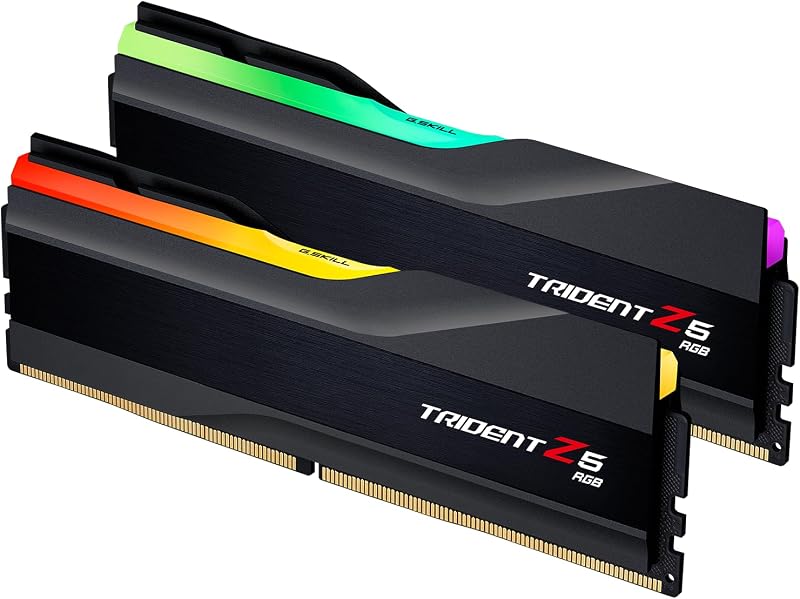
The G.Skill Trident Z5 RGB utilizes a sleek matte black heat spreader crowned with a translucent light bar engineered to diffuse RGB illumination across the top of the module. In any practical G.Skill Trident Z5 RGB DDR5 6000 review, builders routinely appreciate its iconic geometric form factor and understated styling. However, G.Skill does not incorporate dedicated infrared synchronization hardware, relying instead on standard motherboard illumination control or generic addressable RGB headers to coordinate visual patterns.
Edge: Kingston Fury Renegade DDR5, courtesy of its patented Infrared Sync Technology and dedicated FURY CTRL utility with 18 distinct lighting effects.
System Stability, Packaging, and Memory Kit Integrity
Achieving stable high-speed memory operation involves strict manufacturing binning and adherence to multi-channel kit design. When operating at multi-gigatransfert DDR5 speeds, memory traces and motherboard signal lines require perfectly matched pairs to avoid random blue screens, memory parity faults, or failure to post from cold boots.
G.Skill places significant emphasis on hardware verification and user warnings in its product documentation. The company explicitly cautions users never to combine multiple distinct kits, even of identical models, because each matched 32GB package (2x16GB) is factory-tested as a unified set to ensure signal stability. G.Skill also publishes detailed Qualified Vendor List documentation and an online RAM Configurator to confirm hardware compatibility across dozens of individual motherboards spanning both Intel 600/700/800 series and AMD 600/800 series boards before purchase.
Kingston packages the Fury Renegade as a 32GB dual-channel kit (2x16GB) engineered specifically to maximize stability under heavy memory loads and tap into aggressive overclocking thresholds. While Kingston promotes high reliability and XMP 3.0 certification, its listing documentation is less explicit regarding motherboard-specific chipset coverage. Both manufacturers construct their modules using non-ECC, 288-pin UDIMM standards, but G.Skill provides clearer guidance on fallback behavior, noting that systems boot at standard JEDEC default SPD speeds until BIOS profiles are engaged.
Edge: G.Skill Trident Z5 RGB DDR5 6000, thanks to comprehensive chipset validation documentation and transparent guidance on JEDEC fallback parameters.
Pros and Cons
G.Skill Trident Z5 RGB DDR5 6000
Pros
- Dual Intel XMP 3.0 and AMD EXPO profiles
- Broad compatibility across Intel and AMD chipsets
- Lower operating voltage of 1.35V
- 6000MT/s optimal sweet spot for AMD platforms
Cons
- Slower 6000MT/s transfer speed
- Higher CL36 latency
View G.Skill Trident Z5 RGB DDR5 6000 on Amazon
Kingston Fury Renegade DDR5

Pros
- Higher 6400MT/s transfer speed
- Tight CL32 CAS latency
- Patented Infrared Sync RGB lighting
- 18 customizable effects via FURY CTRL
Cons
- Lacks documented AMD EXPO support
- Higher 1.4V operating voltage
View Kingston Fury Renegade DDR5 on Amazon
Who Should Buy Each One
Choose the G.Skill Trident Z5 RGB DDR5 6000 If
- You are building an AMD Ryzen desktop and need verified AMD EXPO profiles right out of the box.
- You want broad, documented chipset support spanning both modern Intel and AMD motherboard series.
- You prefer a cooler-running 1.35V memory module to minimize thermal buildup near the processor socket.
- You want a set frequency of 6000MT/s that sits right in the optimal memory controller ratio for AMD processors.
Choose the Kingston Fury Renegade DDR5 If
- You run an Intel processor capable of driving 6400MT/s memory speeds reliably.
- You want the fastest response times offered by a tight CL32 CAS latency configuration.
- You prioritize synchronized aesthetics and want hardware-based Infrared Sync illumination effects.
- You want to maximize data bandwidth for high-resolution rendering and memory-intensive gaming workloads.
Final Verdict
For PC builders deciding whether to choose G.Skill Trident Z5 RGB or Kingston Fury Renegade for gaming and productivity, the optimal pick depends entirely on your system’s underlying processor architecture. The Kingston Fury Renegade DDR5 emerges as the overall performance champion in pure speed and responsiveness, leveraging its superior 6400MT/s bandwidth and lower CL32 latency. When installed in an Intel gaming rig with an XMP-compatible motherboard, it extracts maximum throughput, minimizes latency bottlenecks, and adds an attractive visual flair thanks to its proprietary infrared lighting synchronization.
However, the G.Skill Trident Z5 RGB DDR5 6000 represents the smarter, more versatile investment for users building on AMD AM5 motherboards or anyone who values universal platform mobility. With certified AMD EXPO and Intel XMP 3.0 profiles preloaded on the module, rock-solid 1.35V operating efficiency, and validated support across twelve distinct chipset tiers, the Trident Z5 RGB provides hassle-free stability that avoids the compatibility headaches often encountered when running aggressive memory profiles on diverse hardware.
FAQ
Does the Kingston Fury Renegade DDR5 feature an AMD EXPO profile?
The product listing certifies the Kingston Fury Renegade DDR5 for Intel XMP 3.0 overclocking profiles and does not list native AMD EXPO support. While some AMD motherboards can attempt to translate XMP values, native EXPO optimization is not explicitly guaranteed by the manufacturer specifications.
Will the G.Skill Trident Z5 RGB DDR5 6000 run at rated speeds automatically upon installation?
No, like all high-performance DDR5 kits, it will initially boot at standard JEDEC default SPD speeds. You must enter your motherboard BIOS and manually enable either the Intel XMP 3.0 or AMD EXPO profile to run the memory at its advertised 6000MT/s CL36 rating.
Why does the Kingston Fury Renegade operate at 1.4 volts while the G.Skill uses 1.35 volts?
The Kingston kit requires 1.40V to maintain signal stability at its higher 6400MT/s transfer speed and tighter CL32 timings. The G.Skill module targets 6000MT/s at CL36, allowing it to maintain operational integrity at a lower 1.35V profile.
Can I combine two separate 32GB kits of G.Skill Trident Z5 to reach 64GB?
G.Skill explicitly warns against mixing separate memory kits, even if they share the exact same part number. Memory kits are factory-tested and binned as matched sets; combining multiple kits can cause severe boot failures or memory stability issues.
What is Kingston FURY Infrared Sync Technology?
Kingston FURY Infrared Sync Technology uses integrated infrared transceivers on each memory module to communicate between adjacent sticks. This hardware link keeps dynamic RGB lighting patterns synchronized without relying solely on software protocols that can drift over time.
Which memory kit is better for gaming on an AMD Ryzen processor?
The G.Skill Trident Z5 RGB DDR5 6000 is generally the superior choice for AMD Ryzen builds. Its preloaded AMD EXPO profile is certified for AMD platforms, and 6000MT/s aligns with the optimal 1:1 memory controller ratio typically recommended for AM5 architecture stability.


