The single technical difference that decides the choice for most buyers between the Samsung 980 Pro and the Samsung 990 Pro is continuous write throughput paired with operational power efficiency. While both drives harness the PCIe 4.0 interface, the newer drive delivers an improved write ceiling of 6,900 MB/s and up to 50 percent higher performance per watt, whereas the earlier flagship tops out at 5,100 MB/s write speeds and centers on baseline Gen4 computing requirements.
Shoppers looking for reliable Gen4 speeds for gaming setups or PlayStation 5 storage expansion without needing high-volume sustained writes should select the 980 Pro. Content creators handling continuous 4K video rendering, heavy file transfers, or dense data analytics will find the sustained performance of the 990 Pro far more advantageous.
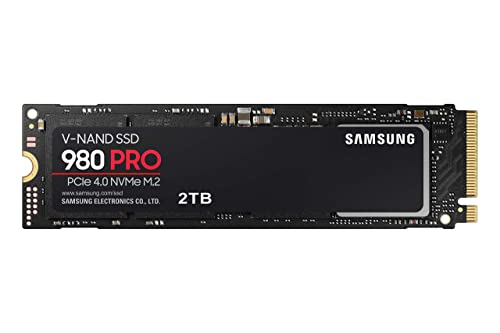

Samsung 980 Pro vs Samsung 990 Pro at a Glance
| Attribute | Samsung 980 Pro | Samsung 990 Pro |
|---|---|---|
| Hard Disk Interface | PCIe Gen 4×4, NVMe | PCIe 4.0, NVMe |
| Sequential Read Speed | Up to 7,000 MB/s | Up to 7,450 MB/s |
| Sequential Write Speed | Up to 5,100 MB/s | Up to 6,900 MB/s |
| Random Performance Improvement | Standard Gen4 Baseline | More than 55% over 980 PRO |
| Power Efficiency | Optimized M.2 efficiency | Up to 50% improved performance per watt over 980 PRO |
| Thermal Dissipation Design | Nickel-coated Elpsis controller, heat spreader label | In-house controller with smart heat control |
| Console Compatibility | Sony PlayStation 5 | Sony PlayStation 5 |
| Hardware Encryption | AES 256-Bit Encryption | The listing does not specify |
| Form Factor | M.2 2280 | M.2 2280 |
| Best For | General Gen4 gaming and everyday desktop workloads | Sustained writes, heavy video production, and high-load computing |
Sequential Write and Read Speeds
Sequential throughput defines how fast a drive processes large, contiguous blocks of data without interruption. This operational metric directly governs how rapidly an internal solid state drive can duplicate massive video projects, import hundreds of gigabytes of raw media, or run large-file system backups. When evaluating samsung 980 vs 990 pro specifications, sequential bandwidth demonstrates the generational leap between Samsung’s two flagship iterations on the PCIe 4.0 protocol.
The 980 Pro operates with rated maximum sequential read speeds of up to 7,000 MB/s and sequential write speeds reaching up to 5,100 MB/s, driven by Samsung V-NAND Flash Technology and the Elpsis controller. In comparison, the 990 Pro pushes close to the physical limits of the PCIe 4.0 x4 bus, offering sequential read rates up to 7,450 MB/s and sequential write rates up to 6,900 MB/s using Intelligent TurboWrite technology. Looking closely at 980 Pro vs 990 Pro speeds reveals a modest 450 MB/s increase in read velocity, but the Samsung 980 Pro vs 990 Pro write speed metric reveals a massive 1,800 MB/s performance expansion in favor of the newer drive.
In routine computing environments, an everyday user will rarely saturate either drive’s sequential write pipeline. However, during workstation tasks like exporting uncompressed digital video timelines or batch transferring multi-gigabyte project archives, the extra 1,800 MB/s sequential write performance of the 990 Pro cuts down transfer times significantly. The 980 Pro still provides more than enough bandwidth to prevent common desktop bottlenecks, but it yields ground when continuous write operations scale into multi-gigabyte production workloads.
Edge: Samsung 990 Pro delivers an 1,800 MB/s higher sequential write rate and an extra 450 MB/s of sequential read throughput.
Power Efficiency and Thermal Dissipation
Thermal management and power efficiency dictate how long a solid state drive can sustain its peak transfer rates before thermal throttling limits performance. As NVMe drives push higher transfer speeds across the PCIe 4.0 interface, power consumption increases, transforming electrical energy into waste heat. Without effective energy conservation and heat mitigation, an SSD will automatically throttle its clock speeds downward to protect the controller and flash memory cells from thermal damage.
The 980 Pro addresses heat management by implementing a specialized nickel coating across the surface of its Elpsis controller alongside a heat spreader label placed directly on the NAND flash package. The 990 Pro builds upon this baseline with an updated in-house controller that features smart heat control and produces up to 50 percent improved performance per watt compared to the 980 Pro. Evaluating Samsung 980 Pro vs 990 Pro power efficiency shows that the 990 Pro executes heavier tasks while consuming fewer watts per gigabyte transferred, reducing overall thermal saturation inside tight computer cases.
This power-to-performance dynamic becomes critical in compact desktop cases, thin performance laptops, or enclosed storage bays. When compared with mainstream consumer options like those detailed in our samsung 980 pro vs 990 evo breakdown, both Pro drives require responsible thermal management, but the 990 Pro operates with significantly lower electrical overhead per unit of data transferred. The improved efficiency prevents the controller from reaching thermal ceiling limits as quickly during prolonged sequential writes.
Edge: Samsung 990 Pro provides up to 50 percent higher performance per watt, resulting in cooler sustained operational efficiency.
Random Access Performance in Heavy Workloads
Random access performance measures an SSD’s ability to read and write tiny, fragmented data clusters scattered throughout different sectors of the flash memory. Unlike sequential transfers that move single large files, random access handles everyday operating system operations, multi-threaded database queries, runtime code execution, game asset caching, and background application services. While sequential speeds capture user attention on spec sheets, random access speeds govern system responsiveness under heavy multi-tasking.
The manufacturer specifications highlight that the 990 Pro achieves more than a 55 percent improvement in random performance over the 980 Pro. This architectural uplift allows the 990 Pro to excel in deep queue-depth scenarios, such as loading complex 3D graphic models, compiling heavy software codebases, and parsing large data analytics workloads. In a thorough Samsung 990 Pro review context, this performance jump illustrates how the revised internal controller manages concurrent operational pipelines without introducing latency pauses.
Readers reviewing generational upgrades from legacy drives like the samsung 970 evo plus vs 980 pro will recognize that the 980 Pro already delivered outstanding responsiveness for PCIe 4.0 systems. Nevertheless, when pushed by enterprise-style computing environments or multi-stream 4K editing caches, the 980 Pro encounters queue saturation earlier than the 990 Pro. For ordinary desktop utility, both drives maintain near-instant responsiveness, but the 55 percent random access advantage makes the 990 Pro far more capable when processing fragmented file trees.
Edge: Samsung 990 Pro provides over 55 percent faster random performance, handling deep data queues with lower latency.
Gaming and PlayStation 5 Console Performance
High-end solid state drives are increasingly evaluated by their ability to slash loading screens and stream real-time environmental assets into modern game engines. Both the 980 Pro and the 990 Pro are officially compatible video game console upgrades for the Sony PlayStation 5, and both feature dedicated gaming design profiles. When deciding on the Samsung 980 Pro or 990 Pro for PS5 use, the fundamental question centers on whether the raw speed surplus of the newer drive translates into practical loading advantages inside games.
The Sony PlayStation 5 requires a PCIe 4.0 x4 M.2 NVMe SSD with minimum read speeds of 5,500 MB/s. The 980 Pro reaches up to 7,000 MB/s sequential read, comfortably clearing Sony’s architectural baseline. The 990 Pro reaches up to 7,450 MB/s sequential read speed, providing extra theoretical headroom. However, in real-world console operations and PC gaming setups, game loading sequences rely extensively on asset decompression algorithms and GPU pipeline handoffs rather than unbuffered raw read throughput.
Consequently, when comparing the Samsung 980 Pro or 990 Pro for gaming, real-world level loading tests show that load times between the two drives remain nearly identical, often separating by only fractions of a second. The 980 Pro offers high-performance bandwidth and throughput tailored specifically for gaming and graphics, making game installations and fast-travel transitions virtually seamless. While future systems may eventually compare against cutting-edge Gen5 hardware like a samsung 990 pro vs 9100 pro pairing, today’s game engines do not fully saturate the read pipeline of either drive.
Edge: Tie. Both models easily surpass Sony PlayStation 5 read requirements and offer indistinguishable loading speeds in real-world games.
Physical Build, Form Factor, and Hardware Features
Form factor dimensions and physical build traits dictate how readily an internal solid state drive integrates into desktop motherboards, gaming laptops, and enclosed expansion slots. Both models conform to the M.2 2280 form factor standard, meaning they measure roughly 22mm in width by 80mm in length. However, small variations in module thickness, bare drive weight, and protective design ratings exist between the two product listings.
The 980 Pro product listing specifies dimensions of 3.15 inches long by 0.94 inches wide by 0.87 inches thick, with an item weight of 1.92 ounces (reflecting retail or packaging measures), alongside hardware-based AES 256-Bit Encryption for data security. The 990 Pro listing records bare drive dimensions of 3.16 inches long by 0.87 inches wide by 0.09 inches thick, with an item weight of 9.07 grams. Additionally, the 990 Pro listing highlights specialized physical endurance attributes, including 9.8-foot drop resistance as well as water and dust resistance specifications.
For PC builders deciding between alternative mainstream drives such as the samsung 980 pro vs 990 evo plus or high-end Pro series drives, component thickness can impact installation underneath tight heatsink shrouds. The slim 0.09-inch profile of the bare 990 Pro fits smoothly into restrictive laptop chassis and motherboard slots, while its drop, dust, and water resistance specifications provide additional durability assurance during handling and system upgrades.
Edge: Samsung 990 Pro features a slimmer bare module profile and explicitly stated drop, water, and dust resistance specifications.
Pros and Cons
Samsung 980 Pro

Pros
- Up to 7,000 MB/s sequential read speed
- Proven Elpsis controller with nickel thermal coating
- Hardware AES 256-Bit encryption included
- Fully compatible with Sony PlayStation 5
Cons
- Sequential write capped at 5,100 MB/s
- Lower power efficiency than the 990 Pro
View Samsung 980 Pro on Amazon
Samsung 990 Pro

Pros
- Blazing 6,900 MB/s sequential write speed
- Near-max Gen4 7,450 MB/s read speed
- Up to 50 percent higher performance per watt
- Over 55 percent higher random performance
Cons
- Extra write speed unutilized by casual gaming
- Encryption details not specified in listing
View Samsung 990 Pro on Amazon
Who Should Buy Each One
Choose the Samsung 980 Pro If
- You need a dependable PCIe 4.0 expansion drive for a Sony PlayStation 5 console without paying for unused write overhead.
- Your primary computing demands center on standard PC gaming, internet browsing, and general office productivity.
- You require hardware-level AES 256-Bit encryption support for sensitive local file storage.
- You want proven Elpsis controller performance with established thermal reliability from its nickel coating.
Choose the Samsung 990 Pro If
- You frequently edit 4K or 8K video timelines, work with 3D animation, or run large-scale data analytics pipelines.
- You routinely transfer multi-gigabyte files and need the maximum 6,900 MB/s sequential write performance of PCIe 4.0.
- You need up to 50 percent higher performance per watt to keep heat accumulation minimal in compact cases or laptops.
- You want over 55 percent faster random performance to process heavy, multi-threaded application queues efficiently.
Final Verdict
When looking at the broad picture of Samsung 990 Pro vs 980 Pro performance, the Samsung 990 Pro represents the superior drive for performance-focused users. By pushing sequential read speeds to 7,450 MB/s, sequential write speeds to 6,900 MB/s, and elevating random performance by more than 55 percent, the 990 Pro takes full advantage of the PCIe 4.0 x4 interface. Combined with an impressive 50 percent gain in performance per watt, users asking is Samsung 990 Pro worth it for professional video creation, heavy software compilation, or sustained file writes will find that the technical performance advantages translate directly into practical workflow time savings.
At the same time, the earlier flagship holds strong value for general enthusiasts. As established throughout this Samsung 980 Pro review assessment, its 7,000 MB/s read ceiling, robust Elpsis controller, AES 256-bit encryption, and full Sony PlayStation 5 compatibility provide more than enough speed for gaming and everyday multi-tasking. For builders who do not regularly execute continuous multi-gigabyte write transfers, the 980 Pro delivers reliable Gen4 responsiveness that handles everyday tasks with absolute stability.
FAQ
Is the Samsung 990 Pro worth it over the 980 Pro?
The 990 Pro is worth choosing if your computer workflow involves writing large files continuously, editing high-resolution video footage, or processing complex data analytics that benefit from its 6,900 MB/s write ceiling and 55 percent higher random performance. For standard desktop use and gaming, the practical difference between the two drives is minimal.
Can I use both the Samsung 980 Pro and 990 Pro in a PS5?
Yes, both drives are compatible with the Sony PlayStation 5 console. Both models utilize the required M.2 2280 form factor and PCIe 4.0 NVMe interface, and both comfortably exceed Sony’s minimum recommended read speed threshold of 5,500 MB/s.
What is the real write speed difference between the 980 Pro and 990 Pro?
The 980 Pro delivers sequential write speeds up to 5,100 MB/s, whereas the 990 Pro reaches sequential write speeds up to 6,900 MB/s. This gives the 990 Pro an advantage of up to 1,800 MB/s during large sustained sequential write operations.
Does the Samsung 990 Pro run more efficiently than the 980 Pro?
Yes, the 990 Pro provides up to 50 percent improved performance per watt compared to the 980 Pro according to Samsung specifications. This improved power efficiency allows the drive to deliver higher transfer rates while consuming less electrical power per unit of data transferred.
Are both SSDs backward compatible with PCIe 3.0 motherboards?
Yes, both solid state drives are fully backward compatible with PCIe 3.0 motherboard slots. However, when installed in a PCIe 3.0 slot, data transfer rates will be capped by the theoretical bandwidth limit of the PCIe 3.0 bus rather than reaching their rated 7,000 MB/s or 7,450 MB/s speeds.
Do both drives support hardware encryption?
The Samsung 980 Pro product listing explicitly lists support for AES 256-Bit hardware encryption to protect stored data. The Samsung 990 Pro product listing does not specifically mention AES encryption specifications in its provided feature list.