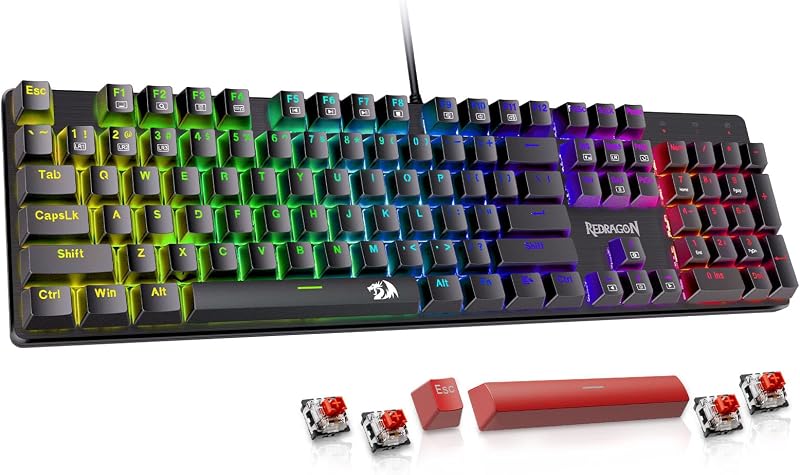
The single difference that decides the choice between the Epomaker TH80 V2 and the 8BitDo Retro Mechanical is the focus on modern internal acoustic engineering versus external tactile retro modularity. While Epomaker concentrates on multi-layered dampening foams and a colossal internal battery to produce a quiet, refined keystroke, 8BitDo prioritizes classic console styling, clicky box switches, and standalone hardware macro pedals.
Choose the Epomaker TH80 V2 if you want a compact desk footprint, smooth acoustic dampening, and enough battery capacity to run wireless for weeks between charges. Choose the 8BitDo Retro Mechanical if you demand nostalgic tabletop aesthetics, dedicated physical switches, and driver-free macro assignment on oversized external buttons.

Epomaker TH80 V2 vs 8BitDo Retro Mechanical at a Glance
| Feature | Epomaker TH80 V2 | 8BitDo Retro Mechanical |
|---|---|---|
| Form Factor & Layout | 75% compact layout (79 keys) | Tenkeyless layout (87 keys) |
| Acoustic Damping | PORON, IXPE, latex, silicone, and PED pad | Not listed (Top mount style plastic build) |
| Battery Capacity | 8000mAh (200+ hours continuous play) | Rechargeable (capacity not listed) |
| Stock Switches | Custom mechanical switches | Kailh Box Switch V2 White |
| Keycaps | Changeable keycaps | Dye-sub PBT keycaps |
| Hardware Controls | Metal rotary knob (volume roller) | Dual Super Buttons, independent control panel |
| Backlighting & Aesthetics | South-facing RGB with dynamic side-plate | Classic power status LED, retro styling |
| Connectivity | 2.4GHz wireless, Bluetooth, wired USB | Bluetooth, USB-C (2.4G listed in title) |
| Device Memory | Up to 5 devices simultaneously | Not listed |
| Best For | Deep acoustic typing and long battery life | Retro gaming setups and physical macro control |
Acoustic Design and Case Dampening
Keystroke acoustics define the typing experience on any modern mechanical board. The Epomaker TH80 V2 targets the enthusiast sound profile by packing five distinct sound-optimizing layers directly inside the chassis. Its internal sandwich features sound-absorbing PORON, an IXPE switch pad, latex foam, a bottom silicone pad, and an integrated PED sheet. This dense arrangement absorbs switch vibrations, rids pinging resonances from the casing, and dampens hollow rattles beneath the spacebar and modifiers. The result is a muffled, low-pitched acoustic signature right out of the box without requiring manual tape modifications.
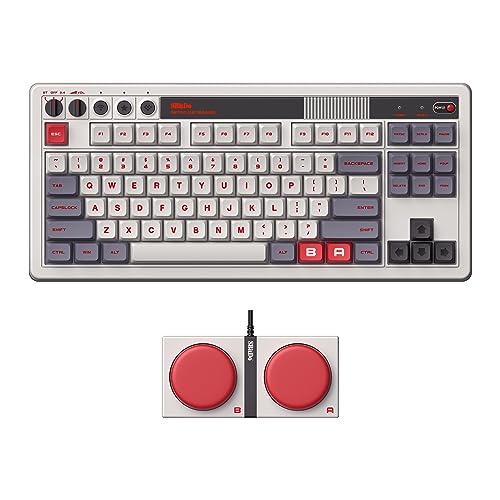
By comparison, the 8BitDo Retro Mechanical takes a traditional approach centered on tactile and audible feedback. Built with a classic plastic enclosure and a top-mount construction style, this keyboard highlights the crisp snap of its included mechanical switches rather than silencing them. The board comes equipped with clicky Kailh Box Switch V2 White switches paired with thick dye-sub PBT keycaps. When evaluating the epomaker th80 v2 vs lofree flow or the 8BitDo, the acoustic character is entirely different: the 8BitDo embraces the loud, typewriter-like auditory feedback reminiscent of 1980s computing terminals.
When deciding between the Epomaker TH80 V2 or 8BitDo Retro Mechanical for typing, your workspace environment determines the winner. The TH80 V2 minimizes desk noise, making it respectful of shared home offices, streaming environments, and open workspaces. The 8BitDo, on the other hand, deliberately produces an unmistakable click with every bottom-out. Users who find rhythmic, high-frequency sound satisfying will appreciate the 8BitDo Retro Mechanical switches, but anyone seeking a muted, creamy sound profile will find the acoustic dampening on the Epomaker vastly superior.
Edge: Epomaker TH80 V2 because its multi-layered PORON, IXPE, latex, and silicone dampening system completely eliminates case ping and hollow rattles.
Battery Life and Power Management
Wireless endurance dictates how frequently a keyboard anchors you to a charging cable. The Epomaker TH80 V2 leads the wireless category by incorporating a massive 8000mAh rechargeable battery. Epomaker states this power reservoir delivers more than 200 hours of continuous wireless gameplay on a single charge cycle. Even with wireless polling active, this capacity allows heavy users to work and play for weeks without looking for a USB port. For desk setups striving for a minimalist, cable-free aesthetic, this massive cell eliminates low-battery anxiety.
The 8BitDo Retro Mechanical listing specifies that the keyboard is battery-powered and rechargeable, but the manufacturer does not specify the exact milliamp-hour capacity or total operating runtime on a single charge. It relies on standard internal battery cells designed to handle daily desktop typing via Bluetooth or USB-C. Because the 8BitDo lacks high-drain per-key RGB backlighting-featuring only vintage power status indicators and classic control LEDs-its energy draw remains modest. However, without confirmed capacity metrics, it cannot match the sheer brute force of Epomaker’s documented cell.
Understanding real-world longevity also means examining connectivity options. The TH80 V2 pairs its power cell with triple-mode connectivity across 2.4GHz wireless, Bluetooth, and wired connections, storing profiles for up to 5 devices simultaneously. Shoppers comparing models like the akko 5075b plus vs epomaker th80 v2 often note that Epomaker TH80 V2 battery life is among the largest available in the compact keyboard market. The 8BitDo provides flexible desktop use, but the documented endurance of the TH80 V2 gives mobile and wireless enthusiasts a tangible reliability advantage.
Edge: Epomaker TH80 V2 because its massive 8000mAh battery delivers over 200 hours of continuous wireless use.
Physical Controls and Macro Hardware
Dedicated physical inputs alter how quickly you execute complex commands, control system audio, and navigate desktop workflows. The 8BitDo Retro Mechanical sets itself apart with its external control modules. The board includes Dual Super Buttons: two giant, programmable arcade-style hardware keys that sit beside the main chassis. These large programmable keys allow users to map complex macros, shortcuts, or single-key inputs instantly on the fly without launching companion software. In addition, the upper-left corner of the main casing houses an independent control panel with a physical volume dial and status knobs inspired by classic electronics.
The Epomaker TH80 V2 approaches physical interaction through an integrated metal knob mounted at the top-right edge of the 75% frame. This multi-functional volume roller allows users to adjust audio levels, mute sound with a quick press, and control lighting intensity depending on firmware configuration. While the Epomaker TH80 V2 rotary knob feels substantial and saves desk space by remaining recessed into the primary footprint, remapping its functions or configuring intricate key combinations requires diving into Epomaker’s configuration software.
For gamers and heavy macro users, the tangible utility of the 8BitDo Retro Mechanical Super Buttons provides a distinct workflow. You can smash the oversized buttons with a palm or thumb during intense sessions, assigning functions like quick-save, discord muting, or game abilities without breaking typing cadence. As seen in comparisons like the nuphy air75 v2 vs 8bitdo retro mechanical, external hardware switches provide instant tactile gratification that standard software-bound keys and compact rotary encoders simply cannot replicate.
Edge: 8BitDo Retro Mechanical because its Dual Super Buttons allow instantaneous, driver-free macro mapping on massive physical inputs.
Form Factor, Layout, and Desk Footprint
Desk real estate directly impacts mouse movement, posture, and operational comfort. The Epomaker TH80 V2 uses a streamlined 75% mechanical form factor with 79 physical keys. This compact configuration condenses the function row, arrow cluster, and key navigation buttons into a tight, seamless cluster, measuring 12.73 inches long, 5.54 inches wide, and 1.74 inches high. By shaving width off the standard desktop layout, the TH80 V2 opens up substantial mouse-swiping room for competitive gaming setups while preserving the vital keys needed for editing and data entry.
In contrast, the 8BitDo Retro Mechanical adheres to an 87-key Tenkeyless (TKL) architecture. The TKL format maintains standard separation between the alpha-numeric keys, the navigation island, and the arrow cluster. This traditional layout requires zero muscle memory adjustments for typists transitioning from full-sized office peripherals. However, the larger footprint and wide framing demand more physical desk surface. While the product listing features an exaggerated package dimension entry, standard TKL boards are noticeably wider than compact 75% alternatives, which limits how closely you can position your mouse pad.
Comparing the 8BitDo Retro Mechanical vs Epomaker TH80 V2 reveals a distinct ergonomic trade-off. The Epomaker delivers greater spatial efficiency, making it easier to transport and simpler to center squarely in front of your monitor. The 8BitDo rewards users who prefer standard spacing and despise squished arrow layouts. If you browse alternative options like the akko 5075b plus vs 8bitdo retro mechanical, you will find that the 75% layout of the TH80 V2 offers the optimal balance between functional key retention and mouse freedom.
Edge: Epomaker TH80 V2 because its 79-key 75% form factor preserves dedicated arrows while maximizing desk space for mouse travel.
Gaming Latency, Polling, and Platform Compatibility
Input responsiveness and system versatility determine how well a keyboard performs across mixed platforms and fast-paced gaming genres. Epomaker engineers the TH80 V2 with a 1000Hz (1k) polling rate and an ultra-low 2ms latency profile, backed by full anti-ghosting matrix technology. These specifications ensure that high-speed key presses register instantaneously during rapid gaming sequences without missed inputs. Furthermore, the TH80 V2 advertises broad hardware support across gaming consoles, laptops, PCs, smartphones, and tablets, storing connections for up to 5 individual devices.
The 8BitDo Retro Mechanical features full n-key rollover across its hot-swappable PCB, ensuring that overlapping key strokes register without locking up. The board explicitly advertises compatibility with Windows 10 (1903 or above) and Android 9.0 or above, alongside gaming console connectivity. While 8BitDo is famous for low-latency retro controllers, the listing does not specify the exact millisecond response time or polling rate for this mechanical keyboard. Gamers must rely on its standard wired USB-C or Bluetooth protocols for connection handling.
Choosing between the Epomaker TH80 V2 or 8BitDo Retro Mechanical for gaming comes down to technical transparency. Gamers engaging in precision shooters and fast-paced competitive titles benefit from the verified 1000Hz polling rate and 2ms input speed of the TH80 V2. The 8BitDo handles casual gaming, retro emulation, and standard console duties with ease, but its clicky Kailh Box switches provide a longer reset travel compared to smooth linear options. When reviewing options like the ducky one 3 vs epomaker th80 v2, the verified low-latency performance of the Epomaker solidifies its position as a performance-oriented peripheral.
Edge: Epomaker TH80 V2 because it guarantees a 1000Hz polling rate, 2ms low latency, and memory for up to 5 devices.
Pros and Cons
Epomaker TH80 V2

Pros
- Massive 8000mAh battery with 200+ hours runtime
- Five internal sound-dampening layers eliminate rattle
- Fast 1000Hz polling rate and 2ms latency
- Integrated multi-function metal rotary knob
- Stores connections for up to 5 devices
Cons
- Requires software for key remapping and macros
- More compressed navigation layout than standard TKL
View Epomaker TH80 V2 on Amazon
8BitDo Retro Mechanical

Pros
- Dual Super Buttons map macros without software
- Durable dye-sub PBT keycaps included
- Tactile Kailh Box Switch V2 White switches
- Independent physical control panel and vintage LED
- Roomy traditional 87-key tenkeyless layout
Cons
- Battery capacity and runtime not listed
- No internal acoustic foam dampening layers
View 8BitDo Retro Mechanical on Amazon
Who Should Buy Each One
Choose the Epomaker TH80 V2 If
- You want internal acoustic dampening layers of PORON, latex, and silicone to eliminate case rattles.
- You need marathon wireless uptime backed by a verified 8000mAh battery offering 200+ hours of runtime.
- You require a compact 75% layout that maximizes mouse travel space while retaining a volume knob.
- You switch actively between up to 5 devices across PC, mobile, tablet, and console platforms.
Choose the 8BitDo Retro Mechanical If
- You love retro hardware aesthetics inspired by classic 8-bit and 16-bit entertainment consoles.
- You want giant, external Super Buttons to map macros and hotkeys on the fly without configuration software.
- You prefer the crisp, loud, typewriter-style tactile feedback of Kailh Box Switch V2 White switches.
- You demand a traditional 87-key tenkeyless layout with standard spacing around the navigation cluster.
Final Verdict
For the vast majority of modern mechanical keyboard buyers, the Epomaker TH80 V2 emerges as the superior overall typing instrument. Epomaker focuses on the metrics that modern keyboard enthusiasts care about most: deep, satisfying acoustics, versatile multi-device pairing, and exceptional battery endurance. With five sound-absorbing dampening layers, south-facing RGB illumination, a 1000Hz polling rate, and an 8000mAh battery that runs for over 200 hours, it functions as an all-around workhorse for gaming, coding, and day-to-day productivity. Any comprehensive Epomaker TH80 V2 review will highlight its high feature density within a space-saving 75% enclosure.
The 8BitDo Retro Mechanical wins handily for a distinct sub-section of enthusiasts: nostalgic gamers, retro system builders, and heavy macro users. If your setup celebrates vintage gaming hardware, or if you regularly execute complex sequences that benefit from oversized, standalone mechanical buttons, this retro peripheral delivers personality that modern minimalist keyboards cannot match. An honest 8BitDo Retro Mechanical review confirms that while it lacks acoustic dampening foams and verified battery specs, its dye-sub PBT keycaps, Kailh Box clicky switches, and instant macro mapping make it a deeply charismatic centerpiece on any vintage-inspired desk.
FAQ
Is 8BitDo Retro Mechanical worth it for office typing?
The 8BitDo Retro Mechanical can work in a private home office, but its stock Kailh Box Switch V2 White switches are clicky and loud. In shared office environments or quiet rooms, the sharp audible bottom-out will likely disturb coworkers. For shared workspaces, the dampened acoustics of the Epomaker TH80 V2 are far better suited.
Can you swap the switches on the Epomaker TH80 V2?
Yes, the Epomaker TH80 V2 features a fully hot-swappable PCB. You can pull out the factory switches and replace them with standard 3-pin or 5-pin mechanical switches without any soldering, allowing you to experiment with linear, tactile, or clicky switch varieties whenever you choose.
Are the 8BitDo Dual Super Buttons required for the keyboard to work?
No, the Dual Super Buttons are independent peripheral modules that plug directly into dedicated ports on the rear of the 8BitDo Retro Mechanical keyboard. The keyboard operates as a fully functional 87-key tenkeyless board whether the Super Buttons are plugged in or disconnected.
How do you map macros to the 8BitDo Super Buttons?
The 8BitDo Retro Mechanical allows hardware-level macro assignment directly from the keyboard chassis. By pressing the dedicated mapping button on the keyboard’s top control panel, entering your desired keystroke sequence, and pressing the targeted Super Button, you can program inputs instantly without downloading or installing background software.
Does the Epomaker TH80 V2 feature RGB lighting?
Yes, the Epomaker TH80 V2 includes full per-key south-facing RGB backlighting as well as a specially customized dynamic RGB side-plate. It supports numerous static and dynamic lighting presets out of the box, with additional customization options available via companion software.
Can the Epomaker TH80 V2 connect to multiple computers simultaneously?
Yes, the Epomaker TH80 V2 supports triple-mode connectivity across 2.4GHz wireless, Bluetooth, and wired USB. It includes on-board memory that allows it to pair with and switch between up to 5 devices, making it easy to jump between a work laptop, gaming PC, and mobile tablet.