The core distinction when comparing the TP-Link Deco BE85 to the Google Nest WiFi Pro comes down to architectural scale: the Deco BE85 is a high-throughput Wi-Fi 7 mesh system engineered around 10Gbps wired ports and 320 MHz wireless channels, while the Nest WiFi Pro is a streamlined Wi-Fi 6E mesh built for automated network balancing and simplified whole-home coverage.
Choose the TP-Link Deco BE85 if you need maximum local bandwidth, multi-gigabit wired backhaul, and dedicated hardware features like SFP+ fiber connectivity and onboard VPN servers. Choose the Google Nest WiFi Pro if you prioritize automated self-diagnosing network software, native Google ecosystem synergy, and broad multi-room coverage for standard everyday household devices.


TP-Link Deco BE85 vs Google Nest WiFi Pro at a Glance
| Feature | TP-Link Deco BE85 | Google Nest WiFi Pro |
|---|---|---|
| Wi-Fi Generation | Wi-Fi 7 (802.11be) | Wi-Fi 6E (802.11ax) |
| Frequency Bands | Tri-Band (2.4 GHz, 5 GHz, 6 GHz) | Tri-Band (2.4 GHz, 5 GHz, 6 GHz) |
| Maximum Data Transfer Rate | 22,000 Mbps (BE22000) | 1,000 Mbps listed |
| Channel Bandwidth | Up to 320 MHz | Up to 160 MHz |
| Ethernet Ports | 2x 10 Gbps (1x RJ45, 1x SFP+/RJ45 combo), 2x 2.5 Gbps | 4 Ports listed (LAN bandwidth >= 2.4 Gbps) |
| Antenna Configuration | 8 Internal Antennas | 2 Internal Antennas |
| Coverage (3-Pack) | Not listed in square feet | Up to 6,600 sq. ft. |
| Hardware Cooling | 2 Internal Cooling Fans | Not listed |
| Operating System & Security | RouterOS, HomeShield, WPA3 | Google’s Nest OS, Secure Boot, WPA3 |
| Best For | Multi-Gigabit Networks & Power Users | Hands-Off Smart Homes |
Wireless Speeds and Wi-Fi Generation
The technological gap between Wi-Fi 7 and Wi-Fi 6E defines the baseline performance of these two mesh systems. The TP-Link Deco BE85 operates on the 802.11be standard, unlocking 320 MHz ultrawide channels, 4K-QAM modulation, Multi-Link Operation (MLO), and Multi-RUs. These protocols allow the Deco BE85 to deliver an aggregate rating of up to 22,000 Mbps across its tri-band spectrum: 11,520 Mbps on the 6 GHz band, 8,640 Mbps on the 5 GHz band, and 1,376 Mbps on the 2.4 GHz band. In a detailed Deco BE85 WiFi 7 vs Nest WiFi Pro 6E comparison, the wider 320 MHz pipeline effectively doubles the single-client bandwidth potential over compatible next-generation hardware.
By contrast, the Google Nest WiFi Pro relies on the Wi-Fi 6E (802.11ax) standard, operating across 2.4 GHz, 5 GHz, and 6 GHz frequencies with channel widths up to 160 MHz. Google specifies that the Nest Pro delivers up to 2x faster performance than Wi-Fi 6 systems limited to 80 MHz channels, listing an overall data transfer rate of 1 Gbps. While the Nest system does not support the multi-link aggregation or wider channels found in Wi-Fi 7, it cleanly routes modern 6E-compatible clients onto the uncongested 6 GHz frequency band to avoid legacy interference. If you are comparing earlier generation systems, reviewing the tp-link deco xe75 vs be85 highlights how substantially Wi-Fi 7 widens overall capacity beyond standard 6E architectures.
When considering real-world throughput in a theoretical TP-Link Deco BE85 vs Nest WiFi Pro speed test, the Deco BE85 possesses a dramatically higher transmission ceiling. The 8 internal high-performance antennas in the Deco unit, paired with 4K-QAM, push more data per packet than the 2 internal antennas found inside the Nest WiFi Pro. For users who transfer massive files locally or subscribe to multi-gigabit residential broadband tiers, the raw capacity advantage sits firmly with TP-Link.
Edge: TP-Link Deco BE85, because its Wi-Fi 7 standard, 320 MHz channels, and 22,000 Mbps aggregate throughput provide vastly higher wireless bandwidth than the Wi-Fi 6E framework on the Nest WiFi Pro.
Wired Connectivity and Port Architecture
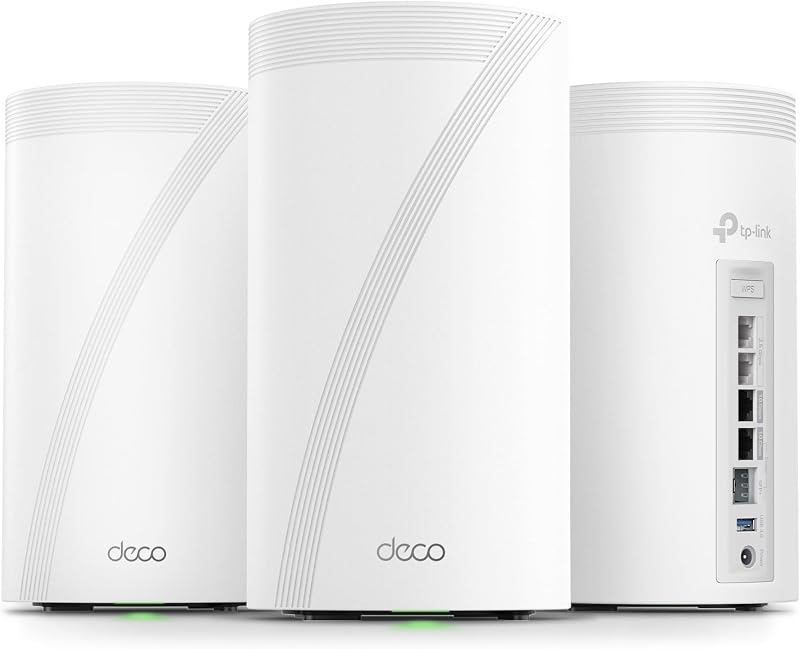
Wired routing capacity reveals an enormous hardware divergence between these two platforms. An analysis of Google Nest WiFi Pro vs Deco BE85 ethernet ports shows that TP-Link designed the BE85 around modern enterprise-style connectivity. Each Deco BE85 node features two 10 Gbps WAN/LAN ports-one standard RJ45 port and one SFP+ Fiber/RJ45 combo port. Alongside those dual 10G interfaces, the unit provides two 2.5 Gbps Ethernet ports and a dedicated USB 3.0 port. This setup allows users to ingest 10G fiber directly into the node, link high-speed network-attached storage (NAS) devices, and run multi-gigabit wired backhauls simultaneously without creating a hardware bottleneck.
The Google Nest WiFi Pro approach is significantly simpler. Google lists four total ports across the platform specifications, supporting LAN port bandwidth rated at >= 2.4 Gbps. The listing focuses primarily on wireless communication rather than expandable high-speed wired infrastructure, and it lacks specialized connectivity like SFP+ fiber cages or auxiliary USB ports for shared network drives. For users who prefer a wire-heavy layout or need to distribute fiber speeds across several desktop switches, the port allocation on the Nest hardware remains utilitarian.
The inclusion of active thermal management on the Deco BE85 highlights the operational demands of its physical ports. Moving 10 Gbps of data through copper and fiber creates noticeable thermal loads, which TP-Link counters with two internal cooling fans. The Nest WiFi Pro relies on fanless passive venting suited for lower-bandwidth consumer operations. Readers researching alternative multi-gig platforms can read our tp-link deco be85 vs asus zenwifi xt9 breakdown for further port comparisons.
Edge: TP-Link Deco BE85, due to its dual 10G ports with SFP+ fiber support, dual 2.5G ports, and USB 3.0 connectivity, which vastly outperform the basic wired interfaces on the Nest WiFi Pro.
Coverage and Mesh Backhaul Handling
Whole-home signal distribution depends on how efficiently satellite units relay packets back to the gateway router. The Google Nest WiFi Pro shines in straightforward residential distribution, with a 3-pack providing up to 6,600 square feet of coverage (or approximately 2,200 square feet per individual router node). Google integrates automated network adjustments to maintain signal stability at the outer perimeter of its coverage boundary, allowing satellite nodes to reposition client devices without manual channel tuning. Note that the Nest WiFi Pro is not backward-compatible with older Google Wifi or Nest Wifi generations due to the structural shift to Wi-Fi 6E.
TP-Link does not list an exact square-foot coverage metric on this specific listing, but it introduces an advanced backhaul feature: simultaneous wireless and wired backhaul. By deploying this proprietary implementation, the Deco BE85 leverages both physical Ethernet connections and wireless Wi-Fi 7 channels at the same time to route data between nodes. This prevents the typical throughput degradation that happens when a mesh node relies strictly on a shared wireless frequency. Combined with AI-driven seamless roaming algorithms that learn your movement patterns throughout the house, the Deco nodes maintain uninterrupted data streams.
Home layout determines which backhaul strategy works best. If you have an un-cabled home measuring over 5,000 square feet and want a pre-calculated multi-node mesh footprint, the three-pack Nest Pro system covers vast floor plans out of the box. However, if your home has structural barriers or pre-wired Ethernet drops, the simultaneous backhaul in the Deco BE85 delivers superior data integrity across nodes. A similar dynamic is explored in our netgear orbi rbk752 vs tp-link deco be85 overview.
Edge: Tie. Google Nest WiFi Pro specifies an expansive 6,600 sq. ft. coverage footprint, while TP-Link Deco BE85 offers technologically superior simultaneous wired and wireless backhaul.
Network Management and Advanced Software Features
Software implementation reflects the divergent audiences targeted by Google and TP-Link. The Nest WiFi Pro operates on Google’s Nest OS, leaning entirely into automated self-maintenance. It actively monitors itself, diagnoses network conflicts, and automatically resolves common connection issues without requiring user intervention. Security is anchored by secure booting, automatic firmware updates to block unauthorized code execution, WPA3 encryption, and an advanced firewall rating. Users manage the network via the Google Home app, where they can pause access for specific devices and configure isolated guest networks with unique credentials.
The TP-Link Deco BE85 operates on RouterOS and places deeper network governance into the hands of the owner through the Deco App. It integrates TP-Link HomeShield, which includes a basic network security suite with automated security scans, IoT device identification, and basic parental controls alongside Quality of Service (QoS) bandwidth management. More importantly for enterprise-minded environments, the Deco BE85 features native VPN client and server support. This capability allows every device connected to the mesh network to route through remote VPN tunnels without installing individual client software, while simultaneously maintaining direct access to the standard local internet.
Choosing between these platforms depends on how much manual control you desire. Google’s software prioritizes seamless operation that hides technical network complexities behind background automation. TP-Link gives you access to access point modes, granular QoS settings, and dedicated VPN tunnels. For those exploring alternative high-end router ecosystems, examining the netgear orbi 970 vs tp-link deco be85 offers helpful context on advanced firmware capabilities.
Edge: TP-Link Deco BE85, because its integrated VPN client/server functionality, HomeShield IoT protection, and granular QoS offer substantially more operational flexibility than Google’s automated interface.
Smart Home Integration and Gaming Latency
Smart home connectivity and gaming responsiveness require stable packet scheduling and minimal local interference. Deciding between the TP-Link Deco BE85 or Google Nest WiFi Pro for gaming hinges on internal antenna design and channel optimization. The Deco BE85 integrates 8 internal antennas per unit and deploys Multi-Link Operation (MLO). MLO enables a compatible client to transmit and receive data across multiple frequency bands simultaneously, cutting down latency spikes that typically disrupt online multiplayer matches. Furthermore, its 10G/2.5G ports allow gaming rigs to connect with near-zero latency.
The Google Nest WiFi Pro approaches traffic prioritization through software automation. Its system actively detects and prioritizes video conferencing and time-sensitive web traffic to prevent lag during busy household hours. In smart home setups, the Nest WiFi Pro integrates smoothly into the Google ecosystem. It is purpose-built to act as a core hub for modern connected devices, letting users coordinate appliances and devices directly from the same Google Home interface used for home automation. However, its antenna array is smaller, utilizing 2 internal antennas per node.
Voice management is supported on both devices, though Deco BE85 provides dual compatibility with both Amazon Alexa and Google Assistant platforms. The Nest WiFi Pro relies exclusively on the Google ecosystem for voice commands. While Google provides a more unified smart home management dashboard, TP-Link provides raw hardware latency advantages and broader voice assistant support for households using mixed ecosystems. A look at the tp-link deco xe75 vs google nest wifi pro highlights how Google’s smart home features fare against mid-tier mesh alternatives.
Edge: TP-Link Deco BE85, due to its Multi-Link Operation, 8 internal antennas, dual voice assistant compatibility, and dedicated 2.5G/10G hardwired gaming ports.
Pros and Cons
TP-Link Deco BE85
Pros
- Next-gen Wi-Fi 7 with 22,000 Mbps speeds
- Dual 10G ports with SFP+ fiber support
- Simultaneous wired and wireless backhaul
- Built-in VPN client and server capability
- Eight internal antennas with cooling fans
Cons
- Requires Wi-Fi 7 clients for full capabilities
- More complex interface than standard mesh
View TP-Link Deco BE85 on Amazon
Google Nest WiFi Pro

Pros
- Tri-band Wi-Fi 6E with 6 GHz support
- Up to 6,600 sq. ft. three-pack coverage
- Self-monitoring automated issue resolution
- Built-in security with secure boot updates
Cons
- Incompatible with older Google Wifi models
- Lacks 10G Ethernet or USB storage ports
View Google Nest WiFi Pro on Amazon
Who Should Buy Each One
Choose the TP-Link Deco BE85 If
- You have a multi-gigabit internet plan (2 Gbps to 10 Gbps) and need dual 10G and 2.5G physical Ethernet ports to avoid connection throttling.
- You own or plan to purchase Wi-Fi 7 client devices to take full advantage of 320 MHz channels, 4K-QAM, and Multi-Link Operation.
- You require integrated VPN client/server functionality to tunnel household network traffic without running standalone client apps on every device.
- You want a simultaneous wired and wireless mesh backhaul system backed by active dual-fan hardware cooling.
Choose the Google Nest WiFi Pro If
- You live in a multi-story or sprawling home up to 6,600 square feet and want broad Wi-Fi 6E coverage across a three-node setup.
- You prefer a self-diagnosing, self-healing network that automatically resolves common issues and prioritizes video calls without manual intervention.
- Your smart home ecosystem is built primarily inside the Google Home application for lighting, cameras, and automated routines.
- You have standard gigabit-tier internet service and want modern 6 GHz connectivity without managing complex networking settings.
Final Verdict
When assessing overall technical merit in this Google Nest WiFi Pro vs TP-Link Deco BE85 matchup, the TP-Link Deco BE85 is the superior hardware platform. By combining the 802.11be standard, 22,000 Mbps of maximum throughput, dual 10 Gbps fiber/copper connections, and 8 high-performance internal antennas, it addresses the demanding bandwidth, backhaul, and latency requirements of modern multi-gigabit households. It is built from the ground up for enthusiasts who require unmatched local transfer speeds, expanded wired port bandwidth, and enterprise-style features like hardware VPN routing.
Nonetheless, the Google Nest WiFi Pro remains an appealing choice for users seeking an accessible Wi-Fi 6E mesh setup. If your household runs on gigabit internet speeds and you want an automated system that covers up to 6,600 square feet while integrating seamlessly into the Google Home framework, the Nest Pro provides dependable whole-home coverage without unnecessary complexity. For power users and high-bandwidth households, however, the Deco BE85 stands in a class of its own.
FAQ
Can the TP-Link Deco BE85 connect to fiber optic lines directly?
Yes. The Deco BE85 features two 10G WAN/LAN ports, one of which is an SFP+ Fiber/RJ45 Ethernet combo port. This design allows you to connect compatible fiber optic lines directly to the mesh router or use high-speed copper Ethernet cabling depending on your infrastructure.
Is Google Nest WiFi Pro worth it if I already have an older Google Wifi system?
Upgrading to the Nest WiFi Pro brings faster Wi-Fi 6E connectivity, the cleaner 6 GHz frequency band, and automatic traffic optimization. However, the listing explicitly notes that the Nest WiFi Pro is not backward-compatible with previous generations of Google Wifi or Nest Wifi, meaning you cannot mix your older units into the new mesh network.
How do the Deco BE85 vs Nest WiFi Pro specs compare for wired devices?
The Deco BE85 provides significantly more wired capacity, offering two 10 Gbps ports (including SFP+ fiber combo), two 2.5 Gbps ports, and a USB 3.0 port. The Nest WiFi Pro listing specifies four total ports with LAN bandwidth rated at >= 2.4 Gbps, lacking multi-gig 10G interfaces, SFP+ cages, and USB connectivity.
Does the TP-Link BE85 vs Nest Pro matchup favor one side for voice control?
The Deco BE85 supports both Amazon Alexa and Google Assistant-enabled devices for voice commands. The Nest WiFi Pro integrates closely with the Google ecosystem, making the Deco BE85 more flexible for households that utilize multiple voice assistant platforms.
Why does the TP-Link Deco BE85 have internal cooling fans?
The Deco BE85 incorporates two internal cooling fans to dissipate heat generated by its high-performance hardware, which includes an 8-antenna array, Wi-Fi 7 radios pushing up to 22,000 Mbps, and dual 10 Gbps Ethernet interfaces handling high-throughput loads.