The core deciding factor between a wired doorbell camera and a battery doorbell camera is the fundamental balance between continuous, maintenance-free power with 24/7 video recording capability versus total installation freedom with drill-free mounting. A hardwired model connects directly to existing low-voltage transformer wiring to ensure constant surveillance and zero battery upkeep, whereas a battery unit operates completely off an internal rechargeable cell, letting you secure any entryway regardless of your home’s electrical infrastructure.
Homeowners with pre-existing chime wiring who prioritize unbroken security feeds and zero recharging downtime should choose a wired doorbell camera, while renters, apartment tenants, or homeowners facing entryways without electrical lines should choose a battery doorbell camera.


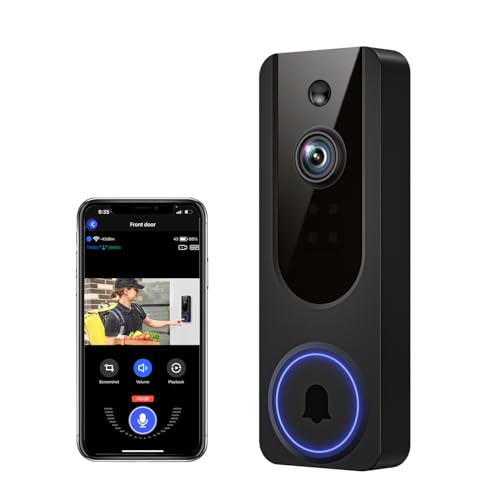

Wired Doorbell Camera vs Battery Doorbell Camera at a Glance
| Feature | Wired Doorbell Camera | Battery Doorbell Camera |
|---|---|---|
| Primary Power Source | Low-voltage AC transformer (16-24V AC) | Internal rechargeable lithium-ion battery |
| Wiring Requirement | Hardwired to existing doorbell circuit | Wire-free (optional wiring on select models) |
| Continuous 24/7 Recording | Supported locally via microSD on compatible units | Event-triggered only (continuous requires wired hookup) |
| Installation Method | Screw-mounted to junction box or doorframe wiring | Tool-free adhesive, corner plate, or screw bracket |
| Wake-Up Latency | Near-instant (camera sensor remains powered) | Brief sleep-to-wake delay on motion trigger |
| Mechanical Chime Support | Supported on select models (bypassed on others) | Requires wireless chime accessory or smart speaker |
| Cold Weather Resilience | Maintains full operational stability via continuous AC | Chemical battery efficiency drops in freezing conditions |
| Best For | Homeowners with existing wiring demanding continuous security | Renters, apartments, and entrances lacking low-voltage wiring |
Power Supply and Continuous Operation
When evaluating a wired vs battery video doorbell power supply, the primary distinction is how each device handles energy delivery and daily maintenance. A wired model draws steady low-voltage alternating current from a dedicated step-down transformer, typically requiring between 16V and 24V AC at 10VA or greater. The WYZE Wired Doorbell Camera v2, for instance, requires 16-24V AC at 10VA or more to sustain its optical sensors, color night vision, and internal processor. Similarly, the Ring Video Doorbell Wired installs directly into pre-existing doorbell lines to provide continuous around-the-clock power without needing manual intervention.
By comparison, battery-operated units rely on internal rechargeable cells that must be periodically recharged to keep the camera online. The VanaOrbi Doorbell Camera utilizes a rechargeable battery pack that powers its 1080p sensor, four infrared LEDs, and wireless connectivity. Meanwhile, the Wyze Battery Video Doorbell features a built-in USB-C rechargeable battery rated for up to 6 months of operation between charges, though it also includes wire nuts, extension wires, and a jump wire if users eventually choose to hardwire it. The inescapable trade-off with wire-free models is routine downtime: removing the camera or detaching its battery with an ejection pin leaves your entryway unmonitored for several hours while the cell recharges over USB.
This ongoing power management is a central theme in any battery vs wired doorbell camera comparison. Just as power stability dictates usage habits when contrasting a wired vs wireless gaming mouse, an uninterrupted physical electrical feed frees you from checking battery percentages or worrying that an unexpected delivery will occur while the doorbell sits on your kitchen counter charging. For homeowners seeking an install-and-forget experience, constant transformer power eliminates operational friction entirely.
Edge: Wired Doorbell Camera because hardwired low-voltage transformers supply nonstop power, completely eliminating the battery degradation, recharging routines, and entryway monitoring blackouts inherent to rechargeable cells.
Installation Flexibility and Mounting Requirements
The physical mounting process marks the sharpest practical division between these two smart home form factors. Evaluating a wired or battery doorbell camera for renters immediately highlights the severe limitations of hardwired units. A wired installation requires access to low-voltage wiring protruding from your home’s exterior wall, connection to an electrical transformer, and occasionally bypassing your mechanical chime box with a jumper wire. The Ring Video Doorbell Wired, for example, includes a specialized tool kit to assist with line connections, but the unit permanently bypasses mechanical chime mechanisms. If your home has no existing wiring or if your lease forbids modifying electrical infrastructure, installing a wired camera requires hiring an electrician or drilling through exterior cladding.
A battery doorbell camera solves this barrier by decoupling placement from your home’s electrical grid. The Wyze Battery Video Doorbell emphasizes a 1-minute easy setup with instant Bluetooth pairing and tool-free mounting capabilities, including both a flat backplate and a corner backplate to optimize viewing angles without drilling into brick or siding. Similarly, the VanaOrbi Doorbell Camera features an ultra-slim 1.8-inch by 1.28-inch footprint designed for simple outdoor wall mounting on narrow door trim. Tenants can affix these units using heavy-duty exterior adhesives or minor bracket screws that are simple to patch and paint upon moving out.
Fixed positioning can restrict your surveillance field if your existing transformer wires are situated in an awkward alcove or too low on a doorframe. In the same way that physical desk space influences your choices between a wired vs wireless mechanical keyboard, wire-free doorbells allow you to position your optical lens exactly where it captures the most unobstructed line of sight. You can position a battery unit on an adjacent column, fence post, or outer gate to capture approaching visitors head-on.
Edge: Battery Doorbell Camera because its wire-free design requires no low-voltage electrical work, allowing rapid placement anywhere on your entryway with basic hardware or removable adhesives.
Video Recording Modes and Storage Capabilities
Understanding wired vs battery doorbell continuous recording reveals why power sources fundamentally dictate camera functionality. Because video encoding, Wi-Fi streaming, and local storage writes consume substantial electrical energy, battery-powered models are designed to preserve battery life by remaining in an ultra-low-power sleep state until motion triggers an event. The VanaOrbi Doorbell Camera relies entirely on event-based motion alerts, utilizing AES-128 encrypted cloud storage where cloud subscribers can review live views, save clips, and replay recorded events, while nonsubscribers retain core live view and detection alerts.
A comprehensive wired doorbell camera review illustrates the immense security benefits of continuous recording. When plugged into constant AC transformer power, the WYZE Wired Doorbell Camera v2 supports true 24/7 continuous local recording directly to an onboard microSD card (sold separately). Rather than capturing fragmented 15-second clips that may miss the moments leading up to an incident, a continuous wired feed records every second of porch activity from start to finish. Even when battery units offer expanded storage-such as the Wyze Battery Video Doorbell, which supports microSD cards up to 256GB in FAT32 or exFAT formats-the listing specifies that 24/7 local recording is only operational when continuous power is supplied via hardwiring.
Local continuous recording also protects you from subscription requirements and cloud storage outages. The WYZE Wired Doorbell Camera v2 pairs its 24/7 local storage with a 2K head-to-toe sensor and an award-winning starlight sensor for vivid color night vision. While the Wyze Battery Video Doorbell matches this night vision capability and offers 1536×1536 HD+ resolution with a 1:1 aspect ratio across a 150-degree by 150-degree field of view, standard wire-free battery deployment restricts it to motion-triggered clips to prevent rapid battery depletion.
Edge: Wired Doorbell Camera because unrestricted access to transformer power enables seamless 24/7 local continuous recording to microSD storage without draining a power cell.
Motion Detection and Alert Latency
Assessing battery vs hardwired doorbell camera reliability involves examining detection latency and notification speeds. Because a hardwired doorbell camera has continuous current, its image processor, passive infrared sensors, and Wi-Fi radio remain in an active state. The Ring Video Doorbell Wired leverages this constant wakefulness to offer Advanced Motion Detection, capturing approaching individuals well before they reach the doorstep and delivering instantaneous real-time alerts to smartphones or Alexa-enabled devices. The Wyze Wired Doorbell Camera v2 similarly processes visual fields continuously, enabling smart notifications, package arrival detection, and instant voice prompts that inform visitors they are being recorded.
In contrast, a battery doorbell camera review must account for the latency introduced by sleep-to-wake cycles. To achieve multi-month battery operation, units like the VanaOrbi Doorbell Camera keep their primary optical pipeline asleep until motion registers. While the VanaOrbi employs advanced AI human detection to filter out extraneous movement from branches or passing traffic, the split-second transition from deep sleep to active Wi-Fi streaming can occasionally result in recorded clips showing only the back of a fast-walking delivery courier as they depart your porch.
Audio latency during two-way communication exhibits similar differences. Just as uninterrupted data throughput is vital when evaluating high-performance audio in a wired vs wireless gaming headset, a doorbell camera requires an immediate, stable link to support real-time conversation. Both the Wyze Wired v2 and the Wyze Battery Video Doorbell support two-way audio with quick auto-responses, but the wired version’s permanently energized Wi-Fi radio connects and displays video feeds more rapidly when an unexpected alert pings your phone.
Edge: Wired Doorbell Camera because its always-on optical sensors and network hardware eliminate wake-up latency, ensuring faster clip capture and lower alert response times.
Environmental Durability and Cold Weather Performance
Evaluating a wired or battery doorbell camera for cold weather exposes the strict chemical constraints of lithium-based batteries. Extreme winter temperatures dramatically hinder battery chemistry: lithium-ion cells suffer internal resistance increases when temperatures plunge below freezing. In sub-zero weather, battery cameras often suffer from accelerated discharge rates, inaccurate battery percentage reporting, or an outright refusal to accept a charge until the unit is detached and brought inside to warm up.
Wired doorbell cameras bypass chemical battery limitations entirely by drawing electrical energy directly from your household breaker through a transformer. The WYZE Wired Doorbell Camera v2 is engineered with an IP65 weatherproof rating, enabling it to withstand heavy rain, blowing snow, and blistering summer heat without experiencing power drops. Because it contains no integrated lithium battery pack, extreme cold does not degrade its power delivery or shorten its operational lifespan.
While the Wyze Battery Video Doorbell is built with weather-resistant materials to handle general outdoor exposure, operating it entirely on battery power in regions with harsh winter freezes will significantly shorten the advertised 6-month battery duration. Over several seasons of deep winter freezes and summer heat waves, integrated chemical cells degrade permanently, a phenomenon well-documented in hardware lifespan comparisons like the hyperx cloud iii vs cloud alpha wireless. A hardwired model provides far greater long-term environmental endurance.
Edge: Wired Doorbell Camera because continuous AC line power is unaffected by the freezing temperatures that severely reduce the capacity and charging ability of chemical battery cells.
Chime Integration and Smart Home Compatibility
Integrating your front door camera with indoor chimes and smart home ecosystems is essential for ensuring you hear visitors when your smartphone is out of reach. In this area, both wired and battery doorbells present distinct hardware compromises. A traditional wired doorbell camera can sometimes interface directly with your home’s pre-existing mechanical chime box. The WYZE Wired Doorbell Camera v2 connects to both existing doorbell wiring and standard mechanical chime boxes inside the home. However, not all wired units maintain chime support; the Ring Video Doorbell Wired explicitly bypasses existing mechanical chime mechanisms, requiring homeowners to pair the unit with a plug-in Ring Chime or a compatible Amazon Echo device to hear auditory alerts indoors.
Battery doorbells cannot trigger a traditional mechanical chime without wired connections, leading manufacturers to adopt digital chime accessories and broad ecosystem integrations. The Wyze Battery Video Doorbell addresses this by offering flexible chime alternatives, including compatibility with the Wyze Chime Controller, the Wyze Universal Wi-Fi Chime, or existing Wyze Cam devices placed throughout the home. Furthermore, it supports integration with Amazon Alexa, Google Assistant, and IFTTT for smart automation routines. The VanaOrbi Doorbell Camera connects via 2.4 GHz Wi-Fi to Android-compatible applications to broadcast instant visitor rings straight to mobile devices.
Navigating these platform connections requires balancing your preferred hardware ecosystem against physical chime wiring. Much like assessing ecosystem convenience and peripheral compatibility in the steelseries arctis nova 7 vs hyperx cloud ii, your decision hinges on whether you want a seamless link to an existing mechanical wall chime or prefer distributing wireless smart speakers and plug-in chime modules throughout multiple rooms.
Edge: Tie because wired doorbells can preserve traditional mechanical chime wiring, while battery models excel with flexible wireless chimes and multi-platform voice assistant ecosystems.
Pros and Cons
Wired Doorbell Camera

Pros
- Continuous 24/7 local recording support
- Maintenance-free constant transformer power
- Zero wake-from-sleep motion latency
- Reliable performance in freezing winter weather
Cons
- Requires existing 16-24V AC wiring
- Permanent installation unsuitable for renters
View WYZE Wired Doorbell Camera v2(Existing Doorbell on Amazon
Battery Doorbell Camera

Pros
- 100% wire-free drill-free mounting options
- Ideal for renters and apartments
- Flexible placement anywhere near the entrance
- USB-C rechargeable internal battery
Cons
- Periodic recharging creates monitoring downtime
- Battery chemistry degrades in sub-zero cold
- Motion-only recording in wire-free mode
View 1080p WiFi Video Doorbell Camera Wireless on Amazon
Who Should Buy Each One
Choose the Wired Doorbell Camera If
- You own your residence and already have a working 16-24V AC low-voltage doorbell circuit and transformer.
- You demand continuous 24/7 local recording to a microSD card to capture every moment rather than relying on motion snippets.
- You live in a northern climate that experiences severe sub-zero winters where battery doorbells suffer performance loss.
- You never want to detach your security camera from your exterior wall to recharge an internal battery over USB.
Choose the Battery Doorbell Camera If
- You rent an apartment or home where drilling into exterior trim or altering electrical doorbell wiring is prohibited.
- Your entryway lacks low-voltage transformer wiring and you want to avoid hiring an electrician to run new cables.
- You want the installation freedom to mount the camera using adhesive brackets or corner plates on any flat surface.
- You prefer a flexible setup that can be detached in minutes and packed when you move to a new property.
Final Verdict
For homeowners whose properties possess functional, low-voltage doorbell wiring, a wired doorbell camera is unequivocally the superior long-term investment. By tapping into constant AC transformer power, wired cameras like the WYZE Wired Doorbell Camera v2 and Ring Video Doorbell Wired eliminate the regular maintenance of charging batteries while delivering zero wake-up latency and continuous 24/7 local recording. You gain immediate motion alerts, crisp night vision, and continuous surveillance resilience that functions reliably through freezing winters and scorching heat waves without ever taking your security perimeter offline.
Conversely, a battery doorbell camera is the indisputable champion for renters, apartment tenants, and homes completely devoid of entryway wiring. If you cannot drill holes or alter low-voltage circuits, models such as the Wyze Battery Video Doorbell and VanaOrbi Doorbell Camera provide high-definition video, two-way audio, and advanced motion alerts that can be deployed in minutes. While you must accept event-based clip recording and periodic recharging downtime, the wire-free versatility and damage-free mounting make a battery model the ideal security solution for temporary or wire-free living spaces.
FAQ
Is a wired doorbell camera worth it if I already have wiring?
Yes, a wired doorbell camera is well worth it if your home already has low-voltage doorbell wiring. Utilizing existing 16-24V AC wiring provides constant, uninterrupted power that supports advanced features such as 24/7 continuous local recording onto a microSD card, eliminates battery charging downtime, and ensures immediate motion detection without the wake-up delays typical of battery units.
Is a battery doorbell camera worth it for renters?
Yes, a battery doorbell camera is ideal for renters because it requires zero electrical modifications and can be installed without drilling into the building. Models like the Wyze Battery Video Doorbell feature simple Bluetooth pairing and can be mounted using included hardware or exterior adhesive strips, allowing you to easily take the camera with you when your lease concludes.
How does cold weather affect wired vs battery doorbell cameras?
Freezing temperatures severely degrade the performance of battery doorbell cameras because sub-zero weather slows the chemical reactions inside rechargeable lithium-ion cells, causing rapid discharge and preventing recharging. In contrast, wired doorbell cameras run directly on constant AC transformer power, maintaining full operational stability and video recording capabilities through extreme winter conditions.
Can a battery doorbell camera record continuous 24/7 video?
In standard wire-free battery operation, doorbell cameras cannot record continuous 24/7 video because processing and recording uninterrupted footage would deplete the battery in just a few days. Battery cameras operate in a sleep mode and wake up only when motion or a button press is detected. Continuous 24/7 local recording on hybrid models, such as the Wyze Battery Video Doorbell, is only unlocked when the unit is connected to permanent hardwiring.
Do wired doorbell cameras work with existing indoor chimes?
It depends entirely on the specific model. The WYZE Wired Doorbell Camera v2 is designed to hardwire to your existing doorbell wiring and sound your mechanical chime inside the house. Conversely, the Ring Video Doorbell Wired bypasses your mechanical chime, requiring you to hear alerts through a plug-in Ring Chime or a compatible Amazon Alexa smart speaker.
How often does a battery doorbell camera need to be recharged?
Recharging frequency varies based on daily activity, motion sensitivity settings, and climate. The Wyze Battery Video Doorbell offers up to 6 months of battery life under typical usage conditions. However, high-traffic doorways with dozens of daily motion triggers or operation in freezing weather will increase power consumption, requiring you to recharge the unit via USB-C every few weeks or months.
What transformer voltage is required for a wired doorbell camera?
Most wired doorbell cameras require a low-voltage step-down transformer supplying between 16V and 24V AC with a power rating of at least 10VA. For example, the WYZE Wired Doorbell Camera v2 explicitly specifies a power requirement of 16-24V AC at greater than or equal to 10VA to ensure stable video capture, two-way talk, and chime operation.