The single deciding factor between the Corsair RM750x and the Corsair RM850x is a 100-watt continuous power difference that dictates your system headroom for demanding graphics cards and sudden transient spikes. Because both power supplies share identical Cybenetics Gold efficiency ratings, ATX 3.1 compliance, native 12V-2×6 cabling, and 140mm fluid dynamic bearing cooling, that wattage ceiling alone dictates which model aligns with your PC build.
Mainstream builders running balanced mid-tier hardware should select the RM750x to comfortably support their day-to-day computing and gaming demands. Enthusiasts pairing high-draw graphics cards or planning future hardware expansions should choose the RM850x for its elevated electrical overhead.
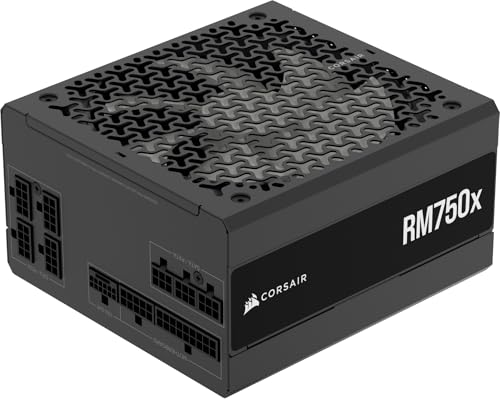
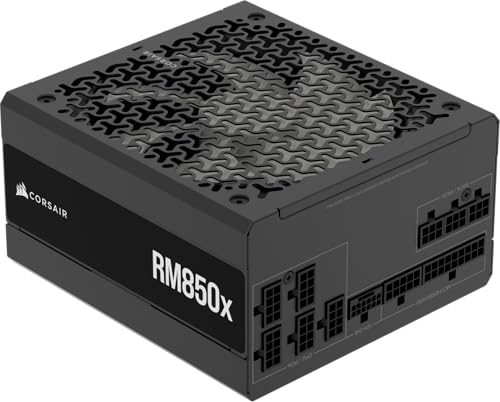
Corsair RM750x vs Corsair RM850x at a Glance
| Feature | Corsair RM750x | Corsair RM850x |
|---|---|---|
| Continuous Output Wattage | 750 Watts | 850 Watts |
| Efficiency Certification | Cybenetics Gold (Up to 91%) | Cybenetics Gold (Up to 91%) |
| Design Standard | ATX 3.1 Compliant (PCIe 5.1 Support) | ATX 3.1 Compliant (PCIe 5.1 Ready) |
| Next-Gen GPU Connector | Native 12V-2×6 Connector | Native 12V-2×6 Connector |
| Internal Capacitors | 100% Japanese 105°C Electrolytic | 100% Japanese 105°C Electrolytic |
| Cooling Fan Size and Type | 140mm Fluid Dynamic Bearing (FDB) Fan | 140mm Fluid Dynamic Bearing (FDB) Fan |
| Cable Construction | Fully Modular Embossed with Low-Profile Combs | Fully Modular Embossed with Low-Profile Combs |
| Rated Input Voltage | 110V to 264V AC | 100V to 240V AC |
| Warranty Length | 10 Years | 10 Years |
| Best For | Mainstream gaming systems and balanced mid-tier builds | High-end graphics cards and heavy transient spike protection |
Continuous Power Output and System Headroom
Continuous power capacity determines the ceiling of hardware components a power supply can reliably energize simultaneously under sustained processing tasks. When modern processors and graphics cards work through heavy gaming scenes or video export timelines, power consumption rises dynamically. Evaluating the primary Corsair RM750x vs RM850x difference reveals that the 100-watt variance directly influences how close your system runs to maximum capacity. Calculating the RM750x vs RM850x wattage headroom helps builders avoid system instability when selecting high-performance desktop components.
A continuous rating of 750 watts on the RM750x handles popular contemporary gaming configurations that feature mid-range multi-core processors paired with upper-mainstream graphics cards. However, modern graphics hardware frequently exhibits microsecond power surges that briefly exceed standard thermal design ratings. Stepping up to 850 watts provides a safer cushion that accommodates these rapid swings while supporting supplementary accessories like custom cooling pumps, extensive fan arrays, and multiple high-speed storage drives. Builders reviewing power thresholds across the Corsair lineup often study our corsair rm750x vs rm1000x comparison to see where diminishing returns begin when planning long-term system overhead.
Operating a power supply closer to the middle of its load curve also provides thermal and acoustic benefits. While both units handle sustained loads reliably, the RM850x runs at a lower utilization percentage when powering an identical hardware load compared to the RM750x. Under a 450-watt gaming workload, the 850-watt unit operates around 53 percent utilization, whereas the 750-watt model operates at 60 percent. That lower relative load keeps internal components cooler and maintains optimal electrical delivery.
Edge: Corsair RM850x because the extra 100 watts delivers vital continuous headroom for power-hungry hardware and absorbs sudden transient excursions.
ATX 3.1 Compliance and Modern GPU Delivery
Desktop hardware standards have evolved rapidly, making modern compliance a critical benchmark for system stability. Both the Corsair RM750x ATX 3.1 and the Corsair RM850x ATX 3.1 adhere to Intel ATX 3.1 specifications and support PCIe 5.1 guidelines. This standard ensures the power supply can handle transient power spikes up to twice its continuous rating for brief intervals without triggering false over-power protection shutdowns. This strict regulation is essential for protecting sensitive silicon from unexpected power cuts during sudden render bursts or high-framerate gameplay.
Both models feature a native 12V-2×6 connector designed specifically for contemporary graphics cards. This connector replaces traditional multi-cable 8-pin adapters with a single dedicated cable that delivers high-wattage power directly from the power supply interface. When deciding between the Corsair RM750x or RM850x for RTX 4080 graphics cards, having a native 12V-2×6 connection ensures secure pin contact and minimizes resistance at the graphics card terminal. Those considering even more demanding flagship graphics configurations can explore our corsair rm850x vs rm1000x guide to determine if high-tier cards require extra capacity beyond the 850-watt mark.
Because Corsair engineered both power supplies to the exact same ATX 3.1 standard with the same native connector architecture, they deliver identical connectivity and spike resistance on a per-rail level. The only divergence between them remains the total wattage driving that interface, making their compliance and connector execution an equal match.
Edge: Tie because both units include full ATX 3.1 compliance, PCIe 5.1 readiness, and a native 12V-2×6 connector.
Efficiency Ratings, Thermals, and Component Quality
Electrical efficiency represents how effectively a power supply converts alternating current from the wall into direct current for computer components. Both the RM750x and RM850x hold Cybenetics Gold certification, reaching up to 91 percent efficiency. High electrical efficiency reduces the amount of energy lost as heat inside the chassis, which lowers operating temperatures and keeps the cooling fan from spinning at high speeds. Independent analyses such as our corsair rm750x vs seasonic focus gx-750 breakdown highlight how rigorous Cybenetics Gold efficiency standards validate reliable thermal performance.
Corsair utilizes 100% Japanese 105°C-rated electrolytic capacitors across both models. These high-grade capacitors ensure consistent ripple suppression, stable voltage regulation, and long-term resilience against heat degradation. Thermal dissipation is managed by a single 140mm fluid dynamic bearing (FDB) fan installed in each unit. The FDB mechanism significantly cuts mechanical friction, extending fan life while keeping noise profiles exceptionally quiet under low and medium workloads. Any thorough Corsair RM750x review or Corsair RM850x review highlights this internal capacitor and fan pairing as a primary driver of long-term reliability.
Despite identical internal component materials, the RM850x achieves a minor operational edge during intense tasks. Because power supply efficiency and thermal dissipation peak when a unit operates near 50 percent capacity, the RM850x dissipates less heat than the RM750x when handling identical upper-mid-range hardware loads. This difference allows the 140mm fan on the larger capacity unit to maintain lower operational RPMs under sustained stress.
Edge: Corsair RM850x because running demanding systems at a lower percentage of total capacity reduces internal heat buildup and operational strain.
Modular Cable Design and Chassis Compatibility
Clean cable management is necessary to maintain unobstructed airflow and maintain a tidy interior inside desktop computer enclosures. Both the RM750x and RM850x feature fully modular cabling configurations, allowing users to connect only the specific power leads required for their motherboard, GPU, and storage drives. Eliminating redundant, unused wiring reduces congestion behind the motherboard tray and improves direct air circulation from front intake fans.
Corsair equips both power supplies with ultra-flexible embossed cables that feature low-profile combs. These embossed cables bend easily around chassis cutouts and grommets without requiring forceful manipulation, simplifying routing in compact desktop towers. When evaluating the Corsair RM750x or RM850x for gaming cases with tight power supply shrouds, both units share identical physical dimensions measuring 2.3 inches high, 3.39 inches wide, and 5.91 inches long. Builders balancing full-sized power supplies against ultra-compact enclosures can examine our corsair rm750x vs sf750 comparison to see how standard ATX housings differ from small-form-factor designs.
Each unit weighs 3.9 pounds and utilizes the same modular port backplane layout on the power supply chassis. Because the cable sets, combs, dimensions, and weights are indistinguishable between the 750-watt and 850-watt models, neither side offers an advantage in physical chassis installation or routing convenience.
Edge: Tie because both models share the exact same physical dimensions, 3.9-pound weight, fully modular design, and flexible embossed cables with combs.
Input Voltage Specifications and Reliability Standards
Input voltage parameters determine how well a power supply functions across diverse regional electrical grids and fluctuating wall outlets. Based on manufacturer specifications, the Corsair RM750x listing indicates an input voltage range of 110V to 264V AC, while the Corsair RM850x listing specifies an input range of 100V to 240V AC. Both ranges accommodate standard household electrical circuits comfortably, providing dependable power regulation without manual voltage toggle switches.
Reliability is further reinforced by a ten-year manufacturer warranty provided for both the RM750x and RM850x. This decade-long guarantee reflects Corsair’s confidence in the 105°C Japanese electrolytic capacitors, ATX 3.1 transient handling architecture, and internal electrical protections. When examining the competitive market landscape, our corsair rm850x vs seasonic focus gx-750 review shows that a ten-year warranty represents the top tier of customer protection in modern power hardware.
In terms of practical reliability in an everyday desktop environment, both models offer parity. Both units use the same internal engineering architecture, top-tier capacitors, and robust circuit protections to ensure steady power delivery year after year, rendering the minor variations in published input voltage boundaries largely irrelevant for standard PC installations.
Edge: Tie because both units feature premium Japanese capacitors, robust input protection, and identical ten-year warranty coverage.
Pros and Cons
Corsair RM750x

Pros
- Cybenetics Gold rated up to 91% efficiency
- Full ATX 3.1 compliance with PCIe 5.1 support
- Native 12V-2×6 connector eliminates messy adapters
- Flexible embossed cables with low-profile combs
- Ten-year manufacturer warranty coverage
Cons
- Lower 750-watt continuous output ceiling
- Limited headroom for flagship graphics cards
Corsair RM850x

Pros
- 850 watts of sustained continuous output
- ATX 3.1 standard absorbs sharp transient spikes
- Native 12V-2×6 direct graphics card connection
- Operates at lower load percentage under gaming
- Ten-year manufacturer warranty coverage
Cons
- Excess continuous capacity for basic hardware
- Narrower listed AC input voltage range
Who Should Buy Each One
Choose the Corsair RM750x If
- You are assembling a mainstream gaming PC powered by mid-tier processors and graphics cards with moderate total power draw.
- You want full ATX 3.1 transient spike resistance and a native 12V-2×6 cable without needing continuous power beyond 750 watts.
- You prefer a fully modular layout with ultra-flexible embossed cables to make cable routing fast and clean in standard ATX cases.
- You run a streamlined system without complex custom water cooling loops, multi-drive storage arrays, or aggressive component overclocks.
Choose the Corsair RM850x If
- You are pairing upper-tier graphics cards such as the RTX 4080 that demand strong continuous power and resilient transient spike headroom.
- You want to keep power supply utilization around 50 percent during heavy gaming loads to maximize efficiency and maintain quieter operation.
- You plan to upgrade your core graphics or processor components in the coming years without having to replace your power supply unit.
- You run multiple high-draw peripherals, secondary storage drives, liquid cooling pumps, and extensive chassis lighting setups.
Final Verdict
The Corsair RM850x stands out as the superior overall option for most modern desktop builders. While both models feature the same Cybenetics Gold efficiency, ATX 3.1 compliance, native 12V-2×6 GPU cabling, and flexible embossed cables, the RM850x provides 100 watts of valuable continuous headroom. This higher wattage buffer accommodates modern graphics hardware, safeguards against sudden transient excursions, and keeps the power supply running at an optimal point on its efficiency curve under gaming loads.
The Corsair RM750x remains an exceptional power supply for builders who have carefully calculated their power needs and know their system will stay well below 750 watts. It provides the exact same Japanese capacitor reliability, 140mm fluid dynamic bearing cooling fan, and ten-year warranty coverage as its larger counterpart. However, unless your hardware demands are strictly modest, asking whether is RM850x worth it is answered by the long-term flexibility and headroom the 850-watt unit delivers.
FAQ
What is the main Corsair RM750x vs RM850x difference?
The primary difference between the two power supplies is their maximum continuous power capacity. The RM750x provides up to 750 watts of continuous delivery, while the RM850x delivers 850 watts. Both power supplies share identical Cybenetics Gold efficiency, ATX 3.1 compliance, physical dimensions, and native 12V-2×6 connectors.
Should you choose the Corsair RM750x or RM850x for RTX 4080 graphics cards?
The Corsair RM850x is the recommended choice for an RTX 4080 system. While a 750-watt unit can technically run an RTX 4080 alongside a moderate processor, the 850-watt model provides essential continuous overhead to absorb transient power spikes and allows the power supply to operate within its most efficient load band.
Do both the RM750x and RM850x include a native 12V-2×6 connector?
Yes, both models feature a native 12V-2×6 connector on the modular panel. This allows direct connection from the power supply to modern graphics cards without using bulky multi-cable splitter adapters, ensuring clean cable management and reliable electrical contact.
Is the RM850x worth it over the RM750x for gaming?
The RM850x is generally worth selecting over the 750-watt model for high-end gaming rigs because modern graphics cards generate rapid power excursions. The additional 100 watts provides breathing room for peak loads and ensures you can upgrade to faster hardware down the road without swapping your power supply.
What efficiency certification do the Corsair RM750x and RM850x have?
Both models are Cybenetics Gold-certified, delivering up to 91 percent operating efficiency. This certification ensures low electrical waste, reduced internal operating temperatures, and quieter overall fan performance during standard and heavy workloads.
How long is the manufacturer warranty on both power supplies?
Corsair backs both the RM750x and the RM850x with a comprehensive ten-year manufacturer warranty. This extensive coverage protects against electrical and manufacturing defects across both wattage capacities.