The decisive difference between the WD Black SN770 and the WD Black SN850X centers on sequential throughput and dedicated cache architecture: the premium drive reaches up to 7,300 MB/s read speeds supported by an installed 1 GB cache memory, while the mainstream model reaches up to 5,150 MB/s read speeds without an onboard cache figure specified in its data.
Choose the WD Black SN770 if you want an efficient, responsive Gen4 drive engineered for standard desktop gaming rigs and power-sensitive laptop configurations. Choose the WD Black SN850X if you demand maximum read and write bandwidth for high-end workstations, massive file transfers, or top-tier PlayStation 5 console storage expansion.
![WD_BLACK 1TB SN770 NVMe Internal Gaming SSD Solid State Drive - Gen4 PCIe, M.2 2280, Up to 5,150 MB/s - WDS100T3X0E - [Previous Generation]](https://m.media-amazon.com/images/I/41dOBI0lrHL._SL500_.jpg "WD_BLACK 1TB SN770 NVMe Internal Gaming SSD Solid State Drive - Gen4 PCIe, M.2 2280, Up to 5,150 MB/s - WDS100T3X0E - [Previous Generation]")
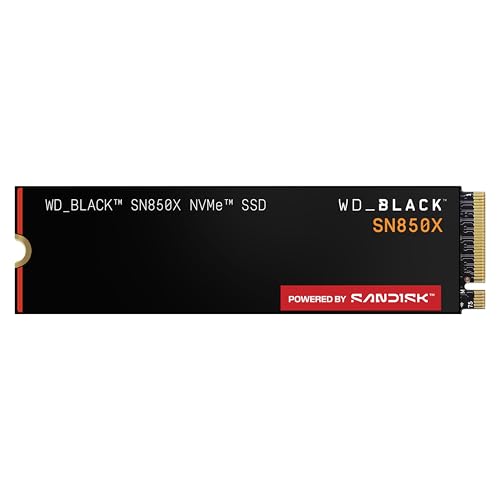
WD Black SN770 vs WD Black SN850X at a Glance
| Specification | WD Black SN770 | WD Black SN850X |
|---|---|---|
| Maximum Read Speed | Up to 5,150 MB/s | Up to 7,300 MB/s |
| Sequential Write Speed | Up to 4,900 MB/s | Up to 6,300 MB/s |
| Interface | PCIe Gen4 (PCIe Gen3 backward-compatible) | PCIe Gen4 NVMe |
| Form Factor | M.2 2280 | M.2 2280 |
| Installed Cache Memory Size | Not listed | 1 GB |
| Maximum Available Capacity | Up to 2TB | Up to 8TB |
| NAND Flash Architecture | Not listed | SanDisk TLC 3D NAND |
| Software Optimization | WD_BLACK Dashboard (Gaming Mode) | Dashboard with Game Mode 2.0 |
| DirectStorage Ready | Supported | Not listed |
| Listed Console Compatibility | PlayStation 5, Xbox Series X, Xbox Series S | PlayStation 5 |
| Best For | Mainstream PC gaming and energy-efficient setups | Enthusiast gaming, heavy production, and PS5 storage |
Sequential Read and Write Performance
Sequential throughput defines how rapidly an NVMe solid-state drive reads and writes continuous blocks of data across its flash memory cells. In everyday computing, sequential performance dictates how quickly a drive copies multi-gigabyte archives, processes raw video footage, and delivers sequential game streaming assets. The SN770 vs SN850X speed disparity is evident immediately upon looking at the manufacturer data sheets. The SN770 delivers up to 5,150 MB/s read speeds and 4,900 MB/s write speeds on its 1TB and 2TB models over a PCIe Gen4 interface. By contrast, the SN850X escalates throughput to an immense 7,300 MB/s read speed and 6,300 MB/s write speed on capacities ranging from 1TB up to 4TB.
In real-world workflow scenarios, an extra 2,150 MB/s in read performance and 1,400 MB/s in write capability changes the equation for users running intensive storage operations. Moving huge 100GB game folders or capturing uncompressed footage rewards the higher sequential ceilings of the flagship drive. Mainstream users who explore comparisons like the wd black sn770 vs blue sn580 often recognize that 5,150 MB/s remains far ahead of entry-level PCIe Gen4 drives, providing plenty of bandwidth for daily computing without hitting bottlenecks. However, when evaluating the absolute limits of the Gen4 protocol in an SN850X vs SN770 comparison, the faster drive utilizes nearly the complete bandwidth potential of an M.2 Gen4 x4 lane configuration.
For creators exporting complex video timelines or gamers loading uncompressed assets, that sequential bandwidth gap translates into measurably shorter processing times. The SN770 stays competitive in general responsiveness, but it cannot match the peak file transfer speeds recorded across the top-tier SN850X line. When pure sequential throughput is the primary requirement, the flagship model demonstrates a clear generational advantage.
Edge: WD Black SN850X. A decisive 7,300 MB/s read and 6,300 MB/s write rating delivers substantially faster sequential data transfers than the SN770.
Cache Memory Architecture and Heavy Transfers
Sustained performance on modern solid-state drives depends heavily on cache architecture. A dedicated onboard cache allows an SSD to store indexing tables and handle incoming write traffic rapidly, preventing write exhaustion and slowdowns during extended file transfers. Examining the WD Black SN770 vs SN850X specs highlights a fundamental architectural separation between these two units. The SN850X listing specifies an installed cache memory size of 1 GB on the 1TB capacity model, working in harmony with its SanDisk TLC 3D NAND to handle relentless data streams. Conversely, the SN770 listing does not specify an installed cache memory allocation.
This design difference plays an influential role when managing prolonged, heavy workloads. While modern drives without dedicated DRAM utilize host memory resources to manage addressing tables, drives equipped with an onboard cache maintain more consistent performance when bombarded by dozens of gigabytes of sustained writes. Readers analyzing a WD Black SN850X review frequently note how the drive handles sustained installations and multi-layer rendering tasks without hitting sudden write speed degradation. For users deciding whether an upgrade like the wd black sn850x vs blue sn580 or the SN770 makes sense, understanding how cache stability prevents latency spikes during massive file copies is essential.
For typical desktop use, launching a web browser, and casual gaming sessions, the absence of an onboard cache specification on the SN770 will rarely cause noticeable friction. Yet, when pushing hundreds of gigabytes of raw production footage or copying entire game drives, the SN850X maintains superior write consistency and lower access latencies because of its dedicated 1 GB cache memory footprint.
Edge: WD Black SN850X. Dedicated 1 GB cache memory equips the drive to handle intensive, sustained write streams without experiencing throughput drop-offs.
Gaming Load Times and DirectStorage Compatibility
Gaming performance involves more than raw sequential figures; random access times, input-output efficiency, and software decompression protocols dictate actual in-game responsiveness. When reviewing WD Black SN770 vs SN850X load times, both drives excel at reducing launch screens to negligible delays. The SN770 listing specifically states that it supports future games developed for Microsoft DirectStorage technology, an API designed to bypass CPU bottlenecks by streaming asset decompression directly through the GPU. The listing also highlights that its Gen4 connection fuels in-game responsiveness, minimizes stutter, and ensures smooth asset streaming.
The SN850X approaches gaming performance through brute-force throughput. Advertising 7,300 MB/s speeds engineered to crush load times and slash throttling, lagging, and texture pop-ins, the drive targets elite gaming rigs. It also incorporates Game Mode 2.0 via the downloadable Windows Dashboard to automate performance features during play. In practical scenarios evaluating the WD Black SN770 or SN850X for gaming, loading standard PC titles typically results in differences of just fractions of a second between the two models. Gamers comparing options like the wd black sn770 vs sn7100 will find that modern title loading rarely saturates the entire 7,300 MB/s bandwidth ceiling of the SN850X.
While the SN850X provides the highest bandwidth ceiling to eliminate texture streaming hiccups in open-world titles, the SN770 features explicit DirectStorage support in its listing copy, ensuring strong forward compatibility as modern PC titles implement direct GPU streaming. Because real-world gaming load times remain remarkably close across modern Gen4 gaming drives, neither drive pulls away cleanly in everyday gameplay scenarios.
Edge: Tie. The SN850X offers higher theoretical throughput to eliminate texture pop-ins, but the SN770 advertises explicit DirectStorage readiness while delivering nearly identical game boot times.
Console Compatibility and PS5 Expansion
Internal storage expansion on modern video game consoles requires strict adherence to physical dimensions, interface specifications, and sequential read thresholds. When gamers debate choosing the WD Black SN770 or SN850X for PS5, internal architecture and speed requirements become the main focus. Sony outlines specific recommendations for expanding internal PlayStation 5 storage, including a PCIe Gen4 x4 interface and recommended sequential read speeds of 5,500 MB/s or higher, paired with effective thermal dissipation.
The SN850X listing directly lists the Sony PlayStation 5 under its compatible console models and delivers 7,300 MB/s read speeds, surpassing console recommendations with headroom to spare. Furthermore, the SN850X product description explicitly highlights a heatsink option designed to maintain performance and prevent thermal throttling inside confined spaces like the PS5 internal expansion bay. By contrast, the SN770 listing notes compatibility with the Sony PlayStation 5, Microsoft Xbox Series X, and Microsoft Xbox Series S. However, the SN770 provides up to 5,150 MB/s sequential read performance, which falls just below the console manufacturer recommended 5,500 MB/s threshold.
While the SN770 can physically fit in the M.2 bay, its lower sequential rating and lack of a listed integrated heatsink make it less optimized for the console environment than the SN850X. Shoppers cross-referencing alternative setups like the wd black sn850x vs sn7100 will recognize that matching or beating console bandwidth guidelines ensures uninterrupted asset streaming in high-budget console exclusives. The SN850X provides certified peace of mind for console owners.
Edge: WD Black SN850X. Blazing 7,300 MB/s read speeds easily clear PlayStation 5 speed recommendations, reinforced by an available heatsink configuration.
Storage Capacity Range and NAND Technology
Storage capacity determines how many modern games, 4K video projects, or extensive application libraries can reside on a single M.2 drive without requiring secondary drives or external enclosures. When evaluating WD Black SN850X vs SN770 specifications, the differences in capacity tiers and flash technology are significant. The SN770 listing specifies capacities up to 2TB, positioning it squarely as a mainstream drive tailored for standard operating systems and moderate game storage. The listing does not specify the exact NAND flash type utilized on the SN770.
The SN850X expands storage horizons drastically. Its product data highlights capacities reaching up to 8TB, constructed with SanDisk TLC 3D NAND flash memory. Offering capacities of 1TB, 2TB, 4TB, and 8TB, the SN850X caters directly to enthusiast gamers and creative professionals who refuse to juggle multiple drives. In an in-depth WD Black SN770 review, the 2TB ceiling emerges as a potential limitation for power users building high-capacity workstations or comprehensive game archives where single games frequently surpass 150GB.
Having up to 8TB available on a single M.2 2280 stick allows PC builders to maximize motherboards with limited M.2 slots. The SanDisk TLC 3D NAND flash in the SN850X offers proven performance density, giving high-capacity buyers an expansive playground for data storage. For anyone asking is WD Black SN850X worth it for extensive media libraries, the broad capacity spectrum provides an affirmative answer.
Edge: WD Black SN850X. An expansive capacity ceiling reaching up to 8TB built on SanDisk TLC 3D NAND easily outperforms the SN770 model line maximum of 2TB.
Power Efficiency and Software Management
Thermal generation and electrical power draw are crucial metrics for system stability, especially inside compact enclosures, small-form-factor desktops, and gaming laptops. The SN770 listing emphasizes power efficiency as a standout feature, noting that the drive boasts up to 20% more power efficiency at maximum speed compared to the prior-generation 1TB WD_BLACK SN750 SE SSD. It also delivers up to 40% faster performance over that preceding generation while remaining backward-compatible with PCIe Gen3 motherboards. With a light weight of 4.54 grams and slim 0.09-inch profile, the SN770 integrates neatly into thermally constrained laptop motherboards.
The SN850X focuses primarily on high performance, which inherently demands greater energy consumption during prolonged peak bursts. To manage this performance envelope, the SN850X listing notes an optional heatsink designed to slash throttling and maintain performance under load. Both drives support proprietary management software through the Windows-only WD_BLACK Dashboard (also branded as the SanDisk Dashboard for the SN850X). The SN770 utilizes the dashboard for monitoring drive health and enabling standard gaming mode, while the SN850X features Game Mode 2.0 to automatically tune drive performance.
For mobile users and compact systems, the superior power efficiency of the SN770 makes it an exceptionally balanced storage drive. Lower power draw translates directly into reduced thermal stress inside laptops, minimizing fan noise and preventing unnecessary battery drain. While the SN850X offers advanced Game Mode 2.0 features, the SN770 takes the lead for overall energy efficiency and thermal friendliness in everyday computing environments.
Edge: WD Black SN770. A rated 20% improvement in power efficiency at maximum speed makes the SN770 superior for laptops and heat-sensitive systems.
Pros and Cons
WD Black SN770

Pros
- Up to 5,150 MB/s read speed
- DirectStorage technology support
- 20% more power efficient than SN750 SE
- PCIe Gen3 backward-compatible
- Lightweight 4.54 g M.2 design
Cons
- No installed cache memory listed
- Maximum listed capacity limited to 2TB
- Lower write speed than the SN850X
WD Black SN850X

Pros
- Up to 7,300 MB/s read speed
- Dedicated 1 GB cache memory installed
- Capacities reaching up to 8TB
- SanDisk TLC 3D NAND architecture
- Optional heatsink to slash throttling
Cons
- Higher power draw at maximum speeds
- DirectStorage support not explicitly listed
View WD Black SN850X on Amazon
Who Should Buy Each One
Choose the WD Black SN770 If
- You are assembling a mainstream PC gaming system and want fast 5,150 MB/s Gen4 speeds without excess thermal buildup.
- You need to upgrade a gaming laptop where the drive’s 20% greater power efficiency helps manage battery life and tight internal temperatures.
- You want explicit DirectStorage support advertised to prepare your system for next-generation Windows gaming APIs.
- You are installing storage into an older system that requires full backward compatibility with PCIe Gen3 motherboard slots.
Choose the WD Black SN850X If
- You are upgrading your PlayStation 5 storage and require 7,300 MB/s speeds that easily surpass Sony’s recommended performance marks.
- You regularly edit multi-stream 4K footage or transfer massive file folders that benefit from dedicated 1 GB onboard cache memory.
- You want to store a massive library on a single drive and need expansive capacity options reaching up to 8TB.
- You operate an enthusiast-grade desktop gaming rig equipped with Game Mode 2.0 to maximize peak performance.
Final Verdict
For the majority of PC gamers and general computer builders, the WD Black SN770 represents the most sensible, balanced choice. Its sequential read speed of up to 5,150 MB/s and write performance of 4,900 MB/s easily manage modern operating system duties, application launches, and demanding game titles. Backed by explicit DirectStorage support, backward compatibility with PCIe Gen3 systems, and an efficient power profile that generates less heat, the SN770 delivers snappy Gen4 responsiveness without demanding specialized cooling or high energy consumption.
The WD Black SN850X earns its victory whenever peak performance, heavy sustained writing, or console requirements take priority. By pushing sequential speeds up to 7,300 MB/s, incorporating a dedicated 1 GB cache memory, offering an available heatsink, and providing massive capacities up to 8TB on SanDisk TLC 3D NAND, the SN850X is built for uncompromising workloads. If you are outfitting a PlayStation 5 console, managing professional content creation workflows, or building a no-compromise gaming workstation, the SN850X is the definitive drive to install.
FAQ
Does the WD Black SN770 work inside a PlayStation 5 console?
Yes, the WD Black SN770 listing notes compatibility with the Sony PlayStation 5 console. However, its sequential read speed tops out at 5,150 MB/s, which sits slightly below Sony’s recommended threshold of 5,500 MB/s. While it functions inside the console, users seeking complete alignment with Sony’s speed recommendations often favor the faster SN850X.
What is the sequential speed difference between the SN770 and SN850X?
The WD Black SN850X achieves sequential read speeds of up to 7,300 MB/s and sequential write speeds of up to 6,300 MB/s on models up to 4TB. The WD Black SN770 delivers up to 5,150 MB/s sequential read speeds and 4,900 MB/s sequential write speeds on its 1TB and 2TB models, giving the SN850X an advantage of 2,150 MB/s in reads and 1,400 MB/s in writes.
Does the WD Black SN850X include dedicated cache memory?
Yes, the specifications for the 1TB WD Black SN850X state an installed cache memory size of 1 GB. Dedicated cache helps the drive maintain consistent write performance during large file transfers. In contrast, the WD Black SN770 listing does not specify an installed cache memory allocation.
Can the WD Black SN770 run on older PCIe Gen3 motherboards?
Yes, the WD Black SN770 listing explicitly confirms that the drive is backward-compatible with PCIe Gen3 motherboards. When installed in a PCIe Gen3 slot, the drive will automatically operate within the speed constraints of the Gen3 interface rather than its peak 5,150 MB/s Gen4 ceiling.
What software is included to monitor drive health and gaming performance?
Both solid-state drives support the Windows-only WD_BLACK Dashboard (also referenced as the SanDisk Dashboard for the SN850X). This downloadable utility enables users to monitor drive health, review performance metrics, and toggle dedicated gaming modes, including Game Mode 2.0 on the SN850X.
What capacities are available across both drive models?
According to the product listings, the WD Black SN770 offers capacities reaching up to 2TB, whereas the WD Black SN850X scales much higher, offering storage capacities that reach up to 8TB built with SanDisk TLC 3D NAND flash memory.