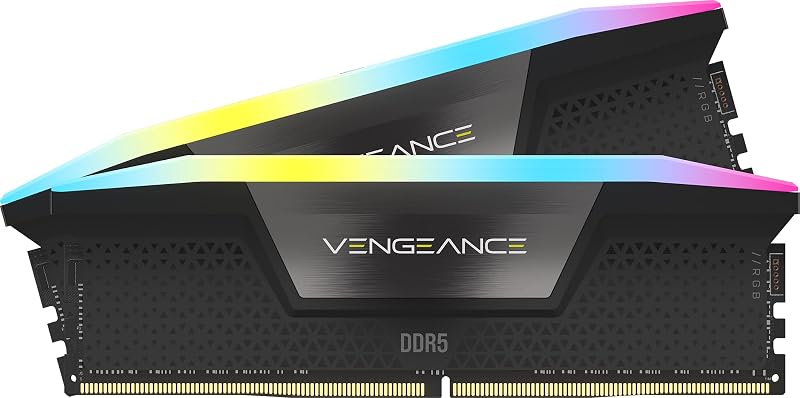
The single deciding factor between the G.Skill Flare X5 DDR5 6000 and the Crucial Pro DDR5 is the choice between aggressive CAS latency tuned for AMD systems and dual-profile compatibility designed for cross-platform hardware. Flare X5 delivers a tighter CL30 timing specification engineered specifically for AMD EXPO platforms, whereas Crucial Pro trades tighter timings for broader flexibility by offering CL36 latency backed by both Intel XMP 3.0 and AMD EXPO overclocking profiles.
Builders putting together a dedicated AMD Socket AM5 system should choose G.Skill for its latency advantage in gaming workloads. Enthusiasts who want guaranteed compatibility across both Intel Core and AMD Ryzen setups should choose Crucial for its plug-and-play profile flexibility.


G.Skill Flare X5 DDR5 6000 vs Crucial Pro DDR5 at a Glance
| Feature | G.Skill Flare X5 DDR5 6000 | Crucial Pro DDR5 |
|---|---|---|
| Kit Capacity | 32 GB (2 x 16 GB) | 32 GB (2 x 16 GB) |
| Data Transfer Rate | 6000 MT/s | 6000 MHz |
| CAS Latency | CL30 | CL36 |
| Extended Timings | 30-38-38-96 | 36-38-38-80 |
| Tested Voltage | 1.35V | 1.35V |
| Overclocking Profiles | AMD EXPO, JEDEC default | Intel XMP 3.0, AMD EXPO |
| Platform Support | AMD X870, X670, B850, B840, B650, A620 | Intel 12th-14th Gen, AMD Ryzen 7000/9000 |
| Heat Spreader | Matte Black Low-Profile | Origami-inspired Aluminum |
| Form Factor | 288-pin Non-ECC UDIMM | 288-pin DIMM |
| Best For | AMD Ryzen Gaming Rigs | Multi-Platform PC Builds |
CAS Latency and Primary Memory Timings
Column Address Strobe (CAS) latency defines the delay between when a memory controller requests data from a memory module and when that data becomes available. In modern high-speed DDR5 memory, lower latency numbers translate directly into reduced memory access bottlenecks. When evaluating the G.Skill Flare X5 DDR5 6000 CL30 vs CL36 configuration of its competitor, the primary differentiator lies in the initial response window. At 6000 MT/s, a CL30 rating provides an absolute first-word latency of 10.0 nanoseconds, while CL36 yields 12.0 nanoseconds. That 2.0-nanosecond gap creates measurable advantages in workloads where the processor repeatedly requests uncached data blocks from system memory.
Examining the complete timing configuration reveals distinct design philosophies between both kits. G.Skill Flare X 6000 timings sit at 30-38-38-96 at 1.35 volts. Crucial Pro specifies extended timings of 36-38-38-80 at the same 1.35 volts. While Crucial features a lower row active time (tRAS of 80 compared to 96), Flare X5 maintains a distinct advantage on the primary CAS step. In high-refresh-rate gaming setups, that lower initial access delay prevents frame pacing hitches. Those comparing broader memory alternatives in our g.skill flare x5 ddr5 6000 vs ripjaws s5 ddr5 analysis will find that sub-timing tuning remains a crucial separator for enthusiasts tuning AMD memory sub-systems.
Crucial states that its 36-38-38-80 timings deliver a 25 percent lower latency compared to standard Crucial Pro plug-and-play modules running JEDEC baselines. However, when paired against an enthusiast-grade CL30 kit, Crucial concedes the primary timing advantage to Flare X5. For gaming engines where frame rate consistency depends on rapid asset streaming and physics calculations, the lower latency rating gives G.Skill a decisive performance edge.
Edge: G.Skill Flare X5 DDR5 6000 because its CL30 primary timing produces faster nanosecond response times than Crucial’s CL36 rating.
Platform Compatibility and Overclocking Profiles
Memory overclocking profiles eliminate the tedious process of entering primary timings, secondary timings, and operating voltages manually into motherboard firmware. System builders must verify that a memory kit’s embedded profiles align with their processor and motherboard socket architecture. Flare X5 targets AMD builders exclusively, coming equipped with AMD EXPO (Extended Profiles for Overclocking) and default JEDEC boot profiles. G.Skill explicitly validates the kit for modern AMD platforms, including AMD X870, X670, B850, B840, B650, and A620 chipsets, with verification backed by motherboard QVL qualification.
In contrast, Crucial Pro DDR5 XMP and EXPO support provides universal platform coverage on a single dual-profile kit. Crucial engineers the module to work across Intel Core 12th, 13th, and 14th generation desktop processors, as well as AMD Ryzen 7000 and newer AMD Ryzen 9000 series CPUs. When asking whether is Crucial Pro DDR5 worth it for dynamic builds, this flexibility is a massive asset. If you upgrade from an Intel platform to AMD, or repurpose the kit into a secondary Intel desktop, the memory retains its full one-click overclocking capabilities via Intel XMP 3.0 without requiring manual memory parameter configuration.
Flare X5 requires an AMD EXPO compatible motherboard BIOS to apply its rated 6000 MT/s CL30-38-38-96 settings with a single toggle. Running the Flare X5 on an Intel motherboard without native EXPO translation means the modules default to baseline JEDEC SPD speeds, requiring manual input to achieve advertised performance. Readers looking into dual-platform builds often explore our g.skill ripjaws s5 ddr5 vs crucial pro ddr5 breakdown, where similar Intel-versus-AMD compatibility differences define system stability.
Edge: Crucial Pro DDR5 because it features integrated profiles for both Intel XMP 3.0 and AMD EXPO on the same modules.
Gaming Performance and System Responsiveness
When selecting G.Skill Flare X5 or Crucial Pro for gaming, real-world frame rates depend on both raw bandwidth and memory response times. Both memory kits deliver 6000 MT/s data rates, which represents the optimal performance frequency for modern AMD desktop processors utilizing a 1:1 memory controller divider. At this speed, system memory delivers exceptional bandwidth for high-end GPUs rendering demanding AAA game titles. However, the tighter CL30 latency of Flare X5 reduces frame time variance during intense combat scenes, driving up 1% low frame rates in competitive multiplayer shooters.
Crucial Pro highlights accelerated gaming performance and states that every millisecond gained benefits fast-paced gameplay. The kit’s 6000 MHz frequency provides smooth multitasking and prevents frame drops during asset loading in massive open-world titles. Yet, in direct Crucial Pro DDR5 vs G.Skill Flare X5 DDR5 6000 evaluations, the Crucial kit’s looser CL36 rating introduces an extra two nanoseconds of latency overhead. While average frame rates in GPU-bound scenarios remain comparable between the two, CPU-bound gaming scenarios reward the tighter access cycles of G.Skill.
For PC builders who prioritize maximum responsiveness in eSports titles running at high refresh rates, Flare X5 edges ahead. Gamers exploring enthusiast memory kits in our g.skill flare x5 ddr5 6000 vs kingston fury renegade ddr5 review will recognize that low latency profiles provide cleaner frame-pacing graphs. Crucial Pro remains thoroughly capable of driving modern games smoothly, but Flare X5 extracts higher performance ceilings from high-end gaming CPUs.
Edge: G.Skill Flare X5 DDR5 6000 because its lower latency ensures tighter frame pacing and better 1% low metrics in competitive games.
Overclocking Potential and Voltage Specifications
Both kits operate at an identical factory-tested voltage of 1.35V to maintain their 6000 MT/s rating. Running at 1.35V represents a moderate increase over the baseline DDR5 JEDEC specification of 1.1V, providing the electrical headroom necessary to sustain tight timings at elevated transfer rates. G.Skill warns builders not to mix memory kits, noting that each set is factory-matched to run together reliably and that deviations from manufacturer specifications can lead to system instability.
Crucial positions this kit as an overclocking-specific variant within its lineup, highlighting Crucial Pro DDR5 6000MHz overclocking capability. Crucial modules draw on parent company Micron’s manufacturing expertise, featuring component-level and module-level factory testing. Crucial’s extended timings of 36-38-38-80 demonstrate a conservative approach to stability, giving the memory controller on the CPU an easier electrical workload than the more demanding CL30 parameters found on Flare X5.
Enthusiasts attempting manual tuning beyond factory profiles will find that both kits hit standard thermal and voltage thresholds quickly without active airflow. Those who compare these kits against high-end alternatives in our corsair dominator titanium ddr5 vs g.skill flare x5 ddr5 6000 analysis understand that 1.35V profiles represent the practical sweet spot for daily stability. Because both kits demand the same 1.35V voltage envelope to achieve 6000 MT/s, neither holds an inherent power efficiency advantage.
Edge: Tie because both memory kits operate at an identical 1.35V tested voltage to achieve their rated 6000 MT/s transfer speeds.
Heat Spreader Design and Thermal Dissipation
DDR5 memory modules incorporate on-die power management integrated circuits (PMIC), which generate localized heat during heavy reading and writing sessions. Consequently, effective heat sink design is critical for long-term reliability. Crucial equips the Pro DDR5 Overclocking edition with custom aluminum heat spreaders inspired by the geometric folds of origami. Crucial notes that these heat spreaders serve a dual function: providing a unique visual appearance while actively dissipating thermal energy away from the DRAM chips and PMIC components during sustained AAA gaming sessions.
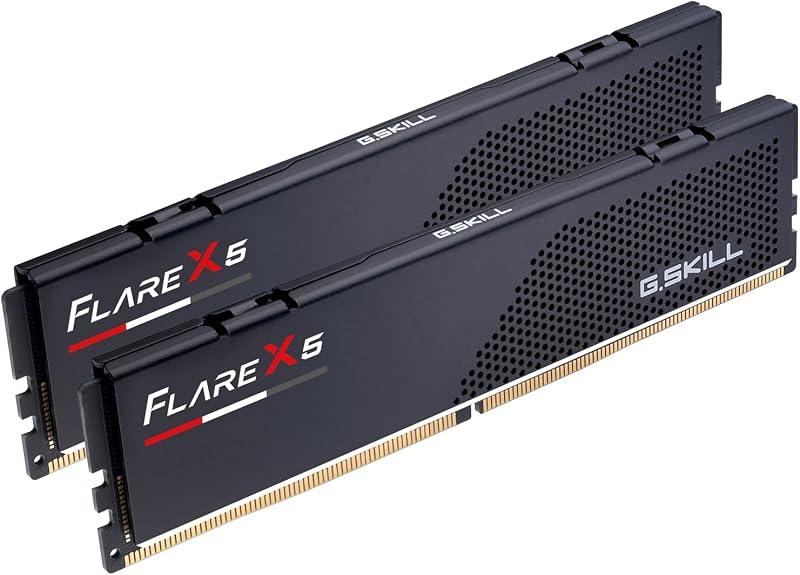
G.Skill outfits the Flare X5 with a minimalist matte black aluminum heat spreader. This design avoids unnecessary bulk, making it an ideal pairing for large dual-tower air coolers where memory height clearance is a frequent concern. While G.Skill does not advertise artistic design inspirations, the functional, low-profile matte black finish blends seamlessly into dark motherboard aesthetics. System builders evaluating premium heat spreaders in our g.skill trident z5 rgb ddr5 6000 vs flare x5 ddr5 6000 comparison will note that Flare X5 focuses strictly on thermal utility and low clearance rather than aesthetic flair.
Crucial Pro stands out by pairing purposeful thermal management with Micron’s 42 years of memory engineering heritage. The origami-inspired heat shield offers slightly more surface area for ambient chassis airflow to wick away heat under heavy multi-threaded productivity tasks. G.Skill offers superior mechanical clearance for oversized CPU air coolers, while Crucial provides a visually refined and thermally efficient heat sink.
Edge: Crucial Pro DDR5 because its origami-inspired aluminum heat spreaders provide effective thermal dissipation and elevated visual appeal.
Pros and Cons
G.Skill Flare X5 DDR5 6000
Pros
- Low CL30-38-38-96 primary timings
- Optimized for AMD Socket AM5 platforms
- Low-profile matte black heat spreader
- 0ns first-word access latency
Cons
- Lacks native Intel XMP 3.0 profile
- Higher tRAS rating of 96
View G.Skill Flare X5 DDR5 6000 on Amazon
Crucial Pro DDR5

Pros
- Dual Intel XMP 3.0 and AMD EXPO support
- Compatible with Intel 12th-14th Gen and AMD Ryzen
- Origami-inspired aluminum heat spreaders
- Rigorous Micron component and module testing
Cons
- Looser CL36 column address strobe latency
- Slightly higher 12.0ns first-word access delay
View Crucial Pro DDR5 on Amazon
Who Should Buy Each One
Choose the G.Skill Flare X5 DDR5 6000 If
- You are building an AMD Ryzen 7000, 8000, or 9000 series gaming desktop.
- You want the lowest possible CAS latency (CL30) for enhanced frame rate stability.
- You use a large dual-tower air cooler that requires low-profile memory modules.
- Your motherboard features native AMD EXPO profile support on chipsets like B650 or X670.
Choose the Crucial Pro DDR5 If
- You need out-of-the-box profile compatibility across both Intel and AMD systems.
- You are running an Intel Core 12th, 13th, or 14th generation desktop processor.
- You value Micron component manufacturing and factory validation testing.
- You appreciate origami-inspired aluminum heat spreader styling in your build.
Final Verdict
When choosing G.Skill Flare X5 or Crucial Pro for Ryzen setups, Flare X5 takes the overall win for pure performance. By hitting 6000 MT/s at CL30-38-38-96, G.Skill matches the ideal 1:1 memory controller frequency for AMD processors while delivering a snappy 10.0-nanosecond access latency. For gamers seeking every single frame and running memory-intensive workloads on AM5 motherboards, Flare X5 provides the tighter timing profile required for top-tier responsiveness.
Crucial Pro DDR5 remains the smarter recommendation for builders demanding versatility and multi-platform reliability. With integrated Intel XMP 3.0 and AMD EXPO support, it works seamlessly whether installed in an Intel Core system or an AMD Ryzen rig. While its CL36 latency trails G.Skill on paper, Crucial’s rigorous module testing and origami-inspired thermal spreaders make it a dependable, versatile memory kit for general-purpose gaming and workstation duties.
FAQ
Can I run G.Skill Flare X5 on an Intel motherboard?
G.Skill Flare X5 includes AMD EXPO and standard JEDEC boot profiles, and is validated specifically for AMD platforms like X670, B650, and X870. While some modern Intel motherboards feature firmware that can read and translate AMD EXPO parameters, native Intel XMP 3.0 profiles are not included on this kit. On an Intel board without EXPO translation, the memory boots at default JEDEC SPD speeds unless configured manually.
Does Crucial Pro DDR5 support both AMD and Intel overclocking profiles?
Yes, Crucial Pro Overclocking DDR5 features dual compatibility with both Intel XMP 3.0 and AMD EXPO. You can enable the full 6000 MHz CL36 profile with a single setting in the BIOS whether your system runs an Intel Core 12th to 14th generation processor or an AMD Ryzen 7000 or 9000 series CPU.
What is the real-world performance difference between CL30 and CL36 at 6000 MT/s?
At 6000 MT/s, CL30 memory provides a true latency of 10.0 nanoseconds, compared to 12.0 nanoseconds for CL36 modules. While both kits deliver the same maximum theoretical bandwidth, the 2.0-nanosecond lower latency of CL30 reduces frame time stuttering and improves 1% low frame rates in CPU-bound competitive games.
Do these memory kits work at 6000 MT/s straight out of the box?
No, neither memory kit runs at 6000 MT/s automatically upon first installation. Both kits boot at standard JEDEC default SPD frequencies to ensure system stability. To reach the advertised 6000 MT/s speed, you must enter your motherboard BIOS and enable the corresponding AMD EXPO or Intel XMP overclock profile.
Can I mix two of these 32GB kits to get 64GB of total system RAM?
G.Skill explicitly warns against combining multiple memory kits, even if they share the identical model number. Factory-sold kits are packaged and tested as matched pairs. Running two separate dual-channel kits simultaneously across four DIMM slots places extra strain on the CPU memory controller, which frequently prevents the modules from booting at advertised 6000 MT/s overclocked speeds.
What operating voltage do both kits require for their rated speeds?
Both G.Skill Flare X5 and Crucial Pro DDR5 require 1.35 volts to operate at their rated 6000 MT/s overclock profiles. This voltage is applied automatically by the motherboard firmware once you enable the AMD EXPO or Intel XMP setting in the BIOS.