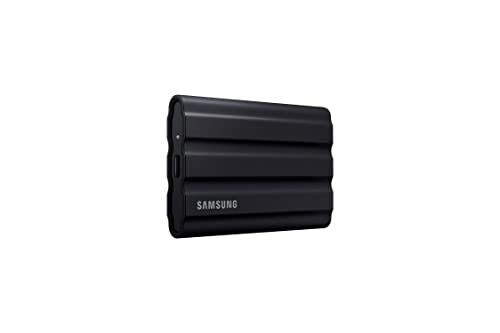
The critical difference that decides the choice between these two portable solid-state drives is their physical resilience versus their portability profile: the Samsung T7 Shield provides heavy-duty IP65 water and dust resistance with 9.8-foot drop protection wrapped in a thick elastomer shell, whereas the Crucial X9 Pro prioritizes a sleek, pocket-friendly polycarbonate build with IP55 protection and 7.5-foot drop resistance.
Outdoor photographers, videographers, and field creators working in challenging weather should choose the Samsung T7 Shield for its superior environmental barrier and impact resistance. Everyday commuters, students, and office professionals seeking an ultra-compact, high-speed backup drive that slips effortlessly into any pocket should choose the Crucial X9 Pro.

Samsung T7 Shield vs Crucial X9 Pro at a Glance
| Feature | Samsung T7 Shield | Crucial X9 Pro |
|---|---|---|
| Ingress Protection (IP Rating) | IP65 (dust-tight, water jets) | IP55 (dust protected, water jets) |
| Drop Resistance | Up to 9.8 feet (3 meters) | Up to 7.5 feet (2 meters) |
| Sequential Read Speed | Up to 1,050 MB/s | Up to 1,050 MB/s |
| Sequential Write Speed | Up to 1,000 MB/s | The listing does not specify |
| Interface & Protocol | USB 3.2 Gen 2 (10 Gbps) PCIe NVMe | USB 3.2 Gen 2 (10 Gbps) USB-C |
| Exterior Material | Advanced outer elastomer | Polycarbonate |
| Capacity Options Listed | 1TB to 4TB | 1TB |
| Security & Encryption | Hardware Encryption, password support | The listing does not specify |
| Included Management Software | Samsung Magician Software | Acronis True Image, Mylio Photos+ (3 months) |
| Best For | Harsh outdoor shoots and field production | Ultralight travel backups and everyday commuting |
Rugged Durability and Environmental Protection
Portable solid-state drives are engineered to travel, but the degree of environmental abuse they can withstand varies significantly based on structural housing and sealing. The Samsung T7 Shield vs Crucial X9 Pro durability comparison highlights two completely different philosophies of enclosure design. Ingress protection ratings use two digits: the first measures dust ingress prevention on a scale up to 6, and the second measures moisture prevention on a scale up to 8. The physical shell determines whether a dropped drive survives an unexpected tumble onto concrete or sustains cracked internal interconnects.
The T7 Shield carries an IP65 rating, meaning it is certified completely dust-tight under testing involving 2kg/m³ of active dust under 2kPa pressure for eight hours. Its moisture resistance is validated against direct water projected by a nozzle at 100kPa for three minutes. Encasing the drive is a dense, advanced outer elastomer layer engineered to absorb kinetic shocks from falls up to 9.8 feet. If you frequently navigate backcountry shoots, rainy outdoor sets, or gritty environments, this heavy rubberized jacket cushions internal flash components from devastating surface impacts. Readers exploring extreme field durability will find similar rugged attributes analyzed in our samsung t7 shield vs sandisk extreme portable ssd review.
By contrast, the Crucial X9 Pro utilizes a streamlined polycarbonate enclosure rated at IP55. The five for solids indicates dust-protected status rather than complete sealing, meaning minor dust may penetrate though it will not impair operation. The five for moisture provides defense against low-pressure water streams from any angle. Its structural drop testing guarantees survival from up to 7.5 feet, which comfortably exceeds typical desk or backpack drop heights. While resilient enough for regular travel, coffee shop spills, or standard urban commuting, the rigid polycarbonate exterior lacks the heavy shock-dispersing rubber bumper of its competitor. When assessing the Samsung T7 Shield vs Crucial X9 Pro IP rating, the Samsung model provides an undeniable technical tier of extra protection against both microscopic grit and high-impact falls.
Edge: Samsung T7 Shield, thanks to its superior IP65 dust-tight seal, rubberized shock bumper, and higher 9.8-foot drop threshold.
Transfer Speeds and Real-World Performance
Sustained data transfer rates determine how long you sit waiting for gigabytes of high-resolution RAW photo catalogs, multi-track audio files, or bulky system backups to offload. Both drives operate over the USB 3.2 Gen 2 bus interface, which establishes a theoretical bandwidth ceiling of 10 Gbps. At this hardware layer, both products utilize internal PCIe NVMe protocol architecture to avoid the legacy bottlenecks of older SATA interfaces.
When reviewing the Samsung T7 Shield vs Crucial X9 Pro transfer speed metrics, manufacturer specifications show matched top-tier sequential read capabilities. The T7 Shield advertises maximum read speeds up to 1,050 MB/s and sequential write speeds up to 1,000 MB/s, driven by Samsung’s proprietary in-house DRAM and NAND flash memory components. It also integrates Samsung’s Dynamic Thermal Guard technology, which monitors and manages operating temperatures to control heat build-up during extended high-throughput write sequences. Those interested in how modern interface generations compare across high-speed drives can inspect our breakdown of the samsung t7 shield vs t9.
The Crucial X9 Pro matches this ceiling with a rated read speed of up to 1,050 MB/s over its native USB Type-C connector. The Amazon product listing emphasizes seamless handling of high-resolution images, 4K media transfers, and swift computer backup routines. However, the listing does not specify the exact sequential write speed for this Crucial reference, stating only general transfer speeds up to 1,050 MB/s and a 10 Gbps data transfer rate. In general file ingestion scenarios, both units provide virtually identical real-world read responsiveness that will saturate standard USB 3.2 Gen 2 ports on contemporary laptops and workstations.
Edge: Tie, as both drives deliver matching maximum sequential read bandwidth of 1,050 MB/s across a 10 Gbps USB 3.2 Gen 2 pipeline.
Video Editing and Content Creation Workflows
Modern video editing workflows place intense demands on portable external drives. Creators frequently require direct drive editing, scrubbing through dense 4K timelines without dropping frames, and recording footage straight from camera bodies or mobile devices. When deciding between the Samsung T7 Shield or Crucial X9 Pro for video editing, the specific hardware certification and heat management become primary considerations.
The T7 Shield is explicitly engineered to interface with modern video production rigs. The product specifications verify native support for Apple iPhone 15 Pro ProRes 4K recording at 60 frames per second using the recommended included cable. With 1,000 MB/s write capability and Dynamic Thermal Guard actively mitigating throttling when ingesting continuous multi-gigabyte video files, the T7 Shield functions as an active live-recording cartridge on camera cages. Furthermore, it offers storage capacities ranging from 1TB up to 4TB, allowing documentarians and commercial filmmakers to stockpile days of high-bitrate footage. For a deeper look at high-bitrate video production storage alternatives, see our comparison of the samsung t7 shield vs sandisk extreme pro portable.
The Crucial X9 Pro is also positioned for media editing, large file offloading, and 4K media organization. Crucial includes a complimentary three-month subscription to Mylio Photos+, providing organizational tools for photographers and catalogers looking to streamline extensive photo and video collections across multiple devices. However, the Crucial listing does not specify explicit certification for mobile ProRes external capture modes or multi-terabyte options beyond the 1TB listing. While it effortlessly handles local editing of proxy workflows, standard 4K timeline scrubbing, and rapid media offloads via its 10 Gbps connection, it lacks the specialized thermal chassis mass and camera-specific capture validations detailed in Samsung’s technical sheet.
Edge: Samsung T7 Shield, due to confirmed iPhone ProRes 4K 60fps recording support, dedicated thermal throttle control, and capacity options up to 4TB.
Form Factor, Weight, and Travel Convenience
When assembling a mobile gear kit, every ounce and cubic inch inside a backpack or utility pouch counts. Frequent flyers, daily commuters, and field operators perceive build volume differently: heavy structural shielding delivers drop safety at the cost of bulk, while sleek minimalist enclosures vanish into pockets but sacrifice outer cushioning.
Crucial built the X9 Pro around effortless transport. Its enclosure consists of smooth, rigid polycarbonate in an ultra-compact footprint designed to slide unobtrusively into any standard jeans pocket, laptop sleeve, or camera bag divider. Because it eliminates thick external rubber armor, it slides smoothly against fabrics without catching, accumulating lint, or adding noticeable drag inside tight compartments. For users who prioritize a lightweight, uncluttered everyday carry, this compact architecture offers pure travel convenience. Travelers weighing streamlined form factors against competing designs can also read our evaluation of the sandisk extreme portable ssd vs crucial x9 pro.
The Samsung T7 Shield, while remaining a portable palm-sized drive, embraces a distinctly bulkier presence. Its advanced elastomer exterior wraps completely around the casing, creating elevated ridges and a tactile, rubberized texture. While this material is vital for gripping the drive with wet or gloved hands and surviving 9.8-foot impacts, the rubberized surface tends to grip pocket linings and attract dust or lint over time. It is noticeably heavier and thicker in hand than Crucial’s polycarbonate shell. For everyday office workers and commuters whose drives never leave air-conditioned desks or padded bags, the extra bulk of the T7 Shield is unnecessary overhead.
Edge: Crucial X9 Pro, providing a substantially sleeker, pocket-friendly polycarbonate footprint that avoids rubber drag and added bulk.
Gaming Console Expansion and Cross-Platform Utility
Modern video game files regularly exceed 100 gigabytes, making external SSD expansions essential for console and PC owners. When considering the Samsung T7 Shield or Crucial X9 Pro for gaming, data compatibility across multiple operating platforms, quick load times, and plug-and-play installation determine overall utility.
The Crucial X9 Pro explicitly highlights gaming use cases, targeting casual gamers and enthusiasts needing rapid auxiliary storage. Its hardware is verified compatible with Sony PlayStation 4, PlayStation 5, Xbox, Windows, Mac, iPad Pro, Chromebooks, Android, and Linux systems. Connecting over USB-C or USB-A, it offers rapid game installation, seamless library archiving, and brisk asset streaming for older-generation titles played directly from external storage. The 1050 MB/s interface ensures game transfer times between internal console drives and the external unit occur at the limit of the system’s USB bus capabilities.
The Samsung T7 Shield provides parallel system compatibility, operating across gaming consoles, PC, Mac, tablets, and Android platforms. Gamers benefit from the same 1,050 MB/s read speed, ensuring game offloading and loading times match the Crucial unit stride for stride. The T7 Shield’s Dynamic Thermal Guard provides an added buffer against thermal throttling if you are transferring an entire 500GB game library in a single continuous session. However, the Crucial’s compact frame allows it to tuck away more discreetly behind television entertainment consoles or sitting atop a compact console chassis without sliding off. Both perform identically when loading game assets.
Edge: Tie, as both drives deliver matching 1050 MB/s transfer ceilings and extensive plug-and-play compatibility across PlayStation, Xbox, and PC systems.
Software Utilities and Data Security
A portable drive protects your digital life not only against physical damage, but also against data corruption and unauthorized access. Drive management utilities and embedded encryption hardware separate basic storage media from comprehensive enterprise-ready backup tools.
The Samsung T7 Shield excels in hardware-level security and drive maintenance. It features built-in Hardware Encryption, enabling users to secure confidential personal, business, or client files with robust password protection. To support this hardware, Samsung provides the proprietary Samsung Magician software suite. This advanced utility lets users monitor real-time drive health, review temperature statistics, verify genuine components, configure LED indicator colors, optimize firmware, and securely manage data protection settings. Because Samsung manufactures its DRAM, NAND flash, and controller firmware entirely in-house, the integration between the drive’s microcode and Samsung Magician is exceptionally tight.
The Crucial X9 Pro focuses its bundled software value on backup and media workflow software. Each drive includes registration access to three months of Acronis True Image and Mylio Photos+. Acronis True Image provides reliable automated backup and disk cloning capabilities, making it straightforward for users to mirror entire operating systems or automate incremental folder backups. However, the Crucial listing does not specify integrated hardware encryption, nor does it provide an in-house hardware diagnostic and firmware management suite comparable to Samsung Magician. Users who handle sensitive commercial data or client assets will miss the integrated hardware-level locking mechanisms standard on the T7 Shield.
Edge: Samsung T7 Shield, featuring integrated hardware encryption and the comprehensive Samsung Magician management suite.
Pros and Cons
Samsung T7 Shield
Pros
- Superior IP65 water and dust resistance
- Higher 9.8-foot drop protection rating
- Integrated hardware encryption support
- Samsung Magician drive health software
Cons
- Bulky elastomer outer build
- Lower 1,000 MB/s maximum write speed
View Samsung T7 Shield on Amazon
Crucial X9 Pro
Pros
- Fast 1,050 MB/s media performance
- Compact polycarbonate enclosure
- Bundled backup software subscription
Cons
- Lower IP55 weather resistance rating
- Reduced 7.5-foot drop tolerance
- Lacks integrated hardware encryption
Who Should Buy Each One
Choose the Samsung T7 Shield If

- You work outdoors, on film sets, or travel through harsh environments requiring an IP65 dust-tight seal.
- You want maximum impact protection, backed by an elastomer bumper rated for drops up to 9.8 feet.
- You record ProRes 4K 60fps video directly from an iPhone 15 Pro or modern camera body.
- You require hardware-based encryption and proprietary Samsung Magician firmware management tools.
Choose the Crucial X9 Pro If

- You prioritize an ultra-compact, lightweight polycarbonate drive that slips easily into pockets without catching on fabric.
- Your primary usage involves everyday business backups, student projects, and casual gaming library expansion.
- You value bundled backup tools like Acronis True Image and photo organization via Mylio Photos+.
- Your storage needs exist primarily in indoor, office, classroom, or controlled home entertainment environments.
Final Verdict
Evaluating this matchup comes down to weighing physical protection against streamlined portability. For the vast majority of users who invest in an external drive for versatile everyday scenarios, the Samsung T7 Shield stands out as the superior overall choice. Between its certified IP65 weatherproofing, class-leading 9.8-foot drop resistance, integrated hardware encryption, and thermal regulation via Dynamic Thermal Guard, it offers unmatched peace of mind. Whether you are performing a rigorous samsung t7 shield review for heavy-duty video work or archiving client deliverables, the T7 Shield ensures your data survives accidents that would crack lesser drives.
Conversely, the Crucial X9 Pro wins decisively when form factor, sleekness, and pocketability take center stage. If you do not plan to expose your storage media to torrential rainstorms, construction sites, or rocky trails, the added bulk and rubberized friction of the T7 Shield may feel unnecessary. The Crucial drive delivers matching 1,050 MB/s read speeds in a clean, lightweight polycarbonate shell accompanied by convenient backup software. To explore higher-tier options within these product families, you can also examine our comparative guide on the samsung t9 vs crucial x9 pro.
FAQ
How does the Samsung T7 Shield vs Crucial X9 Pro IP rating differ?
The Samsung T7 Shield features an IP65 rating, indicating that it is completely dust-tight (level 6) and protected against pressurized water jets from any direction (level 5). The Crucial X9 Pro carries an IP55 rating, which certifies it as dust-protected (level 5, permitting limited non-damaging dust ingress) and resistant to low-pressure water streams (level 5). The Samsung drive offers tighter particulate sealing against fine sand and grit.
Is the Samsung T7 Shield or Crucial X9 Pro for video editing better suited for recording direct from an iPhone?
The Samsung T7 Shield is specifically validated by Samsung to support direct external recording of Apple iPhone 15 Pro ProRes 4K video at 60 frames per second using the recommended cable. The Crucial X9 Pro listing notes general compatibility with mobile platforms and 4K media handling, but it does not specify explicit certification for direct ProRes camera recording modes.
Can both drives be used across Windows, Mac, and gaming consoles?
Yes. Both drives utilize universal USB 3.2 Gen 2 connectivity over USB Type-C and are engineered for cross-platform utility. They interface smoothly with Windows, macOS, Android devices, iPad tablets, PlayStation 4, PlayStation 5, and Xbox consoles right out of the box.
Is Crucial X9 Pro worth it for everyday travel backups?
Yes. If your primary objective is to carry large document libraries, photo archives, and system backups in a pocket-sized, lightweight form factor, the Crucial X9 Pro is well worth consideration. Its compact polycarbonate enclosure fits effortlessly into commuter bags, its 7.5-foot drop protection guards against desk accidents, and it includes Acronis True Image software for streamlined backup routines.
Is Samsung T7 Shield worth it for outdoor field production?
Yes. The Samsung T7 Shield is worth it for creative professionals who shoot on location, travel through inclement weather, or operate in dusty environments. Its combination of an advanced elastomer shock bumper, 9.8-foot drop tolerance, IP65 ingress protection, and thermal heat throttling guarantees reliable data retention under physical stresses that would jeopardize standard consumer hard drives.
Does either drive require an external power supply?
No. Both the Samsung T7 Shield and the Crucial X9 Pro are completely bus-powered portable solid-state drives. They draw all necessary operational power directly through the host device’s USB-C port, eliminating the need for dedicated wall adapters or external power bricks.