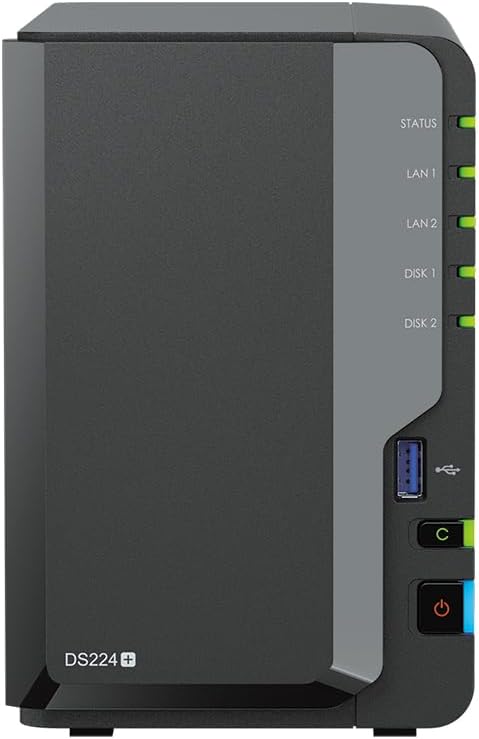
The core difference deciding the choice between these two 2-bay network attached storage units comes down to compute class and networking throughput: the QNAP TS-233 is an entry-level ARM-powered enclosure built around a low-power quad-core chip and standard 1GbE connectivity for simple personal archiving, whereas the UGREEN DXP2800 GT is an enterprise-grade desktop powerhouse equipped with an 8-thread AMD Ryzen processor, 10GbE networking, and U.2 NVMe expansion designed for direct-from-NAS video editing and heavy multitasking.
Buyers looking for a lightweight, quiet data vault for basic document storage, automated phone backups, and snapshot defense should pick the TS-233, while creators, home lab operators, and power users demanding high transfer rates and deep container virtualization should invest in the DXP2800 GT.


QNAP TS-233 vs UGREEN DXP2800 GT at a Glance
| Feature | QNAP TS-233 | UGREEN DXP2800 GT |
|---|---|---|
| Processor | ARM Cortex-A55 Quad-Core 2.0 GHz | AMD Ryzen Embedded R2514 (4C/8T, up to 3.70 GHz) |
| System Memory | 2 GB RAM | 8 GB DDR4 |
| Memory Expansion | Not listed (fixed 2 GB onboard) | Expandable to 64 GB (ECC supported) |
| Network Connectivity | 1x Gigabit LAN (1GbE) | 1x 10GbE LAN |
| Standard Drive Bays | 2x 2.5-inch / 3.5-inch SATA 6 Gb/s | 2x SATA (up to 32 TB each) |
| High-Speed SSD Expansion | Not listed | 2x U.2 NVMe (via SATA bays) + 2x M.2 SSDs (up to 16 TB) |
| Maximum Raw Capacity | Not listed | Up to 80 TB total capacity |
| Security & Protection | Ransomware Snapshots, myQNAPcloud | TLS/SSL, RSA, AES, SHA-512, Security Manager |
| Virtualization & Apps | NPU Image Recognition, ARM NEON | Docker, Virtual Machines, SAN Manager, Surveillance Center |
| Best For | Energy-efficient home backups and basic photo archives | Heavy workflows, direct editing, containers, and 10GbE speeds |
Processing Power and Multitasking Performance
The central processor defines the scope of what any network storage server can accomplish simultaneously. Inside the QNAP TS-233, you get a 64-bit ARM Cortex-A55 quad-core chip operating at 2.0 GHz. This ARM architecture is engineered for low power consumption and consistent background operations, such as synchronizing files or managing automated local copies. It also features an integrated Neural Network Processing Unit (NPU) dedicated to accelerating artificial intelligence tasks, specifically face and object indexing within your personal photo libraries. When reading an in-depth qnap ts-233 vs ugreen dxp4800 plus breakdown, it becomes clear that while an ARM Cortex processor handles solitary backup routines efficiently, it quickly runs out of headroom under parallel request loads.
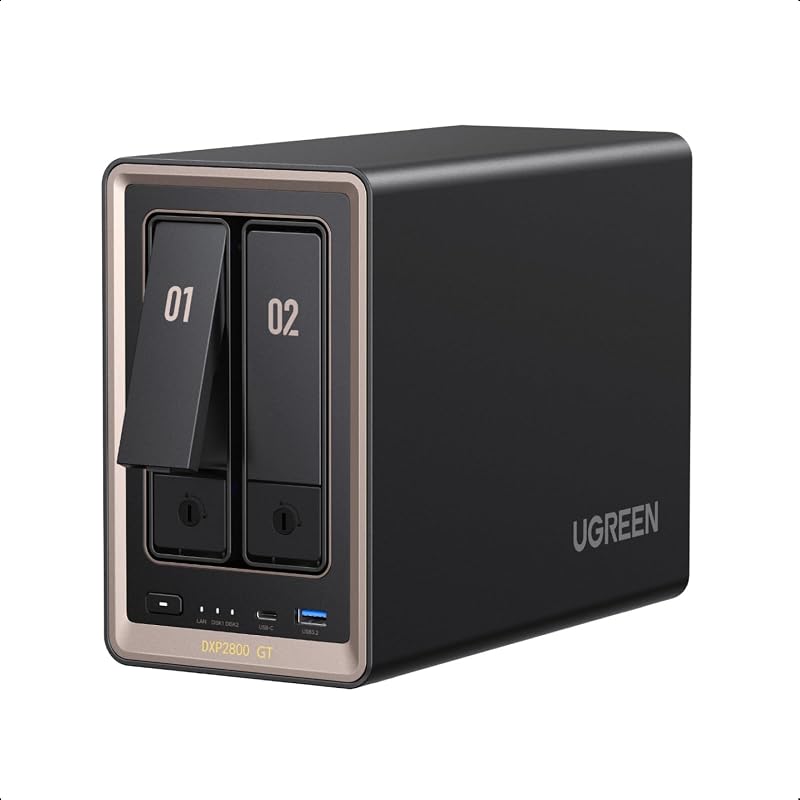
By contrast, the UGREEN DXP2800 GT is powered by an AMD Ryzen Embedded R2514 processor sporting 4 cores and 8 threads capable of boosting up to 3.70 GHz. This x86 enterprise-grade platform elevates the server from a passive backup destination to an active compute hub. The multithreaded Ryzen architecture effortlessly powers multi-stream data pipelines, complex computational routines, and heavy background disk operations. When evaluating the UGREEN DXP2800 GT vs QNAP TS-233, the massive compute gulf becomes the deciding factor for users running simultaneous tasks across various client devices.
For demanding environments involving continuous data indexing, media processing, and high-frequency queries, the Ryzen chip prevents system latency and UI stutter. The TS-233 keeps power draw remarkably minimal, but it is fundamentally limited to lightweight service requests, making high-demand operations sluggish by comparison.
Edge: UGREEN DXP2800 GT, providing superior multi-core compute speeds and double the thread count for intense workloads.
Networking and Transfer Speeds
Network port throughput dictates how fast data moves between the server and your client workstations. The QNAP TS-233 features a single standard Gigabit Ethernet (1GbE) LAN port. According to manufacturer specifications, it yields media speeds around 125 MB/s and transfer rates up to 3 Gbps across its SATA bus. For general document syncing, daily incremental workstation backups, and streaming compressed audio or video files across a local network, a standard 1GbE connection saturates typical consumer home networks without bottlenecking standard gigabit switches. However, large sequential moves, like offloading camera cards or system images, are physically capped by the ceiling of standard gigabit networking.
The UGREEN DXP2800 GT shatters this boundary by integrating native 10GbE networking. With 10GbE capabilities, file transfers can move at up to ten times the bandwidth of standard gigabit Ethernet, provided your network switches and host clients support 10G infrastructure. UGREEN highlights direct-from-NAS editing as a marquee feature made viable solely by this connection. Content creators, video editors, and design professionals can store uncompressed assets directly on the NAS and edit them in real time without waiting for slow file caching. As explored in our qnap ts-464 vs ugreen dxp2800 gt hardware face-off, moving to a native 10GbE network fabric eliminates local storage compromises entirely.
When comparing QNAP TS-233 vs UGREEN DXP2800 GT transfer speeds, the real-world utility separates sharply. The TS-233 caps out at 125 MB/s media performance, which satisfies basic wireless laptop synchronization, while the UGREEN DXP2800 GT 10GbE performance accommodates massive multi-gigabyte files in seconds. For direct workflow pipelines, 1GbE simply cannot compete with 10GbE.
Edge: UGREEN DXP2800 GT, offering unmatched 10GbE networking that allows real-time file editing straight from the drive array.
Memory Capacity, System Scaling, and RAM Limitations
System memory defines how many background daemons, applications, and simultaneous user connections a NAS can sustain before exhausting system resources. The QNAP TS-233 comes equipped with 2 GB of memory. In everyday practice, this compact allocation is dedicated to the core operating system, storage volume management, and lightweight utility packages. However, QNAP TS-233 2GB RAM limitations quickly surface if you try to activate several intensive services at once. Because the listing specifies no memory expansion path, the 2 GB memory ceiling remains permanent for the lifespan of the device.
On the other hand, the DXP2800 GT ships standard with 8 GB of DDR4 RAM and supports memory expansion all the way up to 64 GB. Crucially, the platform also supports ECC (Error-Correcting Code) RAM upgrades, designed to detect and correct data corruption during sustained long-term operations. While the pre-installed 8 GB module is non-ECC, the hardware gives you an explicit upgrade path to install compatible ECC modules. This architecture mirrors larger commercial enclosures like those compared in our synology ds923+ vs ugreen dxp2800 gt technical overview.
Expanding up to 64 GB gives the system ample buffer memory to handle intensive caching, large active file databases, and dense application stacks. Where the TS-233 requires conservative management of background services, the DXP2800 GT provides virtually unrestricted scaling headroom for power users.
Edge: UGREEN DXP2800 GT, delivering 8 GB out of the box with an expansion ceiling up to 64 GB and ECC memory support.
Storage Architecture and High-Speed Drive Expansion
A 2-bay enclosure is typically constrained by physical slot dimensions, making drive flexibility vital. The QNAP TS-233 incorporates two standard SATA drive bays compatible with both 2.5-inch and 3.5-inch hard disk drives and SSDs operating over a SATA 6.0 Gb/s bus. This straightforward dual-drive arrangement allows standard RAID protection for personal collections, ensuring full redundancy against single drive failures. For standard home backup and basic media libraries, two mechanical drives provide more than sufficient volume, though the platform lacks secondary expansion tiers like dedicated NVMe solid-state slots.
UGREEN reengineers the compact 2-bay desktop footprint with extreme density on the DXP2800 GT. It provides two standard SATA bays that accommodate high-capacity drives up to 32 TB each, but it also allows those same two primary bays to house U.2 NVMe solid-state drives. Furthermore, the unit incorporates two dedicated M.2 NVMe SSD slots supporting up to 16 TB of additional flash storage, driving total achievable system capacity up to 80 TB. Comparing drive topologies in the ugreen dxp2800 gt vs terramaster f4-425 analysis highlights how uncommon U.2 compatibility remains within dual-bay home hardware.
This tiered drive architecture lets owners run mechanical mass storage alongside blistering flash tiers without giving up bay real estate. The TS-233 delivers a reliable basic layout, but the DXP2800 GT provides modern enterprise-style expansion that handles both mass storage and ultra-low-latency NVMe pools simultaneously.
Edge: UGREEN DXP2800 GT, thanks to secondary M.2 slots, U.2 NVMe compatibility, and an 80 TB maximum capacity.
Virtualization, Container Support, and Surveillance
Modern network appliances increasingly operate as versatile home servers running modular container software. The QNAP TS-233 relies on its QTS software package, emphasizing file management, remote access through myQNAPcloud, and integrated ransomware defense via file system Snapshots. Snapshots record the state of storage volumes at specific moments, enabling quick recovery if files are modified or encrypted maliciously. Additionally, its hardware incorporates an NPU for AI-powered image recognition and ARM NEON technology to accelerate video processing. However, due to its ARM Cortex architecture and 2 GB memory ceiling, full virtual machine deployment is out of reach.
The UGREEN DXP2800 GT runs the UGOS Pro operating system, which includes full, out-of-the-box support for Docker containers, complete virtual machines (VMs), and a SAN Manager. Users can test software, run isolated operating systems, or host persistent utilities like Home Assistant and media servers. The UGREEN DXP2800 GT Docker performance is backed by an 8-thread x86 processor and extensive memory options, meaning containers execute at near-native bare-metal speeds without choking concurrent tasks. A comprehensive UGREEN DXP2800 GT review reveals how comfortably it operates as an always-on virtualization node.
Additionally, the DXP2800 GT includes an integrated Surveillance Center that connects directly to ONVIF and RTSP IP cameras. It records local 24/7 video streams, delivers live feeds, and protects recordings behind TLS/SSL, RSA, AES, and SHA-512 cryptographic encryption managed by a local Security Manager. While QNAP offers outstanding baseline snapshot protection and AI photo tagging, UGREEN provides a comprehensive virtualization and surveillance suite.
Edge: UGREEN DXP2800 GT, featuring complete virtual machine execution, broad Docker support, and native IP camera surveillance.
Media Streaming and Home Entertainment
Centralizing multimedia for home streaming is one of the primary reasons users buy dual-bay network storage. The QNAP TS-233 is equipped with ARM NEON technology, a specialized SIMD (Single Instruction Multiple Data) acceleration architecture designed to improve multimedia and video processing. The hardware listing also specifies support for hardware-accelerated transcoding, offloading video conversion tasks to native silicon. Through centralized multimedia management, the TS-233 organizes home videos, photo catalogs, and music collections for smooth distribution to household devices. Anyone considering a QNAP TS-233 review for simple living-room streaming will find it efficient at serving clean 1080p and localized video feeds without consuming heavy wattage.
When deciding between the QNAP TS-233 or UGREEN DXP2800 GT for Plex, Emby, or Jellyfin, the processing power of the hardware plays a critical role. UGOS Pro on the DXP2800 GT explicitly supports third-party media ecosystems including Plex, Emby, and Jellyfin. The AMD Ryzen R2514 processor delivers substantial horsepower to handle multi-user streams, on-the-fly container transcoding, and high-bitrate media libraries that would otherwise stall lower-powered platforms. In multi-device households streaming to smartphones, tablets, and smart televisions at once, the Ryzen platform maintains stream stability without hitching. Similar multi-stream capabilities are detailed in our synology ds1522+ vs ugreen dxp2800 gt comparison.
The TS-233 handles standard home entertainment well, but UGREEN delivers a far more resilient media hub for diverse playback clients across varied codecs and network environments.
Edge: UGREEN DXP2800 GT, providing the raw x86 compute power required for seamless Plex, Jellyfin, and Emby multi-stream serving.
Pros and Cons
QNAP TS-233

Pros
- Energy-efficient quad-core ARM processor
- Built-in NPU for AI image recognition
- Snapshot protection against ransomware threats
- ARM NEON multimedia acceleration technology
Cons
- Limited to 2 GB non-expandable memory
- Restricted to standard 1GbE network speeds
- No M.2 or U.2 high-speed SSD slots
UGREEN DXP2800 GT
Pros
- AMD Ryzen 4-core 8-thread processor
- Native high-speed 10GbE network interface
- Up to 80 TB storage with U.2 and M.2 slots
- Expandable to 64 GB RAM with ECC support
- Supports Docker, virtual machines, and surveillance
Cons
- Heavy desktop footprint at 4.41 kg
- Pre-installed 8 GB RAM module is non-ECC
View UGREEN DXP2800 GT on Amazon
Who Should Buy Each One
Choose the QNAP TS-233 If
- You need a low-power, quiet home server dedicated strictly to document backups, photo sorting, and file sharing.
- You require integrated snapshot protection to defend your primary storage volumes against accidental file deletion and ransomware threats.
- You want automated AI-driven image recognition powered by an onboard hardware NPU without needing to configure complex external packages.
- Your home network infrastructure uses standard 1GbE routers and switches, making high-bandwidth 10GbE network interfaces unnecessary.
Choose the UGREEN DXP2800 GT If
- You are a content creator or freelancer needing 10GbE networking for direct-from-NAS editing of large media projects.
- You plan to run Docker containers, multiple virtual machines, and advanced home automation stacks on expandable memory up to 64 GB.
- You want dense, high-speed storage caching or flash volumes via dual M.2 NVMe SSDs or U.2 NVMe drive compatibility.
- You require a centralized surveillance hub with native ONVIF/RTSP camera recording, live monitoring, and robust multi-layer encryption.
Final Verdict
Choosing between the QNAP TS-233 and the UGREEN DXP2800 GT is a matter of selecting the right class of hardware for your operational scope. The DXP2800 GT represents an advanced breed of 2-bay network appliances, combining an AMD Ryzen R2514 8-thread processor, 10GbE networking, M.2 and U.2 SSD expansion, and enterprise-grade ECC memory support. It is engineered for intensive workloads, high-speed media creation pipelines, extensive container deployments, and heavy local multi-client traffic. For power users wondering is UGREEN DXP2800 GT worth it, the hardware ceiling and networking performance thoroughly justify the platform for demanding server roles.
Nevertheless, the QNAP TS-233 remains an exceptionally practical choice when deciding on a QNAP TS-233 or UGREEN DXP2800 GT for home backup. Not every household requires high-throughput 10GbE ports or multi-core virtualization. The TS-233 offers a streamlined minimalist design, highly protective ransomware snapshot capabilities, and integrated NPU-accelerated photo organization wrapped inside an energy-efficient ARM footprint. If your objective is simply to keep your personal photos, files, and family archives safely mirrored and easily accessible across the internet via myQNAPcloud, the TS-233 delivers straightforward, dependable reliability.
FAQ
Can the RAM on the QNAP TS-233 be upgraded?
No, the QNAP TS-233 comes with 2 GB of memory installed, and the listing does not specify any available expansion slots. If your software workloads require extensive memory or container execution, you should consider a platform with expandable memory like the DXP2800 GT.
Does the UGREEN DXP2800 GT support ECC memory out of the box?
The UGREEN DXP2800 GT supports ECC memory upgrades, but the pre-installed 8 GB DDR4 module is non-ECC. To take advantage of error-correcting memory protection, you must install a compatible ECC RAM module separately.
Can I edit 4K video files directly from the UGREEN DXP2800 GT?
Yes, the DXP2800 GT is explicitly designed for direct-from-NAS editing workflows thanks to its integrated 10GbE networking interface and high-speed SSD support, allowing sustained transfer bandwidth far beyond standard 1GbE connections.
Can the QNAP TS-233 protect my stored files against ransomware?
Yes, the QNAP TS-233 includes built-in Snapshot protection. Snapshots capture the state of your files and directories at specific intervals, allowing you to restore uncorrupted versions in the event of accidental deletion or ransomware encryption.
What is the maximum storage capacity supported by the UGREEN DXP2800 GT?
The DXP2800 GT supports up to 80 TB of total raw storage capacity. This is achieved by combining two SATA hard drives up to 32 TB each (or compatible U.2 NVMe SSDs) alongside up to 16 TB across its two dedicated M.2 NVMe SSD slots.
Does the UGREEN DXP2800 GT include hard drives with purchase?
No, the DXP2800 GT is sold as a diskless unit. Hard disk drives, U.2 SSDs, and M.2 NVMe solid-state drives must be purchased separately from third-party manufacturers based on your storage capacity needs.
Can I run third-party media servers like Plex on these enclosures?
The UGREEN DXP2800 GT running UGOS Pro provides native expansion options for Plex, Emby, and Jellyfin. The QNAP TS-233 features centralized multimedia tools with ARM NEON acceleration and hardware transcoding, but its ARM architecture and 2 GB memory limit third-party server multitasking.