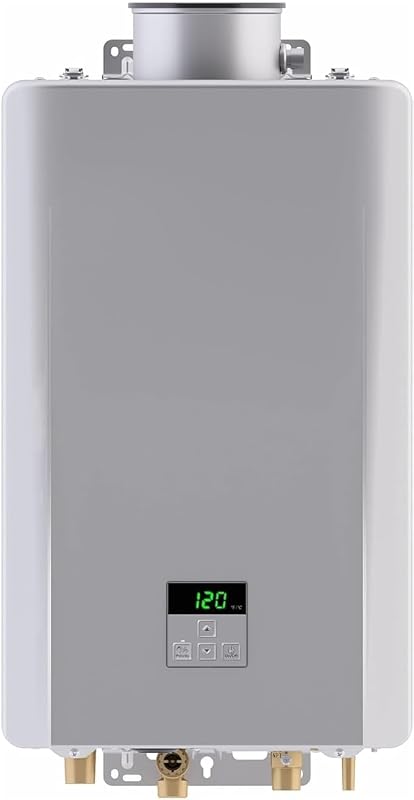
Choosing between a gas-powered condensing unit and a high-draw electric system comes down to household demand and utility infrastructure. The Rinnai RXP160iN is a high-output, gas-fueled condensing tankless water heater engineered to deliver up to 9 gallons per minute with built-in recirculation for multi-bath residences. In contrast, the EcoSmart ECOS 27 is a compact, 27-kilowatt electric tankless water heater designed for point-of-use or moderate whole-home applications where ventless installation and electric power are preferred.
Choose the Rinnai RXP160iN if your household runs multiple hot water fixtures at the same time, has access to natural gas or propane, and wants rapid hot water delivery via an integrated recirculation pump. Choose the EcoSmart ECOS 27 if you have a 240-volt electrical panel capable of handling 112.5 amps, lack gas supply or venting access, and need an ultra-compact unit for lower-demand hot water needs.


Rinnai RXP160iN vs EcoSmart ECOS 27 at a Glance
| Feature | Rinnai RXP160iN | EcoSmart ECOS 27 |
|---|---|---|
| Power Source | Natural Gas or Propane (Convertible) | Corded Electric (240V) |
| Maximum Flow Rate | 9.0 GPM | 6.6 GPM (2.7 to 6.6 GPM range) |
| Thermal / Heat Output | 160,000 BTU/hr | 27 kW (92,126 BTU/hr equivalent) |
| Energy Efficiency | 0.97 UEF | 96% Thermal Efficiency |
| Electrical Draw | 73 Watts (120 Volts) | 112.5 Amps (240 Volts) |
| Recirculation Technology | Smart-Circ pump built-in | None (Not equipped) |
| Dimensions and Weight | 31″ H x 19″ W, 57 lbs | 19″ H x 9.25″ W x 4.25″ D, 10.9 lbs |
| Primary Construction Material | Stainless Steel | Plastic |
| Venting and Location | Indoor or Outdoor (Versa Vent system) | Indoor / Point-of-Use (Ventless) |
| Residential Warranty | 15-yr heat exchanger, 5-yr parts, 5-yr labor (registered) | 5-yr leaks, 1-yr parts |
| Best For | Busy multi-bathroom homes with gas access | Vent-free apartments, cabins, and lower-demand homes |
Water Flow Capacity and Fixture Delivery
Flow capacity determines how many plumbing fixtures can draw hot water simultaneously without dropping the water temperature. The Rinnai RXP160iN flow rate reaches up to 9.0 gallons per minute, which the manufacturer rates for running up to six fixtures at once under favorable conditions. Powered by a 160,000 BTU condensing gas burner, this unit generates enough thermal energy to maintain high-volume delivery even when incoming municipal water is cold. Homeowners comparing the rinnai re180in vs rxp160in will note that the RXP line prioritizes this high flow rate alongside advanced distribution hardware.
The EcoSmart ECOS 27 delivers between 2.7 and 6.6 gallons per minute depending directly on incoming water temperatures. Operating on 27 kilowatts of electric heating elements, its self-modulating technology adjusts energy consumption to reach up to 140 degrees Fahrenheit, but its peak flow rate drops significantly in colder northern climates where inlet groundwater temperatures plummet. The listing notes that this 27-kilowatt model is ideal for a bathroom, small sink, office breakroom, or lower-flow applications. In a busy single-family home, attempting to run two showers alongside a dishwasher simultaneously will exceed the ECOS 27 capacity in regions with cold tap water.
For large families or properties with multi-shower layouts, the gap between 6.6 GPM and 9.0 GPM is substantial. The RXP160iN handles peak-hour morning routines across multiple bathrooms without flow degradation, whereas the ECOS 27 requires staged water usage or installation closer to designated single-zone fixtures.
Edge: Rinnai RXP160iN delivers significantly higher flow rates and supports more concurrent fixtures than the electric unit.
Power Source and Utility Infrastructure Requirements
Utility infrastructure determines whether a home can support a given tankless water heater without extensive panel upgrades or fuel line installations. The EcoSmart ECOS 27 electrical requirements are substantial: it operates at 240 volts and draws up to 112.5 amps of electricity. Standard residential electrical panels often total 100 to 200 amps for the entire house, meaning that installing this 27 kW electric water heater frequently necessitates an electrical service upgrade, multiple dedicated high-amp circuit breakers, and heavy-gauge copper wiring. However, because it is purely electric, it requires no chimney, flue, or combustible fuel supply.
The Rinnai RXP160iN relies on combustible gas rather than heavy electric amperage. It draws a modest 73 watts at 120 volts to run its internal electronics, control board, and pump, which plugs easily into a standard household outlet. Fueling its 160,000 BTU burner requires a dedicated natural gas line or propane tank. Rinnai integrates its Smart Sense gas control system, allowing the unit to adapt to either fuel source. Those examining the rinnai re180in vs ecosmart ecos 27 dynamic will quickly notice that gas fuel supply lines represent a different installation trade-off compared to high-amp electrical upgrades.
Evaluating which heater is easier to connect depends entirely on existing home utilities. If a home already possesses a robust natural gas line and appropriate venting pathways, the Rinnai installs with minimal impact on the electric panel. If a home lacks gas infrastructure entirely and already possesses an upgraded 200-amp or 300-amp electrical panel, the EcoSmart avoids the need to run gas piping or cut exhaust holes through walls.
Edge: Tie, as the Rinnai requires gas supply lines while the EcoSmart demands heavy 112.5-amp electrical panel capacity.
Recirculation and Hot Water Delivery Speed
One common drawback of traditional on-demand water heaters is the wait time for hot water to travel from the unit through cold pipes to the faucet. The Rinnai RXP160iN addresses this directly with its Smart-Circ Intelligent Recirculation system. The heater houses an internal circulation pump that loops water through the supply plumbing. The Smart-Circ system monitors and learns household usage habits over time, automatically cycling the pump during peak usage windows so hot water is immediately available at the fixture without wasting water down the drain.
The EcoSmart ECOS 27 does not contain an internal recirculation pump or integrated scheduling logic. As an on-demand unit, it initiates heating instantly when its flow sensor detects water movement, modulating power to maintain the selected temperature within 1 degree. However, any water sitting between the ECOS 27 and the fixture must be flushed out manually before warm water arrives. For users considering the rinnai ru199in vs rxp160in, this internal recirculation pump is a hallmark feature of the RXP series that separates premium condensing gas models from standard units.
The practical advantage of built-in recirculation is reduced domestic water waste and eliminated wait times at distant sinks or upstairs showers. The ECOS 27 can reduce line delay only if installed at point-of-use directly underneath a vanity or kitchen counter, but it lacks the hardware to circulate hot water through a whole-house plumbing loop.
Edge: Rinnai RXP160iN provides integrated pump-driven recirculation and automated pattern learning that the EcoSmart lacks entirely.
Installation Flexibility and Physical Footprint
Space limitations and installation location play major roles when selecting a water heater. The EcoSmart ECOS 27 weighs just 10.9 pounds and measures 19 inches high, 9.25 inches wide, and 4.25 inches deep. Its plastic housing and vent-free operation allow it to fit inside small utility closets, beneath kitchen cabinets, or on basement partition walls. Because electric resistance elements produce no exhaust gasses, there is no need for PVC, polypropylene, or metal flue pipes cutting through walls or roofs.
The Rinnai RXP160iN is compact for a 160,000 BTU condensing gas heater, but it is substantially larger than the electric competitor. Measuring 31 inches high and 19 inches wide with a total weight of 57 pounds, it requires a sturdy wall mounting bracket into solid wall framing. Construction consists of durable stainless steel components. As a gas unit, it requires combustion air intake and exhaust venting, though Rinnai simplifies this with its Versa Vent system, allowing indoor venting or outdoor installation using the optional RX-OVC vent cap. When exploring options like the rinnai ru199in vs ecosmart ecos 27, venting logistics are often the defining architectural barrier.
Where tight physical dimensions and complete absence of exterior vent pipes are mandatory, the ECOS 27 has a clear advantage. However, the RXP160iN offers an outdoor installation option that eliminates indoor space consumption altogether, provided the proper vent cap is used.
Edge: EcoSmart ECOS 27 offers an ultra-compact 10.9-pound footprint that installs on the wall without exhaust venting.
Energy Efficiency and Operating Design
Efficiency ratings dictate how much input energy translates directly into heated water. The Rinnai RXP160iN achieves a Uniform Energy Factor (UEF) of 0.97. Condensing technology uses a secondary heat exchanger to capture residual heat from exhaust gasses before they exit the flue, pushing thermal efficiency to 97 percent. The unit also includes a Quick Flush feature to simplify the periodic descaling process necessary to maintain this high efficiency. Readers comparing the rinnai rxp160in vs rheem rtgh series will recognize 0.97 UEF as the upper tier for residential gas heating appliances.
The EcoSmart ECOS 27 listing specifies 96 percent thermal energy efficiency. Electric immersion elements transfer nearly all electrical energy directly into the water passing through the chambers. EcoSmart utilizes self-modulating technology, which continuously monitors flow rate and incoming water temperature, drawing only the precise electrical wattage needed to hit the target temperature within 1 degree. It uses zero standby power when no faucet is open, avoiding the standby losses typical of traditional storage tanks.
Is EcoSmart ECOS 27 worth it on efficiency grounds alone? Both models convert over 96 percent of their supplied energy into usable hot water. However, the Rinnai pairs its 0.97 UEF with the Smart-Circ pump, allowing it to shut down circulation cycles during hours when the home is asleep or empty, avoiding unnecessary thermal loss through house pipes. The Rinnai also supports optional Wi-Fi monitoring through a separate Controlr module.
Edge: Rinnai RXP160iN edges out the competition with a 0.97 UEF rating combined with automated circulation scheduling.
Warranty and Long-Term Durability
The mechanical build quality and manufacturer backing indicate how long a water heater will reliably serve a home. The Rinnai RXP160iN features commercial-grade stainless steel construction and comes with a residential warranty covering 15 years on the heat exchanger, 5 years on parts, and 5 years on labor (provided the unit is registered within 90 days of installation, defaulting to 1 year of labor without registration). Rinnai specifically notes that professional installation is recommended and provides the Rinnai Central App to assist licensed technicians with setup, service, and troubleshooting.
The EcoSmart ECOS 27 listing outlines a 5-year limited warranty against leaks and a 1-year warranty on parts. It uses a plastic exterior enclosure and internal electric heating modules. In comparisons such as the rinnai rxp160in vs rheem 18kw tankless, electric units frequently offer shorter factory coverage periods because electric elements operate in direct contact with hard water minerals, leading to wear over time.
When assessing Rinnai RXP160iN vs EcoSmart ECOS 27 specs, the difference in warranty duration reflects their intended operational lifespans. Rinnai provides a robust 15-year commitment on its core stainless steel heat exchanger, establishing higher confidence for permanent whole-house infrastructure investments.
Edge: Rinnai RXP160iN provides a 15-year heat exchanger warranty and superior stainless steel build quality compared to the 5-year coverage of the EcoSmart.
Pros and Cons
Rinnai RXP160iN

Pros
- High 9.0 GPM maximum flow rate
- Built-in Smart-Circ recirculation pump
- Dual-fuel natural gas and propane compatibility
- Ultra-high 0.97 UEF condensing efficiency
- 15-year heat exchanger warranty
Cons
- Requires gas supply and venting
- Heavier 57-pound stainless steel cabinet
View Rinnai RXP160iN on Amazon
EcoSmart ECOS 27

Pros
- Ventless indoor and point-of-use installation
- Extremely compact 10.9-pound plastic chassis
- Self-modulating 96 percent thermal efficiency
- Precise temperature control within 1 degree
Cons
- Massive 112.5-amp electrical draw
- Lower peak flow rate up to 6.6 GPM
- Lacks internal recirculation pump
View EcoSmart ECOS 27 on Amazon
Who Should Buy Each One
Choose the Rinnai RXP160iN If
- Your home has multiple bathrooms and high peak-demand routines requiring up to 9 GPM.
- You already have an active natural gas line or propane storage system installed on site.
- You want hot water delivered quickly to distant fixtures via an integrated recirculation pump.
- You prefer a durable stainless steel heat exchanger supported by a 15-year residential warranty.
Choose the EcoSmart ECOS 27 If
- Your home lacks natural gas lines, propane tanks, or exterior venting pathways.
- You have an electrical panel with at least 112.5 amps of spare breaker capacity at 240 volts.
- You need an ultra-compact 10.9-pound unit for a small home, cabin, or point-of-use application.
- Your flow requirements remain between 2.7 and 6.6 GPM across moderate climates.
Final Verdict
When weighing Rinnai RXP160iN or EcoSmart ECOS 27 for whole house applications, the Rinnai RXP160iN emerges as the more capable primary water heating solution for most single-family residences. Its 160,000 BTU condensing burner, 9.0 GPM maximum flow rate, 0.97 UEF rating, and internal Smart-Circ pump ensure uninterrupted hot water across multiple simultaneous fixtures without long line delays. Backed by a 15-year heat exchanger warranty and robust stainless steel construction, it provides the heavy-duty throughput necessary for modern multi-bathroom households.
The EcoSmart ECOS 27 remains a practical, space-saving option for installations where venting is structurally impossible or gas is unavailable. If your electrical panel can support the 112.5-amp load and your household water usage falls within its 2.7 to 6.6 GPM capacity, the ECOS 27 delivers reliable on-demand hot water from a tiny 10.9-pound wall-mounted box. However, for whole-home performance and peak family demand, the Rinnai RXP160iN takes the win.
FAQ
Can the Rinnai RXP160iN be installed outdoors?
Yes, the Rinnai RXP160iN can be installed outdoors or indoors using its Versa Vent system, though an outdoor installation requires the dedicated RX-OVC vent cap specified by the manufacturer.
What size electrical breaker does the EcoSmart ECOS 27 require?
The EcoSmart ECOS 27 draws up to 112.5 amps at 240 volts, which typically requires multiple dedicated double-pole circuit breakers totaling over 120 amps in your main electrical service panel.
Can the Rinnai RXP160iN switch between natural gas and propane?
Yes, the Rinnai RXP160iN features a Smart Sense gas control system that allows the heater to operate using either natural gas or propane configurations.
Is EcoSmart ECOS 27 worth it for whole-house use in cold climates?
In cold northern climates where groundwater is near freezing, the ECOS 27 output flow rate drops toward 2.7 GPM, making it better suited for single fixtures rather than whole-home simultaneous use.
Does the Rinnai RXP160iN include built-in Wi-Fi control?
The Rinnai RXP160iN supports Wi-Fi functionality, but the Controlr module required for wireless operation is not included in the standard box and must be acquired separately.
What is the maximum water temperature on both models?
Both the Rinnai RXP160iN and the EcoSmart ECOS 27 have a maximum temperature rating of 140 degrees Fahrenheit.