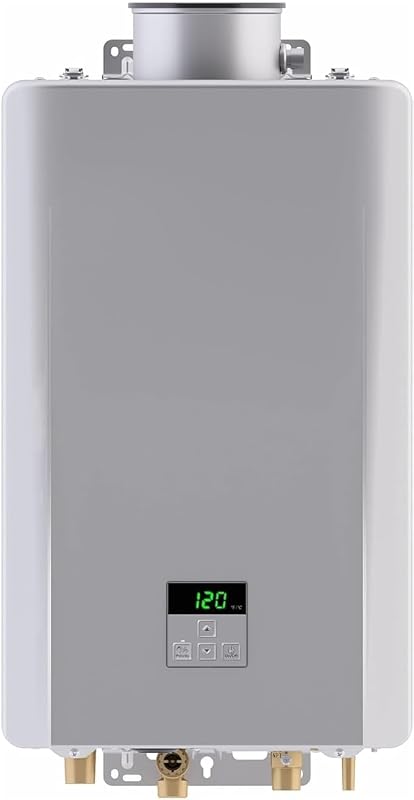
Choosing between high-efficiency condensing gas water heaters comes down to how your home distributes hot water and where the appliance must be mounted. The primary technical divider between these two units is delivery architecture: the Rinnai RXP160iN includes an integrated recirculation pump with intelligent usage learning and dual-fuel capability, whereas the Rheem RTGH Series focuses on an ultra-compact indoor direct-vent chassis that prevents cold-water bursts using solid-state buffer programming.
Homeowners who endure long wait times for hot water at distant taps or need outdoor installation versatility should choose the Rinnai RXP160iN. Property owners looking for a space-conscious indoor natural gas replacement that drops neatly into tight utility closets without requiring a dedicated return loop should choose the Rheem RTGH Series.

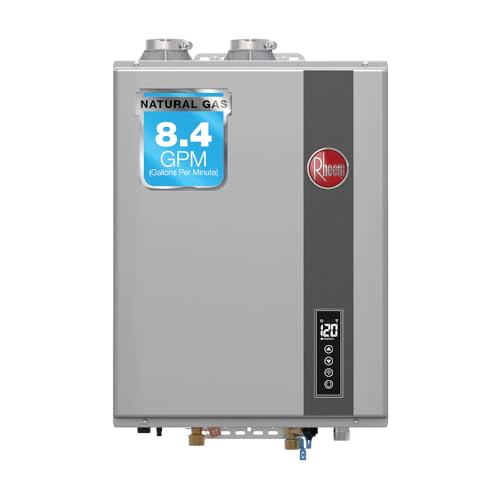
Rinnai RXP160iN vs Rheem RTGH Series at a Glance
| Feature | Rinnai RXP160iN | Rheem RTGH Series |
|---|---|---|
| Maximum Flow Rate | 9.0 GPM | 8.4 GPM |
| Maximum Heat Input | 160,000 BTU/hr | 157,000 BTU/hr |
| Uniform Energy Factor (UEF) | 0.97 | 0.93 |
| Fuel Source | Natural Gas or Propane (Smart Sense) | Natural Gas |
| Recirculation System | Internal Smart-Circ Pump | Hot Start Programming (No Pump) |
| Installation Location | Indoor or Outdoor (Versa Vent) | Indoor Direct Vent Only |
| Cabinet Dimensions (W x H) | 19 inches x 31 inches | 17.7 inches x 23.7 inches |
| Operating Power Draw | 73 Watts | 132 Watts |
| Residential Warranty | 15-Yr Heat Exchanger / 5-Yr Parts / 5-Yr Labor | 15-Yr Heat Exchanger / 5-Yr Parts |
| Best For | Instant hot water delivery and flexible mounting | Compact indoor natural gas utility spaces |
Water Delivery and Recirculation Technology
The time required for hot water to travel from a tankless unit to a distant faucet is a common homeowner complaint. In a detailed Rheem RTGH Series vs Rinnai RXP160iN assessment, the mechanisms used to combat delivery lag reveal fundamentally different engineering philosophies. The Rinnai unit tackles plumbing latency directly by incorporating an internal pump. Powered by Smart-Circ intelligent recirculation, this system tracks household hot water usage habits over time, automatically cycling heated water through the supply pipes before scheduled high-demand periods so water arrives at the fixture without an extended purge time.
The Rheem takes a different path by omitting an internal mechanical circulation loop in favor of Hot Start Programming. This programming logic keeps the water heater in an active ready state between consecutive draws, eliminating the temperature drop known as a cold-water sandwich when somebody turns off the tap and turns it back on moments later. While this internal thermal readiness prevents shocking bursts of cold water during back-to-back showers, it cannot pre-charge long plumbing runs across a home. Buyers who study comparable models in our rinnai re180in vs rheem rtgh series guide will note that eliminating structural delivery delay strictly requires an active mechanical pump.
Consequently, the built-in Rinnai RXP160iN recirculation pump offers a marked functional upgrade for sprawling floor plans or multi-level homes. Without an integrated pump on the Rheem, home occupants must either wait for ambient-temperature standing water to exit the pipe run or purchase and install an external aftermarket pump to achieve continuous line priming.
Edge: Rinnai RXP160iN, because its integrated Smart-Circ pump proactively primes hot water lines based on learned family habits.
Flow Rate and Heating Output
Flow capacity determines how many fixtures can operate at the same time without an unexpected drop in water temperature. When evaluating the Rinnai RXP160iN vs Rheem RTGH flow rate, the numbers demonstrate that both are engineered for demanding domestic loads, yet Rinnai claims a modest performance lead. The Rinnai model is rated to deliver up to 9.0 gallons per minute (GPM), powered by a heat engine rated at 160,000 BTU per hour. According to the manufacturer, this volume is sufficient to handle up to six fixtures simultaneously under favorable inlet water temperatures.
By comparison, the Rheem RTGH Series (model RTGH-84DVLN-3) produces 157,000 BTU per hour and yields up to 8.4 GPM based on a 35°F groundwater temperature rise. Rheem specifies this capacity as ideal for supporting three to four simultaneous showers. When comparing the Rheem RTGH-84DVLN vs Rinnai RXP160iN in colder climates where incoming groundwater temperatures drop substantially, the 3,000 BTU gap between the two burner assemblies creates a minor difference in sustained multi-point delivery, though both perform reliably within common residential fixture demand limits.
When deciding on the Rinnai RXP160iN or Rheem RTGH Series for whole house service in homes with three or more bathrooms, the extra 0.6 GPM and higher thermal input of the Rinnai provide greater headroom. Readers sizing large systems can explore our rinnai ru199in vs rheem rtgh series breakdown for high-demand comparisons, but between these two specific candidates, Rinnai holds the volume edge.
Edge: Rinnai RXP160iN, delivering a higher 9.0 GPM flow ceiling and 160,000 BTU output to support more simultaneous outlets.
Energy Efficiency and Electrical Consumption
Condensing technology extracts latent heat from exhaust gases before venting, pushing efficiency beyond standard atmospheric water heaters. In any rigorous Rinnai RXP160iN review, thermal efficiency stands out as a headline specification. The unit achieves an exceptional Uniform Energy Factor (UEF) of 0.97. This Rinnai RXP160iN efficiency rating reflects minimal flue losses and superior primary-to-secondary heat transfer within its stainless steel heat exchanger assembly.
The Rheem RTGH Series is no slouch, achieving a 0.93 UEF rating that the manufacturer notes uses up to 34 percent less energy than a traditional 50-gallon electric storage tank. However, a 0.04 spread in UEF ratings indicates that the Rinnai converts a slightly higher percentage of combustible gas directly into usable thermal energy. When evaluating operational efficiency, electrical demands while operating must also be factored in. The Rinnai specifies an operating draw of 73 watts at 120 volts, whereas the Rheem listing indicates an electrical demand of 132 watts at 120 volts.
The lower electrical power consumption of the Rinnai, paired with its higher thermal efficiency rating, minimizes resource draw during peak heating cycles. Those investigating alternate energy configurations can compare these metrics against non-gas options in our rinnai rxp160in vs rheem 18kw tankless technical review. In fuel and electrical utilization, the Rinnai sets the higher benchmark.
Edge: Rinnai RXP160iN, courtesy of its superior 0.97 UEF rating and significantly lower 73-watt operational power consumption.
Fuel Versatility and Installation Placement
A major structural challenge when installing or replacing a tankless system is adapting the machine to existing utility lines and structural venting paths. Rinnai addresses this via its Smart Sense gas control system, which allows the RXP160iN to run on either natural gas or liquid propane without requiring an entirely different appliance chassis. Furthermore, the unit features Rinnai’s Versa Vent system, which enables both indoor direct venting and outdoor exterior wall installation (using the optional RX-OVC outdoor vent cap).
The Rheem RTGH Series model RTGH-84DVLN-3 is strictly an indoor-configured appliance engineered solely for natural gas supplies. It utilizes a direct-vent design that exhausts outdoor air through dedicated ducting. While this focus simplifies its factory tuning for standard natural gas basements and mechanical closets, it completely excludes off-grid, rural, or propane-dependent homes, as well as warm-climate regions where exterior mounting is preferred to free up interior utility space.
Because the Rinnai adapts effortlessly between two distinct fuels and supports both inside and outside placements, it accommodates complex home layouts and sudden renovation changes far better than the indoor-only natural gas Rheem. The flexibility to mount the Rinnai outside also removes interior intake and exhaust venting pipe runs through living spaces.
Edge: Rinnai RXP160iN, offering field-convertible fuel technology and certified indoor or outdoor mounting options.
Chassis Dimensions and Installation Clearances
Space savings remain a driving motivation for replacing bulky storage tanks, but not all tankless cabinets share the same footprint. In this Rheem RTGH Series review, physical sizing represents Rheem’s clearest design triumph. The Rheem unit measures 17.7 inches wide by 23.7 inches high with a depth of 9.8 inches, weighing 59.9 pounds. Its vertical height of under 24 inches allows it to tuck between existing plumbing risers, low ceiling joists, and compact alcoves that cannot clear taller appliances.
The Rinnai RXP160iN presents a larger mechanical package. Its chassis measures 19 inches wide by 31 inches tall, weighing 57 pounds. While it is nearly three pounds lighter than the Rheem, that 31-inch vertical height demands over seven additional inches of wall space. When fitting a unit into an existing mechanical closet where water supply valves, gas cocks, and condensate drains crowd the wall, those extra inches can complicate the layout.
For tight interior retrofit locations, the Rheem’s compact stature simplifies installation. Homeowners comparing compact options against whole-home electric hardware in our rheem rtgh series vs ecosmart ecos 27 analysis will recognize the utility of small-format gas cabinets. Rheem also integrates an exclusive Overheat Film Wrap around the heat exchanger, a safety wrap engineered to cut power if extreme thermal thresholds are breached.
Edge: Rheem RTGH Series, featuring a substantially shorter 23.7-inch cabinet that fits confined indoor closets with tighter clearances.
Diagnostics, Maintenance, and Warranty Terms
Tankless water heaters require periodic maintenance to flush mineral scale from their internal waterways, making onboard service interfaces vital over years of ownership. Rinnai equips the RXP160iN with an integrated Quick Flush feature, designed to simplify routine descaling flushes without demanding complex valve sequencing. For diagnostics and smart controls, the unit connects to the Rinnai Central App for professional setup, though direct consumer Wi-Fi remote access requires an optional Controlr module that is not included in the box.
The Rheem RTGH Series integrates a precise digital LED temperature controller directly into the front panel, providing adjustments accurate to within 1°F, alongside built-in freeze protection and CSA safety certification. However, it lacks a dedicated push-button maintenance flush sequence like Rinnai’s Quick Flush, meaning servicing follows standard manual isolation pump protocols.
When looking at factory warranty support, both manufacturers demonstrate strong confidence in their stainless steel heat exchangers, providing limited 15-year coverage on the primary exchanger and 5 years on component parts. However, Rinnai includes a 5-year limited labor warranty if the appliance is registered within 90 days of installation (defaulting to 1 year if unregistered), whereas Rheem’s provided listing details cite parts and heat exchanger protections without extended multi-year labor coverage. For further context on brand configurations, see our rheem 18kw vs rheem rtgh series reference.
Edge: Rinnai RXP160iN, offering streamlined maintenance via Quick Flush and up to 5 years of labor warranty coverage upon registration.
Pros and Cons
Rinnai RXP160iN

Pros
- Built-in Smart-Circ recirculation pump
- Super-high 0.97 UEF efficiency rating
- Convertible natural gas or propane operation
- Versatile indoor or outdoor installation
- Higher 9.0 GPM flow capacity
Cons
- Taller 31-inch vertical cabinet height
- WiFi module sold separately
View Rinnai RXP160iN on Amazon
Rheem RTGH Series

Pros
- Compact 23.7-inch vertical height
- Hot Start Programming prevents cold bursts
- Overheat Film Wrap safety protection
- Precision 1°F digital temperature adjustments
Cons
- No integrated recirculation pump
- Natural gas and indoor installation only
- Higher 132-watt electrical draw
View Rheem RTGH Series on Amazon
Who Should Buy Each One
Choose the Rinnai RXP160iN If
- You want hot water at distant faucets rapidly using an integrated, self-learning recirculation pump.
- Your home is powered by liquid propane, or you require an outdoor installation to save interior living space.
- You need the maximum flow volume possible (up to 9.0 GPM) to feed up to six fixtures at once.
- You value a super-high 0.97 UEF efficiency rating and built-in maintenance flush controls.
Choose the Rheem RTGH Series If
- You need an ultra-compact indoor condensing unit under 24 inches tall to fit a tight mechanical closet.
- You run exclusively on natural gas and want an indoor direct-vent system without unneeded dual-fuel components.
- Your primary plumbing annoyance is cold-water bursts during consecutive showers, solved by Hot Start Programming.
- You prefer a simple on-chassis digital LED interface with 1°F incremental temperature adjustments.
Final Verdict
For most households seeking a comprehensive modern upgrade, the Rinnai RXP160iN is the clear overall winner. Its built-in Smart-Circ recirculation pump solves the universal annoyance of waiting minutes for hot water to reach remote bathrooms, while its convertible gas control system and dual indoor/outdoor venting options provide unparalleled installation flexibility. Add in an industry-leading 0.97 UEF rating, 9.0 GPM flow capability, and a generous 5-year labor warranty upon registration, and the RXP160iN proves itself as a complete whole-house water heating solution.
Nonetheless, is Rheem RTGH Series worth it for specific installation profiles? Absolutely. If your home has a dedicated indoor utility closet with limited vertical height, already uses natural gas, and has compact plumbing loops where recirculation is unnecessary, the Rheem RTGH Series shines. Its 23.7-inch frame, Hot Start ready-state programming, and reliable 8.4 GPM condensing engine make it an exceptional drop-in indoor replacement that delivers continuous hot water without taking up precious square footage.
FAQ
Does the Rinnai RXP160iN require a dedicated return line for recirculation?
The Rinnai RXP160iN contains an internal pump capable of operating with either a dedicated return line or through a thermal bypass valve installed at the furthest fixture. The integrated Smart-Circ technology automates the pump’s scheduling to circulate water efficiently across both plumbing types.
Can the Rheem RTGH Series run on liquid propane?
The Rheem RTGH-84DVLN-3 model covered here is engineered strictly for natural gas fuel sources. It does not feature automatic dual-fuel convertible controls, so homes relying on liquid propane should opt for the dual-fuel Rinnai RXP160iN instead.
How does Rheem Hot Start Programming work without an internal pump?
Hot Start Programming is an internal software and burner control system that maintains the internal heat exchanger in an active ready state between rapid consecutive water draws. It does not circulate water through your home’s pipes, but it ensures that when someone turns the shower back on within a short timeframe, the unit does not send an unheated slug of water down the pipe.
Can the Rinnai RXP160iN be installed outdoors?
Yes. The Rinnai unit features the Versa Vent design, which allows it to be installed indoors using standard direct venting or outdoors using the optional RX-OVC outdoor vent cap. The Rheem RTGH Series model is restricted to indoor direct-vent configurations only.
What electrical service is required for these condensing water heaters?
Both models plug into standard 120-volt residential electrical outlets to power their electronic ignition, control logic, and internal sensors. The Rinnai consumes 73 watts of electricity during operation, while the Rheem lists an operational power draw of 132 watts.
What does the Quick Flush function on the Rinnai do?
Quick Flush is a specialized maintenance function engineered into the Rinnai RXP160iN that simplifies the process of circulating descaling solutions through the heat exchanger. This helps homeowners and technicians flush out mineral deposits without requiring manual sensor bypasses.